Key takeaways
- Solid walls and flat-sheared hedges (0% porosity) create violent leeward rotor turbulence within 3H–5H; target 40–50% optical porosity for smooth 10H–20H shelter.
- USDA NRCS Standard 380 pairs 40–60% density with gardens and orchards, reserving >=65% density for livestock lots or snow traps set >=100 ft from driveways and roofs.
- Select species across all four US maritime coasts (Zones 4b–11), drop ash due to Emerald Ash Borer, and avoid banned invasives like Australian pine and Brazilian peppertree.
- Backfill coastal planting holes with unamended native sand, topdress 3–4 inches of mulch clear of trunk flares, and remove temporary flexible stakes in 6–12 months.
- Flush root zones with fresh water after salt storms and maintain 40–50% permeability via selective hand-thinning rather than flat electric shearing.
Quick answer: Design US coastal windbreaks to USDA NRCS Standard 380 at 40–50% optical porosity rather than a solid wall. Letting 40–50% of wind bleed through prevents leeward rotor turbulence and creates 10H–20H shelter downwind (peaking at 2H–5H). Layer Row 1 salt-spray shrubs ahead of salt-hardy conifers and canopy trees suited to your coast, backfill with native sand, flush storm salts deeply, and avoid flat shearing and invasive species.
Why Solid Walls Fail and NRCS Standard 380 Relies on 40–50% Porosity
Coastal property owners from Cape Cod and the Outer Banks to the Gulf islands and Oregon headlands instinctively try to stop ocean gales with a solid privacy fence or an airtight wall of sheared Leyland cypress. Aerodynamic field trials compiled by the USDA Agricultural Research Service (ARS) and USDA Natural Resources Conservation Service (NRCS) under Conservation Practice Standard 380 (Windbreak/Shelterbelt Establishment and Renovation) show that solid barriers create the exact turbulence they are meant to prevent.
When salt-laden wind hits a 0% porosity solid wall, air has nowhere to go except straight up and over the crest. Pressure spikes on the ocean face while a low-pressure vacuum opens immediately behind the barrier. Air spilling over the top plunges downward into a churning rotor vortex, slamming gusts and concentrated salt spray onto patios, beds, and young trees within 3 to 5 times the barrier height (3H–5H).
By contrast, a living belt managed to 40–50% optical porosity (50–60% foliar density when viewed sideways against the sky) lets a metered stream of air bleed through branches and needles. That bleed flow equalizes pressure across the belt, eliminating the leeward vacuum and stretching the quiet zone out to 10H–20H downwind, with peak wind reduction of 50% to 70% between 2H and 5H plus a modest 2H–5H windward cushion ahead of the first row. A 30-foot coastal cedar belt built to 40–50% porosity calms wind meaningfully across 300 to 600 feet of yard, raised beds, or small orchard rows.
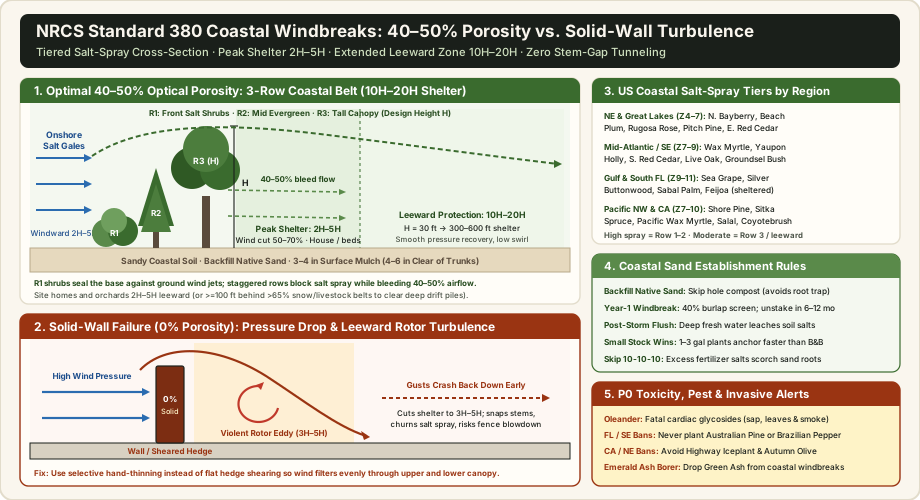
USDA NRCS Standard 380 Windbreak Density Tiers, Shelter Distances, and Coastal Setbacks
Barrier Type & Optical Porosity | Leeward Quiet Zone | Peak Wind Reduction Zone | Turbulence & Drift Risk | Best US Coastal Use |
|---|---|---|---|---|
Solid wall or tightly sheared hedge (0–15% porosity) | 3H–5H before wind recovers | Unstable eddy right behind barrier | Severe leeward rotor vortex; snaps stems and dumps salt pockets | Avoid as sole oceanfront windbreak; pair behind a porous living row |
Single or 2–3 row living windbreak (40–50% porosity) | 10H–20H downwind (plus 2H–5H windward) | 2H–5H leeward (cuts wind speed 50–70%) | Low swirl; air bleeds smoothly with minimal pressure drop | Gold standard for coastal gardens, orchards, coastal raised beds, and homes |
Dense multi-row evergreen belt (65–80% density / 20–35% porosity) | 8H–12H downwind (shorter than 40–50% belt) | 1H–4H leeward (near-calm lee pocket) | Moderate downwind swirl; traps heavy snow or sand drifts within 2H–4H | Great Lakes or New England winter snow traps and livestock shelter (set back >= 100 ft from driveways and roofs) |
Prevent stem-gap tunneling at ground level: As tall pines and oaks mature, lower limbs die back from shade or salt abrasion, leaving an open 5-to-8-foot corridor near the soil. Onshore wind accelerates underneath that gap like a nozzle, sand-blasting tender perennials behind the belt. Always anchor the windward edge with low, persistent shrubs so vertical porosity stays even from soil grade to crown.
Salt Spray vs. Root-Zone Salinity Across US Coastal Zones
Coastal salt damage hits through two separate pathways, and plants built for one often fail under the other:
- Aerosol salt spray: Breaking surf carries sodium and chloride droplets inland—heaviest within 300–1,000 feet of open beach, though nor'easters and hurricanes push spray miles inland. Crystals draw moisture across thin leaves and scorch ocean-facing buds.
- Soil and groundwater salinity: Low marsh margins, overwash flats, and brackish coastal wells raise root-zone electrical conductivity (dS/m), pulling water osmotically out of roots even in damp sand. Match wet swales using coastal garden selections and dune salt grasses.
- Wind desiccation and root rock: Sustained 20–40 mph gales dry foliage faster than sand supplies water while loosening unanchored saplings. Cross-check regional frost and heat limits with our USDA plant finder and frost-date calendar.
Keep USDA hardiness bounds realistic: contiguous US maritime and Great Lakes shores span USDA Zones 4b–5 (coastal Maine and northern Michigan) through Zones 6–9 (Mid-Atlantic, Southeast, and Pacific Northwest) up to Zones 10–11 (South Florida and Southern California). Ignore generic claims recommending Zone 2 coastal windbreaks.
Multi-Row Windbreak Geometry: Orienting, Spacing, and Layering
Align the windbreak perpendicular to your county's most destructive seasonal gales—nor'easters on the Atlantic, hurricane fetch along the Gulf, or winter storms on the Pacific. Where two wind angles threaten, curve the belt in a continuous L-shape without corner gaps.
Sizing rows for coastal lots vs. acreage
- Three-row NRCS acreage belt (35–50 ft wide): Plant Row 1 (windward) with 4–10 ft salt shrubs spaced 4–6 ft apart to block ground jets. Leave 10–12 ft, plant Row 2 medium evergreens (15–35 ft) 8–12 ft apart in staggered triangles, leave 12–16 ft, then plant Row 3 canopy trees (35–65 ft) 12–18 ft apart.
- Two-row residential screen (14–22 ft wide): Place a staggered Row 1 shrub hedge (4–5 ft spacing) 8–10 ft upwind of staggered fast-growing privacy trees or coastal conifers spaced 8–12 ft apart.
- Narrow side-yard screen (6–10 ft wide): Stagger two alternating salt-hardy evergreen species with a 2–3 ft offset at 6–8 ft spacing so mixed canopies maintain 40–50% porosity without monoculture die-off.
- Patch gaps immediately: One dead tree turns into a wind nozzle that accelerates sand and salt into the garden. Keep homes and orchards in the 2H–5H zone and >=15–20 ft clear of tall trunks and septic lines.
Best Salt-Tolerant Trees and Shrubs Across All Four US Coasts
One plant list never fits Maine, Corpus Christi, and coastal Oregon at the same time. Humidity, summer heat, winter freezes, and sandy soil pH vary sharply across US shorelines. Use the four-coast matrix below to pick high-spray frontline pioneers for Row 1 and structural evergreens for Rows 2 and 3, cross-checking zone-keyed salt-tolerant species and drought-tolerant coastal shrubs for micro-site drainage.
Four-Coast US Coastal Windbreak Matrix: Verified Trees & Shrubs by Exposure Tier
US Coastal Region (USDA Zones) | Row 1 Windward Buffer (High Spray) | Row 2 Mid-Screen (High to Mod. Spray) | Row 3 Tall Canopy H (Core & Leeward) | Regional Notes & Tradeoffs |
|---|---|---|---|---|
Northeast & Great Lakes (Zones 4b–7) | Northern Bayberry (Morella pensylvanica, 5–10 ft), Beach Plum (Prunus maritima, 6–10 ft), Rugosa Rose (Rosa rugosa, 4–6 ft), Black Chokeberry (4–8 ft), Sea Buckthorn (8–15 ft) | Eastern Red Cedar (Juniperus virginiana, 30–45 ft), American Holly (Ilex opaca, 20–35 ft, buffered slightly from direct surf) | Pitch Pine (Pinus rigida, 40–60 ft), White Spruce (Picea glauca, 40–60 ft, cold coasts / Great Lakes) | Avoid salt-scorched arborvitae in direct surf; check town dune rules before planting suckering Rosa rugosa |
Mid-Atlantic & Southeast (Zones 7–9) | Wax Myrtle (Morella cerifera, 10–20 ft), Yaupon Holly (Ilex vomitoria, 12–20 ft), Groundsel Bush (Baccharis halimifolia, 6–12 ft), Chaste Tree (10–15 ft) | Southern Red Cedar (Juniperus virginiana var. silicicola, 25–40 ft), American Holly (Ilex opaca), Pineapple Guava (Zones 8–10, buffered) | Southern Live Oak (Quercus virginiana, 40–80 ft tall × 60–100 ft wide), Sabal Palm (Sabal palmetto, 30–50 ft) | Live Oak needs huge lateral space; skip Green Ash due to Emerald Ash Borer mortality |
Gulf Coast & South Florida (Zones 9–11) | Sea Grape (Coccoloba uvifera, 15–30 ft, frost-sensitive), Silver Buttonwood (Conocarpus erectus var. sericeus, 15–25 ft), Fourwing Saltbush (dry Texas coast) | Yaupon Holly (Zones 7–9), Wax Myrtle, Rosemary & Common Myrtle (sheltered sand ridges) | Sabal Palm (Sabal palmetto), Live Oak (Zones 8–10), Coconut Palm (Zone 10b–11 South FL only) | Never link Sea Grape (Coccoloba uvifera) to table grapes; avoid prohibited Australian pine and Brazilian pepper |
Pacific Northwest & California Coast (Zones 7–10) | Coyotebrush (Baccharis pilularis, 2–8 ft), Salal (Gaultheria shallon, 3–6 ft), Coast Silk Tassel (Garrya elliptica, 8–15 ft), Escallonia (6–10 ft) | Pacific Wax Myrtle (Morella californica, 15–30 ft), Ceanothus thyrsiflorus (6–15 ft), European Olive (CA dry bluffs, buffered) | Shore Pine (Pinus contorta var. contorta, 25–45 ft), Sitka Spruce (Picea sitchensis, 60–100+ ft, cool fog belt), Monterey Cypress (Hesperocyparis macrocarpa, CA coast) | Use 2-needle Shore Pine over salt-sensitive 5-needle pines; skip invasive Carpobrotus highway iceplant in CA |
When designing multi-species screens across large properties, look closely at windbreak shelterbelt spacing and living wildlife berry fences that weave pollinator forage into Row 1 and Row 2. On alkaline, wind-whipped West Texas or dry Southern California edges, hardy drought specialists such as fourwing saltbush, ice plant (non-invasive hardy Delosperma rather than California Carpobrotus), and lavender survive dry spray where lush Atlantic shrubs wilt.
Toxic Plants, Banned Invasives, and Dead-End Trees to Avoid
Several classic nursery salt picks carry severe human toxicity, ecological bans, or regional pest collapse. Screen out three groups before ordering:
Severe toxicity alert — Oleander (Nerium oleander): While oleander shrugs off Zone 8b–11 salt spray and sand, its leaves, flowers, sap, and pruning smoke carry lethal cardiac glycosides (oleandrin) dangerous to children, pets, and livestock. Skip oleander near homes or pastures; plant yaupon holly, wax myrtle, or pineapple guava instead.
- Prohibited coastal invasives: Never plant Australian pine / casuarina or Brazilian peppertree (Schinus terebinthifolia) in Florida, where banned stands destabilize beaches. Skip highway iceplant (Carpobrotus edulis) in California, Russian olive and autumn olive across northern shores, athel tamarisk in western basins, and state-listed thorny olive (Elaeagnus pungens).
- Emerald Ash Borer casualties: Drop green ash (Fraxinus pennsylvanica) from Zones 3–9 windbreaks; beetle mortality opens huge canopy gaps within a decade.
- Blight- and beetle-prone pines: Japanese black pine (Pinus thunbergii) suffers heavy pine wilt nematode and bark beetle collapse along the Mid-Atlantic and Northeast; choose native pitch pine, shore pine, or deodar cedar on buffered upland sites.
Planting in Sandy Coastal Soil Without Creating Root Traps
Packing rich compost into an individual tree pit in beach sand creates an abrupt moisture interface that keeps roots circling inside the pocket instead of anchoring into native sand. Extension planting trials favor five field steps:
- Choose smaller stock: Plant vigorous 1–3-gallon shrubs or 3–5-gallon trees rather than heavy balled-and-burlapped specimens; smaller saplings build deep roots and wind taper far faster.
- Time planting to frost: Plant in spring across cold Zones 4b–7 so roots anchor before winter gales, and in fall across mild Zones 8–11 to catch winter rains.
- Backfill with native sand: Dig holes 2–3× root-ball width and no deeper than the root flare (keep flare level or 1 in high in low swales). Score circling roots and settle native sand with water.
- Topdress broadly: Spread 1–2 inches of compost across the entire bed surface, then top with 3–4 inches of pine bark or wood chips, kept 4–6 inches clear of trunks. See mulching sandy coastal beds and sandy soil nutrient retention.
- Screen windward edges: Erect temporary 40–50% burlap fencing 2–3 ft upwind of Row 1 in Year 1. Use loose low webbing ties only if trunks rock, and remove stakes in 6–12 months.
Irrigation, Storm Salt-Flushing, and Porosity Pruning
Supply 1 inch of fresh water weekly via drip during Years 1–2 using our drip irrigation for sandy soil guide and first-year tree watering schedule. Run a Cooperative Extension soil test before fertilizing; coastal sands rarely need annual 10-10-10 whose soluble salts scorch roots.
Year-Round Coastal Windbreak Care: Salt Flushing, Pruning & Protection
Maintenance Task | Timing / Trigger | Correct Technique | Common Mistake to Avoid |
|---|---|---|---|
Post-storm foliar & soil salt flush | Within 24–48 hours after hurricanes, nor'easters, or dry gales | Hose salt crusts off foliage early morning; apply 1–2 inches of fresh water deeply to leach sodium below roots | Leaving salt crusts baking on leaves or watering shallowly |
Porosity-preserving pruning | Late winter or post-bloom | Selectively hand-thin 15–25% of crowded inner limbs so wind filters evenly at 40–50% porosity | Flat mechanical shearing (creates a 0% shell and leeward turbulence) |
Deer & rabbit protection | Planting through Year 3 | Install 4-ft wire cages on young bays and plums; mix unpalatable deer-resistant plants | Leaving young Row 1 shrubs unprotected in winter |
Every third year, sight through the belt toward the ocean. Thin congested deciduous pockets if visible sky drops below ~35%, and reinforce thinning lower rows with drought-tolerant trees and shrubs to preserve your 10H–20H quiet zone.