
Key takeaways
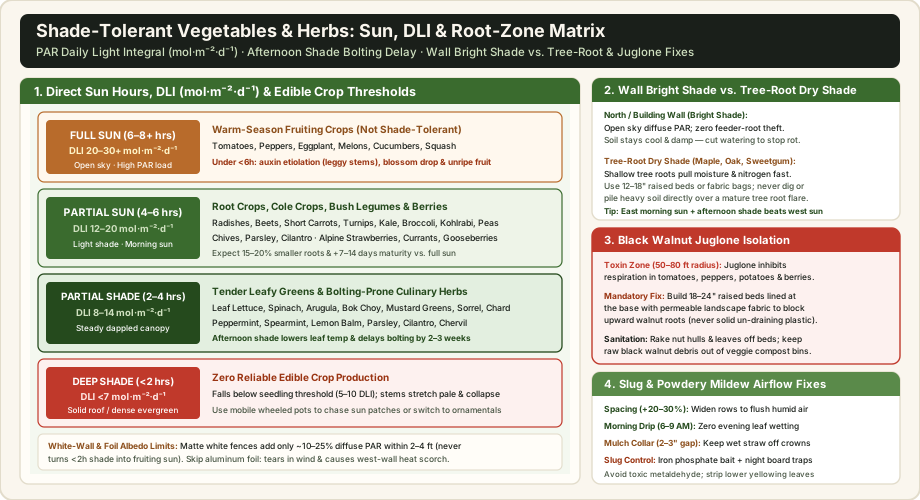
- Track both solar hours and Daily Light Integral (DLI): Partial Sun (4–6 h; ~12–20 mol·m⁻²·d⁻¹) supports roots, brassicas, and shade berries, Partial Shade (2–4 h or dappled; ~8–14 mol·m⁻²·d⁻¹) suits greens and herbs, and Deep Shade (<2 h; <7 DLI) produces no reliable harvests.
- Warm-season fruiting crops (tomatoes, peppers, eggplant, melons) need >= 20–30 mol·m⁻²·d⁻¹ (6–8+ h direct sun) for flower fertility and sugar fill; below 6 h they turn leggy, drop blossoms, and fail to ripen.
- Afternoon shade (west/southwest shelter) slows bolting in lettuce, spinach, arugula, cilantro, parsley, and chives, extending tender salad harvests by 2–3 weeks.
- Separate open-sky wall bright shade (cool, damp, zero root competition) from dry tree-root shade and black walnut juglone zones (50–80 ft radius), which require 18–24 inch raised beds lined with permeable landscape fabric.
- Matte white fences add only ~10–25% diffuse PAR within 2–4 ft and cannot convert <2 h shade into tomato sun; skip aluminum foil sheets that shred in wind and scorch foliage against west walls.
Quick answer: Productive shade gardening matches plant harvest parts to measured Photosynthetically Active Radiation rather than eye guesswork. Areas receiving Partial Sun (4–6 hours direct light; roughly 12–20 mol·m⁻²·d⁻¹ DLI) support radishes, beets, short carrots, kale, broccoli, chives, alpine strawberries, and currants, while Partial Shade (2–4 hours direct or steady dappled sun; 8–14 mol·m⁻²·d⁻¹) yields tender leaf lettuce, spinach, arugula, bok choy, mint, lemon balm, parsley, and cilantro while delaying summer bolting by two to three weeks. Warm-season fruiting crops (tomatoes, peppers, eggplant, melons) turn leggy and fail below 6 hours (<20 DLI), and Deep Shade (<2 hours; <7 DLI) yields zero reliable vegetable crops. Separate cool damp wall shade from competitive tree-root dry shade and black walnut juglone zones using 18–24 inch fabric-lined raised beds, widen spacing by 20–30%, and run soil-line drip between 6:00 and 9:00 AM.
Solar Hours, DLI Thresholds & Why Human Eyes Misread Shade
Most shady edible beds fail during site assessment rather than seed sowing. Human pupils dilate under a porch roof or oak canopy, making dim soil look bright even when Photosynthetic Photon Flux Density (PPFD across 400–700 nm) has fallen 85% below open sky. As Virginia Cooperative Extension explains in its DLI manual (SPES-720), foot-candle and lux meters measure human brightness rather than the photosynthetic photons plants turn into sugars.
Horticulturists measure daily usable light via Daily Light Integral (DLI) in `mol·m⁻²·d⁻¹`, uniting light intensity and duration like a solar rain gauge. Clear summer open sun hits ~2,000 µmol·m⁻²·s⁻¹ PPFD and 40–55 mol·m⁻²·d⁻¹—dropping sharply under tree leaves, fence shadows, or low seasonal sun angles. Tracking hourly sun across one clear day using our sun-exposure mapping guide prevents planting high-demand crops in light-starved corners.
Solar Hours, Daily Light Integral (DLI) Brackets & Crop Yield Reality
Light Class | Direct Sun Hours | Typical Outdoor DLI | Viable Edible Crops | Expected Growth & Failure Mode |
|---|---|---|---|---|
Full Sun | 6–8+ hours direct sun | 20–30+ mol·m⁻²·d⁻¹ | Tomatoes, peppers, eggplant, melons, squash, sweet corn | Minimum threshold for high sugar fill and heavy fruit set; yields collapse below 6 h |
Partial Sun (Light Shade) | 4–6 hours direct sun | 12–20 mol·m⁻²·d⁻¹ | Radishes, beets, short carrots, turnips, kale, broccoli, peas, chives, strawberries, currants | Reliable harvests with morning sun; allow +7–14 days maturity and 15–20% smaller roots |
Partial Shade (Dappled) | 2–4 hours direct or steady dappled canopy | 8–14 mol·m⁻²·d⁻¹ | Leaf lettuce, spinach, arugula, bok choy, mustard greens, mint, lemon balm, parsley, cilantro | Tender broader leaves; afternoon shade delays summer bolting by 2–3 weeks |
Deep / Dense Shade | <2 hours direct sun (solid roof or evergreen) | <7 mol·m⁻²·d⁻¹ | None in ground beds (below 5–10 DLI seedling floor) | Leggy auxin stretching, pale foliage, damping-off; move wheeled containers to sun pockets |
Timing matters as much as total duration. Four hours of morning sun (8:00 AM–12:00 PM) with afternoon shade dries overnight dew quickly while sparing crops from 90°F+ heat. Four hours of harsh afternoon sun (2:00–6:00 PM) forces cool greens to wilt and bolt early. Deciduous trees also transmit abundant spring PAR before May leaf-out, making early spring prime for quick greens before summer canopy shade closes in.
Why Fruiting Crops Fail Below 6 Hours While Greens & Herbs Benefit
A common mistake is tucking tomatoes or peppers into a 4-hour side yard and blaming soil fertility when harvests stall. Michigan State University Extension trials show fruiting vine crops demand 20–30+ mol·m⁻²·d⁻¹ to sustain dense canopies, flower fertility, and fruit sugar fill—and every 1% drop in DLI cuts output roughly 1%. Below 6 hours, auxin redistribution drives etiolation: stems stretch tall and weak between nodes, blossoms drop unpollinated, and green fruit hangs unripe until autumn frost.
Fruiting threshold exception: In scorching desert or southern summers where afternoon temperatures top 95–105°F and UV causes sunscald and pollen sterility, 5–6 hours of direct morning sun followed by light afternoon shelter can match unprotected full-sun yields. Review heat-shelter spacing in our southwest afternoon-shade guide for tomatoes and peppers—just never mistake midday heat relief for 2–3 hours of heavy shade.
Leafy greens, cole crops, and woodland herbs work under opposite physiology. Harvesting leaves rather than energy-dense fruit lets crops like lettuce (12–17 DLI) and parsley (10–15 DLI) form broader, thinner blades with high chlorophyll density—producing more tender, less fibrous leaves than sun-baked rows. Afternoon shade caps leaf temperature and slows gibberellin-triggered bolting in leafy crops, stretching a 3-week spring lettuce or cilantro harvest into 5–7 weeks.
Matching US shade exposure to local heat instead of zone locks
Avoid treating USDA winter cold-hardiness ratings as shade prescriptions; match bed aspect to summer heat and season length. Across cool northern states and the Pacific Northwest, favor morning-sun exposures and fast-maturing varieties (45–55 day greens and 25-day radishes). Across hot humid Southern and Plains summers, east- and north-shaded beds serve as vital cooling stations protecting lettuce and spinach from summer bolting. Read local sun and frost shifts in our frost, sun, and wind microclimate guide and browse regional picks in the plant finder.
Best Shade-Tolerant Vegetables, Roots, Culinary Herbs & Berries
Follow Iowa State University Extension's plant-part rule when selecting crops: allocate the dimmest 2.5–4 hour beds to leaves and tender herbs, reserve 4–6 hour partial-sun edges for roots and cole crops, and place shade-tolerant berries only where 4–6 hours of clean light reach canes.
Verified Crop & Cultivar Selection Matrix for Shaded US Gardens
Crop Group & Pick | Min Direct Sun | DLI Floor (mol·m⁻²·d⁻¹) | Shade Advantage & Trade-Off | Proven Varieties & Cultural Notes |
|---|---|---|---|---|
Leaf Lettuce & Arugula | 2.5–4 hours | 10–14 | Afternoon shade curbs bitterness and extends cut-and-come-again harvest 2–3 weeks | Pick loose-leaf ('Black Seeded Simpson', 'Oakleaf') over tight head lettuce; sow biweekly |
Spinach, Bok Choy & Mustard Greens | 3–4 hours | 10–15 | Cooler soil slows bolting; thinner leaves stay crisp without leathery midribs | 'Bloomsdale', 'Space', tatsoi, 'Red Giant'; harvest outer leaves at 4–5 in for airflow |
Swiss Chard, Kale & Kohlrabi | 4–5 hours | 12–16 | Slightly smaller leaves at +10 days maturity; holds steady through warm summer spells | 'Fordhook Giant', 'Red Russian', 'Lacinato' kale; strip lower older leaves early |
Radishes, Beets & Short Carrots | 4–6 hours | 12–18 | Roots size 15–20% smaller in shade but stay sweet; beet tops yield bonus greens | Pick short/fast types ('Cherry Belle', 'Paris Market'); keep top 8 in loose; thin early |
Broccoli, Cauliflower & Sugar Snap Peas | 4.5–6 hours | 14–18 | Afternoon shelter prevents summer brassica buttoning; pods fill slightly slower | Expect medium side-shoots over giant heads; trellis peas vertically for upper PAR |
Peppermint, Spearmint & Lemon Balm | 2–4 hours | 8–12 | Vigorous woodland-edge spreaders stay lush in dappled light with solid essential oil | Grow in pots or containers to control mint runners |
Parsley, Cilantro & Chives | 3–5 hours | 10–16 | Afternoon shade delays cilantro bolting while keeping flat-leaf parsley dark green | Direct-sow 'Slow Bolt' or 'Santo' cilantro; divide chives every 3 years |
Alpine Strawberries, Red Currants & Gooseberries | 4–5 hours | 12–16 | Understory berries set reliable fruit in light shade; lower sugar below 4 h | Choose 'Alexandria' alpine strawberries or tart Ribes shrubs; thin canes every winter |
Woody Mediterranean herbs—rosemary, thyme, sage, and Greek oregano—carry a strict quality trade-off. While Clemson HGIC notes light-shade survival at 4–5 hours, aromatic oil synthesis tracks sun intensity; under 4 hours, woody herbs stretch thin, rot in damp shade soil, and lose punch. Keep Mediterranean herbs in sunny pots and give dim beds to mint, parsley, chives, cilantro, and part-shade edible perennials such as currants and gooseberries.
When sowing beets or short carrots in 4–5 hours of light, harvest young roots rather than forcing jumbo storage sizes. Pull carrots at finger thickness (`4–5 in`) and beets at `1.5–2 in`, consulting our container depth guide for root crops where native ground is rocky or compacted.
Wall Bright Shade vs. Tree-Root Dry Shade & Black Walnut Juglone
Applying one generic watering and compost rule to every shaded bed backfires because building-wall shade and mature tree shade behave like opposite climates—and black walnut trees add chemical root toxicity on top of drought stress.
Microclimate Diagnostics: Wall Bright Shade vs. Tree-Root Dry Shade & Black Walnut Zones
Shade Type | Light & Moisture Profile | Primary Failure Risk | Correct Engineering Fix |
|---|---|---|---|
North / Building-Wall Bright Shade | Open-sky diffuse PAR; cool, wet, slow-drying soil with zero root theft | Overwatering root rot, damping-off, slugs, and powdery mildew | Check 2 in deep before watering; widen spacing +25%; prefer east morning exposure |
Maples / Oaks / Sweetgum Tree-Root Dry Shade | Dappled canopy plus dense shallow feeder roots stripping moisture and nitrogen | Stunted drought-locked greens and tree root-flare damage from deep digging | Never till or bury trunk flares; set 12–18 in raised beds or fabric bags with morning drip |
Black Walnut / Butternut / Hickory Juglone Zone | Shade + allelopathic juglone across a 50–80 ft radius from the trunk | Rapid irreversible wilting in nightshades, berries, cabbage, and rhubarb | Build 18–24 in raised beds lined with permeable fabric at the base; import clean mix; rake hulls |
Solid Porch Roof / Evergreen Deep Shade | <2 h direct sun and <7 DLI with minimal sky bounce | Severe leggy stretching, leaf drop, and zero usable root or fruit fill | Place containers on wheeled dollies rolled to sun spots, or plant ornamental foliage |
Solving tree-root dry shade without harming mature trees
Shallow-rooted maples, oaks, and sweetgums pack dense absorbing roots into the top 6–12 inches of yard soil. Rototilling under the canopy severs feeder roots, while piling 6–8 inches of dirt over root zones suffocates tree roots—and tree roots quickly invade unlined beds anyway. Place raised garden beds 12–18 inches deep near the outer canopy edge (never banked against the trunk flare), line the base with woven landscape fabric to slow root intrusion while draining rain, and run targeted drip irrigation inside the bed.
Isolating black walnut juglone toxicity (50–80 ft root zone)
Penn State Extension and University of Wisconsin–Madison Extension report that black walnut (Juglans nigra) and butternut (J. cinerea) exude juglone (5-hydroxy-1,4-naphthoquinone) from buds, leaves, nut hulls, and roots across a 50–80 foot radius. Juglone inhibits cellular respiration, causing tomatoes, peppers, potatoes, eggplants, blackberries, blueberries, cabbage, and rhubarb to wilt and die even in wet soil—and decaying roots persist in leaching juglone for years after tree removal.
Although beans, beets, carrots, onions, and squash tolerate moderate juglone (see our walnut-tolerant guild plants), fruiting crops still fail under heavy shade. Where 4–6 hours of light breaks through inside a walnut root zone, grow inside 18–24 inch raised beds lined across the bottom with permeable woven landscape fabric (or hardware cloth for rodents—never un-draining solid plastic sheets) filled with clean imported topsoil and aged compost. Rake fallen walnut hulls, leaves, and twigs away cleanly, and exclude raw walnut debris from vegetable compost.
Airflow Spacing for Slugs & Powdery Mildew Plus Reflective Albedo Limits
Cool, still air under canopies holds boundary-layer moisture against leaves, driving powdery mildew and slugs. UC IPM notes that open sunlight's ultraviolet light degrades powdery mildew spores, whereas shaded foliage lets mildew spread rapidly even without rain—especially in humid walls covered in our southeast shade airflow guide.
- Widen row and plant spacing by 20–30%: Space 8-inch full-sun lettuce at 10–11 inches in shade so cross-breezes strip damp air off lower leaves.
- Water at soil level between 6:00 and 9:00 AM: Drip lines or soaker hoses keep canopies dry; skip evening overhead sprinkling that feeds mildew and nocturnal slugs.
- Hold a 2–3 inch bare-soil mulch gap: Pull straw or wood chips 2–3 inches back from seedling crowns so slugs cannot shelter against tender stems, and strip yellowed bottom leaves.
- Combine physical traps with safe baiting: Collect nocturnal slugs under damp boards at dawn or set flush beer saucers, and apply pet-safe iron phosphate bait along bed edges (never metaldehyde). Check tactics in our powdery mildew treatment guide and slug control checklist.
White-wall and aluminum-foil albedo limits: real physics vs. hype
Many gardening blogs claim white paint or aluminum foil turns deep shade into tomato sun. Light physics shows strict limits. Matte white paint (albedo ~0.65–0.80) reflects diffuse sky and morning light within 2–4 feet of a wall—adding a modest 10–25% diffuse PAR boost that keeps 3–4 hour greens compact, without ever turning `<2 hour` deep shade into the `20–30 mol·m⁻²·d⁻¹` fruiting threshold.
Skip stapling aluminum foil onto stakes or siding. Foil shreds in wind, creates patchy glare spots, traps rot-inducing moisture on wood, and—behind south- or west-facing summer beds—adds double radiant thermal load that wilts and scorches leaves. Use matte white masonry or exterior fence paint on north walls, and pair movable low-light shade herb pots or no-dig raised beds with summer shade-cloth cooling where afternoon sun spikes.