Key takeaways
- Concrete slabs and stucco walls hit 120°F+ while upper-floor wind strips leaf humidity; set all pots 1–2 inches on pot feet to break slab heat.
- Thin dark plastic cooks outer feeder roots past 110°F–120°F, while unglazed terracotta loses water 2–3× faster; double-walled resin, fiberglass, and light glazed ceramic buffer both.
- Blend a 40% pumice or expanded shale gritty mix for Agave, Sedum, and Mediterranean herbs, or buffered coir/pine-bark loam for flowering heat annuals so peat never turns hydrophobic.
- Grow cold-hardy Sedum, Lavandula, and Thymus outdoors in Zones 4–9 (frost-proof pots) and move tender Agave, Rosmarinus, or Bougainvillea indoors below Zone 7–9.
- Respect the IRC Table R301.5 40 psf balcony live-load limit over wall beams, secure upper-floor railing trays inward, and guard pets against Nerium, Lantana, Aloe, and Euphorbia sap.
Quick answer: Drought-proofing a sunny balcony starts with container physics and substrate structure, not just thirsty-plant swaps. Raise pots 1–2 inches on pot feet above 120°F+ concrete slabs, pick double-walled resin, fiberglass, or light glazed ceramic over thin dark plastic (>110°F root scorch) and fast-drying unglazed terracotta (2–3× moisture loss), and plant Zone 4–11 xeric species in a 40% pumice or expanded shale gritty mix or buffered coir loam. Keep wet planters over main wall beams inside the IRC 40 psf load limit, bolt rail boxes inward, and exclude ASPCA-toxic Nerium oleander, Lantana, Aloe, and Euphorbia from pet decks.
Why Concrete Balconies Cook Plants Faster Than Ground Beds
Exposed balconies act like suspended heat islands. Afternoon sun warms concrete decks and stucco walls to 120°F or higher, bouncing intense long-wave radiant heat onto planter bases and sidewalls—especially along shallow 2-to-4-foot recessed decks wrapped in glass railings or light stucco. At the same time, upper-story wind gusts strip the thin humid boundary layer from foliage, driving transpiration well past ground-bed rates from Phoenix western exposures to humid Southeast apartments.
With zero cool earth beneath them, pots under 8 to 10 inches wide can dry completely inside 24 hours once ambient temperatures hit 95°F (University of Arizona Cooperative Extension), swinging root-zone temperatures wildly between dawn and dusk. Start by tracking afternoon shade lines in our balcony sun exposure mapping guide and verifying cold hardiness in the USDA zone plant finder.
- Raise pots 1–2 inches on risers: Pot feet, brick shims, or slatted cedar tiles break direct conduction from 120°F concrete and keep drainage ports unobstructed.
- Cluster pots edge-to-edge: Grouping 12-inch+ planters against the interior wall shades neighboring pot flanks from low western glare, detailed in our pot grouping guide.
- Filter harsh wind gusts: Open cedar slats or 30–40% balcony shade cloth slow drying drafts while keeping air circulating, matching our rooftop root protection guide.
Container Material Physics: Double-Walled Resin vs. Dark Plastic vs. Terracotta
Generic advice praising "plastic pots" misses a dangerous thermal trap on sunny balconies. Container wall material controls root-zone temperature spikes, sidewall evaporation, and winter cracking.
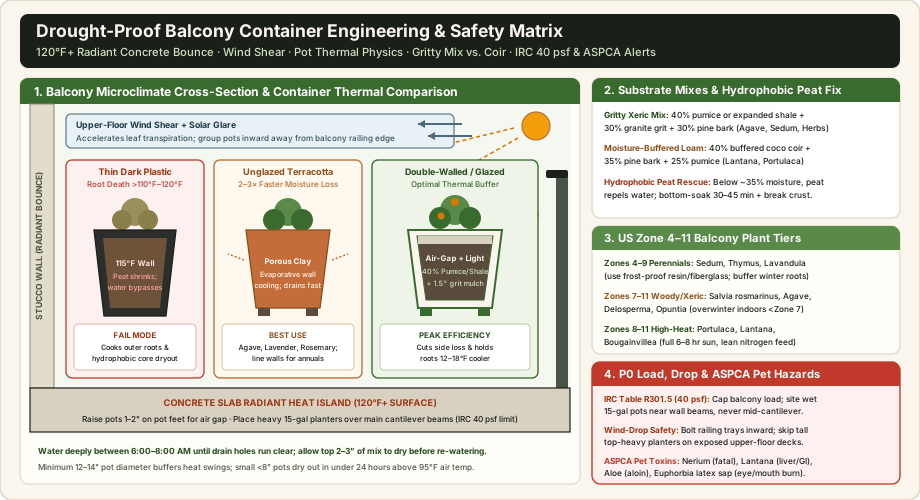
University of Kentucky and LSU AgCenter container trials reveal two opposite extremes. Thin dark plastic absorbs direct sunlight and drives soil temperatures along outer walls past 110°F–120°F (43°C–49°C), cooking feeder roots and inviting opportunistic root rot. Unglazed terracotta cools clay walls slightly via evaporative wicking, yet dries 2–3× faster than sealed pots and spalls outdoors during Zone 4–6 winter freezes.
Container Material Thermal, Moisture & Freeze Performance (14-Inch Pot)
Material | Wall Moisture Loss | Peak Root-Zone Temp | Wet Weight (14") | Freeze Risk & Best Fit |
|---|---|---|---|---|
Thin Dark Plastic | Low (sealed) | 110°F–120°F+ (root death) | 18–26 lb | UV-brittles fast; hide inside light cachepots |
Unglazed Terracotta | Very High (2–3× faster) | 85°F–98°F (evap cooling) | 28–38 lb | Cracks Zones 4–6; ideal for Agave, Lavender, Rosemary |
Double-Walled Resin | Low (air-gap wall) | 80°F–92°F (buffered) | 20–28 lb | Frost-proof Z4–11; best overall heat/weight balance |
Light Fiberglass | Low (composite) | 82°F–94°F (insulated) | 21–30 lb | Frost-proof Z4–11; rigid support for tall shrubs |
Light Glazed Ceramic | Low (vitrified) | 84°F–96°F (reflective) | 36–50+ lb | May crack wet in Z4–6; place over load beams |
Double-walled resin and light fiberglass planters use trapped air gaps or reflective walls to keep root zones roughly 12–18°F cooler than black plastic without drying through porous clay. For clay lovers, nest a nursery pot inside a slightly wider terracotta outer shell (double-potting) to preserve evaporative shade while cutting sidewall loss. Compare tradeoffs in our pot material watering guide, double-potting heat manual, and frost-proof container comparison.
Never set dark single-wall plastic in direct afternoon glare: Even desert Agave lose outer feeder roots once pot walls cross 110°F–113°F. Sleeve existing black nursery pots inside light fiberglass or cedar boxes before peak summer heat.
Substrate Engineering: 40% Mineral Grit vs. Coir Loam and Hydrophobic Peat Rescue
Most bagged potting soils contain 60–75% sphagnum peat moss. Once peat dries below ~35% moisture, waxy coatings shrink and turn hydrophobic: top-watered irrigation beads on top and pours straight down the air gap between root ball and pot wall, leaving roots bone-dry.
Rescuing a hydrophobic peat root ball in four steps
- Bottom-soak 30–45 minutes: Set the dry pot in a basin holding 2–4 inches of tepid water until bubbling stops and surface soil darkens, then drain completely.
- Break tension carefully: On heavy immovable tubs, add 1–2 drops of pure liquid castile soap per gallon (or commercial yucca wetting agent) to let water penetrate waxed fibers.
- Close the wall gap: Press moist soil gently back against the pot walls and scratch the crusted top 1 inch with a hand fork.
- Mulch immediately: Top with 1–1.5 inches of light crushed pumice or river gravel to shade the surface.
Long term, swap peat-heavy bags for two purpose-built substrates—and skip putting gravel in the bottom of pots, which raises the perched water table as shown in our container drainage gravel myth guide.
Balcony Substrate Recipes: Mineral Gritty Mix vs. Buffered Coir Loam
Formula & Best Species | Volume Recipe | Water & Aeration Behavior | Refresh Cadence |
|---|---|---|---|
Formula A: Gritty Xeric Mix (Agave, Sedum, Lavandula, Rosmarinus, Thymus) | 40% pumice or expanded shale + 30% crushed granite grit + 30% aged pine bark fines | Zero peat hydrophobicity; permanent macro-pores prevent root rot after cloudbursts | Lasts 3–5+ yrs; top-dress slow minerals yearly |
Formula B: Buffered Coir Loam (Portulaca, Lantana, Bougainvillea, Patio Herbs) | 40% washed calcium-buffered coco coir + 35% pine bark fines + 25% pumice/shale | Rewets cleanly after drought without shrinking; buffers 30–40% more water than Formula A | Top off bark yearly; swap mix every 2–3 yrs |
Avoid: Standard Peat + Native Soil | 70% raw peat + fine sand or garden topsoil | Compacts like brick, repels water below 35% moisture, and suffocates roots in rain | Replace at spring repotting |
Pumice and expanded shale (porous popped ceramic aggregate highlighted in Colorado State soil studies) resist floating to the rim during watering or blowing off windy upper-floor decks better than dusty perlite. When mixing Formula B, always pick washed, calcium-buffered coco coir bricks rather than raw unbuffered coir so excess sodium and potassium salts do not lock out calcium in fast-growing blooms. See our gritty succulent mix guide, coco coir buffering guide, perlite vs. vermiculite breakdown, and container mulching rules.
USDA Zone 4–11 Xeric Balcony Flora: Selection, Watering & Overwintering
Drought-proof balcony planting spans cold Zones 4–6 as well as desert Zones 9–11. Remember the two-zone container buffer rule: because pot walls freeze from all sides, outdoor roots experience winter temperatures roughly two USDA zones colder than ground soil. Hardy stonecrops survive northern decks outdoors inside frost-proof resin pots, while tender Mediterranean woody plants need winter garage or sunny-window shelter below Zone 7.
Group plants strictly by water demand (hydrozoning), referencing our neglect-tolerant container guide, Southwest heat containers, full-sun culinary herbs, and 25 durable container picks.
USDA Zone 4–11 Xeric Balcony Plants: Pot Size, Mix, Watering & Pet Notes
Plant | USDA Zone & Winter Rule | Min Pot & Material | Mix & Peak Watering | Pet & Balcony Safety |
|---|---|---|---|---|
Stonecrop (Sedum spp.) | Zones 3–9 (hardy outdoors Z4–9 in resin) | 10–14" resin or clay | Formula A; every 5–10 days dry | Ornamental sedums non-toxic; drapes nicely inward |
Compact Agave (Agave parryi) | Zones 5–10 (tender spp. indoors <35°F) | 14–18" heavy resin/clay | Formula A (50% grit); every 10–18 days | Sharp terminal spines—set back from walkways |
Rosemary (Salvia rosmarinus) | Zones 7–10 (sunny window <Z7) | 12–16" clay or twin resin | Formula A; every 3–6 days | Pet-safe culinary herb; hates wet winter roots |
Zones 5–9 (cluster by warm wall Z4–5) | 14–16" light glazed/clay | Formula A (pH 6.5–7.5); every 4–7 days | Mild GI sensitivity if chewed heavily; sharp drain | |
Zones 4–9 (hardy outdoors Z4–9) | 10–12" bowl or underplant | Formula A or B; every 3–5 days | Pet-safe living mulch shading taller root balls | |
Moss Rose / Purslane | Annual Zones 4–11 (loves 100°F+ glare) | 10–12" light resin box | Formula B; every 3–5 days | Keep pets from grazing P. oleracea (oxalates) |
Lantana (Lantana camara) | Zones 8–11 (annual Z4–7) | 14–16" twin resin/glazed | Formula B; every 2–4 days | ASPCA TOXIC (liver/GI)—skip on pet balconies |
Dwarf Bougainvillea | Zones 9–11 (overwinter <40°F) | 16–18" fiberglass/resin | Formula B; dry top 3" between soaks | Long thorns and mild sap irritation; prune tight |
Round out arrangements with ice plant (Zones 5–9), garden sage (Zones 4–8), oregano (Zones 4–9), or spineless prickly pear. Water deeply between 6:00 AM and 8:00 AM until drainage runs clear—roughly 0.5 gallon for a 10-inch pot, 1–1.5 gallons for a 14-inch tub, and 2+ gallons for an 18-inch planter. Check soil 2 to 3 inches deep with a finger first, and avoid heavy nitrogen that drives weak, wind-wilting shoots. In Zones 4–6, pull dormant Sedum, Lavandula, and Agave tubs slightly under balcony eaves so winter sleet never pools in cold crowns. Automate absences with our balcony drip kit guide or container olla watering guide, and follow northern overwintering steps.
IRC 40 psf Weight Limits, Railing Drop Safety, and ASPCA Pet Toxicity
Under International Residential Code (IRC) Table R301.5, US balconies and decks are rated for a minimum 40 pounds per square foot (40 psf) live load. Wet gritty or coir mix weighs 60 to 80 lb per cubic foot (8–10+ lb/gal). Pair 15 gallons of saturated mix with a 45 lb ceramic planter and one pot hits 140–165 lb over under 2 sq ft—exceeding 70–80 psf locally. Check lease and engineering margins in our 40 psf balcony weight guide and HOA patio guide.
- Place heavy tubs over structural wall beams: Keep 14–18 inch planters flush against the building ledger rather than loading outer cantilever edges.
- Switch to resin or fiberglass: Double-walled composites cut empty pot weight 50–70% compared with stoneware or concrete.
- Ban unbolted railing-ledge pots: Upper-floor wind gusts turn unanchored rail planters into lethal sidewalk drop hazards; bolt rail boxes inside the railing using steel brackets, and prune tall shrubs low to reduce wind sail.
P0 ASPCA Pet & Ocular Sap Warning — Check Every Species: Confined balconies put foliage directly at pet mouth and eye height. According to the ASPCA Animal Poison Control Center, **Oleander (Nerium oleander) contains lethal cardiac glycosides causing arrhythmias and collapse (never grow it around pets); Lantana carries liver-toxic triterpenoids; Aloe vera outer leaf latex holds emetic saponins and aloin; and Euphorbia species** (Pencil Cactus, Crown of Thorns) leak caustic diterpene-ester milky latex that burns mouths, stomachs, and pet or human corneas.
Wear gloves and safety glasses when trimming Euphorbia or spiny Agave, and pick verified non-toxic swaps from our pet-safe container list when dogs or cats share the deck.
Heatwave Maintenance, Salt Leaching, and Pest Control
Learn to separate afternoon thermal flagging from true dehydration before grabbing a watering can at 4:00 PM. Even hydrated herbs droop slightly during peak 100°F reflection and bounce back once shade hits after dusk; verify root moisture 2–3 inches deep with a wooden skewer before watering so you never drown heat-stressed roots in warm, oxygen-starved mix. Keep balcony foliage clean and salt-free through heat domes using our summer container watering schedule and summer balcony mistakes guide:
- Leach mineral salts monthly: Drench pots twice in the morning until 15–20% clear water flushes out drain holes to clear hard-water sodium and calcium.
- Pause fertilizer above 90°F: Feed once lightly in spring; high summer nitrogen pushes soft water-hungry leaves.
- Add 2–6 PM heatwave shade: Clip temporary 30–40% shade cloth or an umbrella during 100°F+ spells to block west stucco glare.
- Spray spider mites early morning: Blast dusty leaf undersides with plain water at sunrise; never apply horticultural oil above 85°F.