A clear homestead pond surrounded by a vegetative buffer zone of deep-rooted native grasses and cattails, with solar aeration diffusers bubbling gently under early morning light.
Key Takeaways
- Buffer width: Maintain a vegetative buffer strip of 15 to 50 feet around the pond perimeter to filter out 85% of incoming runoff nutrients.
- Barley straw: Apply barley straw at a rate of 2 to 3 bales per surface acre in early spring as an algistatic biological prevention method.
- Pond design: Design pond banks with a 3:1 run-to-rise slope and a 3-foot minimum shoreline depth to block sunlight and prevent bottom-dwelling algae.
- Aeration: Install mechanical aeration systems to maintain dissolved oxygen levels above 5 mg/L, preventing toxic fish kills.
- Biological control: Stock 15 to 20 pounds of mixed-sex adult tilapia per acre for biological control of filamentous algae in warm climates.
Quick answer: To naturally fix a green, murky, or algae-choked pond, implement vegetative buffer zones, apply barley straw, ensure proper pond design with adequate depth, install aeration systems, and consider biological controls like tilapia in warm climates.
A healthy farm pond acts as the biological heart of a permaculture homestead, storing over 50,000 gallons of harvested rainwater to buffer dry seasons. However, when these storage bodies are neglected, they quickly turn into stagnant, algae-choked eyesores that smell of sulfur and clog irrigation equipment. You can restore clarity to green, murky water by establishing natural filters that process excess nutrients, without resorting to harsh chemical algaecides.
For homesteaders managing 1 or 2 acres of water storage, maintaining ecological balance is a continuous process that depends on correct design. Ponds that receive excessive agricultural runoff or lack adequate oxygenation will inevitably experience severe planktonic blooms. Rebuilding this balance requires understanding the underlying biological cycles and implementing passive earthwork structures to capture silt before it reaches the main body of water.
This process of restoring a pond can successfully reclaim a water system that has been neglected for over 5 years. By addressing the root nutrient load, integrating deep-rooted plants, and setting up natural biological barriers, you can establish a clean water supply that supports both your crops and livestock.
Understanding the root cause of pond murky greenness
This excessive coloration and turbidity in a homestead pond is almost always driven by an overabundance of dissolved nutrients. When phosphorus and nitrogen levels spike, they trigger rapid cellular division in planktonic and filamentous algae populations. In typical farm ponds, a concentration of phosphorus exceeding 0.03 mg/L is enough to fuel severe blooms, turning clear water into a thick green soup within 48 hours. Solar radiation penetrates the shallow, warm layers of the water column, accelerating photosynthesis and causing algae biomass to double every 3 to 5 days.
Eutrophication Danger: When dissolved phosphorus concentrations exceed 0.03 mg/L, the pond enters a eutrophic state where rapid algae multiplication blocks sunlight, depletes oxygen, and threatens aquatic life.
These sudden blooms do not just look unappealing; they actively threaten the survival of your aquatic ecosystem. Algae consume massive amounts of oxygen at night through respiration. When a bloom crashes, the decomposition of dead organic matter by aerobic bacteria rapidly deoxygenates the water column. This biological collapse can drop dissolved oxygen levels below 3 mg/L, which is the critical threshold that causes massive fish kills.
To correct this ecological imbalance, homesteaders must avoid relying on harsh chemical treatments. While synthetic algaecides like copper sulfate provide a quick kill, they do not address the underlying nutrient load and can harm beneficial microbial populations. Reclaiming a murky pond requires a systematic approach that addresses nutrient inputs, enhances water circulation, and utilizes natural biological controls to establish a self-regulating, clear ecosystem over 12 months.
Managing nutrients with 15-to-50-foot vegetative buffer zones
These vegetative margins serve as the primary line of defense against agricultural and turf runoff. Establishing a permanent buffer zone that is 15 to 50 feet wide around the entire perimeter of the pond will filter out sediment and absorb dissolved nutrients before they enter the water. Deep-rooted native plants intercept runoff, absorbing up to 80% of dissolved phosphorus and 60% of nitrates. In sloping areas, expanding the buffer zone to 100 feet ensures adequate filtration even during heavy rainfall events.
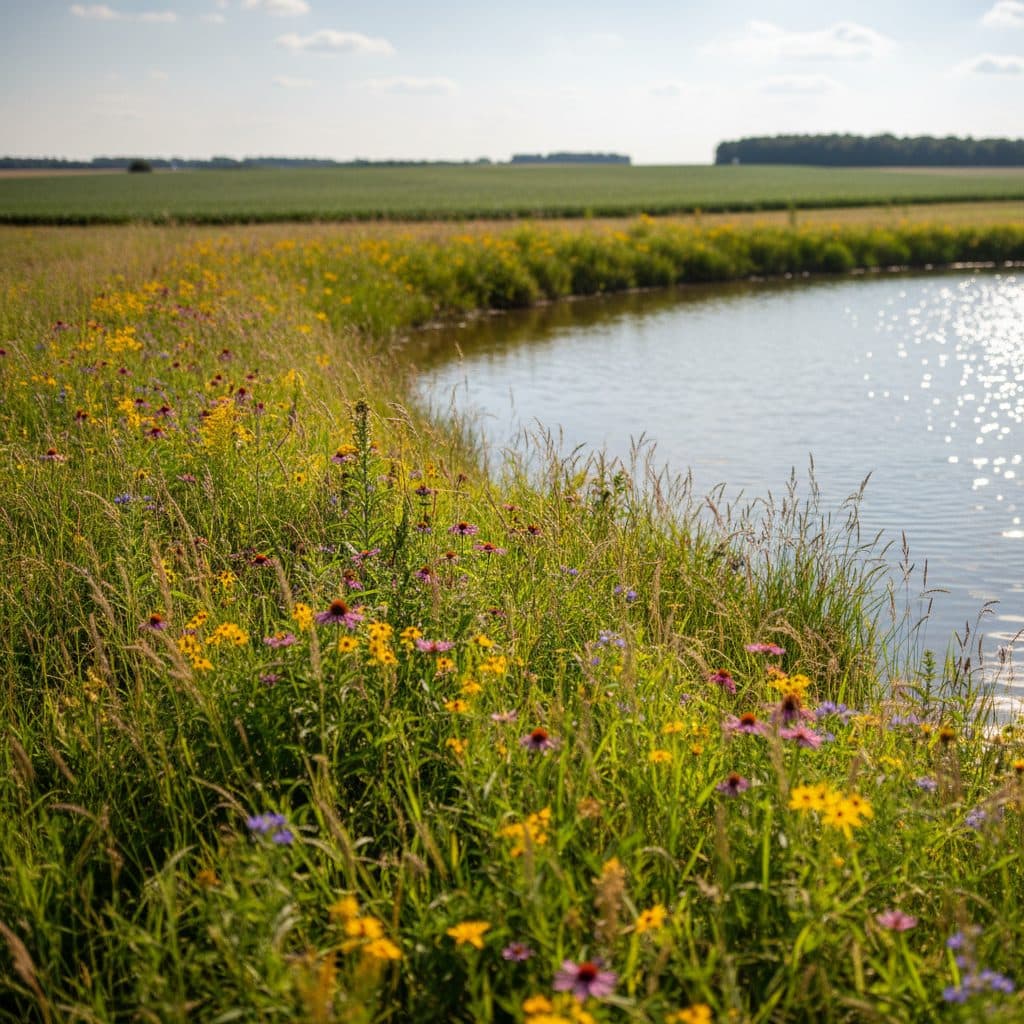
A dense twenty-five foot vegetative buffer strip of native grasses and wildflowers bordering a clear farm pond, filtering agricultural runoff under bright afternoon sun.
Native plants like broadleaf cattail (cattail) and sacred lotus (lotus) are excellent for the shallow margins, as their root systems absorb massive amounts of nitrogen. On the dry banks, planting deep-rooted native grasses like switchgrass and big bluestem creates a physical barrier that slows surface runoff. Regular maintenance, such as mowing the buffer zone just 1 or 2 times a year, helps keep the plants in an active growth phase.
Planting these vegetative margins is best accomplished using high-quality tools to minimize bank erosion. Using the Garden Hand-Tool Set allows you to plant bare-root sedges and aquatic plugs directly into the muddy banks without disturbing the soil structure. Inserting root plugs at a spacing of 12 to 18 inches ensures rapid coverage, establishing a functional vegetative barrier within 90 days.
Implementing barley straw at 2 to 3 bales per surface acre
This biological method is an effective, non-toxic way to prevent new algae growth. Barley straw acts as an algistatic agent, meaning it inhibits the division of new algae cells rather than killing existing blooms. The standard application rate recommended by university extension offices is 2 to 3 bales per surface acre of water, which equates to roughly 10 to 25 grams of straw per square meter of pond surface area. Applying more than 5 bales per acre should be avoided, as decomposing organic matter can deplete dissolved oxygen.
Barley straw application guidelines
- Spring Timing: Place the straw in the water before temperatures exceed 50°F.
- Mesh Bags: Package the straw loosely in mesh bags to ensure constant water flow.
- Surface Placement: Anchor the bags near the surface where oxygen and sunlight are highest.
- Active Window: Replace the straw every 6 months to maintain continuous protection.
Barley straw must be applied in early spring, before the water temperature reaches 50°F and algae growth begins. Barley straw does not work instantly; it takes 6 to 8 weeks to decompose in water temperatures below 60°F, and about 2 to 3 weeks in warmer summer conditions. To apply it, break the bales apart and place the straw loosely into porous mesh bags or cages. Anchor these bags at the pond surface where wind and wave action will circulate water through the decaying fibers.
Decaying straw fibers release soluble humic substances into the water column. In the presence of sunlight and dissolved oxygen, these humic acids react to form low concentrations of hydrogen peroxide, which is highly toxic to dividing algae cells but harmless to fish and larger aquatic plants. To ensure the treatment is applied evenly across the pond margins, a liquid barley extract can be sprayed using the Delixi Electric Garden Sprayer. This sprayer allows for a controlled application of biological treatments directly to the shoreline zones where filamentous algae mats first begin to form, targeting the top 6 inches of the water column.
Designing ponds with a 3:1 slope and 3-foot minimum depth
These physical dimensions are critical for limiting the solar exposure that algae need to photosynthesize. When constructing or renovating a pond, maintaining a proper bank slope of 3:1 (a 3-foot horizontal run for every 1-foot vertical drop) is highly effective. This slope angle provides bank stability, prevents soil erosion, and minimizes the shallow shoreline zones where warm water and sunlight create perfect breeding grounds for filamentous algae.
Control Method | Action Type | Target Spec | Functional Life |
|---|---|---|---|
Barley Straw | Algistatic (Inhibitor) | 2-3 bales per surface acre | 6 months (spring/fall) |
Vegetative Buffer | Nutrient Filtration | 15-50 feet margin width | Permanent (perennial) |
Bottom Aeration | Deoxygenation / Circulation | DO levels > 5 mg/L | Continuous (24 hours) |
Biological Stocking | Direct Grazing (Algicidal) | 15-20 lbs tilapia per acre | Seasonal (above 55°F) |
Shoreline areas shallower than 2 feet allow sunlight to reach the pond bottom, encouraging the growth of benthic algae and submerged weeds. To prevent this, design principles require that the water depth reaches at least 3 feet at a point 6 feet out from the shoreline. For ponds stocking fish, ensuring that at least 25% of the pond area has a depth of 6 to 8 feet is vital for providing cool water refuges in summer and preventing winter freezes.
Integrating these earthworks with adjacent passive irrigation features maximizes water efficiency on the homestead. A well-designed pond can store runoff harvested from uphill swales, acting as a clean source for gravity-fed irrigation systems. Before executing any earthworks, testing the clay content of your soil with the 3-in-1 Soil pH, Moisture & Light Meter helps determine if a bentonite clay liner is required to prevent water seepage through the banks.
Installing solar-powered aeration for 24-hour oxygenation
This oxygenation strategy is the single most important action for maintaining water clarity and fish health. Stagnant water quickly stratifies, creating a warm, oxygen-rich surface layer and a cold, anoxic bottom layer. Installing a bottom-diffusion aeration system breaks this stratification by pumping air through diffusers placed at the deepest part of the pond. This continuous circulation rises to the surface, bringing oxygen-depleted bottom water into contact with the atmosphere for gas exchange 24 hours a day.
A wooden rake resting on the edge of a pond bank next to a pile of harvested filamentous green algae mats, illustrating manual nutrient extraction during early morning.
Aerobic bottom bacteria are stimulated by this mechanical movement, accelerating the decomposition of organic muck. Aerobic microbes break down organic matter up to 10 times faster than anaerobic organisms, locking up phosphorus in the sediment and keeping it unavailable to algae. Maintaining dissolved oxygen levels above 5 mg/L prevents phosphorus from dissolving back into the water column, effectively starving the algae populations.
Pond aeration is highly compatible with gravity-fed water setups and passive earthworks. Ponds placed high on the landscape can receive harvested water from swales (permaculture swale maintenance), filter it through aeration, and then supply clean water to downhill drip irrigation layouts (drip irrigation system design). This clean water is also ideal for supplying sub-surface wicking beds or filling ollas in adjacent gardens, as it is free from the algae clumps that clog irrigation emitters. This clean water can also be recycled through a household greywater system recycling network, designed over a 5-day earthworks project.
Stocking 15 to 20 pounds of tilapia per acre
These biological control agents provide active, ongoing suppression of filamentous algae. Stocking 15 to 20 pounds of mixed-sex adult tilapia (Oreochromis aureus or Oreochromis niloticus) per surface acre in late spring provides excellent control of floating algae mats. Tilapia are voracious consumers of filamentous algae and organic detritus, consuming up to 30% of their body weight in aquatic vegetation daily.
- Water Temperatures: Monitor water temperatures carefully; tilapia require at least 65°F to actively feed.
- Stocking Density: Keep stocking rates between 15 to 20 pounds per acre to avoid overcrowding.
- Co-habitation: Tilapia fry serve as high-protein forage for species like largemouth bass.
- Annual Cycle: Plan for annual restockings in zones where winter temperatures fall below 55°F.
Because tilapia are tropical species, they will die when water temperatures drop below 55°F in the fall. This natural temperature limit prevents them from becoming invasive in northern climates but requires annual restocking in regions with freezing winters. In warmer southern states, tilapia reproduce rapidly and become food for larger predatory fish like largemouth bass, while the water stays clear through summer.
Those managing larger aquatic weed infestations may also consider stocking triploid grass carp (Ctenopharyngodon idella). University extensions recommend stocking 5 to 10 triploid grass carp per acre for mild infestations, and up to 20 fish per acre for severe submerged weed problems. Unlike tilapia, grass carp prefer rooted submerged plants and are not effective for controlling filamentous algae. It is critical to obtain sterile, triploid fish from certified hatcheries to prevent ecological disruption in connected waterways.
Conclusion
This holistic approach to pond management replaces temporary chemical fixes with a self-sustaining ecosystem. By combining 15-to-50-foot vegetative buffer zones, early spring barley straw applications, mechanical aeration, and targeted biological stocking, a murky pond can be transitioned to clear, healthy water within 12 months. This clear water then becomes a reliable resource for downstream gravity-fed systems, wicking beds, and general farm use. Clean water can be supplemented by rainwater harvesting systems designed uphill.
Establishing natural biological systems requires patience, as processes establish themselves over several seasons, typically taking 1 to 2 years to reach biological equilibrium. Monitoring water clarity with a simple Secchi disk and checking soil and water parameters regularly will help you track the pond’s progress. With proper design and natural management, your farm pond will serve as a beautiful, productive water storage hub that supports both your crops and local wildlife for decades.
Frequently Asked Questions
How long does it take for barley straw to clear a pond?
Decomposing barley straw typically takes 6 to 8 weeks to become effective in cool water temperatures below 60°F. In warmer summer waters, the process accelerates to about 2 to 3 weeks, but the straw must be applied in early spring as a preventative measure.
Will grass carp eat filamentous algae in my pond?
No, triploid grass carp do not efficiently consume filamentous algae. These herbivorous fish prefer submerged, succulent plants such as pondweed and coontail, so stocking them for a floating algae mat problem is generally ineffective.
What is the optimal width for a vegetative runoff buffer?
A vegetative buffer strip should be at least 15 to 50 feet wide to filter out agricultural and turf runoff. Wider buffers of up to 100 feet are recommended for steeper bank slopes to ensure effective nutrient removal.
Is copper sulfate a safe natural treatment for pond algae?
No, copper sulfate is a harsh chemical algaecide that kills algae rapidly, but it is not a natural or sustainable solution. The sudden death of large algal populations can deplete dissolved oxygen levels below 3 mg/L, leading to severe fish kills.
Can aeration alone eliminate a green water algae bloom?
Aeration is a critical tool for circulation and maintaining dissolved oxygen levels, but it is rarely a standalone solution. It must be paired with nutrient reduction methods, such as buffer zones and biological filters, to successfully clear green water.
References
- Penn State Extension. Pond Management Using Barley Straw. https://extension.psu.edu/pond-management-using-barley-straw
- Oklahoma State University Cooperative Extension. Barley Straw for Algae Control. https://extension.okstate.edu/fact-sheets/barley-straw-for-algae-control.html
- Clemson University Home & Garden Information Center. Pond Algae Management. https://hgic.clemson.edu/factsheet/pond-algae-management/
- Texas A&M AgriLife Extension AquaPlant. Biological Control Options. https://aquaplant.tamu.edu/management-options/biological-control/
- University of Maryland Extension. Pond Management and Water Quality. https://extension.umd.edu/resource/pond-management