Key takeaways
- Greywater, from showers, sinks, and laundry, can reduce household potable water use by 30% to 50%.
- California has progressive greywater laws, with simple laundry-to-landscape systems often exempt from permits for up to 250 gallons per day.
- Arizona allows unpermitted greywater systems up to 400 gallons per day, while Texas historically has stricter rules, often requiring permits for systems over 150 gallons per day.
- Greywater should be applied subsurface, avoiding human contact and use on root crops that are eaten raw.
- Selecting low-sodium, low-boron, and biodegradable soaps is crucial for plant health and soil longevity.
- Passive irrigation methods like ollas, wicking beds, and earthworks effectively distribute greywater and conserve moisture.
Quick answer: Greywater laws vary significantly by state, with California and Arizona offering more permissive regulations for systems up to 250-400 gallons per day, while Texas has historically had stricter requirements, often needing permits for systems over 150 gallons per day.
Water scarcity is a growing concern across the American West, particularly in states like California, where annual rainfall can drop below 10 inches in some regions during drought years. This challenge pushes growers to look for every possible way to conserve water, and one significant opportunity lies in reusing household water. A typical US household uses about 50 gallons of water per person per day indoors, and roughly 30% to 50% of this is greywater from showers, sinks, and laundry that can be safely repurposed for irrigation [0, 1].
Understanding greywater laws by state is essential for any grower considering these systems, as regulations vary widely from permissive frameworks in Arizona to more structured requirements in Texas. Proper greywater use can significantly reduce potable water demand, support garden growth, and even recharge local groundwater, offering a practical solution for water management in regions facing 100°F summer temperatures and limited water access.
Understanding greywater: what it is and its benefits
Greywater refers to wastewater generated from household activities like showering, bathing, washing hands, and doing laundry. It specifically excludes water from toilets (blackwater) and kitchen sinks, which often contain higher levels of grease and food particles that require more complex treatment before reuse. Redirecting this water can cut a household’s potable water consumption by 30% to 50%, a substantial saving for any grower, especially in arid regions like USDA zone 9 in Southern California where water bills can reach hundreds of dollars monthly during peak irrigation seasons [0, 1].
basic greywater treatment and application
For garden use, greywater typically requires minimal treatment beyond a simple filter to remove lint and hair. The goal is to apply it directly to the soil, ideally subsurface, to prevent human contact and minimize pathogen exposure. This method also ensures the water infiltrates the root zone efficiently, reducing evaporation losses by 20% to 30% compared to surface irrigation. Proper application supports healthy soil microbiology and plant growth, making it a viable option for irrigating fruit trees, ornamental shrubs, and many perennial vegetables in regions receiving less than 20 inches of annual precipitation.
- Showers and baths: typically 20-30 gallons per use
- Washing machines: 15-45 gallons per load
- Bathroom sinks: 1-2 gallons per minute of use
- Clothes washer discharge: often the largest greywater source
- Laundry-to-landscape systems: simplest and most common setup
California’s progressive greywater framework
California stands out with some of the most progressive greywater regulations in the United States, driven by persistent drought conditions and a need for water conservation. The state’s 2009 Greywater Systems Policy and subsequent amendments to the California Plumbing Code in 2010 significantly streamlined the process for installing greywater systems. For instance, simple laundry-to-landscape systems, which direct washing machine discharge directly to the landscape via a branched drain, are often exempt from permits if they meet specific criteria, including a maximum flow of 250 gallons per day and subsurface application [1, 4].
permitting tiers and specific requirements
More complex greywater systems, such as those that collect water from multiple fixtures or involve storage tanks, typically require a permit and adherence to more stringent design and installation standards. These systems must still ensure the greywater is used for subsurface irrigation, preventing ponding or runoff, and must be designed to avoid contact with people or animals. The state’s approach encourages widespread adoption by reducing bureaucratic hurdles for basic systems, making it easier for homeowners in regions like USDA zone 10 to implement water-saving practices. For more details on system types, see our article on greywater systems.
- Laundry-to-landscape systems: up to 250 gallons per day, no permit often needed
- Subsurface irrigation: required for all systems to prevent contact
- No storage tanks: generally for unpermitted systems to prevent anaerobic conditions
- Simple branched drain systems: common for direct application to plants
- Professional installation: recommended for systems over 250 gallons per day
Arizona and Texas: contrasting approaches to greywater
Arizona has historically been one of the most greywater-friendly states, reflecting its arid climate and long-standing need for water conservation. The Arizona Department of Environmental Quality (ADEQ) allows for the installation of greywater systems that discharge up to 400 gallons per day without requiring a permit, provided they meet specific simple design and installation criteria. These criteria include subsurface discharge, avoiding ponding, and ensuring the system does not connect to a potable water supply. This permissive stance has encouraged many residents in areas like Phoenix and Tucson (USDA zone 9) to adopt greywater for landscape irrigation, significantly reducing their reliance on municipal water supplies [5].
texas’s evolving greywater landscape
In contrast, Texas has traditionally maintained a more conservative approach to greywater reuse, though regulations are gradually evolving. The Texas Commission on Environmental Quality (TCEQ) generally requires a permit for greywater systems exceeding 150 gallons per day, and even smaller systems must adhere to specific design and health standards. Often, these permits necessitate plans stamped by a professional engineer, adding complexity and cost for homeowners. This difference means that while a simple laundry-to-landscape system might be permit-exempt in Arizona, a similar setup in Texas, especially in regions like the Panhandle (USDA zone 7), could involve more regulatory hurdles. For more on water management in the state, consider our article on homesteading in Texas.
- Arizona: up to 400 gallons per day often permit-exempt
- Texas: permits often required for systems over 150 gallons per day
- Subsurface discharge: a common requirement in both states
- Professional engineering: often needed for Texas greywater permits
- Avoidance of ponding: critical for health and safety in all systems
Restrictions, plant compatibility, and soap considerations
While greywater reuse offers significant benefits, it’s not without restrictions. Across most states, greywater cannot be used for spray irrigation due to the risk of human contact with pathogens, nor can it be discharged directly into surface waters like streams or ponds. It is also generally prohibited for irrigating root crops that are eaten raw, such as carrots or radishes, to minimize health risks. Some states, particularly in the Northeast or those with high water tables, have more restrictive greywater laws, sometimes prohibiting its use entirely or requiring advanced treatment for even basic landscape irrigation, due to concerns about groundwater contamination [2, 3].
choosing plants and soaps for greywater
Selecting the right plants and soaps matters for a successful greywater system. Plants that thrive with greywater include established trees, ornamental shrubs, and many perennial food crops like fruit trees (e.g., citrus in USDA zone 9, apples in USDA zone 6) and berries. Avoid salt-sensitive plants such as blueberries, azaleas, or ferns, as greywater often contains elevated levels of sodium from detergents. For soaps, always choose biodegradable, low-sodium, and low-boron options. Chlorine bleach, harsh detergents, and products with high levels of phosphates should be avoided, as they can harm soil structure and plant health over time. A simple test kit can measure soil salinity after a year or two of greywater use, ensuring long-term soil viability. Consider an expandable hose with a 7-pattern spray nozzle for precise application of potable water when needed.
- Avoid spray irrigation: prevents human contact with greywater
- No raw root crops: minimizes pathogen risk for edible plants
- Choose low-sodium soaps: protects soil and salt-sensitive plants
- Biodegradable detergents: breaks down naturally in soil
- Avoid chlorine bleach and boron: harmful to plants and soil microbes
Passive irrigation and earthworks for greywater application
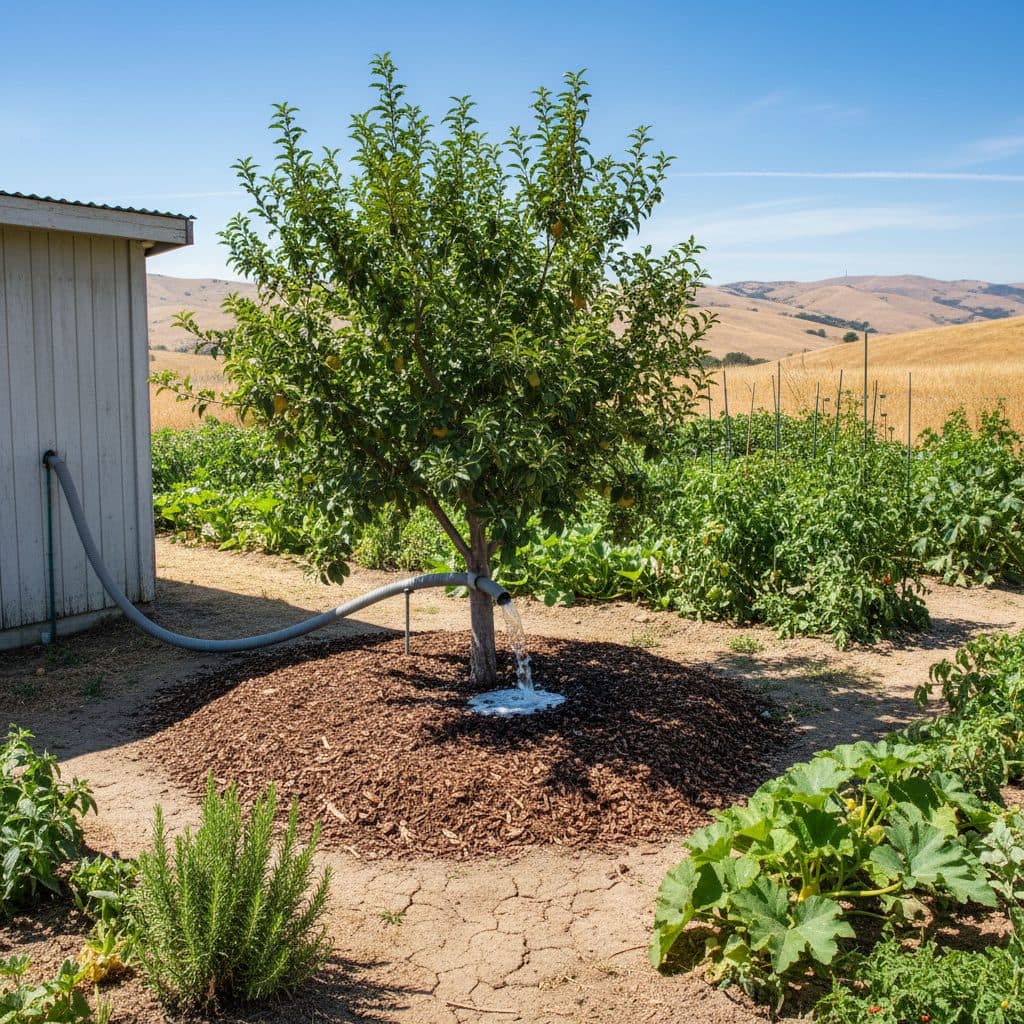
Integrating greywater into passive irrigation systems and earthworks maximizes its effectiveness and further reduces water waste. Instead of simply discharging greywater, directing it into mulch basins around trees or into wicking beds ensures the water is absorbed efficiently by plant roots. Mulch basins, typically 6 to 12 inches deep and 3 to 5 feet in diameter around a tree, reduce evaporation by 50% to 70% and help distribute moisture evenly. This method is particularly useful in dry climates like USDA zone 8, where every gallon of water is precious.
ollas, wicking beds, and swales
Ollas, traditional porous clay pots buried near plants, can be filled with filtered greywater to provide slow, consistent subsurface irrigation, saving up to 70% more water than surface methods. Wicking beds, designed with a water reservoir at the bottom, can also be fed with greywater, providing a self-watering system that keeps soil consistently moist. Furthermore, earthworks like swales – shallow trenches dug along contours – and berms can capture and spread greywater across the landscape, mimicking natural water flow patterns. The USDA Natural Resources Conservation Service promotes these types of practices for increasing soil moisture and reducing runoff, noting that properly designed swales can hold hundreds of gallons of water after a rain event or greywater discharge [6]. For more on water collection, explore rainwater harvesting.
- Mulch basins: 6-12 inches deep, 3-5 feet wide for trees
- Ollas: porous clay pots for targeted subsurface irrigation
- Wicking beds: self-watering systems with a bottom reservoir
- Swales: contour trenches to capture and infiltrate water
- Berms: raised earth to direct water flow and prevent runoff
Greywater System Regulations Comparison (Simplified)
State | Unpermitted Daily Limit (gal) | Permit Complexity | Common Restrictions |
|---|---|---|---|
California | 250 (laundry-to-landscape) | Low for simple systems, higher for complex | Subsurface only, no ponding, no raw root crops |
Arizona | 400 | Very low for simple systems | Subsurface only, no ponding, no spray irrigation |
Texas | 150 (often requires permit) | Moderate to high, often needs engineer stamp | Subsurface only, no ponding, specific design standards |
New York | 0 (generally prohibited or highly restricted) | Very high, often requires advanced treatment | Strict health codes, often not allowed for irrigation |
Water Savings: Greywater systems can reduce indoor potable water use by 30% to 50% in an average US household.
Permit-Exempt in AZ: Arizona allows greywater systems up to 400 gallons per day without a permit, provided specific conditions are met.
Soil Health: Using low-sodium, biodegradable soaps ensures greywater benefits soil microbiology and plant health over decades of use.
Frequently asked questions
What is the main difference between greywater and blackwater?
Greywater comes from showers, baths, and laundry, containing fewer pathogens and less organic matter. Blackwater, from toilets and kitchen sinks, contains human waste and high levels of food particles, requiring advanced treatment before any reuse. A typical family of four can generate over 100 gallons of greywater daily.
Can I use greywater on my vegetable garden?
Yes, you can use greywater on many vegetables, especially those where the edible part is not in direct contact with the soil, like corn, squash, or fruit trees. However, it is generally prohibited to use greywater on root crops that are eaten raw, such as carrots or radishes, to minimize health risks, as regulations often specify a 12-inch separation from edible parts.
What kind of soaps are safe for greywater systems?
For greywater systems, use biodegradable, low-sodium, and low-boron soaps and detergents. Avoid products containing chlorine bleach, harsh chemicals, or high levels of phosphates, as these can harm your plants and degrade soil quality over time. Many natural liquid laundry detergents are suitable, often containing less than 10 ppm of sodium.
Do I need a permit to install a greywater system?
Permit requirements vary significantly by state and the complexity of the system. In California, simple laundry-to-landscape systems under 250 gallons per day are often permit-exempt. Arizona allows up to 400 gallons per day without a permit. In Texas, systems over 150 gallons per day typically require a permit, sometimes needing a professional engineer’s stamp.
How does greywater benefit soil health?
When applied subsurface, greywater, especially with appropriate soaps, contributes moisture and some nutrients to the soil, supporting microbial activity. This helps break down organic matter and improves soil structure. Over a year, a greywater system can deliver thousands of gallons of water, enriching the soil in dry regions.
References
- Greywater Treatment (2015). Greywater Treatment.
- Greywater systems (2023). Greywater systems.
- Greywater Usages and Management (2015). Greywater Usages and Management.
- Greywater Treatment (2015). Greywater Treatment.
- Greywater systems (2023). Greywater systems.
- USDA Natural Resources Conservation Service (2024). USDA Natural Resources Conservation Service.