Key takeaways
- Broad beans (Vicia faba) are hardy, cool-season legumes that thrive in UK maritime conditions, tolerating frosts down to -10°C.
- Sow cold-hardy varieties like 'Aquadulce Claudia' outdoors in October or November for a late-May to June harvest that escapes black bean aphids.
- Sow spring varieties from February under cloches or modules through April for continuous summer cropping until July.
- Broad bean plants develop deep taproots and fix atmospheric nitrogen in root nodules, improving soil fertility for subsequent heavy-feeding crops.
- Pinch out the top 7 to 10 cm of stem tips as soon as the first four to five trusses of flowers set pods to prevent blackfly infestations.
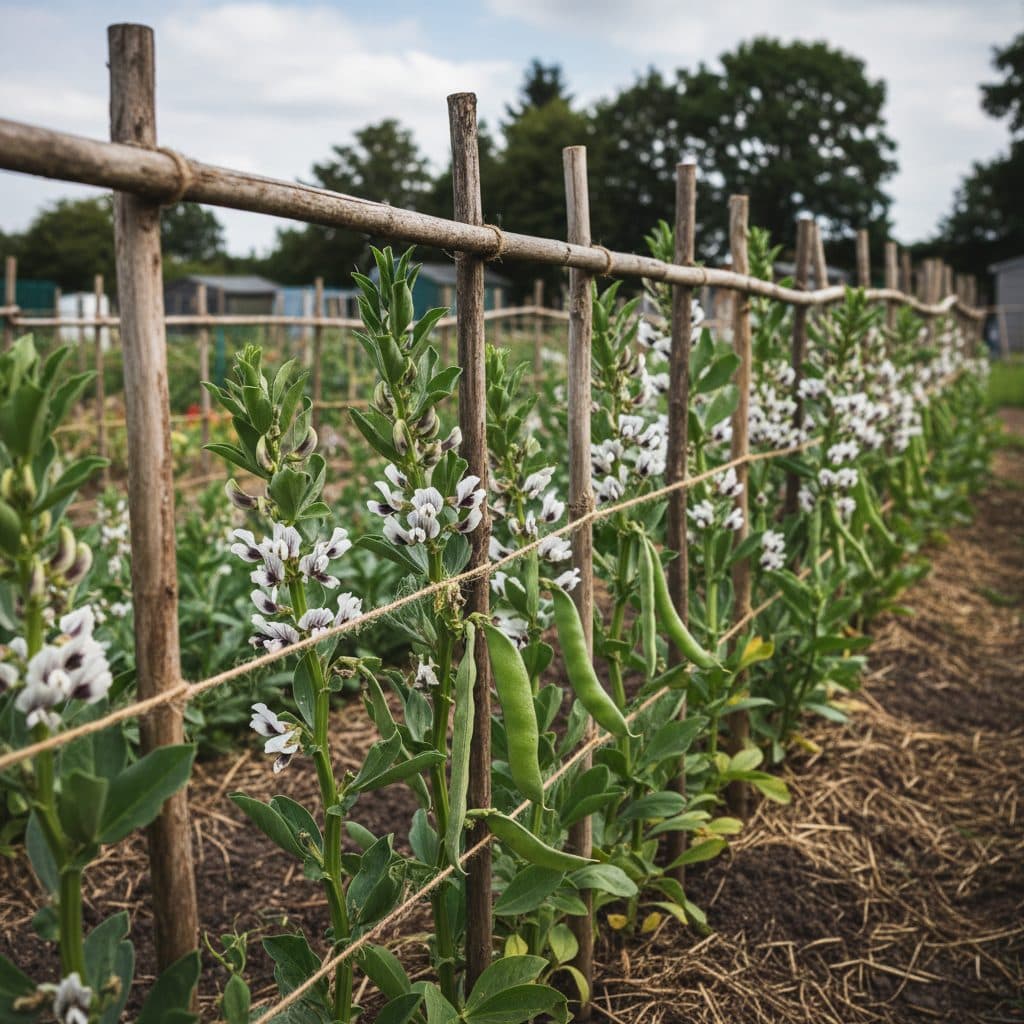
- Support tall varieties with stout corner stakes and parallel horizontal twine lines to prevent wind rocking during spring gales.
Quick answer: For an early summer harvest, sow hardy broad beans like 'Aquadulce Claudia' outdoors in October or November, or start seeds in modules in February. Plant in fertile, well-drained soil spaced 20 to 25 cm apart, support stems with string corrals, and pinch out the tender growing tips once the lowest pods set to deter blackfly.
Broad beans are among the oldest cultivated crops in the British Isles, celebrated for their hardiness, early seasonal harvests, and ability to condition heavy soils. Unlike tender runner beans and French beans that require warm summer soil, broad beans flourish in the cool, damp days of late autumn and early spring.
Growing broad beans gives you fresh, sweet green beans as early as May, filling the traditional "hungry gap" before maincrop summer vegetables arrive. Their sturdy, upright stems produce distinctive fragrant white-and-black flowers that attract the season's earliest emerging bumblebees.
This guide covers overwintering autumn crops and spring sowing on allotments under UK weather conditions.
+-------------------------------------------------------------+
|              UK BROAD BEAN SEASONAL SOWING CALENDAR         |
|                                                             |
|   SOWING WINDOW       VARIETY TYPE           HARVEST PERIOD |
|   -------------       ------------           -------------- |
|   Oct - Nov (Autumn)  'Aquadulce Claudia'    May to June    |
|   Feb - March (Module)'Masterpiece Green     June to July   |
|                       Longpod'                              |
|   March - April (Dir) 'Bunyards Exhibition'  July to August |
+-------------------------------------------------------------+
When should you sow broad beans in the UK?
UK gardeners benefit from two distinct sowing windows: autumn for overwintering crops, and spring for maincrop summer yields.
1. Autumn sowing (October to November)
Autumn sowing is ideal across southern and central England where winter temperatures are relatively mild and soils drain freely:
- Best varieties: 'Aquadulce Claudia' and 'Super Aquadulce' are specifically bred for cold tolerance and winter damp.
- Advantages: Autumn-sown broad bean plants develop strong root systems before winter dormancy. They flower in April and crop three to four weeks earlier than spring sowings, largely avoiding black bean aphid infestations.
- Soil requirement: Ground must be free-draining. Heavy, waterlogged clay causes large seeds to rot in cold winter soil. On wet soils, sow in module trays in an unheated greenhouse or cold frame instead.
2. Spring sowing (February to April)
Spring sowing is dependable across all UK regions, particularly on heavy clay soils or in northern England and Scotland:
- Early spring (February): Sow individual seeds 5 cm deep in multi-cell trays or 7.5 cm pots inside an unheated greenhouse or cold frame. Plant out in late March once soil is workable.
- Maincrop direct sowing (March to April): Broad beans germinate from about 5°C; waiting until the soil is around 8°C and rising gives faster, more even emergence. Excellent spring cultivars include 'Masterpiece Green Longpod', 'Bunyards Exhibition', and the compact dwarf variety 'The Sutton' (30 to 45 cm tall, ideal for windy plots and containers).
+-------------------------------------------------------------+
|               BROAD BEAN SOWING SPECIFICATIONS              |
|                                                             |
|   METRIC                RECOMMENDATION                      |
|   ------                --------------                      |
|   Sowing Depth          5 cm (2 inches)                     |
|   In-Row Spacing        20 to 25 cm between plants          |
|   Double-Row Spacing    25 cm between pair; 60 cm path      |
|   Germination Temp      From 5°C (optimum 8°C to 15°C)      |
+-------------------------------------------------------------+
How do you prepare the soil and support the plants?
Broad beans are deep-rooted legumes that thrive in rich, well-drained loam with a neutral to slightly alkaline pH (6.5 to 7.5).
Soil preparation
- Incorporate well-rotted garden compost or well-aged farmyard manure into the soil during late summer or early autumn.
- Avoid applying fresh manure or high-nitrogen chemical fertilisers; excess nitrogen stimulates soft, sappy foliage that is vulnerable to fungal disease and aphid attack, while reducing root nodulation.
- On no-dig allotment plots, simply top-dress the bed with a 3 to 5 cm layer of compost before planting. Learn complete bed setup in our guide on no dig allotment conversion.
Staking and wind support
Although broad beans have sturdy, square stems, heavy winds and the weight of developing pods will cause plants to sprawl and snap at the base.
- Push stout 1.2 m wooden stakes into the ground at the four corners of each double row.
- Tie strong garden twine tightly around the perimeter stakes at a height of 30 cm from the ground.
- Add a second twine line at 60 cm as plants grow taller. For long allotment rows, insert intermediate support stakes every 2 metres.
+-------------------------------------------------------------+
|               DOUBLE-ROW TWINE SUPPORT CORRAL               |
|                                                             |
|      [Stake]========================[Stake]  <-- Twine 60cm |
|         |    -      *      *      *    |     <-- Twine 30cm |
|         |   (Plant Row 1 - 25 cm)      |                    |
|         |                              |                    |
|         |   (Plant Row 2 - 25 cm)      |                    |
|         |    -      *      *      *    |                    |
|      [Stake]========================[Stake]                 |
+-------------------------------------------------------------+
Why should you pinch out the growing tips?
Pinching out the top growing shoot prevents the single most common broad bean pest in the UK: the black bean aphid (Aphis fabae).
+-------------------------------------------------------------+
|              PINCHING OUT BROAD BEAN STEM TIPS              |
|                                                             |
|               \  /    <-- Pinch out top 7-10 cm soft tip    |
|                \/         (deters black bean aphid)         |
|               |  |                                          |
|              [FLOWER]                                       |
|               |  |                                          |
|              [POD SET] <-- Trigger: lowest 4-5 trusses set  |
|               |  |                                          |
+-------------------------------------------------------------+- Timing: Wait until the lowest four to five flower trusses have dropped petals and formed small, visible green pods (usually late May or early June).
- Action: Using clean fingers or snips, snap off the top 7 to 10 cm of soft, tender tip growth from every main stem.
- Double benefit: Removing the succulent shoot tip takes away the soft growing point that blackfly colonies feed on. Halting terminal growth also diverts plant sugars straight into swelling the developing pods below.
- Culinary use: Do not waste the pinched tips. Fresh broad bean tops are tender and delicious steamed with butter or tossed into fresh salads. Safety note: Broad beans are not safe for people with G6PD deficiency (favism), and they interact with MAOI antidepressants.
To encourage pollinating bees during the earlier flowering phase, explore our companion planting recommendations in plants for pollinators.
How do you troubleshoot common UK pests and diseases?
UK allotments face specific pest and disease challenges due to damp maritime weather. Follow cultural and biological practices:
1. Black bean aphid (Aphis fabae)
- Symptoms: Dense, sooty clusters of black aphids coating young shoots and flower stalks.
- Control: In addition to pinching tips, blast early colonies with a firm jet of clean water. Encourage natural predators like ladybirds, lacewing larvae, and hoverflies by leaving flowering borders nearby.
2. Chocolate spot (Botrytis fabae)
- Symptoms: Small, reddish-brown chocolate spots on leaves that merge into large patches during prolonged damp spring weather.
- Control: Overwintered crops are the most at risk of chocolate spot. No widely sold garden variety is reliably resistant, so manage it culturally: ensure generous 25 cm plant spacing to maximise air circulation through the crop, maintain free-draining soil with adequate potassium, avoid excess nitrogen, and clear away crop debris at the end of the season.
3. Pea and bean weevil (Sitona lineatus)
- Symptoms: Distinctive U-shaped notches eaten out of leaf margins on young spring seedlings.
- Control: Cover young plants with fleece until they are growing strongly. Established plants outgrow the notching without yield loss.
+-------------------------------------------------------------+
|             BROAD BEAN TROUBLESHOOTING MATRIX               |
|                                                             |
|   ISSUE             CAUSE                 REMEDY            |
|   -----             -----                 ------            |
|   Black stem tips   Black bean aphids     Pinch top 10 cm   |
|   Brown leaf spots  *Botrytis* fungus     Widen plant gaps  |
|   Notched leaves    Bean weevil adults    Fleece young crops|
|   Fallen over stems High wind loading     Tie twine corrals |
+-------------------------------------------------------------+
How and when should you harvest broad beans?
Broad beans can be harvested at different stages depending on culinary preference:
- Immature baby pods (finger length): Pick very young, 5 to 7 cm pods and cook them whole like mangetout or sugar snaps.
- Tender fresh beans: Harvest pods when they are plump and the internal beans feel distinct through the velvety pod wall, but before the scar (hilum) where the seed connects to the pod turns dark black. At this green-hilum stage, the skins are thin, sweet, and tender.
- Mature beans for drying or freezing: Allow pods to fill completely. If bean skins become tough and grey, briefly blanch shelled beans in boiling water for 60 seconds and slide off the outer waxy skin (double-podding).
After your final summer harvest in July, cut stems off at the soil surface and add the leafy tops to your compost bin. Leave the roots in the ground; the nitrogen stored in root nodules will feed subsequent brassica or leafy green crops. Integrate broad beans into a sustainable rotational scheme as detailed in our guide on crop rotation plans for home gardens, or follow on with climbing runner beans on summer cane supports.