Key takeaways
- Runner beans (Phaseolus coccineus) are tender perennials grown as heavy-yielding annuals across UK gardens and allotment plots.
- Sow seeds indoors in pots during mid to late April, or direct sow into warm outdoor soil in late May after the last spring frost.
- Runner bean plants demand moisture-retentive soil rich in organic matter; traditional compost trenching in winter ensures deep root hydration.
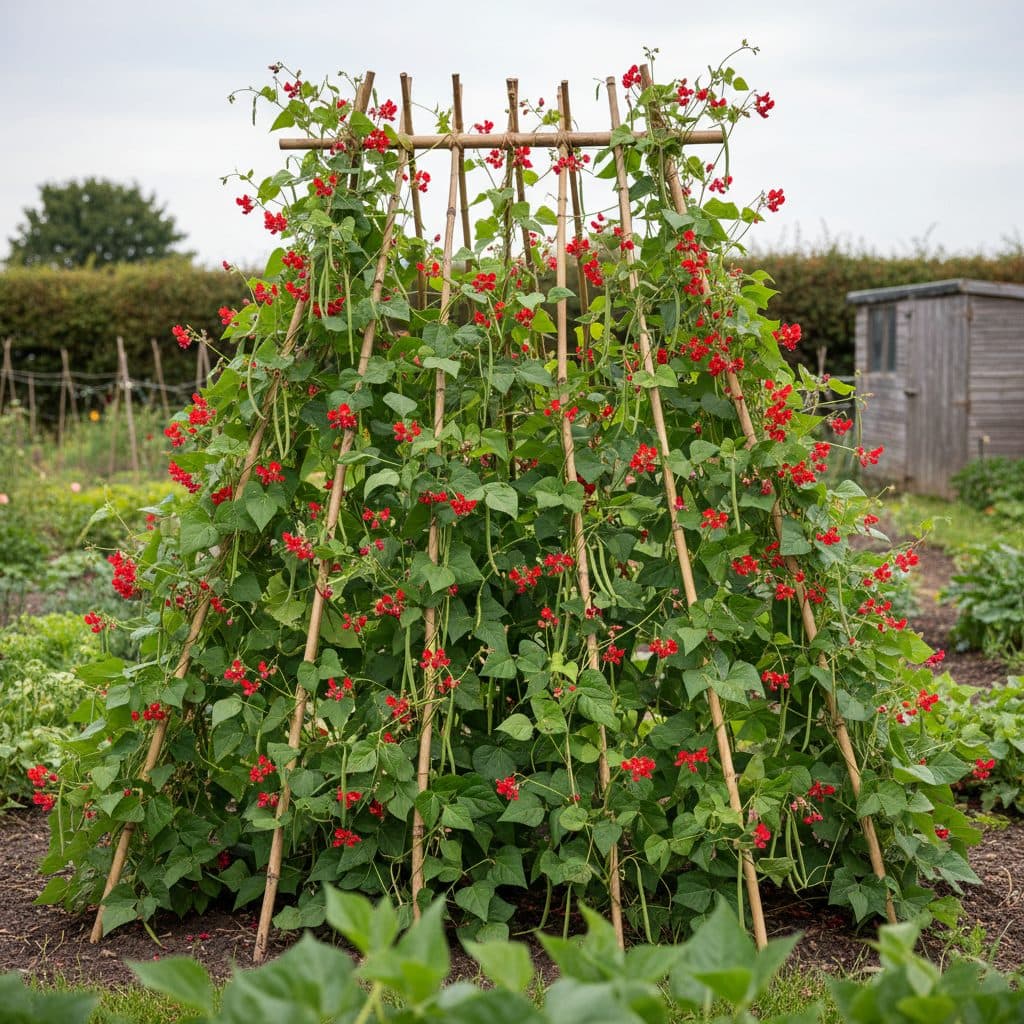
- Construct sturdy bamboo cane A-frames or wigwams at least 2.4 metres high to withstand strong UK summer winds.
- Poor pod set in hot dry spells comes mainly from dry soil at the roots and daytime heat above about 30°C; soak the root zone deeply and mulch.
- Harvest pods regularly while they are tender and under 20 cm long to prevent stringiness and stimulate continuous flower production.
Quick answer: For reliable crops in the UK, sow runner beans indoors in April or direct outdoors from late May once frost risk has passed. Plant seedlings against sturdy 2.4 m cane wigwams or A-frames in soil enriched with garden compost, water deeply during flowering, and pick pods twice weekly when young to maintain continuous cropping until October.
Runner beans have long been an iconic centrepiece of British kitchen gardens and council allotments. Prized for their vigorous climbing habit, decorative scarlet or white blossoms, and heavy yields of long, tender green pods, they provide fresh vegetables from midsummer through to the first autumn frosts.
Successfully growing runner beans requires giving these vigorous climbers adequate root moisture, sheltered sun, and physical support. Unlike their close relatives, the cold-tolerant broad beans, runner beans originate from the high-altitude tropics of Central America and cannot tolerate freezing temperatures or dry, compacted soil.
Whether you are cultivating a dedicated row on an allotment or growing a compact wigwam in a back garden bed, this guide covers every stage from seed sowing to autumn clearing.
+-------------------------------------------------------------+
|              RUNNER BEAN UK GROWING TIMELINE                |
|                                                             |
|   MONTH           ACTIVITY                                  |
|   -----           --------                                  |
|   Jan - March     Dig compost trench or top-dress no-dig bed|
|   Mid - Late AprilSow seeds indoors in 7.5 cm pots or cells |
|   Late May - June Harden off seedlings; plant out; cane build|
|   July - August   Water deeply at base; mulch root zone     |
|   Aug - October   Harvest twice weekly; pick pods under 20cm|
+-------------------------------------------------------------+
When should you sow and plant out runner beans in the UK?
Timing is important when establishing runner beans, as young seedlings are tender and quickly succumb to late spring frosts or cold, waterlogged soil.
Indoor sowing (April)
Starting seeds indoors on a sunny windowsill, in a cold greenhouse, or on a staging bench gives plants a three to four-week head start:
- Sow one seed per 7.5 cm (3 in) pot or deep root trainer cell, burying the large seed 5 cm (2 in) deep.
- Water gently and place at room temperature (15°C to 20°C). Germination typically occurs within 7 to 10 days.
- Once leaves emerge, move seedlings to a bright, unheated greenhouse or cold frame to keep growth compact and prevent leggy stems.
- Harden off seedlings over 7 to 10 days in mid-May by setting them outside during the day and bringing them in at night.
Direct outdoor sowing (late May to June)
Direct outdoor sowing works well once soil temperatures consistently exceed 12°C:
- Wait until late May in southern England, or early June in northern England and Scotland.
- Sow two seeds 5 cm deep at the base of each cane support.
- If both seeds germinate, thin to the single strongest runner bean plant once seedlings reach 10 cm in height.
To contrast this warm-season schedule with cool-season legumes that overwinter in UK soil, review our guide on growing broad beans.
+-------------------------------------------------------------+
|               RUNNER BEANS SOWING SPECIFICATIONS            |
|                                                             |
|   PARAMETER             RECOMMENDED METRIC                  |
|   ---------             ------------------                  |
|   Sowing Depth          5 cm                                |
|   Soil Temp for Germ.   12°C to 20°C                        |
|   Plant Spacing         20 to 30 cm along row               |
|   Row Spacing           1.5 to 1.8 metres between rows      |
+-------------------------------------------------------------+
How do you prepare a moisture-retentive bean trench?
Runner beans are thirsty plants and heavy water users once they start flowering; RHS guidance is roughly 5 to 9 litres per square metre every few days in dry weather. Lack of moisture at the roots leads to flower drop, stringy pods, and early senescence.
The traditional trench method
On dug plots, prepare a bean trench during late winter or early spring (February to March):
- Excavate a trench 30 cm deep and 45 to 60 cm wide along your chosen planting line.
- Line the bottom with clean, unprinted cardboard, well-soaked newspaper, or raw vegetable scraps to hold moisture.
- Fill the lower half with well-rotted manure or homemade garden compost.
- Backfill with topsoil, creating a slight depression or saucer along the surface to capture natural rainfall and irrigation.
The no-dig alternative
On no-dig plots, you do not need to excavate trenches. Instead, apply a 10 cm surface layer of well-rotted manure and garden compost over the planting zone in early spring, allowing earthworms to carry the organic matter down into the root zone. Learn the full bed conversion process in our guide on setting up a no dig allotment.
What are the best support structures for UK allotment plots?
Runner bean vines climb by twining anti-clockwise around vertical supports, easily reaching heights of 2.5 to 3.5 metres. A weak structure will collapse under the weight of wet foliage during summer gales.
+-------------------------------------------------------------+
|             TRADITIONAL A-FRAME VS WIGWAM SUPPORTS          |
|                                                             |
|      A-FRAME (Row Growing)           WIGWAM (Small Beds)    |
|                                                             |
|         / \   / \   / \                     /|\             |
|        /   \ /   \ /   \                   / | \            |
|       /  X  \  X  \  X  \                 /  |  \           |
|      / /   \ \   \ \   \ \               /   |   \          |
|     | /     \ |   | \   \ |             |    |    |         |
|     Canes tied to cross-pole         6-8 canes tied at top  |
+-------------------------------------------------------------+
1. The traditional A-frame
- Push 2.4 to 3.0 m (8 to 10 ft) bamboo canes 30 cm deep into the soil in two parallel rows spaced 60 to 90 cm apart.
- Angle canes inward so opposite pairs cross roughly 20 cm below the top.
- Lay a long horizontal ridge cane across the intersections and lash every junction firmly with garden twine.
- Add diagonal bracing canes at both ends of the row to prevent the structure from swaying in high winds.
2. The garden wigwam
- Ideal for square beds or windy corners. Push 6 to 8 bamboo canes in a circle 1 to 1.2 metres in diameter.
- Gather the tops together in the centre and bind tightly with natural twine.
- Plant one or two runner bean seedlings at the base of each cane.
Tip: pinching growing tips
When vines reach the top of their canes in midsummer, pinch out the growing tips. This halts vertical climbing and diverts the plant's energy into side shoots, flowering spurs, and pod fattening.
Why are runner bean flowers dropping without setting pods?
One of the most frequent frustrations for allotment gardeners is seeing abundant scarlet flowers drop off the vine without forming bean pods. This is caused by environmental and biological factors:
- High night temperatures and dry air: When daytime temperatures exceed 30°C or night temperatures stay elevated, pollen becomes sterile and flowers abort.
- Dry root zones: If soil dries out during flowering, the plant sheds blossom to conserve water. Water deeply at the base twice a week, applying 10 to 15 litres per metre of row.
- Lack of pollinating bumblebees: Unlike French beans, runner beans rely heavily on bumblebees to trip the flower mechanism and achieve pollination. Attract beneficial pollinators by planting companion flowers nearby; explore top selections in our guide on pollinator companion flowers for fruit set and plants for pollinators.
- Root hydration vs misting: Misting the flowers is a traditional remedy with no evidence behind it, and wetting foliage overnight spreads halo blight; water the roots instead and mulch to retain moisture.
+-------------------------------------------------------------+
|             FLOWER DROP TROUBLESHOOTING CHECKLIST           |
|                                                             |
|   SYMPTOM                  ROOT CAUSE          SOLUTION     |
|   -------                  ----------          --------     |
|   Flowers fall cleanly     Dry root zone       Deep soaking |
|   Flowers dry on stem      Heat above 30°C     Mulch + soak |
|   Petals bitten at base    Nectar robbing bees Grow self-   |
|                                                fertile types|
|   No bee activity          Sparse flowers      Plant borage |
+-------------------------------------------------------------+
How do you manage pests and diseases without chemicals?
Maintaining healthy runner bean plants in the UK relies on preventative cultural methods and physical barriers, adhering to UK allotment standards where synthetic pesticide approvals frequently change.
- Slugs and snails: Young seedlings are vulnerable during their first two weeks outdoors. Protect transplants with biological controls (such as microscopic pathogenic nematodes, Phasmarhabditis hermaphrodita, applied to warm, moist soil in May) or physical barriers like copper tape on raised beds and beer traps. Adopt proactive protection strategies from our prevention-first gardening pest guide.
- Black bean aphid (Aphis fabae): Dense clusters of black aphids often colonise soft shoot tips in July. Pinch out infested growing tips and drop them into a bucket of soapy water, or blast colonies with a strong jet of clean water to dislodge them for ladybirds and hoverfly larvae.
- Halo blight (Pseudomonas savastanoi pv. phaseolicola): Bacterial leaf spotting with yellow halos. The disease is seed-borne, so never save seed from an infected crop; buy fresh certified seed, avoid working among wet foliage, and rotate legumes on a three-year cycle.
How and when should you harvest runner beans?
Harvesting runner beans is a continuous task that begins in late July and runs until October frosts arrive.
- Pick young and tender: Harvest pods when they are 15 to 20 cm (6 to 8 in) long, smooth, and flexible. The outline of individual seeds inside should barely be visible.
- Pick every 2 to 3 days: Never allow pods to mature fully on the vine unless saving seed at the end of the season. Once the plant senses mature seeds developing, it stops flowering and ceases new pod production.
- Cut cleanly: Use a sharp pair of kitchen scissors or pruners to snip pods from the stem, avoiding tearing the main vine.
At the end of the season in October, cut vines off at ground level and add the foliage to your compost heap. Leave the root system undisturbed in the soil; the nodulated roots decay over winter, releasing stored nitrogen and organic matter into the soil for next spring's brassica crops.