Key takeaways
- Sow leek seeds in module trays or deep pots from February indoors, or in outdoor seedbed drills from late March to April.
- Transplant pencil-thick leek plants into the plot in June or July using the classic 15 cm deep dibber and puddling-in technique.
- Avoid backfilling transplant holes with dry soil; allow watering to wash soil around the roots to encourage long, clean white stems.
- Blanch developing shanks by gradually earthing up surrounding soil or fitting cardboard collar sleeves as plants mature.
- Protect crops against allium leaf miner and leek moth using ultra-fine 0.8 mm insect mesh from spring through autumn.
Quick answer: Growing leeks (*Allium ampeloprasum var. *porrum, Porrum Group) in the UK requires a long growing season in fertile, moisture-retentive soil enriched with well-rotted organic matter. Sow seeds under glass in February or outdoors from late March to April, then transplant seedlings into individual 15 cm deep dibber holes when stems reach pencil thickness in June. Puddle seedlings in with water without refilling the holes, earth up soil during late summer to blanch the lower shanks, and harvest fresh throughout winter into spring.
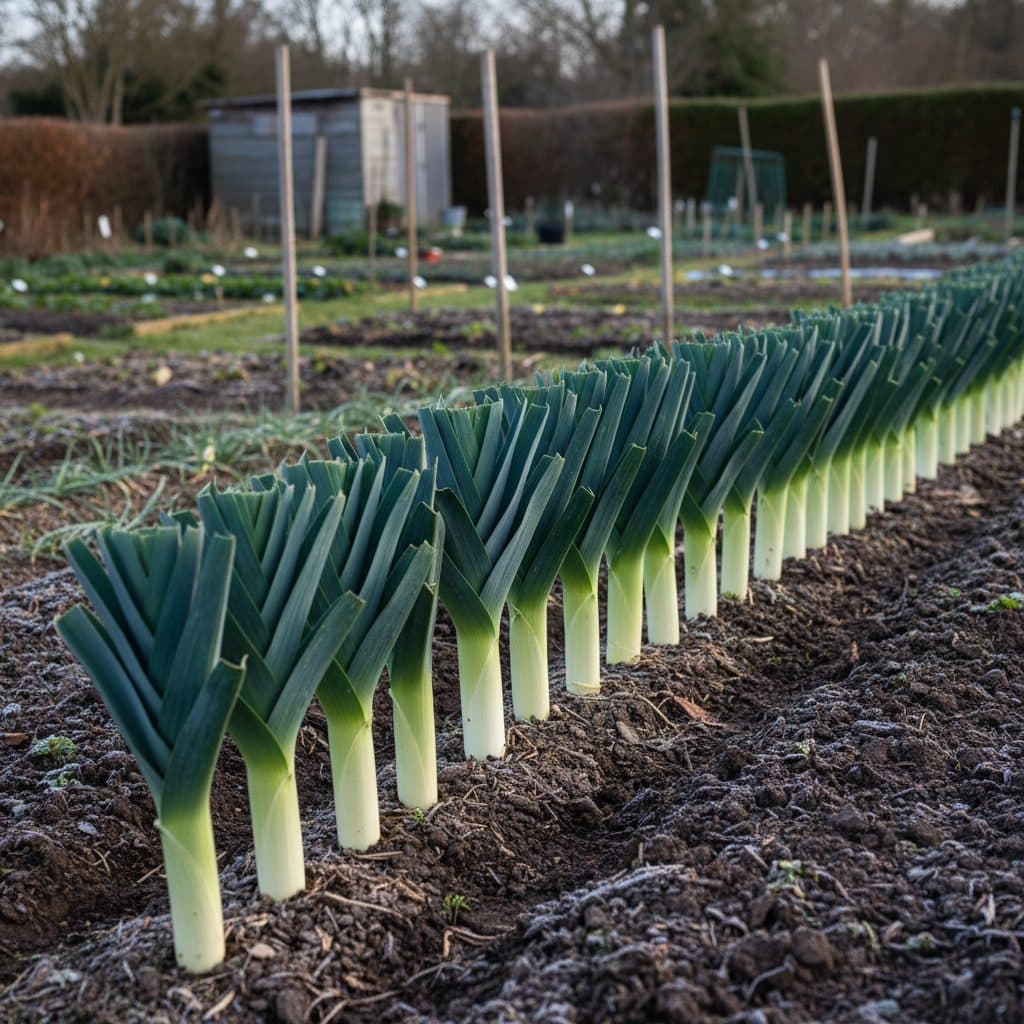
Leeks are among the hardiest and most resilient winter staple vegetables on British allotments. Unlike onions and garlic that mature and cure in summer, winter leeks stand unprotected through frost, snow, and torrential winter rain, providing fresh greens when little else survives in the kitchen garden.
Producing prize-worthy leeks with long, sweet, tender white shanks requires attention to two critical phases: raising vigorous seedlings to pencil thickness and establishing deep root crowns through proper transplanting.
Whether you grow early autumn cultivars for September eating or ultra-hardy heritage selections that hold in the ground until April, following proven UK allotment practices guarantees a dependable winter harvest.
UK cultivar selection and sowing calendar
Leek varieties are categorised by their harvest window and cold tolerance. Early varieties grow quickly with pale green foliage but must be picked before hard frosts. Late winter cultivars feature thick blue-green flags and endure freezing temperatures without tissue breakdown.
+--------------------+-------------------+-----------------------+------------------------------+
| Cultivar           | Harvest Season    | Sowing Window (UK)    | Key Attributes               |
+--------------------+-------------------+-----------------------+------------------------------+
| Jolant             | Early Autumn      | Feb to March (indoors)| Rapid growth, long shanks    |
| Autumn Mammoth     | Mid Autumn        | March to April        | Heavy yield, thick stems     |
| Musselburgh        | Winter / Spring   | March to April        | Scottish heritage, hardy     |
| Bandit             | Late Winter       | April                 | Very hardy; good rust resist |
| Bleu de Solaise    | Late Winter/Spring| April                 | Purple-tinted, ultra-hardy   |
+--------------------+-------------------+-----------------------+------------------------------+
+-------------------------------------------------------------------+
| UK LEEK ANNUAL CROP CALENDAR |
+-------------------------------------------------------------------+
| [Feb - Mar] Sow indoors in module trays (15°C to 18°C) |
| [Late Mar - Apr] Outdoor seedbed sowings; grow on in cold frames |
| [Jun - Jul] Transplant pencil-thick seedlings via puddling-in|
| [Aug - Sep] Earth up soil around stems to blanch lower shanks|
| [Oct - Apr] Harvest continuously from autumn through spring |
+-------------------------------------------------------------------+Soil preparation and manuring
Leeks are gross feeders that demand rich, moisture-retentive soil with a neutral pH between 6.5 and 7.0. Heavy ground that stays waterlogged causes base rotting, while light sandy soil dries out too fast during summer bulking.
+------------------------+-------------------------------------------------------------+
| Soil Parameter         | Allotment Target                                            |
+------------------------+-------------------------------------------------------------+
| Soil pH                | 6.5 to 7.0 (neutral loam)                                   |
| Organic Fertility      | Well-rotted garden compost or farmyard manure dug in autumn |
| Nitrogen Balance       | Moderate early nitrogen, shifting to potassium for winter   |
| Drainage Capacity      | Moisture-retentive but free-draining (no standing water)    |
+------------------------+-------------------------------------------------------------+
Work two bucketfuls of well-rotted organic compost per square metre into the bed during autumn or early spring. If the soil is acidic, apply garden lime several weeks before transplanting.
Avoid high-nitrogen chemical dressings in late summer, as lush, soft foliage is highly susceptible to leek rust and frost damage. For soil management techniques, combine this with our guide on how to grow onions.
Sowing and raising seedlings to pencil thickness
Leeks can be started in module trays, deep seed pots, or dedicated outdoor nursery beds.
+-------------------------------------------------------------------+
|                 PROPAGATION METHODS COMPARISON                    |
|                                                                   |
| [Deep Pot Sowing]                   [Module Cell Multi-Sowing]    |
| Scatter 30-40 seeds in 15 cm pot    Sow 2-3 seeds per cell station|
| Deep root run; shake roots bare     Plant out in clusters of 2-3  |
| Produces classic single show leeks  Higher yield per square metre |
| Requires June bare-root transplant  Minimal root disturbance      |
+-------------------------------------------------------------------+
Deep pot method for long single shanks
- Fill a 15 cm deep pot with fine, peat-free seed compost in late February or March.
- Space seeds 1 cm apart across the surface and cover with 1 cm of sieved compost.
- Water well and germinate at 15°C to 18°C indoors, then move to a cold greenhouse or cold frame once sprouted to grow on.
- When seedlings reach 15 cm to 20 cm in height and match the thickness of an ordinary pencil (usually early June), they are ready for planting out.
The classic dibber and puddling-in transplanting method
Transplanting into deep individual holes is the traditional UK method for producing clean, long white stems without forcing grit between the inner leaves.
+-------------------------------------------------------------------+
|               PUDDLING-IN TRANSPLANT PROCEDURE                    |
|                                                                   |
|         1. Make Hole           2. Drop Seedling        3. Puddle  |
|            [    ]                  [    ]                [~~~~]   |
|            |    |                  |  | | <- Leaf Tips   |  | |   |
|     15 cm  |    | 20 cm apart      |  | |                |  | |   |
|     Deep   |    |                  | (O)| <- Root Base   | (O)|   |
|            +----+                  +----+                +----+   |
|    (Dibber in soil)       (Do NOT fill soil)     (Fill with water)|
+-------------------------------------------------------------------+- Thoroughly water the seedling pot, gently tip out the root ball, and separate the young leek plants in a bucket of water.
- (Optional traditional practice): You may trim long tangled roots to 3 cm and snip 2 cm off the top foliage, though current guidance confirms untrimmed seedlings establish equally well without setback.
- Use a broom handle or thick garden dibber to make vertical holes 15 cm deep and 5 cm wide, spaced 20 cm apart in rows 30 cm apart.
- Drop one bare-root leek plant into each hole so that only the green leaf tips protrude above the soil line.
- Do not backfill the holes with soil. Fill each hole to the brim with water from a watering can without a rose.
- The water carries fine soil particles down around the roots to anchor them ("puddling in"), leaving the vertical shaft open. As the leek expands, it fills the void, producing a naturally blanched white shank without trapped soil grit.
Coordinate bed preparation using weed smart sowing stale seedbed.
Blanching techniques for longer white shanks
The prized white portion of a leek (the shank) develops when sunlight is excluded from the expanding stem.
+------------------------+-----------------------------------+-------------------------+
| Blanching Method       | Procedure                         | Advantage               |
+------------------------+-----------------------------------+-------------------------+
| Soil Earthing Up       | Draw soil up around stems in Aug  | Traditional, zero cost  |
| Cardboard / Paper Tube | Slip 15 cm cardboard tubes on stem| Keeps stem completely clean|
| Deep Trench Planting   | Plant in 15 cm trench; backfill   | Produces longest shanks |
+------------------------+-----------------------------------+-------------------------+
When earthing up with soil, do so on dry days in stages (5 cm every three weeks) to prevent soil from washing into the leaf axils. For pristine, grit-free stems, slide toilet roll tubes or folded brown paper sleeves over the lower stems in late August.
Pest and disease management without chemicals
UK allium crops face two significant biological challenges: leek rust and insect pests.
+------------------------------------+--------------------+---------------------------------------------------------------+
| Problem                            | Symptoms           | Cultural / Physical Control                                   |
+------------------------------------+--------------------+---------------------------------------------------------------+
| Leek Rust (*Puccinia allii*)       | Bright orange spots| Space widely; avoid high nitrogen feed                        |
| Allium Leaf Miner                  | White puncture dots| Cover with 0.8 mm insect mesh net                             |
| Leek Moth Caterpillars             | Mined leaves, rot  | Cover with fine netting; crush pupae                          |
| White Rot (*Sclerotium cepivorum*) | Fluffy white mould | Do not grow alliums on infected soil (sclerotia last 15+ yrs) |
+------------------------------------+--------------------+---------------------------------------------------------------+
Cover from March to early May and again from September until the end of November for allium leaf miner; if leek moth is a local problem, keep the mesh on from April through August as well. Ensure the mesh does not touch the foliage directly by supporting it over hoops.
Harvesting and winter plot management
Winter leeks stand well in the ground and can be lifted as needed from October into spring, though quality falls once they start to bolt.
+-------------------------------------------------------------------+
|               WINTER LEEK HARVESTING BEST PRACTICES               |
+-------------------------------------------------------------------+
| - Ease soil around roots with a border fork to avoid snapping     |
| - Pull firmly from the base of the shank                          |
| - In frozen soil, cover rows with straw to allow winter digging   |
| - Lift remaining leeks before flowering seed scapes form in April |
+-------------------------------------------------------------------+
Plan your autumn and winter succession planting alongside growing beetroot, growing spring onions, and our guide on fall winter gardening midsummer sowing.