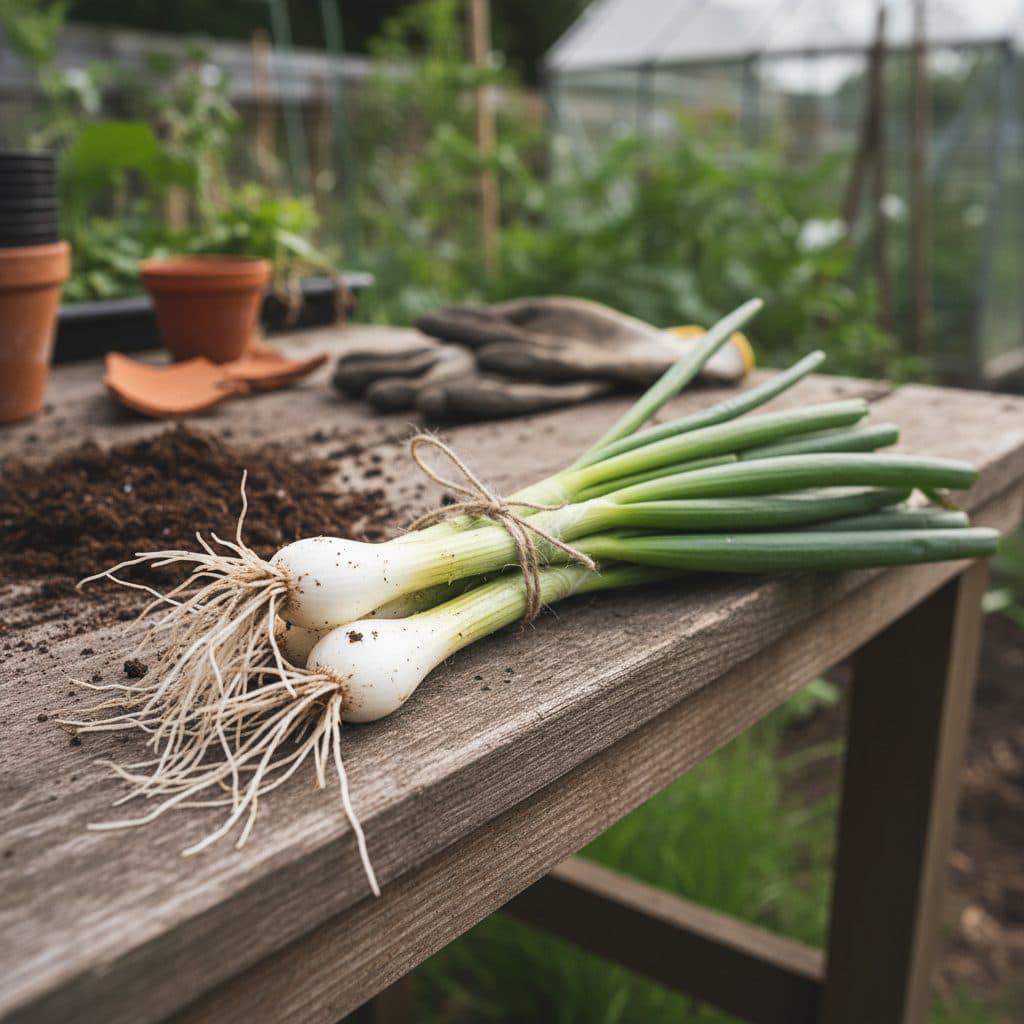
Key takeaways
- Sow spring onion seeds every three weeks from March to September to maintain a continuous harvest of crisp salad onions.
- Multi-sow six to eight seeds per module cell in early spring to plant out intact clumps at 15 cm spacing.
- Grow spring onions in patio containers or window boxes with a minimum soil depth of 15 cm and balanced potting compost.
- Choose winter-hardy cultivars like White Lisbon Winter Hardy or Performer in August for harvesting throughout the colder months.
- Regrow kitchen spring onion root bases in water or damp compost for one or two quick flushes of supplemental greens.
Quick answer: Growing spring onions (*Allium fistulosum and *Allium cepa) in the UK requires a sunny position, free-draining fertile soil, and consistent moisture. Sow seeds outdoors in shallow drills 1.0 cm to 1.5 cm deep from March to September, or multi-sow 6 to 8 seeds per module tray cell for clump transplanting. Roots mature within 8 to 12 weeks, providing crisp, mild white stems and pungent green tops for kitchen salads.
Spring onions (often called salad onions or scallions) are among the fastest and most versatile allium crops for British gardeners. Taking up minimal space, they fit easily into small allotment borders, raised beds, patio containers, and windowsill planters.
Unlike bulbing onions that demand months of summer heat to form storage skins, spring onions are harvested young while their stems remain tender, succulent, and mild. Because they mature in roughly two months, they serve as excellent "catch crops" sown between slower-growing brassicas, parsnips, and maincrop potatoes.
Once you understand the difference between bunching and salad onions, learn to multi-sow, and keep up regular succession plantings, you can pick fresh green onions nearly every month of the year.
Cultivar selection: bunching vs salad onions
Spring onions fall into two distinct botanical categories: true non-bulbing bunching onions (Allium fistulosum) and immature salad cultivars of common bulb onions (Allium cepa).
+------------------------+-----------------------+-----------------------+-----------------------------+
| Cultivar               | Botanical Species     | Sowing Window (UK)    | Key Attributes              |
+------------------------+-----------------------+-----------------------+-----------------------------+
| White Lisbon           | *Allium cepa*         | March to August       | Classic crisp British salad |
| White Lisbon (Winter)  | *Allium cepa*         | August to September   | High frost hardiness        |
| Ishikura               | *Allium fistulosum*   | March to July         | Long, pure white shanks     |
| North Holland Blood Red| *Allium cepa*         | March to July         | Striking crimson stems      |
| Performer              | *Allium fistulosum*   | April to August       | Upright, dark green foliage |
| Apache                 | *Allium cepa*         | March to July         | Purple-skinned mild bulb    |
+------------------------+-----------------------+-----------------------+-----------------------------+
+-------------------------------------------------------------------+
| UK SPRING ONION SUCCESSION SOWING TIMELINE |
+-------------------------------------------------------------------+
| [Mar - Apr] First outdoor sowings & early module trays under glass|
| [May - Jul] Maincrop succession drills every 3 weeks |
| [Aug - Sep] Autumn sowings for overwintering spring harvests |
| [May - Oct] Continuous summer salad harvesting |
| [Nov - Apr] Overwintered crop picking under cloches |
+-------------------------------------------------------------------+Soil preparation and container growing requirements
Spring onions thrive in fertile, moisture-retentive, open soil with a pH between 6.5 and 7.0. Because their shallow fibrous roots occupy the top 15 cm of soil, structural tilth and consistent surface moisture are essential for crispness.
+------------------------+-------------------------------------------------------------+
| Parameter              | Ideal Benchmark for UK Gardens                              |
+------------------------+-------------------------------------------------------------+
| Soil pH                | 6.5 to 7.0 (neutral loam)                                   |
| Container Depth        | Minimum 15 cm to 20 cm with base drainage holes             |
| Compost Substrate      | Peat-free multipurpose compost mixed with 20% horticultural sand|
| Drainage Capacity      | Free-draining; prevent waterlogged bases                    |
| Sunlight Requirement   | Full sun (minimum 5 to 6 hours direct daily light)          |
+------------------------+-------------------------------------------------------------+
When growing on allotments, rake the bed to a fine, crumbly tilth and remove large stones and perennial weed roots. In containers, ensure pots have drainage holes and use fresh compost.
For container setups with self-regulating water reservoirs, review self watering containers veggies herbs.
Sowing methods: direct drills vs multi-sown clumps
There are two primary ways to sow spring onions in the UK.
+-------------------------------------------------------------------+
|                 SOWING TECHNIQUE COMPARISON                       |
|                                                                   |
| [Multi-Sown Module Clumps]          [Direct Outdoor Drills]       |
| 6-8 seeds per module cell           1 seed every 1 cm in drill    |
| Plant out as clump at 15 cm spacing 1.0-1.5 cm deep; rows 15 cm   |
| Early March start in greenhouse     Direct outdoors from late March|
| Highest space efficiency            Requires careful hand weeding |
+-------------------------------------------------------------------+
Method 1: multi-sown module clumps
- Fill standard 40 or 60-cell module trays with fine seed compost in February or March.
- Drop six to eight seeds into each individual cell and cover with 1 cm of compost.
- Keep the tray at 15°C to 18°C on a windowsill or unheated greenhouse bench.
- When seedlings reach 8 cm tall, plant each module clump intact into the garden at 15 cm spacing in each direction.
- The clump expands outward as a tight bunch, allowing you to harvest entire clusters at once without root disturbance.
Method 2: direct drilling in rows
Make shallow drills 1.0 cm to 1.5 cm deep spaced 15 cm apart. Sow seeds thinly, aiming for one seed every 1 cm. Water the base of the drill before covering with fine soil.
Unlike bulbing onions, spring onions need minimal thinning; slight crowding produces slender, tender stems. For foundational allium bed care, compare techniques in how to grow onions.
Intercropping and companion planting on the allotment
Because spring onions have a narrow, vertical growth habit and shallow root zones, they make ideal companion plants throughout the kitchen garden.
+------------------------+-----------------------------------+-------------------------+
| Companion Plant        | Planting Layout                   | Horticultural Benefit   |
+------------------------+-----------------------------------+-------------------------+
| Carrots                | Alternate rows 15 cm apart        | Allium scent confuses fly|
| Winter Brassicas       | Sown around base of kale/cabbage  | Utilises vacant ground  |
| Lettuces & Salads      | Interplanted in grid pattern      | Shared shallow watering |
| Strawberries           | Border rows along strawberry beds | Suppresses fungal pests |
+------------------------+-----------------------------------+-------------------------+
Interplanting spring onions between rows of maincrop carrots helps deter the carrot rust fly (Psila rosae), whose olfactory receptors are overwhelmed by the strong sulfur aroma of allium foliage.
Regrowing spring onions from kitchen scraps
Spring onions possess useful vegetative regenerative capacity for quick garnishes. You can produce supplementary green shoots from shop-bought or garden-harvested root bottoms.
+-------------------------------------------------------------------+
|               KITCHEN SCRAP REGROWTH PROCEDURE                    |
|                                                                   |
| 1. Cut Stems:   Leave 3 cm of white shank attached to root base   |
| 2. Water Start: Place upright in shallow glass (1 cm water)       |
| 3. Sunlight:    Position on a bright kitchen windowsill           |
| 4. Water Daily: Change water every 24 hours to prevent rot        |
| 5. Potting On:  Plant into compost once green shoots reach 5 cm   |
+-------------------------------------------------------------------+
Regrowing in water provides one or two modest flushes of green shoots before the bulb reserves deplete and flavor fades. Potting the rooted bottoms into compost prolongs growth somewhat, but sustaining continuous kitchen harvests requires regular sowing from seed.
Watering, weed management and pest protection
Because spring onion seedlings are slender and grass-like during their first four weeks, they cannot compete against vigorous annual allotment weeds.
+------------------------+-------------------+---------------------------------------------------+
| Risk Factor            | Impact            | Management Action                                 |
+------------------------+-------------------+---------------------------------------------------+
| Weed Competition       | Stunted stems     | Hand-weed close to crowns; hoe inter-rows shallowly|
| Drought Stress         | Pungent, tough stem| Water weekly during dry summer weather            |
| Allium Leaf Miner      | Internal rot      | Cover with 0.8 mm mesh (Mar-May & Sep-Nov)        |
| Downy Mildew           | Pale yellow leaves| Avoid wetting foliage; ensure airflow             |
+------------------------+-------------------+---------------------------------------------------+
Their upright cylindrical leaves cast virtually no shade, making them highly vulnerable to being smothered by aggressive weeds. However, because spring onions have delicate, shallow roots easily severed by a hoe blade, avoid deep hoeing close to the stems. Hand-weed carefully between seedlings and hoe only very shallowly in the inter-row space.
Physical barriers like fine 0.8 mm insect mesh placed over beds during peak adult flight windows (March to early May and September through November) protect crops against allium leaf miner and leek moth caterpillars.
Harvesting and overwintering care
Harvest timing depends on whether you prefer slender, mild green onions or thicker, pungent scallions.
+--------------------+-------------------+--------------------+------------------------+
| Stage              | Stem Thickness    | Growth Duration    | Kitchen Character      |
+--------------------+-------------------+--------------------+------------------------+
| Slender Salad      | 0.5 cm to 1.0 cm  | 8 to 10 Weeks      | Crisp, sweet, mild raw |
| Thick Scallion     | 1.5 cm to 2.0 cm  | 12 to 14 Weeks     | Robust, stir-fry onion |
| Overwintered       | Variable          | Overwintered       | Early spring kitchen use|
+--------------------+-------------------+--------------------+------------------------+
To harvest, loosen the soil beside the clump with a hand fork and pull gently from the base of the stem. Wash roots clean, trim outer dry leaves, and use fresh.
For autumn succession planning, pair your spring onion sowings with growing beetroot, growing leeks, and fast-growing growing radishes.