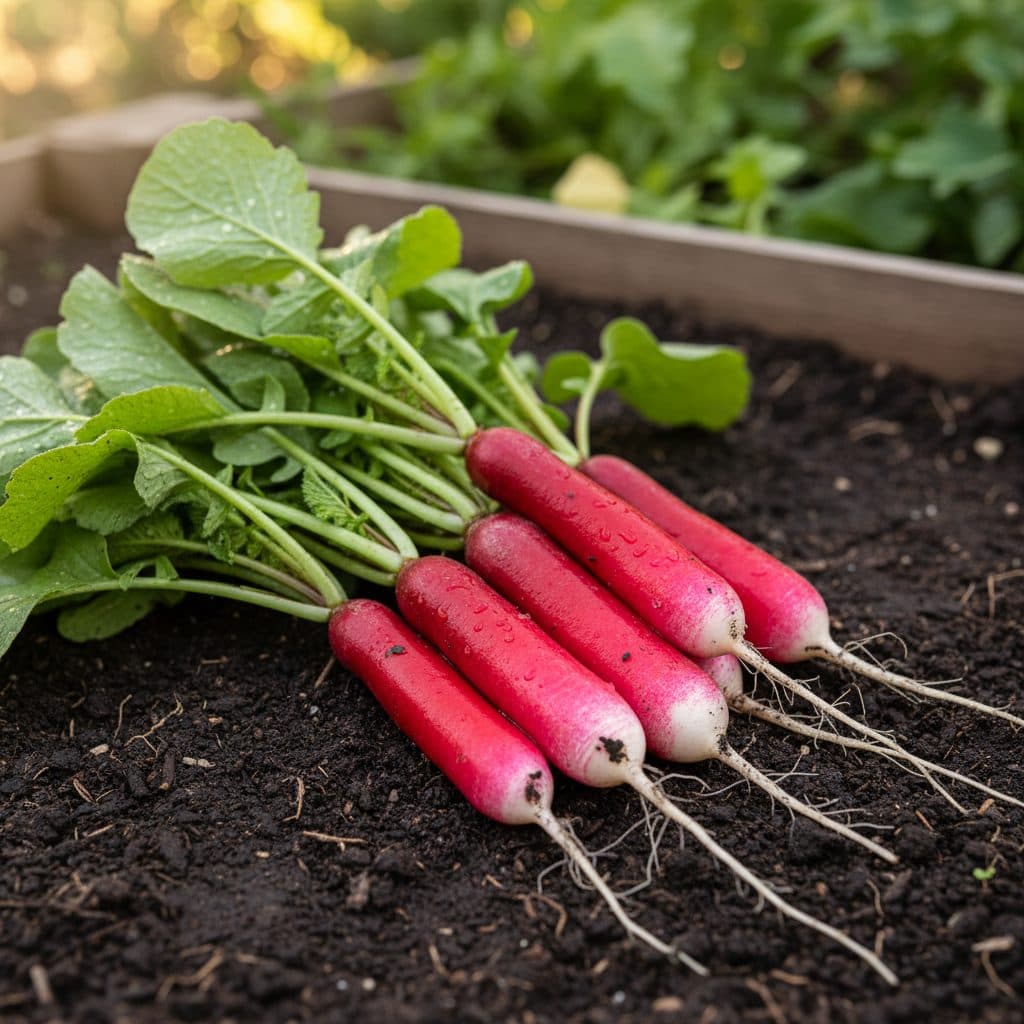
Key takeaways
- Sow radish seeds every two weeks from March to September for a continuous supply of crisp, mild roots.
- Spring and summer salad cultivars mature in 21 to 28 days, making them among the fastest edible crops on the allotment.
- Maintain consistent soil moisture; irregular watering and high heat cause roots to become unpleasantly woody, hollow, and fiercely pungent.
- Protect young seedlings from flea beetle damage by covering beds with fine horticultural fleece or 0.8 mm insect mesh from emergence.
- Sow winter radishes like Black Spanish Round and China Rose in August for autumn and winter harvesting.
Quick answer: Growing radishes (*Raphanus sativus*) in the UK requires a sunny plot with light, stone-free soil and steady moisture. Sow seeds directly in shallow drills 1 cm deep from March to September, spacing rows 15 cm apart and thinning seedlings to 2.5 cm to 5 cm apart. Most summer salad varieties mature in just 3 to 4 weeks, while larger winter storage types sown in August take 8 to 10 weeks to develop.
Radishes are among the easiest, fastest, and most rewarding vegetables to grow in British gardens. Because they germinate in just three to five days and mature in under a month, they provide rapid early-season harvests while slower crops establish.
On UK allotments, radishes are invaluable "marker crops." Sowing radish seeds alongside slow-germinating parsnips or carrots marks the drill lines for early hoeing. By the time the parsnips emerge, the radishes are already being pulled for the kitchen table. They also thrive in shallow window boxes, container troughs, and polyhouse borders.
However, producing mild, succulent radishes rather than tough, split, or aggressively hot roots requires careful moisture control and prompt harvesting before plants bolt.
UK cultivar selection: summer salad vs winter storage
Radishes divide into fast-growing summer salad varieties and robust, slow-maturing winter storage types, alongside elongated Asian mooli radishes.
+------------------------+--------------------+-----------------------+-----------------------------+
| Cultivar               | Type & Shape       | Sowing Window (UK)    | Days to Maturity            |
+------------------------+--------------------+-----------------------+-----------------------------+
| French Breakfast       | Oblong, red/white  | March to August       | 21 to 25 Days               |
| Cherry Belle           | Round, bright red  | March to August       | 22 to 28 Days               |
| Sparkler               | Globe, scarlet/white| March to August      | 24 to 28 Days               |
| White Icicle           | Long, tapered white| April to July         | 28 to 32 Days               |
| Black Spanish Round    | Winter, black skin | July to August        | 55 to 70 Days               |
| China Rose             | Winter, pink cylindrical| July to August   | 50 to 60 Days               |
| Mino Early (Mooli)     | Long Asian daikon  | July to mid-August    | 45 to 55 Days               |
+------------------------+--------------------+-----------------------+-----------------------------+
+-------------------------------------------------------------------+
| UK RADISH SUCCESSION SOWING TIMELINE |
+-------------------------------------------------------------------+
| [Mar - Apr] Early outdoor sowings under cloches or fleece |
| [May - Jul] Fortnightly succession sowings in partial shade |
| [Aug - Sep] Sow winter storage varieties & late salad crops |
| [Apr - Oct] Continuous summer salad harvesting |
| [Oct - Dec] Lift winter black radishes for kitchen storage |
+-------------------------------------------------------------------+Soil preparation and bed fertility
Radishes thrive in light, fertile, moisture-retentive soil with a neutral pH of 6.5 to 7.0. Because their growth cycle is brief, they do not require heavy feeding.
+------------------------+-------------------------------------------------------------+
| Parameter              | Allotment Target                                            |
+------------------------+-------------------------------------------------------------+
| Soil pH                | 6.5 to 7.0 (neutral loam)                                   |
| Organic Fertility      | Soil enriched for a previous crop; avoid fresh manure       |
| Soil Structure         | Friable, stone-free, crumbly seedbed tilth                  |
| Moisture Retention     | Even, continuous moisture without surface crusting          |
| Container Depth        | Minimum 12 cm for salad globes; 25 cm for winter types     |
+------------------------+-------------------------------------------------------------+
Brassica family rotation and soil health
Because radishes are members of the brassica family (Raphanus sativus, Brassicaceae), keep them within your plot's brassica crop rotation slot and avoid ground with a known history of clubroot (Plasmodiophora brassicae).
Never apply fresh animal manure or high-nitrogen organic fertilisers before sowing radishes. Excessive nitrogen stimulates lush, oversized green foliage at the expense of root swelling, leading to spindly plants with no bulb development.
Prepare beds by raking the top 5 cm into a fine crumbly tilth as outlined in our guide on weed smart sowing stale seedbed.
Sowing, spacing and thinning best practices
Direct sowing in the open garden or containers is always preferable to module transplants, as taproot disturbance causes distorted, woody bulbs.
+-------------------------------------------------------------------+
|                 RADISH SOWING & SPACING PROCEDURE                 |
|                                                                   |
|   1. Draw Drills:   1 cm deep with a cane, 15 cm between rows     |
|   2. Water Drill:   Moisten the base before scattering seeds      |
|   3. Sow Thinly:    Drop 1 seed every 2 cm to reduce thinning     |
|   4. Cover & Firm:  Rake fine soil over; tamp lightly with rake   |
|   5. Thin Early:    Thin salad types to 3 cm; winter to 10 cm     |
+-------------------------------------------------------------------+
Thinning should occur as soon as the first true leaves appear (around day 10). Crowded radish seedlings compete for light and soil volume, resulting in thick foliage and thin, unswollen stems. Use the tender thinned seedlings as nutritious microgreens in fresh salads.
For comprehensive root-crop container options, reference growing carrots root vegetables containers.
Intercropping strategies on the allotment
Because radishes vacate the ground within four weeks, they are the supreme catch crop for maximizing allotment productivity.
+------------------------+-----------------------------------+-------------------------+
| Maincrop Partner       | Planting Layout                   | Horticultural Benefit   |
+------------------------+-----------------------------------+-------------------------+
| Parsnips & Carrots     | Sown directly in the same drill   | Marks slow rows for hoeing|
| Winter Brassicas*      | Sown in vacant spaces between kale| Cropped before canopy closes|
| Sweetcorn & Squash     | Sown along south border of mound  | Rapid early harvest     |
| Broad Beans            | Sown between bean stations        | Early ground cover      |
+------------------------+-----------------------------------+-------------------------+
* Note: Sowing radishes among kale or cabbage keeps brassicas together in the rotation but concentrates flea beetle pressure on the same bed; cover the entire block with 0.8 mm mesh.
When marking parsnip rows, mix one part radish seed to four parts parsnip seed. The radishes emerge in days, clearly indicating where to hoe weeds without damaging the unseen parsnip seedlings below.
Growing radishes in patio containers and window boxes
Radishes are exceptionally well-suited to container cultivation, requiring minimal root run for salad varieties.
+------------------------+-----------------------------------+-------------------------+
| Container Type         | Sowing Density                    | Moisture Management     |
+------------------------+-----------------------------------+-------------------------+
| Window Box (15 cm deep)| 2 rows, seeds spaced 3 cm apart   | Water daily in summer   |
| 30 cm Patio Pot        | Broadcast evenly 3 cm apart grid  | Morning watering        |
| Fabric Raised Bed      | Grid spacing 4 cm x 4 cm stations | Mulch with fine compost |
+------------------------+-----------------------------------+-------------------------+
In containers, use a 50/50 mix of peat-free multi-purpose compost and horticultural loam. Keep pots in morning sun and provide afternoon shade during hot summer spells to prevent the substrate from drying out rapidly.
Managing common cultural problems and pests
Most radish failures stem from erratic watering or insect pressure during dry spring spells.
+------------------------+-------------------+-----------------------------------------+
| Symptom / Pest         | Primary Cause     | Organic / Physical Solution             |
+------------------------+-------------------+-----------------------------------------+
| Flea Beetle Shot-Holes | Tiny jumping beetles| Cover bed with fleece from day of sowing|
| Hot, Pithy, Woody Root | Drought & heat    | Water evenly every 2 to 3 days          |
| Split, Cracked Roots   | Heavy water after dry| Maintain steady, mulch-buffered moisture|
| Bolting / Flowering    | Long days & heat  | Sow in summer afternoon shade; pick early|
| Slugs & Snails         | Damp soil shelter | Clear debris shelter; evening hand-collection; beer traps |
+------------------------+-------------------+-----------------------------------------+
Flea beetles (Phyllotreta species) chew tiny pinholes through cotyledons and leaves during warm, dry weather. Covering the bed with horticultural fleece or insect mesh immediately after sowing excludes the beetles without chemical sprays. Learn more about physical exclusion barriers in flea beetles eggplant arugula brassicas row covers.
If plants bolt during midsummer heatwaves, allow them to flower and form succulent green seed pods ("radish pods"). These crisp, peppery pods make delicious additions to summer salads and stir-fries.
Harvesting, eating and winter storage
Radishes do not hold long in the ground during warm summer weather; once mature, they quickly become woody and push up flower stalks.
+--------------------+-------------------+--------------------+------------------------+
| Cultivar Class     | Harvest Diameter  | Timing             | Storage Method         |
+--------------------+-------------------+--------------------+------------------------+
| French Breakfast   | 1.5 cm to 2.5 cm  | 3 to 4 Weeks       | Eat fresh within 5 days|
| Round Summer Reds  | 2.5 cm to 3.0 cm  | 3 to 4 Weeks       | Refrigerator crisper   |
| Winter Black Spanish| 5.0 cm to 8.0 cm | 8 to 10 Weeks      | Sand boxes in cold shed|
+--------------------+-------------------+--------------------+------------------------+
To harvest, pull salad radishes by grasping the leaf base at soil level. Trim off green tops immediately to prevent them from drawing moisture out of the roots.
Winter radishes, such as Black Spanish Round, should be lifted in October or November before hard frosts, trimmed, and stored in boxes of damp sand alongside growing beetroot.
Combine your radish successions with growing spring onions and winter alliums in growing leeks to maintain year-round allotment harvests.