
Key takeaways
- Call 811 first: Have public gas, electric, water, and fiber lines marked 2–3 working days ahead—and locate private barn, septic, or irrigation lines separately—before driving 24–36+ in steel ground posts.
- Block ACQ galvanic corrosion: Modern ACQ/copper-treated lumber baseboards aggressively pit aluminum wiggle-wire tracks and standard zinc screws; lay continuous EPDM or butyl flashing under aluminum channels and fasten with 304/316 stainless or ASTM A153 Class D hot-dipped galvanized hardware.
- Engineer bows for snow and wind: Space galvanized bows 4 ft on center in snow belts (5–6 ft only with heavy 2.375-in or larger steel in mild regions), link every arch with continuous purlins, and brace all four end bays with diagonal wind struts.
- Skin warm and avoid bare PVC: Pull 6-mil UV-stabilized greenhouse PE (3–4+ yr rated) on a calm >60–70°F day so film stays taut without winter contraction rips, and never drape PE directly over unpainted Schedule 40 PVC pipe whose outgassed plasticizers turn poly brittle.
- Size vents to 20% or more of floor area: Combine double-channel roll-up sides with gable vents (72+ sq ft for a 30 × 12 ft tunnel) and pair double-layer inflated poly (50–100 W blower) to cut winter fuel demand 30–40%.
Quick answer: A wind- and snow-resilient US hoop house starts underground: Call 811 at least 2–3 business days before driving 24–36+ in steel ground posts (36–48 in with concrete collars in loose sand or high-wind corridors), space bows at 4–6 ft with continuous ridge/shoulder purlins and diagonal corner wind braces, and isolate ACQ copper-treated baseboards from aluminum wiggle-wire tracks using EPDM or butyl flashing plus stainless or ASTM A153 hot-dipped galvanized fasteners. Pull 6-mil UV-stabilized greenhouse polyethylene (rated 3–4+ yr) on a calm >60–70°F day, avoid bare PVC pipe contact that leaches film-embrittling plasticizers, and size roll-up sides plus gable vents to at least 20% of floor area.
Site Layout, Call 811 Utility Safety, and Ground Post Anchoring
High tunnels collapse most often from wind uplift or wet spring snow exploiting shallow stakes or out-of-square frames. Before cutting lumber for a DIY hoop house or weighing frame gauges in our hoop house cost and durability guide, check site drainage and orient freestanding frames east-to-west for winter solar gain unless fierce crosswinds favor pointing a gable into prevailing storms alongside perimeter windbreak trees.
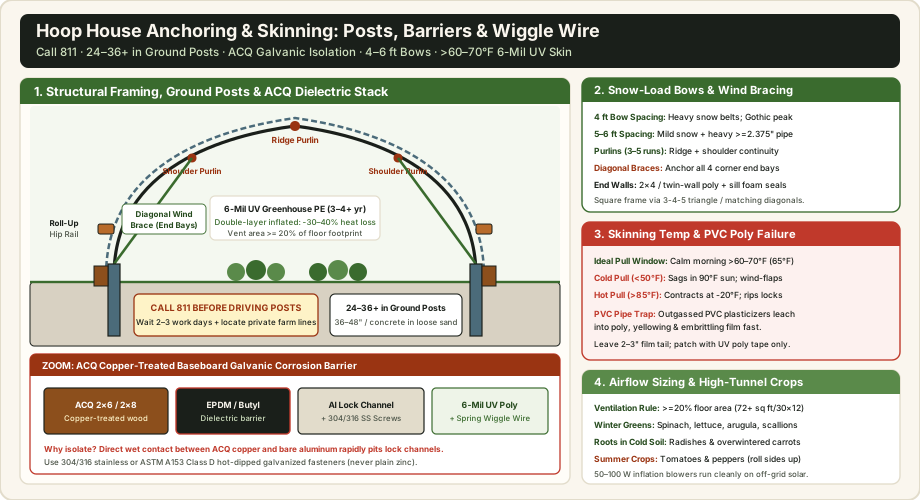
Call 811 before driving 24–36+ in ground posts: State one-call laws apply to driven pipe posts just as strictly as trenching. Outline the tunnel footprint with white paint or stakes and call 811 (or submit an online state ticket) 2–3 business days before breaking ground so public gas, electric, fiber, and water lines are marked free of charge. Remember that 811 locators mark only utility-owned mains up to the meter—buried farm power lines to barns, propane runs, well pipes, septic fields, and irrigation lines are private property and require separate private locating or verified trench maps before driving a single post.
Square your footprint with a 3-4-5 right triangle (or 18-24-30 ft layout) and confirm equal corner-to-corner diagonals within half an inch before driving posts. Set batter boards with taut mason twine along both long walls so every stake aligns linearly. In undisturbed clay or loam, drive 1.315-in to 2.375-in galvanized steel ground posts 24 to 36+ inches deep using a pneumatic or manual sleeve driver that keeps surrounding soil dense. In loose sand, saturated frost-heave soils, or exposed plains facing 70–90 mph gusts, auger 36 to 48 inches deep (below regional frost depth) and pour concrete footings around galvanized ground posts—or screw in 30-to-36-inch helical earth anchors—so uplift forces exceeding 1,000 lb per post cannot pull anchors loose. Match all post tops with a laser level before dropping arches in place and locking through-bolts, whether building a permanent gothic structure or a low-cost caterpillar tunnel.
ACQ Baseboard Corrosion Barriers, Bow Spacing, and Wind Bracing
Perimeter baseboards milled from 2×6 or 2×8 ground-contact lumber tie ground posts into a rigid rectangle, block low drafts and burrowing pests, and support wiggle-wire tracks cleanly. Overlap baseboard splices by 12 to 18 inches over galvanized backing plates and level the top edge end-to-end.
Isolating ACQ copper-treated wood from aluminum and steel
Modern pressure-treated lumber relies on Alkaline Copper Quaternary (ACQ) or micronized copper azole (CA-C). High dissolved copper levels form an aggressive electrochemical cell whenever condensation or rain wets metal touching the board. Direct contact between wet ACQ lumber and aluminum wiggle-wire channels triggers rapid galvanic pitting that eats screw holes loose within two to three seasons while stripping standard zinc coatings.
- Install a continuous dielectric barrier: Lay EPDM rubber membrane, butyl flashing tape, or 6–10 mil sill-seal poly continuously across ACQ baseboards wherever aluminum wiggle-wire tracks or galvanized brackets make contact.
- Upgrade every fastener alloy: Fasten aluminum wiggle-wire tracks strictly with Type 304 or 316 stainless steel screws, and secure galvanized steel brackets and baseboard bolts with 304/316 stainless or ASTM A153 hot-dipped galvanized hardware (1.00 oz/sq ft average Class D for fasteners 3/8 in and under; 1.25 oz/sq ft Class C over 3/8 in)—never plain steel or thin yellow-zinc deck screws.
- Seal raw cuts: Coat field-cut lumber ends with copper naphthenate preservative before bolting near wet soil.
Hoop House Structural Anchoring, Bow Spacing, and Wind Bracing by US Climate Zone
Climate & Exposure Tier | Ground Post Spec & Depth | Bow Spacing & Profile | Purlins, Bracing & Hardware |
|---|---|---|---|
Mild Sunbelt / Low Snow (<15 psf, <60 mph wind) | 1.315–1.66 in galvanized pipe driven 24–30 in deep | 5–6 ft centers (6 ft needs >=2.375 in 14-ga pipe for NRCS spec) | 1 ridge + 2 shoulder purlins; corner diagonal braces; ASTM A153 HDG bolts |
Midwest / Mid-Atlantic Snow (15–30 psf, 70+ mph gusts) | 1.90–2.375 in 14-ga pipe driven 30–36 in deep (concrete in sand) | 4 ft centers (Gothic peak preferred to shed wet snow cleanly) | 1 ridge + 2–4 lateral purlins; full end-bay diagonal braces + collar ties |
Northern Snow Belt / Plains (>30 psf snow, 80–90+ mph gusts) | 2.375 in 14-ga structural steel set 36–48 in deep in concrete piers | 4 ft centers max; steep Gothic peak + snow truss struts | Continuous ridge + 4 shoulder purlins; double diagonal corner bracing + 304/316 SS fasteners |
Bow spacing, purlins, and diagonal wind bracing
Follow USDA NRCS Practice Standard 325 snow rules: space bows 4 ft on center across snow regions, reserving 5–6 ft spacing for mild snow zones or heavy 2.375-in (14-gauge) commercial arches. Tie arches together using a continuous ridge purlin plus two to four shoulder purlins bolted through every hoop so snow distributes across the whole tunnel. Anchor diagonal wind braces (pipe struts or aircraft cable) from all four corner ground posts up to the second or third bow purlins so broadside gusts cannot rack the frame flat. For heavy northern winters, review our snow and wind bracing guide and cold-climate sizing and siting guide.
Selecting 6-Mil UV Poly Film, PVC Warnings, and Wiggle Wire Channels
Skip hardware-store clear builder's sheeting, which turns brittle within three to six months outdoors. Install 6-mil UV-stabilized multi-layer co-extruded greenhouse polyethylene (warranted 3–4+ years), choosing infrared-retentive (IR) and anti-condensate (AC) films that reduce night heat loss and sheet condensation toward gutters instead of dripping onto seedlings.
PVC pipe plasticizer warning: protect poly from bare vinyl: Never stretch greenhouse polyethylene directly over bare Schedule 40 PVC pipe bows, PVC snap clamps, or vinyl trim. Under sun and tunnel heat, PVC leaches plasticizers straight into polyethylene film, stripping UV stabilizers and causing yellowing, cracking, and splitting along every hoop crest. Use galvanized steel tubing for permanent hoops—or coat existing small PVC hoops completely with water-based white exterior latex paint or wrap contact points with polyethylene anti-hotspot batten tape (never oil-based paint or duct tape).
Mount aluminum or galvalume wiggle-wire channels along baseboards, hip boards (4 to 5 ft high along sidewalls), end bows, and doors using stainless screws every 12 to 16 inches over EPDM or butyl barriers on ACQ wood. File sharp burrs off cut ends, tape protruding bolt heads on arches with foam or batten tape, and run double-track hip channels so roll-up curtains and roof film lock independently. Always feed the double-layer squirrel-cage inflation blower (50–100 W continuous fan) with dry outdoor intake air via a short elbow duct rather than humid indoor air, otherwise trapped condensation clouds the air pillow and breeds algae between sheets. Compare frame and glazing systems in our low-cost propagation scaling, greenhouse styles, and greenhouse kits and cost guides.
Glazing Architecture Comparison: Single vs. Double-Layer Inflated 6-Mil Poly vs. Bare PVC
Covering Setup | R-Value & Heat Retention | Rated Lifespan & Failure Mode | Best Fit & Hardware Notes |
|---|---|---|---|
Single-layer 6-mil UV greenhouse PE | R ~0.83; higher night radiant cooling | 3–4+ yr warranty; wind-whips if pulled below 55°F | 3-season tunnels, summer shade swaps, unheated winter greens |
Double-layer inflated 6-mil UV PE (inner IR/AC + outer UV) | R ~1.7–2.0; cuts heat loss 30–40% | 3–4+ yr warranty; pressurized pillow resists 80–90 mph gusts | Uses continuous 50–100 W blower drawing dry outside air + double channel |
Clear construction plastic or poly on bare PVC bows | R ~0.8; heavy ceiling condensation drips | 3–12 months; UV chalking & PVC plasticizer embrittlement | AVOID for permanent structures; use steel arches + true 6-mil UV poly |
Skinning at >60–70°F, End-Wall Framing, and Roll-Up Ventilation
Ambient skinning temperature dictates whether plastic stays tight year-round. Schedule pulling day for a calm morning above 60–70°F (65–75°F ideal) with wind under 5 mph. Cold-skinning below 50°F leaves slack sheets flapping in 90°F summer sun, whereas pulling tight above 85°F causes -20°F winter shrinkage that rips poly out of wiggle wire or bows end-wall studs.
- Cut with 2–3 ft pulling overhang: For a 30 × 12 × 8 ft tunnel, use roughly a 36 × 28 ft sheet for secure hand grip on every edge.
- Float evenly over bows: Unroll lengthwise beside one baseboard, tie padded tennis-ball pull ropes along the opposite edge, and walk ropes smoothly across arches.
- Lock one side, tension across: Snap spring wiggle wire into the windward channel from center out, pull the opposite margin taut without overstretching, and lock the opposing track.
- Finish end bows and keep tails: Lock gable bows from peak downward and leave a 2–3 inch film tail outside channels—never flush-cut—so warm-day re-tensioning remains easy.
End walls, gaskets, and the 20% floor-area ventilation benchmark
Frame end walls with kiln-dried 2×4 studs over sill foam or fit 6–8 mm twin-wall polycarbonate panels around a centered 36–48 inch wheelbarrow door, anchoring bottom end-wall posts 24–36 inches deep so wind hitting the flat gable never twists door jambs out of plumb. Seal door stops and end-arch interfaces with closed-cell EPDM weatherstripping and exterior silicone caulk. Size roll-up sides (built on 1.315-in steel pipe cranks clipped cleanly to the bottom curtain hem) plus high gable vents to provide unobstructed airflow equal to at least 20% of tunnel floor area (72+ sq ft of open vent on a 30 × 12 ft bay) per our passive ventilation guide, greenhouse climate control, and shade cloth and whitewash cooling manuals. Off-grid builds can power 50–100 W inflation blowers cleanly using a 100 W array sized via our solar greenhouse fans and off-grid solar kit guide.
Year-Round Crop Pairing and Seasonal Film Maintenance
Well-anchored tunnels run nearly year-round when winter greens under inner floating row covers rotate smoothly into spring roots and trellised summer crops—explore layered freeze buffering in our four-season greenhouse design and cold-frame and low-tunnel combinations.
Four-Season US Hoop House Crop Pairing and Cover Management Schedule
Tunnel Season | Target Crops & Verified Species | Ventilation & Cover Protocol | Hardware & Film Check |
|---|---|---|---|
Deep Winter (Dec–Feb) | Seal nightly; crack gable vents above 50–55°F sunny days; add inner row cover below 20°F | Sweep heavy wet snow off roof with push broom; verify blower pulls dry outdoor air | |
Early Spring (Mar–May) | Overwintered spinach, crisp lettuce, fast arugula, early tomatoes | Open roll-up sides above 70–75°F; close 1 hour before sunset | Re-tension loose wiggle wire once >65°F afternoons soften plastic |
Summer Peak (Jun–Aug) | Trellised tomatoes, sweet/hot peppers, heat-tolerant alliums and scallions | Lock roll-up sides wide open (20%+ floor vent); add 30–40% shade cloth for tomato pollination | Patch nicks immediately with UV poly greenhouse tape (NEVER duct tape) |
Fall Transition (Sep–Nov) | Direct-sown carrots, radishes, late peppers, overwintered spinach | Drop sides mid-afternoon to trap soil warmth; clear summer high tunnel crops | Inspect wiggle-wire tails, test gable latches, and trim perimeter weeds |
Inspect channels after major windstorms and seal small punctures promptly with UV-stabilized polyethylene greenhouse repair tape on clean, dry film (avoid duct tape, which rots in months and leaves gummy residue). Pair autumn storms and late freezes with frost protection tactics and fall row cover strategies so your 6-mil cover lasts its full 3- to 4-year service cycle.