Key takeaways
- Sow seeds under cover from March to April, or direct in an outdoor seedbed in late spring.
- Tread the soil thoroughly before transplanting because Brussels sprouts demand firm ground.
- Stake tall plants individually with stout timber stakes to prevent winter wind rock.
- Protect crops from cabbage white butterflies and pigeons using fine insect mesh.
- Avoid excessive nitrogen fertilisers which cause loose, open, blown sprouts.
- Pick buttons from the bottom of the stem upward after the first autumn frosts improve flavour.
Quick answer: To master how to grow Brussels sprouts in the UK, sow seeds from March to April under cover, transplant into exceptionally firm, well-limed soil in May or June, and space plants 60 cm apart. Stake stems against autumn gales, protect with insect netting, and harvest firm buttons from the base upward from October through February.
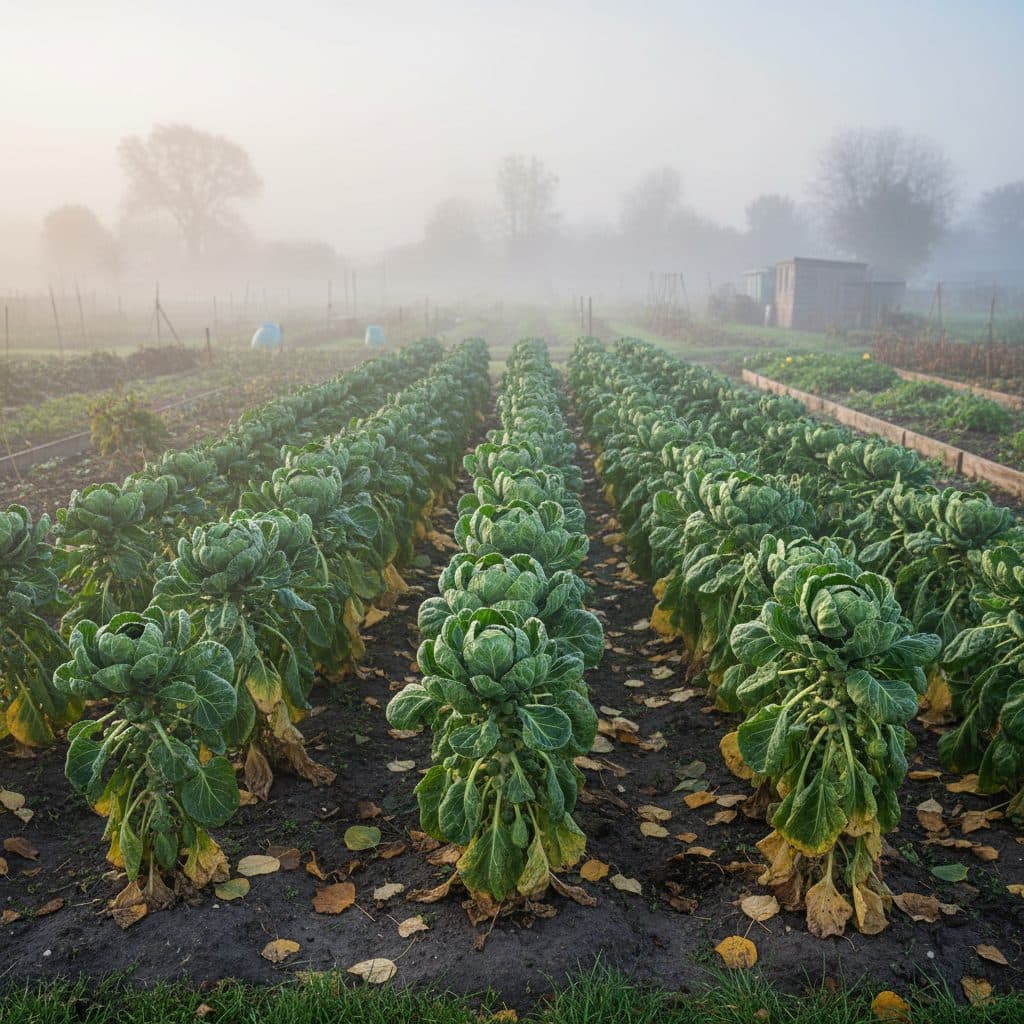
Brussels sprouts (Brassica oleracea var. gemmifera) are a cornerstone of the British winter allotment. Standing proudly through freezing rain, frost, and snow, they provide fresh green harvests from late autumn right through to February. For many UK growers, harvesting home-grown sprouts for Christmas dinner is an annual tradition that rewards patience and careful soil preparation.
Success with learning how to grow Brussels sprouts requires understanding their long development cycle. These plants occupy bed space for up to nine months, requiring steady moisture, high soil fertility, and solid anchorage against winter winds. When given loose soil or unbalanced feeding, plants produce unpalatable leafy rosettes rather than firm, tight buttons.
By preparing firm ground well in advance, netting against allotment pests, and staking tall stems, you can harvest baskets of sweet, nutty sprouts throughout the coldest months of the year.
+--------------------------------------------------------------------------+
|                  BRUSSELS SPROUTS UK GROWING CALENDAR                    |
+-------------------+----------------------------------+-------------------+
| Growth Stage      | Timing Window                    | Key Action        |
+-------------------+----------------------------------+-------------------+
| Early Sowing      | March to April (Under Glass)     | Modules or pots   |
| Outdoor Sowing    | April to May (Seedbed)           | Drills 15 mm deep |
| Transplanting     | May to June                      | Tread soil firm   |
| Active Growth     | July to September                | Netting & feeding |
| Staking Support   | September to October             | Cane & soft twine |
| Winter Harvest    | October to February              | Pick bottom-up    |
+-------------------+----------------------------------+-------------------+
Sowing Brussels sprouts in the UK climate
Brussels sprouts need a long growing season to build a robust root system and thick central stem before buttons form in late summer. Depending on your setup, you can sow seeds in modular trays under unheated glass or direct into an outdoor nursery bed.
For early crops, sow indoors from March to mid-April in module trays filled with peat-free seed compost. Sow two seeds per module at a depth of 15 mm, thinning to the strongest seedling once germinated. Keep the trays in a cold frame, unheated greenhouse, or bright windowsill at 12°C to 16°C. Modular sowing protects delicate emerging seedlings from slug damage and prevents root disturbance during planting.
If you prefer outdoor sowing, prepare a dedicated nursery seedbed in late April or early May. Rake the soil to a fine tilth and draw shallow drills 15 mm deep and 15 cm apart. Sow seeds thinly, water gently with a fine rose, and thin the emerging seedlings to 7 cm apart. By late May or June, seedlings will have developed five to six true leaves and stand roughly 10 cm to 15 cm tall, ready for transplanting into their permanent cropping positions.
For broader allotment planting schedules through midsummer, see our guide on what to plant in july uk.
Soil preparation and the importance of firm ground
Brussels sprouts require rich, moisture-retentive, heavy soil with excellent drainage. Unlike tender salad crops that prefer loose, fluffy soil, brassicas demand firm, compacted ground to support their substantial top growth and prevent roots from shifting in autumn gales.
Prepare your sprout bed during the previous autumn or winter by digging in generous amounts of well-rotted garden compost or well-rotted farmyard manure. Heavy clay soils, common across many UK regions, are naturally well-suited to sprouts once conditioned. For strategies on managing heavy ground, explore our guide on improving clay soil.
Brassicas thrive in neutral to slightly alkaline soil with a pH between 6.5 and 7.5. Acidic soils favour clubroot, a persistent soil-borne disease caused by Plasmodiophora brassicae — a slime-mould-like organism rather than a true fungus — whose resting spores can survive in the ground for up to 20 years. If your soil pH tests below 6.5, apply garden lime in late winter according to package guidelines.
Before transplanting in late spring, consolidate the bed by treading across the surface with your heels. This traditional technique eliminates air pockets and locks the soil particles together, giving the root system rigid stability.
Transplanting and spacing requirements
Transplant your Brussels sprout seedlings between late May and late June. Spacing is critical: crowded plants compete for sunlight and air, resulting in weak, elongated stems and tiny buttons.
- Standard cultivars: Space plants 60 cm to 75 cm apart in both directions.
- Dwarf cultivars: Space plants 50 cm to 60 cm apart.
- Raised bed plots: If growing on structured beds, plant 50 cm apart in a staggered grid. You can read more about planning layouts in our guide on allotment raised beds.
Use a trowel to dig planting holes deep enough to bury the seedlings up to their lowest set of true leaves. Firm the soil firmly around each plant with your fists or boots. Water each plant thoroughly to settle the roots. Rake a balanced organic fertiliser, such as blood, fish, and bone or poultry manure pellets, into the surrounding surface at planting time.
Practicing sound crop rotation prevents soil-borne diseases. Avoid planting sprouts where any brassica — cabbage, cauliflower, kale, swede, turnip, radish or a mustard green manure — grew in the previous three to four years, and longer still on a plot with a clubroot history. To plan multi-year bed cycles, consult our guide on crop-rotation-home-garden-plans.
Staking Brussels sprouts against UK winter weather
As autumn approaches, Brussels sprout plants grow into heavy, top-heavy bushes reaching 75 cm to 1 metre in height. Autumn rain softens the ground, and fierce gales can easily rock the plants, snapping feeder roots and causing loose buttons.
Staking is essential on exposed allotment sites and open garden plots:
- Individual stakes: Drive a stout wooden stake or thick bamboo cane 30 cm into the ground beside each stem in September.
- Tying: Secure the main stem to the stake in two places using soft garden twine or cloth strips, tying in a figure-eight pattern to prevent rubbing.
- Earthing up: Draw 10 cm of surrounding soil up around the base of the stems in late summer to encourage adventitious root growth and anchor the lower trunk.
Remove any yellowing lower leaves throughout autumn to improve airflow around the developing sprouts and deter fungal problems like grey mould (Botrytis cinerea).
Preventing blown sprouts and cultural care
One of the most common frustrations for sprout growers is "blown sprouts"—loose, open, leafy rosettes instead of tight, dense buttons. Understanding the cultural causes allows you to prevent this issue entirely.
+----------------------------------------------------------------------------------------------------+
|                               TROUBLESHOOTING BLOWN BRUSSELS SPROUTS                               |
+------------------------+----------------------------------+----------------------------------------+
| Primary Cause          | Why It Happens                   | Corrective Action                      |
+------------------------+----------------------------------+----------------------------------------+
| Loose Soil             | Roots move in the ground         | Tread soil firm prior to planting      |
| Excess Nitrogen        | Stimulates leafy rush            | Use balanced organic feeding           |
| Irregular Water        | Growth checks and restarts       | Mulch and water evenly through summer  |
| Cultivar/date mismatch | Buttons fill during warm weather | Match cultivar to sowing date: early   |
|                        |                                  | types Feb-March under glass for autumn |
|                        |                                  | picking, maincrop and late types late  |
|                        |                                  | March-April for winter                 |
| Shade Competition      | Plants stretch for light         | Full sun position only                 |
+------------------------+----------------------------------+----------------------------------------+
Watering must remain consistent during dry summer spells. A prolonged dry period followed by heavy autumn rain causes a growth surge that forces tight buttons open. Apply a 5 cm mulch of garden compost or straw around the base of the plants in midsummer to conserve moisture and suppress weeds.
Avoid feeding with high-nitrogen liquid fertilisers from August onward. Excess nitrogen softens plant tissue and encourages loose leaves rather than tight buttons. If plants need a midsummer boost, apply a potassium-rich comfrey feed or light dressing of sulphate of potash to encourage dense, firm button formation.
Pest protection without chemicals
Brassicas are vulnerable to several common garden pests in the UK. Because UK pesticide regulations change and domestic garden chemicals are restricted, physical barriers and cultural controls are the most effective and reliable defense.
- Cabbage white butterflies (Pieris brassicae and P. rapae): Lay yellow or white eggs on leaf undersides, hatching into voracious caterpillars that can skeletonise plants in summer. Cover the entire bed with fine insect mesh (0.8 mm to 1.35 mm aperture) supported on hoops from transplanting until late autumn. Keep the netting clear of the leaves so butterflies cannot lay eggs through the mesh.
- Pigeons: Wood pigeons can shred mature brassica foliage during winter when other food is scarce. Keep protective netting in place right through the winter months.
- Cabbage root fly: Adult flies lay eggs in the soil around the stem base, and emerging maggots destroy root systems. Fit 10 cm rubber or cardboard cabbage collars flat around the stem base at transplanting to prevent the fly from accessing the soil.
- Cabbage whitefly: Small white insects that congregate under leaves in autumn, excreting sticky honeydew. Wash colonies off with a strong jet of water on sunny mornings, or encourage natural predators like ladybirds and hoverflies.
For broader autumn sowing and winter cropping ideas, review our guide on fall-winter-gardening-midsummer-sowing.
Harvesting, top greens, and kitchen preparation
Brussels sprout buttons mature progressively up the stem from the base toward the top. In the UK, harvesting begins in October for early cultivars and continues through February for late-season varieties.
Signs that sprouts are ready to pick:
- Buttons reach 2.5 cm to 4 cm in diameter and feel dense and firm when squeezed.
- Outer wrapper leaves remain green and tight against the button.
- Frost has touched the plants, converting starches into sugars for sweeter flavour.
To harvest, grasp the button firmly and snap it downward from the stalk. Alternatively, use a sharp harvesting knife to slice the button cleanly from the stem. Harvest from the bottom of the stem upward, taking a few sprouts from each plant per week to prolong the cropping window.
Once all lower buttons are harvested in mid-winter, you can cut and cook the leafy top crown (the "sprout tops"). These tender greens have a delicious, mild cabbage flavour and provide a welcome fresh harvest in January and February.