Key takeaways
- Apply thick organic surface mulches annually to build durable crumb structure without heavy digging.
- Avoid digging or walking on heavy clay soil when it is wet to prevent severe structural damage and compaction.
- Rely on well-rotted garden compost, well-rotted manure, and leaf mould as the primary soil amendments.
- Understand that gypsum rarely improves UK clay soils because they are not sodic — gypsum only flocculates clay that sodium has dispersed.
- Construct raised timber beds to improve root zone drainage and accelerate spring soil warming.
- Select deep-rooting vegetable and ornamental crops that naturally penetrate dense subsoil layers.
Quick answer: For lasting results when improving clay soil in UK gardens, top-dress beds annually with 5 cm to 10 cm of well-rotted organic matter such as garden compost, leaf mould, or aged manure. Avoid cultivating wet clay, adopt a no-dig approach to let earthworms incorporate nutrients, and build raised beds where winter waterlogging persists.
Clay soil is one of the most common and challenging soil types encountered by British gardeners and allotment holders. Across large swathes of London, the Home Counties, the Midlands, and the North, gardeners contend with soil that turns into slick, sticky grease in winter and bakes into rock-hard bricks during summer dry spells.
Despite these physical challenges, clay soil possesses immense horticultural value. It is naturally fertile, packed with mineral nutrients, and has superior moisture and nutrient-holding capacity compared to light sands. The challenge lies in altering its dense physical structure so that roots, water, and oxygen can move freely through the profile.
Transforming heavy ground does not require back-breaking rotovating. By applying proven methods for improving clay soil through organic top-dressing, no-dig beds, and smart plant selection, you can build loose, friable soil that supports productive vegetables and robust ornamental plantings.
+----------------------------------------------------------------------------------------------------+
|                            CLAY SOIL IMPROVEMENT METHODS: UK COMPARISON                            |
+--------------------------+-----------------------------+-------------------------------------------+
| Amendment Method         | Effectiveness in UK Soils   | Best Application Time                     |
+--------------------------+-----------------------------+-------------------------------------------+
| Well-Rotted Compost      | High (Universal structure)  | Autumn or Early Spring                    |
| Leaf Mould               | High (Fungal conditioning)  | Autumn top-dressing                       |
| Well-Rotted Manure       | High (Nutrients & aeration) | Late Autumn / Winter                      |
| Sharp Horticultural Grit | Moderate (Local only)       | Whole-bed rates only — never planting hole|
| Gypsum (Calcium Sulphate)| Low to Negligible (Inland)  | Saline/coastal soils                      |
| No-Dig Mulch Layers      | High (Earthworm activity)   | Year-round maintenance                    |
+--------------------------+-----------------------------+-------------------------------------------+
Understanding the structure of UK clay soils
Clay soil is composed of microscopic mineral particles measuring less than 0.002 mm in diameter. Because these plate-like particles are flat and pack tightly together with minimal pore space between them, clay holds water tightly through capillary action.
When rain falls steadily through a British autumn and winter, tiny pores fill completely with water, driving out oxygen. Roots suffocate in waterlogged conditions, and beneficial soil microbes slow their metabolic activity. Conversely, during hot summer spells, the water evaporates, causing the clay plates to contract and fissure into wide surface cracks.
However, clay particles carry negative electrical charges that attract and hold positively charged plant nutrient ions (cations) such as potassium, calcium, and magnesium. Once you open up physical pathways for air and water, clay becomes the most productive and nutrient-rich soil in the garden. For insights on managing moisture saturation, see our guide on how to fix-waterlogged-beds-clay.
The Golden Rule: never work wet clay
The single biggest mistake gardeners make with clay is cultivating, rotovating, or digging the soil when it is wet. Working wet clay destroys what little crumb structure exists, squeezing out air channels and creating a dense, smeared paste that dries into impenetrable clods.
Follow these strict working rules:
- The squeeze test: Take a handful of soil and squeeze it into a ball. If it leaves a slick, shiny smear on your fingers and holds together like modelling clay, leave it alone. If it crumbles under light thumb pressure, it is safe to work.
- Use timber planks: Never walk directly on clay beds during wet weather. Lay wide scaffolding boards across paths and beds to distribute your body weight evenly and prevent compaction.
- Harness winter frosts: If you must roughly turn unbroken ground, do so in late autumn. Leave the large overturned clods exposed through winter. The freeze-thaw cycle of expanding ice will naturally shatter the heavy clods into fine tilth by March.
Organic matter amendments: the true long-term solution
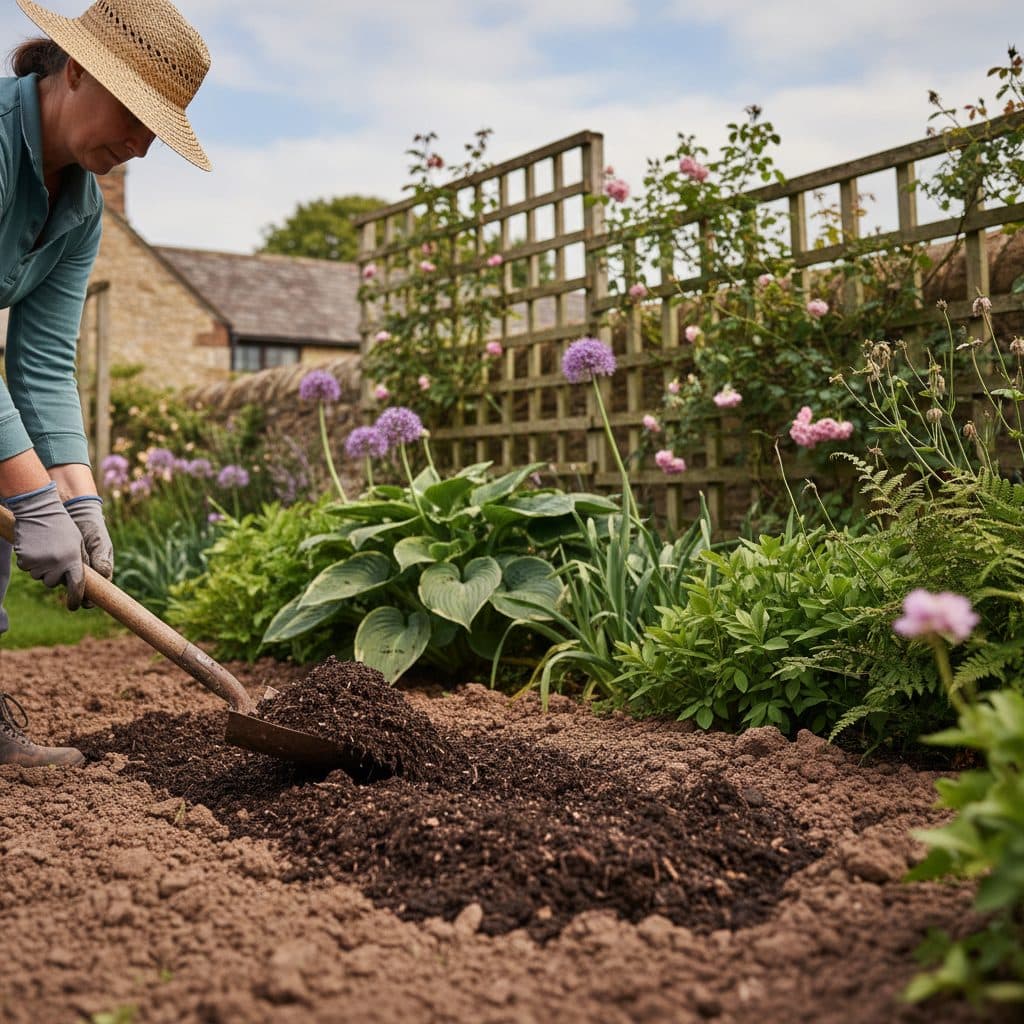
Adding copious amounts of bulky organic matter is the only reliable, permanent way to improve clay soil structure. Organic matter acts as a biological sponge, wedging itself between tight clay particles to create larger pore spaces (macropores) that admit air and allow water to percolate downward.
Key organic amendments for UK gardens:
- Well-rotted garden compost: Rich in humic substances and in the bacteria and fungi whose polysaccharides and glomalin — a glycoprotein produced by mycorrhizal fungi — glue clay particles into stable crumbs.
- Leaf mould: Decomposed deciduous leaves provide slow-release carbon and stimulate fungal mycorrhizae, which physically weave through clay particles.
- Well-rotted farmyard manure: Sourced from local stables or farms, aged manure adds bulk organic matter and primary plant nutrients. Ensure it is well-rotted to avoid introducing weed seeds or residual herbicide contamination.
- Composted bark fines: Small bark chips break down slowly, maintaining physical pore space for several years.
Apply a 5 cm to 10 cm layer of organic matter across the soil surface every autumn. Earthworms, beetles, and soil microbes will draw this material down into the subsoil naturally, aerating the profile far more efficiently than a mechanical tiller. Do not improve individual planting holes in clay. A pocket of grit or compost surrounded by clay acts as a sump that fills with water. Improve a wide area, or plant into the native soil and mulch the surface. You can compare regional amendment strategies in our guide to amend-heavy-clay-soil-midwest.
The truth about gypsum on British clay soils
Gypsum (calcium sulphate) is frequently promoted online as a quick chemical cure for heavy clay. It functions by introducing calcium ions that displace sodium ions on clay particles, causing the particles to clump together (flocculate) into larger granules.
However, in the vast majority of UK soils, gypsum provides little to no noticeable benefit:
- Inland UK soils: British clays are non-sodic — they carry very little exchangeable sodium. Gypsum works by displacing sodium, so with no sodium to displace there is nothing for it to flocculate. (Calcium status varies: Oxford Clay is calcareous, while Weald Clay soils are typically acidic and lime-free — but neither responds to gypsum.)
- Coastal soils: Gypsum is primarily useful on coastal land that has been flooded by seawater, where high exchangeable sodium (sodic conditions) have dispersed the clay structure.
Rather than spending money on bags of gypsum, invest your resources in bulk organic compost, leaf mould, and mulch materials that are guaranteed to improve physical structure regardless of your soil chemistry.
Why the no-dig method excels on clay
Adopting the no-dig gardening approach is arguably the most transformative step you can take on heavy clay ground. Digging turns up buried weed seeds, disrupts established fungal networks, and creates an artificial hardpan layer just below spade depth.
+--------------------------------------------------------------------------+
|                     NO-DIG CLAY BED ESTABLISHMENT                        |
+--------------------------------------------------------------------------+
|  [ Layer 3: 5-8 cm Well-Rotted Compost (Planting Zone) ]                 |
|  [ Layer 2: Overlapping Cardboard (Suppresses Weeds & Softens Clay) ]    |
|  [ Layer 1: Undisturbed Clay Soil (Earthworm Channels Preserved) ]       |
+--------------------------------------------------------------------------+
To establish no-dig beds over existing heavy clay:
- Mow or scalp existing grass and annual weeds down to ground level.
- Lay down thick, unprinted brown cardboard across the area, overlapping edges by at least 15 cm to prevent weeds from finding light gaps.
- Spread 10 cm to 15 cm of rich organic compost directly over the cardboard.
- Plant directly into the compost layer.
Within a single season, worms migrate upward to feed on the cardboard, boring thousands of vertical drainage channels directly through the clay subsoil beneath. The soil beneath softens, drainage improves noticeably, and bed maintenance drops dramatically.
Improving drainage and constructing raised beds
Where ground remains saturated for weeks in winter due to high water tables or low-lying topography, building raised beds provides an immediate solution for productive growing.
Raised beds lift the root zone 15 cm to 30 cm above the surrounding waterlogged ground, so vegetable roots keep access to air even during persistent winter downpours. The soil within raised timber frames warms up two to three weeks earlier in spring, allowing earlier seed sowing and transplanting.
When building raised beds on clay:
- Construct frames using thick timber scaffold boards or untreated larch. Learn more about sizing and plot planning in our guide on allotment raised beds.
- Fork the base of the native clay lightly to loosen the interface before filling, but do not invert the subsoil.
- Fill the frames with a mix of topsoil, well-rotted manure, and compost.
For pathways between beds, lay woodchips over cardboard. Woodchips absorb winter moisture, provide clean footing for wheelbarrows, and slowly break down into rich fungal compost that can be shoveled onto beds in future years.
Best plants and vegetables for UK clay soils
Certain crops and perennial plants tolerate or even thrive in heavy clay soils, making them ideal choices while your soil-building programme takes effect.
Top vegetable performers on conditioned clay:
- Brassicas: Brussels sprouts, cabbages, kale, and purple sprouting broccoli thrive in heavy ground because firm soil anchors their tall stems against autumn winds. Read our comprehensive guide on how to grow brussels sprouts for specific planting techniques.
- Broad beans and peas: Deep-rooting legumes penetrate compacted soil and leave behind nitrogen-rich root nodules.
- Squash and pumpkins: Vigorous surface feeders that love the rich nutrient reserves and moisture of warm clay mounds.
Reliable ornamental perennials and shrubs for clay:
- Geranium (Hardy Cranesbill): Tolerates seasonal moisture swings with ease.
- Cornus alba (Dogwood): Thrives in damp, heavy ground and produces brilliant winter stems.
- Hosta and Astilbe: Flourish in moisture-retentive, organic-rich clay borders.
- Rosa species: Traditional garden roses develop deep, anchoring roots in mineral-rich clay.
For a wider directory of resilient species suited to heavy soil conditions, consult our complete guide to plants-for-clay-soil.