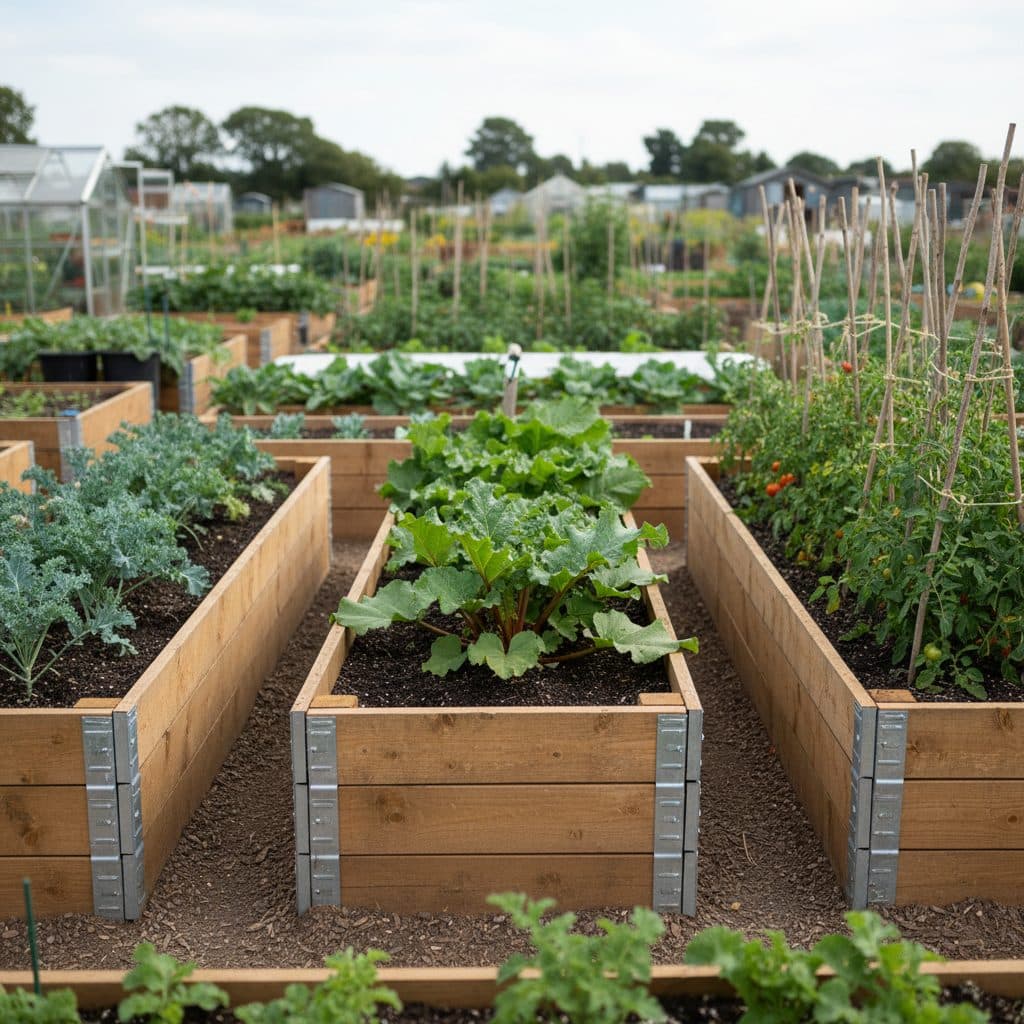
Key takeaways
- Construct beds 1.2 metres wide so you can comfortably reach the centre from either side without stepping on soil.
- Keep the main spine path 80 cm to 90 cm wide for a loaded wheelbarrow, and 60 cm between parallel beds.
- Use untreated British larch or reclaimed scaffold boards for durable, non-toxic bed borders.
- Check your local council or allotment association tenancy agreement for restrictions on bed heights and materials.
- Fill deep timber frames affordably using hügelkultur layers of rotten logs, cardboard, and rough compost.
- Combine raised timber beds with a no-dig top-dressing strategy to suppress weeds.
Quick answer: For an effective allotment raised beds setup in the UK, build timber frames 1.2 metres wide by 2.4 to 3 metres long and 20 cm to 30 cm deep using scaffold boards or larch. Keep the main spine path 80 cm to 90 cm wide for a loaded wheelbarrow, and 60 cm between parallel beds, fill the lower half with decaying organic matter (hügelkultur), and top with rich compost to create free-draining, productive growing zones.
Converting a traditional British allotment plot into a grid of raised timber beds is one of the most effective ways to bring order, high yields, and manageable maintenance to your growing space. Whether you have taken on a pristine plot or inherited an overgrown jungle choked with couch grass, raised beds establish clear, permanent boundaries between walking paths and fertile growing soil.
However, deciding whether to install allotment raised beds requires weighing the initial investment in materials against the long-term benefits to soil structure and time management. On heavy UK clay soils or low-lying sites prone to winter waterlogging, raised timber beds elevate crop roots into warm, oxygenated soil weeks before open in-ground plots are workable.
By choosing the right timber, planning an ergonomic plot layout around standard rod dimensions, and filling beds affordably using layered organic matter, you can build a highly productive, low-maintenance allotment system that lasts for years.
+--------------------------------------------------------------------------+
|                  ALLOTMENT RAISED BEDS: PROS AND CONS                    |
+-------------------+------------------------------------------------------+
| Advantages        | - Superior drainage on heavy UK clay soils           |
|                   | - Free-draining raised soil warms earlier in spring  |
|                   |   than flat, wet ground                              |
|                   | - Zero soil compaction from foot traffic             |
|                   | - Clear boundaries suppress creeping path weeds      |
+-------------------+------------------------------------------------------+
| Considerations    | - Upfront cost for timber, fixings, and compost      |
|                   | - Dries out faster during peak summer dry spells     |
|                   | - Timber borders eventually rot and need renewal     |
+-------------------+------------------------------------------------------+
Are raised beds worth it on an allotment?
Before purchasing timber and hardware, evaluate whether raised beds suit your specific allotment site and gardening goals.
The primary advantages in the UK climate include:
- Drainage and aeration: If your plot sits on heavy clay, raised beds lift root zones 20 cm to 30 cm above waterlogged ground, preventing winter root rot in overwintering crops. For broader clay management, see our guide on improving clay soil.
- Faster spring warming: Elevated soil drains faster in March and April, absorbing solar radiation and warming significantly quicker than flat, wet ground.
- Eliminating compaction: Because you never step on the growing area, the soil structure remains open, porous, and teeming with beneficial earthworms.
- Manageable workflow: An allotment divided into defined beds allows you to tackle weeding, planting, and harvesting in bite-sized sections without feeling overwhelmed by a vast open plot.
The main trade-off is the initial labour and expense of sourcing timber and filling the frames. Elevated beds dry out faster during hot summer dry spells, requiring attentive watering or thick organic surface mulches. For a broader overview of structure designs, explore our guide to raised-bed-gardening.
Understanding UK allotment rules and regulations
Before building any permanent or semi-permanent structures, consult your allotment association rules or local council tenancy agreement. While most UK allotment societies welcome raised beds, specific local guidelines often apply.
Tenancy rules to verify:
- Height restrictions: Some associations limit raised bed heights to 30 cm or 45 cm to preserve open site visibility across the field.
- Cultivation clause: Tenancy agreements require the plot to be kept in active cultivation. Some set a specific proportion — 75% is the figure most often quoted — but many are worded qualitatively and there is no national standard. Read your own agreement.
- Treated timber restrictions: Older creosote treatments are prohibited across the UK. Modern pressure-treated timber uses copper-based preservatives (such as Tanalith E), which are generally permitted, though some organic-certified associations prefer untreated larch or cedar.
- Boundary setbacks: Keep raised bed borders at least 30 cm to 45 cm away from plot boundary lines to allow maintenance and avoid encroaching on neighbouring plots.
If you are planning to store tools and collect water on site alongside your beds, review our comprehensive allotment shed guide for council rules and base construction.
+--------------------------------------------------------------------------+
|                  STANDARD 10-ROD ALLOTMENT BED LAYOUT                    |
+--------------------------------------------------------------------------+
|  [ Main Access Path - 90 cm wide (Allows heavy wheelbarrow turn) ]       |
|                                                                          |
|  +---------------------------+       +---------------------------+       |
|  | Bed 1: 1.2 m x 3.0 m      |       | Bed 2: 1.2 m x 3.0 m      |       |
|  | (Brassicas / Overwinter)  |       | (Root Crops / Carrots)    |       |
|  +---------------------------+       +---------------------------+       |
|                                                                          |
|  [ Working Inter-Bed Path - 60 cm wide (Clean access with bucket) ]      |
|                                                                          |
|  +---------------------------+       +---------------------------+       |
|  | Bed 3: 1.2 m x 3.0 m      |       | Bed 4: 1.2 m x 3.0 m      |       |
|  | (Legumes / Peas & Beans)  |       | (Potatoes / Alliums)      |       |
|  +---------------------------+       +---------------------------+       |
+--------------------------------------------------------------------------+
Designing your allotment layout: rod dimensions and pathways
A standard British allotment plot measures 10 poles (also known as 10 rods or perches), which equates to approximately 250 square metres (roughly 25 metres long by 10 metres wide).
To maximise growing area while maintaining smooth access:
- Bed width (1.2 metres): The universal standard for raised beds is 1.2 metres (4 feet). This width allows a person of average height to reach the exact centre of the bed comfortably from either side without ever placing a foot on the soil.
- Bed length (2.4 m to 3.6 m): Standard timber boards in the UK are sold in 2.4 m, 3.0 m, and 3.6 m lengths. Designing bed lengths around standard timber cuts minimises offcut waste.
- Main path width (80 cm to 90 cm): Ensure your central spine path is wide enough for a fully loaded wheelbarrow and two people to pass without tripping over bed edges.
- Inter-bed path width (60 cm): Paths between parallel beds should comfortably accommodate a wheelbarrow tire and kneeling gardeners.
For path surfaces, lay thick overlapping brown cardboard directly over mown grass or weeds and cover with a 7 cm layer of coarse woodchips. Woodchips suppress weeds, provide clean, mud-free footing throughout wet UK winters, and gradually rot down into rich organic matter.
Timber selection: balancing durability and cost
Choosing the right timber determines how many years your beds will last before the boards rot and require replacement.
- Reclaimed scaffold boards (38 mm x 225 mm): The most popular choice on UK allotments. Thick, robust, and readily available from scaffolding suppliers. Unbanded used boards are affordable and typically last 5 to 8 years in direct soil contact.
- Untreated British-grown larch: A resinous, moderately durable softwood (EN 350 durability class 3) that resists rot without chemical treatment. Expect roughly 7 to 10 years in soil contact, less where boards carry sapwood. Douglas fir is also widely grown in Britain but is less durable in ground contact and will not match larch.
- Gravel boards (treated softwood): Budget-friendly and widely available at builders' merchants. At 19 mm to 22 mm thick, they are lighter than scaffold boards but may bow outward if unsupported over spans exceeding 2 metres.
- Recycled plastic planks: Completely rot-proof and durable for decades, though significantly more expensive upfront.
Secure corners using 50 mm x 50 mm timber corner posts driven 20 cm into the ground, fastening the boards with exterior-grade decking screws (minimum 65 mm length) to withstand wet soil pressure.
Budget-friendly filling methods: the hügelkultur approach
Filling multiple raised beds with commercial bagged compost can quickly become expensive. A traditional 10-rod plot with 8 to 12 beds requires cubic metres of growing medium.
The most economical and soil-enriching technique is to build a hügelkultur base:
+--------------------------------------------------------------------------+
|                     AFFORDABLE BED FILLING PROFILE                       |
+--------------------------------------------------------------------------+
|  Top 10-15 cm: Well-Rotted Garden Compost or Topsoil (Seedling Zone)     |
|  Middle 10 cm: Half-Rotted Manure, Leaves, and Green Garden Waste        |
|  Bottom 10 cm: Inverted Turf Sods, Cardboard, and Rotten Tree Branches   |
|  Base Ground : Native Allotment Subsoil (Loosened with Fork)             |
+--------------------------------------------------------------------------+- Bottom layer: Cardboard smothers annual weeds and weakens couch grass, but bindweed, horsetail and well-established couch will grow through both the card and the fill. On plots with those three, clear the regrowth repeatedly through the first season or exclude light with a heavy cover for a full growing year before building. Use only well-rotted wood; fresh prunings tie up nitrogen in the first year. Expect a wood-cored bed to settle by roughly a quarter over its first season, so plan to top it up with compost the following spring. This woody core is a long-term moisture sponge.
- Middle layer: Add inverted turf sods (grass-side down), autumn leaf mould, fresh grass clippings, and half-rotted manure from your compost heap.
- Top layer: Finish the top 10 cm to 15 cm with a blend of fine garden compost and topsoil.
To accelerate biological activity and improve nutrient retention within new bed fill, consider incorporating amendments covered in our guide on biochar-raised-beds-compost-amendment.
Crop planning and rotation for raised bed systems
A grid of raised beds makes implementing a four-year crop rotation exceptionally simple. Assign specific crop families to individual beds and rotate them systematically each season:
- Bed 1 (Brassicas): Brussels sprouts, cabbage, kale, and broccoli. These heavy feeders benefit from firm ground and residual lime; see our detailed guide on how to grow brussels sprouts.
- Bed 2 (Roots and Alliums): Carrots, parsnips, beetroot, onions, and garlic. The loose, stone-free compost in raised beds produces long, straight root crops without forking.
- Bed 3 (Legumes): Broad beans, peas, and runner beans that fix atmospheric nitrogen into the bed.
- Bed 4 (Nightshades and Cucurbits): Potatoes, outdoor tomatoes, courgettes, and winter squash.
By combining structured raised beds with annual organic top-dressings, your allotment will deliver abundant, reliable harvests while keeping weed pressure and heavy digging to an absolute minimum.