Key takeaways
- Permaculture zone planning effectively scales down to small suburban lots, even 0.1 acres.
- Strategic placement of high-use areas (Zone 1) near the home saves time and effort.
- Swales and rain gardens help manage stormwater runoff and conserve water on site.
- Plant guilds and food forests maximize diverse yields and build soil health in limited spaces.
- A detailed site analysis, including sun, wind, and water flow, is the foundation for successful design.
- Even small-scale permaculture can significantly reduce water use and increase food production.
Quick answer: Permaculture zone planning can be effectively applied to a 0.25-acre suburban lot by strategically placing high-use areas (Zone 1) near the home, integrating water management like swales, and designing multi-layered food forests and plant guilds. This approach maximizes productivity and resource efficiency in limited spaces.
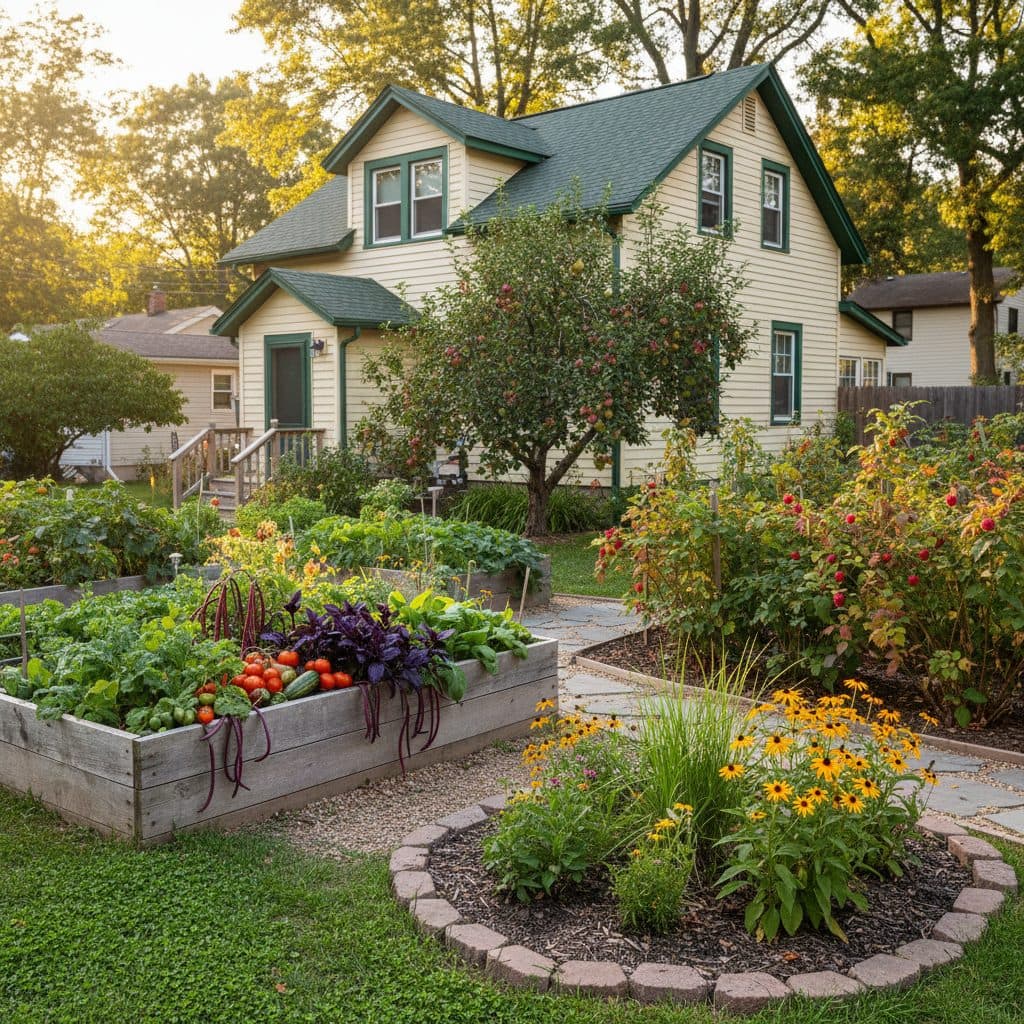
Many people associate permaculture design with large farms or expansive rural properties, picturing vast food forests and meandering swales across acres of land. However, the core principles of permaculture (observing natural patterns, conserving resources, and designing for efficiency) are adaptable to smaller scales. In a typical suburban neighborhood in Ohio, for instance, a 0.25-acre lot, which is about 10,890 square feet, offers ample opportunity to implement these powerful design strategies, transforming a conventional lawn into a productive, resilient ecosystem. This approach can significantly reduce maintenance while increasing food output, proving that you don’t need acreage to grow a substantial amount of your own food.
Applying permaculture zone planning, food forests, plant guilds, and water management features like swales works on a small suburban property. Reading the site and placing elements strategically creates a productive system suited to local conditions, such as USDA Zone 6 where winter lows typically range from -10°F to 0°F [1].
Understanding permaculture zones for small spaces
Permaculture zone planning organizes your landscape based on the frequency of human interaction and the intensity of management required. On a suburban lot, these zones become more compressed but remain equally important for efficiency. Zone 0 is your home itself, the center of activity and resource use. Zone 1, the most frequently visited area, should be within 30 feet of your main living spaces, containing plants that require daily attention like annual vegetables, herbs, and small fruits. For example, a raised bed of lettuce, basil, and cherry tomatoes might be located just outside the kitchen door, requiring only a few minutes of daily care.
Zone 2 extends outward, encompassing plants needing less frequent, perhaps weekly, attention. This could include perennial vegetables, berry bushes, and smaller fruit trees. On a 0.25-acre lot, Zone 2 might reach 50 to 70 feet from the house, providing space for diverse crops. This zone is also ideal for composting systems and small animal housing, if appropriate for your local ordinances and space. A well-placed compost bin can process 50 to 100 pounds of organic waste per month, turning kitchen scraps into valuable soil amendments.
Mapping your property’s zones
To begin, sketch your property, including the house, driveway, and any existing features like large trees or utility lines. Mark your primary entry points and common pathways. Then, draw concentric circles or irregular shapes representing your zones. Remember, these aren’t rigid circles; they adapt to your site’s unique features, such as a sunny south-facing wall perfect for Zone 1 edibles, even if it’s slightly further from the back door. Consider the sun exposure, prevailing winds, and slope of your land, as these factors will heavily influence plant placement and water management strategies. A detailed site analysis is the first step in effective design, allowing you to understand your property’s natural flows and microclimates. You can learn more about this foundational step at agripure.org/articles/permaculture-design.
- Identify high-traffic areas near the home.
- Map sun and shade patterns throughout the day.
- Note existing trees, shrubs, and hardscapes.
- Mark water flow paths during rain events.
- Consider neighbor’s properties for shade or privacy needs.
Designing productive food forests and plant guilds
A food forest, or an agroforestry system, mimics the structure of a natural forest but focuses on edible and useful plants. On a small suburban lot, this means creating a multi-layered planting system that maximizes vertical space and plant interactions. Instead of a single canopy tree, consider a dwarf fruit tree like a ‘Honeycrisp’ apple (a dwarf yields a fraction of what a standard tree does, and apples are not self-fertile (plan a second, compatible variety flowering at the same time, or you will get blossom and no fruit)) as the canopy layer, surrounded by understory shrubs such as blueberries or elderberries. Below that, you can plant herbaceous perennials like rhubarb or asparagus, groundcovers like strawberries, and nitrogen-fixing plants like clover. This layered approach can significantly increase the total yield from a given area, making the most of every square foot.
Plant guilds are communities of plants that support each other, improving growth, deterring pests, and building soil fertility. A classic example is the ‘three sisters’ guild of corn, beans, and squash, where corn provides a stalk for beans to climb, beans fix nitrogen in the soil, and squash shades the ground, suppressing weeds and conserving moisture. For a fruit tree, a guild might include comfrey as chop-and-drop mulch, chives (pest deterrent), and clover (nitrogen fixer). Plant only the sterile ‘Bocking 14’ cultivar: common comfrey (Symphytum officinale) sets viable seed and self-sows across a small lot. Comfrey of every cultivar contains hepatotoxic pyrrolizidine alkaloids, so treat it as mulch and never as food or fodder. Guild plantings generally out-produce the same ground kept as a single crop, mostly by using vertical space and by shading out weeds, but home-scale guild yield data is thin and very site-specific.
Selecting species for your climate
When choosing plants, always consider your specific USDA hardiness zone. For a USDA zone 6 lot, you have a wide range of options, including apples, pears, peaches, plums, cherries, and various berry types. Look for disease-resistant varieties suited to your local climate and soil conditions. For example, ‘Liberty’ apple is a good choice for disease resistance in many regions. Research local native plants that can be incorporated into your guilds, as they are often well-adapted to the environment and require less input. The USDA National Agroforestry Center provides valuable resources on species selection for various regions and systems [5].
- Choose dwarf or semi-dwarf fruit trees for the canopy.
- Select understory shrubs like currants or gooseberries.
- Incorporate herbaceous perennials such as oregano, sorrel, or rhubarb. If you want mint, sink it in a buried container; in open ground it will run through the whole guild by the second season.
- Plant groundcovers like wild strawberries or creeping thyme.
- Add nitrogen fixers like lupine or clover to enrich the soil.
Integrating water management with swales and rain gardens
Effective water management is central to permaculture, especially on a suburban lot where stormwater runoff can be a significant issue. Swales are shallow ditches dug along contour lines, designed to slow, spread, and sink rainwater into the landscape. Even on a relatively flat 0.25-acre property, a subtle slope can be identified to implement small, strategically placed swales. These features can reduce stormwater runoff by 50% or more, preventing erosion and recharging groundwater [2]. The berm created from the excavated soil can be planted with water-loving trees or shrubs, further stabilizing the soil and adding to your food forest. A 6-inch deep swale, 2 feet wide, can capture hundreds of gallons of water during a single rain event.
Rain gardens offer another excellent solution for managing excess water. These are depressed landscape areas planted with native vegetation that can tolerate both wet and dry conditions. They are designed to collect runoff from impervious surfaces like roofs and driveways, allowing it to slowly infiltrate the soil instead of flowing into storm drains. Rain gardens can capture and filter 30% more stormwater runoff than a traditional lawn area, improving water quality and reducing the burden on municipal systems [2]. For a typical 1,500 square foot roof, a rain garden of about 150 square feet can effectively manage much of the runoff.
Harvesting rainwater from structures
Beyond landscape features, consider harvesting rainwater directly from your home’s roof. A 1,000 square foot roof can collect approximately 600 gallons of water from just one inch of rainfall. Installing rain barrels or a larger cistern system can provide a reliable source of irrigation for your garden, reducing your reliance on municipal water and lowering your water bill by 10% to 20% during growing seasons. Ensure your system includes a first-flush diverter to prevent roof debris from entering your storage. This harvested water is ideal for irrigating Zone 1 and 2 plants, especially during dry spells in summer months when rainfall might be scarce.
- Design swales along contour lines to slow water flow.
- Create rain gardens to capture runoff from roofs and driveways.
- Install rain barrels or cisterns to store rainwater.
- Use permeable paving materials for pathways and patios.
- Direct downspouts into planted areas or swales.
Implementing a permaculture garden plan
Once your zones are mapped and your water management strategies are in place, it’s time to implement your planting plan. Start small, focusing on Zone 1 and Zone 2 areas first. These are the spaces that will provide the most immediate returns and require the most frequent interaction. For example, begin by establishing a 4 by 8-foot raised bed for annual vegetables near your kitchen door. This manageable size allows you to learn about your soil, local microclimates, and plant needs without feeling overwhelmed. As you gain experience, you can gradually expand into other zones, adding more complex guilds and larger plantings. You can find a sample first-year layout at agripure.org/articles/permaculture-garden-plan.
Consider using no-dig gardening methods to build healthy soil from the outset. This involves layering organic materials like compost, leaves, and wood chips directly onto the soil surface, which improves soil structure, fertility, and water retention over time. Mulching with wood chips, for instance, can reduce soil moisture evaporation by 25% to 50%, significantly cutting down on irrigation needs [4]. This method also minimizes disruption to soil life and supports soil organisms. For a 200 square foot garden bed, you might need 2 to 3 cubic yards of wood chips for a 4-inch layer.
Ongoing maintenance and observation
Permaculture requires ongoing observation and adaptation. Regularly monitor your plants for signs of stress or pests, and observe how water moves across your property during different rain events. Take notes on what works well and what needs adjustment. For example, if a particular plant guild isn’t thriving, consider swapping out one of the companion plants or adjusting its location. This continuous feedback loop allows you to refine your design over time, leading to a more resilient and productive system. Even a 0.1-acre (4,356 square feet) garden can provide a significant portion of a family’s fresh produce with careful planning and observation [4].
- Start with small, manageable Zone 1 and 2 projects.
- Utilize no-dig methods to build soil health.
- Apply thick layers of mulch to conserve moisture.
- Regularly observe plant health and water flow.
- Adapt your design based on seasonal performance.
Beyond the basics: advanced techniques for small lots
Once you’ve established your core permaculture system, you can explore more advanced techniques to further increase productivity and resilience on your suburban lot. Vertical gardening, for instance, is an excellent way to maximize space. Growing vining plants like cucumbers, pole beans, or even small squash varieties on trellises, fences, or arbors can significantly increase yield per square foot. A 10-foot section of fence can support dozens of vining plants, producing more food than the same area planted horizontally. Consider a living fence of riverbank grape (Vitis riparia), a hardy North American native, for both privacy and edible fruit.
Integrating small-scale aquaculture or vermiculture can also add significant value. A small pond (e.g., 500 gallons) can support edible fish and provide irrigation water rich in nutrients for nearby plants. Vermiculture, or worm composting, is a highly efficient way to process kitchen scraps into nutrient-dense worm castings, which are excellent for boosting soil fertility. A worm bin measuring 2 feet by 2 feet will handle a household's kitchen scraps once the population is established, producing valuable fertilizer for your garden beds. Add scraps only as fast as the worms clear the last lot; feeding ahead of them turns the bin anaerobic and the worms die.
Creating microclimates and extending seasons
Even on a small property, you can intentionally create microclimates to extend your growing season or protect sensitive plants. A south-facing wall, for example, absorbs solar energy during the day and radiates it at night, creating a warmer microclimate that can be ideal for heat-loving plants or for getting an early start on spring crops. Building a small cold frame or hoop house, perhaps 4 feet by 8 feet, can extend your growing season by several weeks in both spring and fall, allowing you to harvest fresh produce well into colder months. An unheated cold frame or hoop house holds plants only a few degrees above the outside air (enough to carry a light frost, not a hard freeze), and it needs venting on sunny days or the plants inside will cook.
- Utilize vertical space with trellises and living fences.
- Consider small-scale aquaculture or vermiculture systems.
- Create warm microclimates with south-facing walls or thermal mass.
- Extend growing seasons with cold frames or hoop houses.
- Experiment with diverse, unusual edible plant varieties.
Long-term benefits and ecological impact
Implementing permaculture on your suburban lot offers numerous long-term benefits that extend beyond your property line. By reducing stormwater runoff, you contribute to healthier local waterways and reduce the burden on municipal drainage systems, potentially lessening flood risks in your community. A single rain garden can filter hundreds of gallons of water annually. The increased biodiversity from diverse plantings attracts beneficial insects and birds, creating a more balanced ecosystem that requires fewer chemical interventions for pest management. In practice most gardeners find they reach for a spray far less often than in a conventional bed, though how much less depends on the site, the crops, and the pest pressure.
A well-designed permaculture system can significantly reduce your household’s carbon footprint. Agroforestry systems, including food forests, build soil and biomass carbon over time, though published rates vary widely with species, soil, and climate [5]. By growing a portion of your own food, you decrease reliance on industrial agriculture, which often involves long-distance transportation and energy-intensive processes. This shift trims the share of your food that has to be trucked in, though the size of the effect depends heavily on what you grow and what it displaces.
Building community resilience
Your permaculture efforts can also inspire and educate your neighbors, fostering a more resilient and connected community. Sharing surplus produce, offering advice, or even hosting small workshops can spread knowledge and encourage others to adopt similar practices. If multiple 0.25-acre lots in a neighborhood produce food, share resources, and manage water effectively, the collective impact can be substantial. This localized food production strengthens food security and builds a sense of self-reliance, important qualities in an unpredictable world. Some municipalities and water utilities run rain-garden rebate or cost-share programs. Check with your local stormwater utility, conservation district, or extension office for what is offered where you live.
- Reduce stormwater runoff and improve water quality.
- Increase local biodiversity and attract beneficial wildlife.
- Sequester carbon through perennial plantings and healthy soil.
- Decrease reliance on industrial food systems.
- Build community connections and share knowledge.
Conventional lawn vs. permaculture suburban lot (0.25 acre)
Feature | Conventional Lawn | Permaculture Lot |
|---|---|---|
Water Use | High (20,000-30,000 gallons/year for irrigation) | Low (5,000-10,000 gallons/year, reduced by swales/mulch) |
Food Production | Minimal to none | Significant (100-500+ lbs/year of diverse produce) |
Maintenance | Weekly mowing, fertilizing, weeding | Less frequent, focused on harvesting and observation |
Biodiversity | Low (monoculture grass) | High (diverse plants, insects, birds) |
Stormwater Runoff | High (contributes to local flooding) | Low (captured by swales, rain gardens) |
Carbon Sequestration | Low | Moderate to High |
Water Savings: Mulching with wood chips can reduce soil moisture evaporation by 25% to 50%, significantly cutting irrigation needs [4].
Increased Yield: Plant guilds make fuller use of the same ground than a single-crop bed, chiefly by stacking layers and suppressing weeds.
Runoff Reduction: Rain gardens can capture and filter 30% more stormwater runoff than a traditional lawn area [2].
Frequently asked questions
Can permaculture really work on a small suburban lot?
Yes, permaculture principles are highly adaptable to small spaces. By focusing on vertical gardening, plant guilds, and efficient zone planning, even a 0.1-acre lot can become highly productive, yielding hundreds of pounds of food annually.
What are the first steps to starting permaculture on my property?
Begin with a thorough site analysis to understand your sun exposure, water flow, and existing features. Then, map out your permaculture zones, prioritizing Zone 1 (most frequently visited) within 30 feet of your home for daily-use plants.
How do swales and rain gardens help on a suburban property?
Swales and rain gardens help manage stormwater runoff, prevent erosion, and conserve water. Rain gardens can capture and filter 30% more stormwater than traditional lawns, reducing your water bill and environmental impact.
What is a plant guild and why is it important?
A plant guild is a group of plants that support each other, improving growth and deterring pests. For example, a guild around a fruit tree might include sterile ‘Bocking 14’ comfrey as chop-and-drop mulch and chives for pest deterrence. Use only ‘Bocking 14’, since common comfrey self-sows, and keep comfrey out of the kitchen and the feed bucket (its pyrrolizidine alkaloids are hepatotoxic).
How much food can I realistically grow on a 0.25-acre lot?
With thoughtful permaculture design, a 0.25-acre lot can produce a significant portion of a family’s fresh produce, potentially hundreds of pounds of fruits, vegetables, and herbs per year, far exceeding what a conventional lawn provides.
Do I need special tools for permaculture gardening?
While some tools like broadforks or soil moisture meters can be helpful, you can start with basic gardening tools. The emphasis is on observation and working with natural processes, not necessarily specialized equipment. Many techniques, like no-dig beds, reduce the need for heavy machinery.
References
- USDA Natural Resources Conservation Service (2024). USDA Natural Resources Conservation Service.
- EPA — Soak Up the Rain (2024). EPA — Soak Up the Rain.
- SARE — Sustainable Agriculture Research & Education (2023). SARE — Sustainable Agriculture Research & Education.
- ATTRA / NCAT Sustainable Agriculture (2023). ATTRA / NCAT Sustainable Agriculture.
- USDA National Agroforestry Center (2023). USDA National Agroforestry Center.