Key takeaways
- Target an air temperature between 65°F and 75°F for most leafy greens to prevent premature bolting and encourage robust growth.
- Maintain relative humidity between 60% and 70% to support optimal transpiration and nutrient uptake in hydroponic systems.
- Understand Vapor Pressure Deficit (VPD) and aim for a range of 0.8 to 1.2 kPa for vigorous vegetative growth.
- Utilize precise monitoring tools like digital thermometers and hygrometers, checking conditions several times daily.
- Implement active control measures such as heaters, fans, and dehumidifiers to keep your growing environment stable.
- Adjust conditions slightly for specific crops; for example, mustard greens tolerate slightly cooler temperatures than basil.
Quick answer: To prevent bolting in hydroponic lettuce, maintain an air temperature between 65°F and 75°F and relative humidity between 60% and 70%. This stable environment supports robust vegetative growth and prevents premature flowering.
In the fertile agricultural valleys of California or the high plains of Nebraska, growers understand that controlling the environment is essential to a successful harvest. For those of us cultivating leafy greens indoors, whether in a small grow tent in a suburban garage or a commercial vertical farm in an urban center, managing temperature and humidity is critical. These two environmental factors directly influence plant health, growth rate, and the quality of your final product, impacting everything from leaf texture to nutrient content.
Without precise control, greens like lettuce, spinach, and arugula can quickly suffer from issues such as tip burn, stunted growth, or, most commonly, premature bolting. Bolting, where the plant prematurely sends up a flower stalk, renders many greens bitter and inedible. By understanding and actively managing the air temperature and relative humidity within your indoor growing space, you can ensure a consistent supply of crisp, flavorful, and bolt-free produce, regardless of the outdoor conditions in your USDA zone.
The critical balance for leafy greens
Achieving the right balance of temperature and humidity is fundamental for healthy indoor leafy green cultivation. Plants, much like people, thrive within specific environmental comfort zones. For most common greens, including varieties of lettuce and spinach, an air temperature range of 65°F to 75°F is generally considered ideal for robust vegetative growth. Deviations outside this range, especially prolonged exposure to temperatures above 80°F, can trigger stress responses, leading to issues like bolting or reduced leaf quality.
why temperature and humidity matter
The relationship between temperature and humidity directly affects a plant's transpiration rate, the process by which water vapor is released from leaves. If the air is too dry, plants transpire excessively, potentially leading to wilting or nutrient deficiencies even when water is abundant at the roots. Conversely, overly humid conditions can suppress transpiration, reducing nutrient uptake and increasing the risk of fungal diseases, which can decimate a crop in just a few days. Maintaining a relative humidity between 60% and 70% supports healthy transpiration without promoting pathogens. For example, maintaining optimal humidity can reduce instances of powdery mildew across lettuce crops.
- prevents bolting: keeps plants in a vegetative state longer.
- optimizes nutrient uptake: supports efficient water and nutrient transport.
- reduces disease risk: discourages fungal and bacterial growth.
- improves yield quality: leads to larger, crisper leaves.
Optimal temperature ranges for crisp growth
For most popular leafy greens grown in indoor hydroponic or soilless systems, a consistent air temperature is paramount. Lettuce varieties, such as romaine and butterhead, thrive when ambient temperatures are held between 65°F and 70°F. Temperatures exceeding 75°F for prolonged periods can signal to the plant that its life cycle is accelerating, often leading to premature bolting and a bitter taste. Conversely, temperatures consistently below 60°F can slow growth significantly, extending the harvest time by one to two weeks, which impacts production schedules and energy costs.
day and night temperature cycles
While a steady daytime temperature is crucial, many growers find success by implementing a slight temperature drop during the night cycle. A reduction of 5°F to 10°F from the daytime temperature (for example, 68°F during the day and 60°F at night) can mimic natural conditions and promote stronger plant development. This diurnal temperature variation has been shown to improve overall plant vigor and potentially improve flavor profiles in some leafy greens. For example, a night drop in temperature can result in an increase in fresh weight for spinach harvests. Consider using a reflective indoor grow tent to help maintain these temperature differentials more efficiently.
- lettuce: 65°F to 70°F for optimal leaf development.
- spinach: 60°F to 68°F, tolerates slightly cooler conditions.
- arugula: 60°F to 70°F, prone to bolting if too warm.
- mustard greens: 60°F to 75°F, adaptable but prefers cooler for best flavor.
Humidity, VPD, and air movement
Relative humidity (RH) is the amount of water vapor present in the air compared to the maximum amount it can hold at a given temperature. For leafy greens, maintaining an RH between 60% and 70% is crucial for healthy growth. If the RH drops below 50%, plants may struggle to transpire efficiently, leading to stress and reduced nutrient uptake. Conversely, if RH consistently exceeds 75%, it creates an environment conducive to fungal growth, such as powdery mildew, which can spread rapidly and damage crops. The USDA Natural Resources Conservation Service emphasizes proper environmental controls for plant health [3].
understanding vapor pressure deficit (vpd)
Vapor Pressure Deficit (VPD) is a more precise measurement that considers both temperature and humidity, indicating the drying power of the air. It’s the difference between the amount of moisture in the air and how much moisture the air can hold when it’s saturated. For vegetative growth of leafy greens, a VPD range of 0.8 to 1.2 kPa is generally considered optimal. A VPD below 0.8 kPa indicates high humidity, slowing transpiration, while a VPD above 1.2 kPa suggests low humidity, causing plants to transpire too quickly. Regular air movement, achieved with small oscillating fans, is also important. It helps distribute heat and humidity evenly, strengthens plant stems, and reduces localized humidity around leaves, minimizing disease risk.
- maintain 60-70% RH: supports optimal transpiration rates.
- target 0.8-1.2 kPa VPD: balances water loss and nutrient uptake.
- ensure gentle airflow: prevents stagnant air and strengthens plants.
- monitor for condensation: indicates excessively high humidity.
Tools for precise control
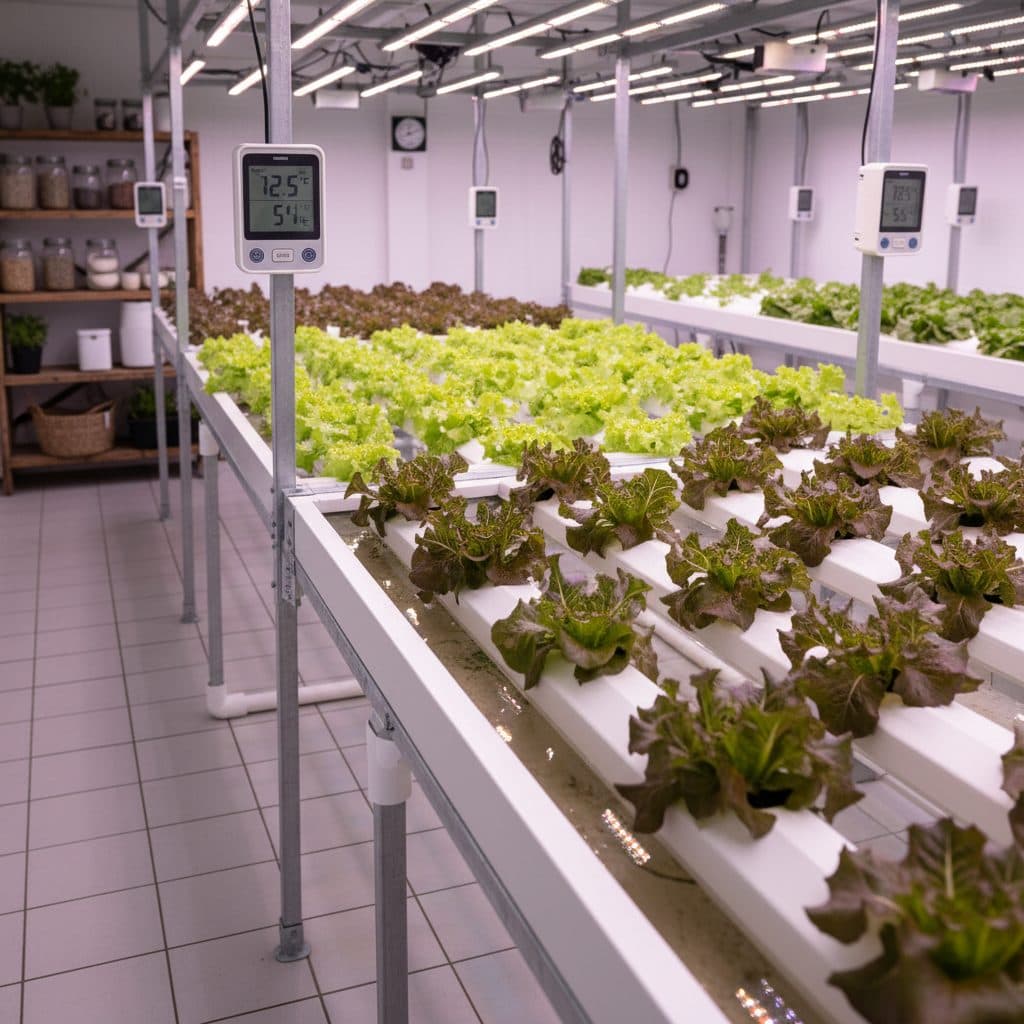
Accurate monitoring and control of your indoor growing environment are non-negotiable for success. The first step is investing in reliable monitoring equipment. A digital thermometer and hygrometer combination unit, often costing less than 30 dollars, provides real-time data on both temperature and relative humidity. Placing these sensors near the plant canopy, rather than at floor level, gives you a more accurate reading of the conditions your plants are actually experiencing. Some advanced units can even log data over time, allowing you to identify trends and make informed adjustments. The Building America Indoor Temperature and Humidity Measurement Protocol notes that sensor placement affects data accuracy [2].
active environmental control equipment
Once you know your baseline, you can deploy active control measures. For temperature regulation, small electric heaters or heating mats can raise temperatures in cooler environments, while exhaust fans paired with intake fans can help dissipate excess heat, especially during warmer months in USDA zones 7-9. Humidity control often requires a humidifier to add moisture in dry climates or a dehumidifier to remove it in humid regions. For example, a 50-pint dehumidifier can effectively manage humidity in a 200 square foot grow room. Proper ventilation matters; exhaust fans should be sized to exchange the air in your grow space every one to three minutes. A soil moisture meter can help you ensure plants are not over or under-watered, which also impacts overall plant health.
- digital thermometer/hygrometer: essential for accurate readings.
- oscillating fans: for air circulation and temperature distribution.
- heaters/cooling fans: to maintain target temperature ranges.
- humidifiers/dehumidifiers: for precise humidity management.
Tailoring conditions for specific greens and systems
While a general range of 65°F to 75°F and 60% to 70% RH works for many leafy greens, fine-tuning these parameters for specific species can yield superior results. For example, some varieties of mustard greens and other brassicas prefer slightly cooler temperatures, ideally between 60°F and 70°F, to develop their characteristic pungent flavor without becoming overly spicy or bolting prematurely. Conversely, herbs like basil, often grown alongside greens, prefer warmer conditions, thriving closer to 70°F to 75°F with slightly higher humidity, around 70%. Understanding these nuances allows for a more diverse and productive indoor garden, potentially increasing yield for specific crops.
hydroponics, aquaponics, and soilless systems
The type of growing system also influences how you manage your environment. In hydroponic systems, where roots are directly in nutrient-rich water, maintaining optimal water temperature (typically 65°F to 72°F) is as important as air temperature. Water that is too warm can reduce dissolved oxygen and promote root diseases, while water that is too cold can slow nutrient uptake. Aquaponics systems introduce the added complexity of fish, which have their own temperature and water quality requirements that must be balanced with plant needs. Soilless media, like coco coir or rockwool, offer excellent drainage and aeration, but their moisture retention properties can affect local humidity around the plant base, requiring careful monitoring. The Sustainable Agriculture Research & Education (SARE) program offers extensive resources on optimizing these diverse systems [5].
- lettuce: prefers consistent 65-70°F and 60-65% RH.
- spinach/arugula: tolerate 60-68°F, may bolt above 75°F.
- mustard greens: best at 60-70°F for flavor development.
- basil: thrives at 70-75°F with 65-70% RH.
Comparison of Environmental Targets for Common Leafy Greens
Leafy Green | Optimal Air Temp (°F) | Optimal Relative Humidity (%) | VPD (kPa) |
|---|---|---|---|
Lettuce (Romaine, Butterhead) | 65-70 | 60-65 | 0.8-1.0 |
Spinach, Arugula | 60-68 | 60-70 | 0.8-1.1 |
Mustard Greens, Kale | 60-75 | 60-70 | 0.9-1.2 |
Basil, Mint | 70-75 | 65-70 | 0.9-1.2 |
Temperature Stability: Significant temperature fluctuations can stress plants and reduce yields.
Humidity Control: Maintaining relative humidity above 75% can increase fungal disease risk.
VPD Range: An optimal Vapor Pressure Deficit (VPD) between 0.8 and 1.2 kPa is crucial for robust vegetative growth in most greens.
Frequently asked questions
What happens if my indoor grow room gets too hot for leafy greens?
If your indoor grow room consistently exceeds 75°F, especially for crops like lettuce or spinach, plants will likely experience heat stress. This can lead to premature bolting, where the plant produces a flower stalk, making the leaves bitter and unpalatable. High temperatures also reduce overall leaf quality and can decrease your harvest yield.
How can I increase humidity in a dry indoor growing environment?
To increase humidity in a dry indoor growing environment, you can use a humidifier, which can add several gallons of moisture to the air daily. Another method is to place trays of water near your plants, though this is less effective. Ensuring your grow space is sealed, like within a grow tent, also helps retain moisture, often increasing ambient humidity compared to an open room.
Is it important to have air circulation in my indoor grow space?
Yes, consistent air circulation is very important. Gentle airflow from oscillating fans prevents stagnant air pockets, which can lead to localized humidity buildup and increased risk of fungal diseases like powdery mildew. Air movement also strengthens plant stems and helps with transpiration, ensuring plants can efficiently move water and nutrients, potentially boosting growth.
What is Vapor Pressure Deficit (VPD) and why is it important?
Vapor Pressure Deficit (VPD) measures the drying power of the air, combining temperature and humidity into a single value. It indicates how much moisture the air can hold versus how much it currently holds. For leafy greens, maintaining a VPD between 0.8 and 1.2 kPa is crucial because it promotes optimal transpiration, allowing plants to absorb nutrients effectively without drying out or becoming waterlogged. Deviations outside this range can impact plant health.
Can I grow different types of greens with different temperature needs in the same space?
Growing various greens with differing temperature needs in the same space is challenging but possible with careful planning. You’ll need to find a compromise temperature range that most plants can tolerate, perhaps 68°F. Alternatively, you can create microclimates within a larger space using barriers or by placing plants that prefer cooler temperatures closer to an air intake or fan, often resulting in a temperature difference.
References
- The relationship between indoor and outdoor temperature, apparent temperature, relative humidity, and absolute humidity (2013). The relationship between indoor and outdoor temperature, apparent temperature, relative humidity, and absolute humidity.
- Building America Indoor Temperature and Humidity Measurement Protocol (2014). Building America Indoor Temperature and Humidity Measurement Protocol.
- USDA Natural Resources Conservation Service (2024). USDA Natural Resources Conservation Service.
- EPA — Soak Up the Rain.
- SARE — Sustainable Agriculture Research & Education.
- ATTRA / NCAT Sustainable Agriculture.