Key takeaways
- Mulch basins are earthworks designed to capture and slowly infiltrate water, preventing runoff and maximizing soil moisture.
- They effectively distribute greywater from household sources, reducing potable water use by up to 50% in many gardens.
- Proper design, including a 12-inch minimum depth and a 30:1 carbon-to-nitrogen ratio for mulch, prevents ponding and odors.
- Selecting appropriate, water-loving plants like fruit trees or native shrubs for basins aids nutrient uptake.
- Regular maintenance, such as topping up mulch every 6-12 months, ensures long-term system effectiveness.
- Mulch basins can significantly reduce irrigation needs, especially in arid regions like the US Southwest, saving hundreds of gallons annually.
Quick answer: Mulch basins are earthworks that capture and slowly infiltrate greywater into the soil, nourishing plants while reducing potable water use by up to 50%. They improve soil health, suppress weeds, and moderate soil temperatures, making them ideal for water conservation.
In drought-prone regions like California’s Central Valley, where water conservation matters, growers seek methods to maximize every drop. Mulch basins offer a practical solution by directing runoff and household greywater into the soil. These simple earthworks, often just a few feet in diameter, capture and slowly infiltrate water, nourishing plants while reducing evaporation and erosion.
A well-designed mulch basin can reduce irrigation needs by 25% to 50%, especially when integrated with a greywater system. This approach conserves potable water (a significant benefit for a typical US household using 300 gallons per day), builds healthier soil structure, supports beneficial microbiology, and minimizes nutrient runoff. These systems can be implemented without ponding or unpleasant odors.
Understanding mulch basins and their benefits
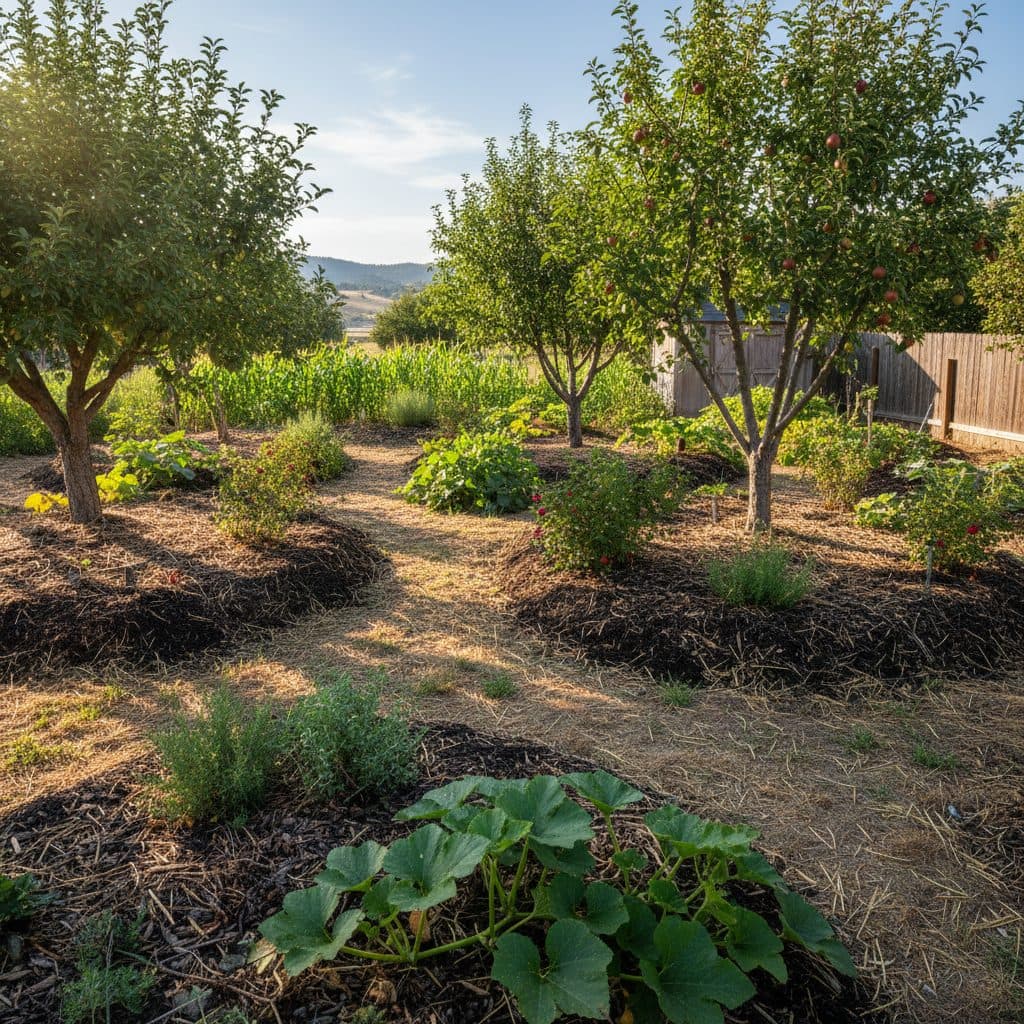
Mulch basins are essentially depressions in the landscape, typically 6 to 18 inches deep, filled with organic material. Their primary function is to slow, spread, and sink water, mimicking natural hydrological processes. When rain falls or greywater is discharged, these basins act as sponges, holding water in place until it can slowly percolate into the soil profile. This is particularly valuable in areas with compacted soils or on slopes where water might otherwise run off quickly, carrying away valuable topsoil.
The benefits extend beyond simple water retention. The organic mulch layer (often wood chips, straw, or shredded leaves) provides a steady supply of nutrients as it breaks down, feeding soil microbes and improving soil structure. This process can increase soil organic matter by 1% to 2% annually, enhancing its water-holding capacity by up to 20,000 gallons per acre-foot of soil. Furthermore, the mulch acts as a thermal buffer, keeping soil temperatures more stable, which protects plant roots during hot summers in USDA zone 7 and above. For more detailed information on capturing free water, consider reading our article on rainwater harvesting.
Key advantages of using mulch basins
Integrating mulch basins into your garden design offers several significant advantages for the US grower. They are particularly effective in areas receiving less than 20 inches of annual rainfall, where every drop counts. Research shows that proper mulching can reduce soil loss by 80% to 90% compared to bare soil, as demonstrated in studies on rice straw mulch [3]. This helps maintain soil fertility and prevents erosion, especially during intense storm events common in many parts of the US.
- Water conservation: Reduces irrigation needs by 25-50%, saving hundreds of gallons per week for a typical 1,000 square foot garden.
- Soil health improvement: Increases soil organic matter, supporting soil organisms and improving nutrient cycling.
- Weed suppression: A 4-6 inch layer of mulch can suppress up to 90% of weed growth, reducing labor.
- Temperature moderation: Keeps soil 10-15°F cooler in summer and warmer in winter, protecting roots.
- Reduced runoff: Prevents valuable topsoil and nutrients from washing away, protecting local waterways.
Designing and building your mulch basin
Effective mulch basin design starts with understanding your site’s topography and soil type. For most applications, a basin should be at least 12 inches deep and have gently sloping sides, creating a bowl shape. The size will depend on the plant it serves; a young fruit tree might need a 3-foot diameter basin, while a mature tree could require one 6-8 feet across. In USDA zone 9, where summer temperatures regularly exceed 95°F, larger basins help retain more moisture through extended dry periods.
When digging, ensure the basin’s bottom is level to promote even water distribution and prevent localized ponding. The excavated soil can be used to build a berm around the downhill side of the basin, increasing its capacity. For greywater applications, position basins at least 10 feet away from any potable water sources or property lines, adhering to local building codes which often specify setbacks for such systems. Consider connecting your greywater source to these basins; more information can be found in our article on greywater systems.
Materials and construction steps
The choice of mulch determines basin performance. Wood chips, aged arborist waste, or straw are excellent options, providing a good carbon-to-nitrogen ratio, ideally around 30:1, which promotes slow decomposition without tying up soil nitrogen. Avoid finely shredded materials that can compact too easily, reducing infiltration rates. A 6-inch initial layer of coarse mulch is a good starting point for most basins, providing adequate water penetration and weed suppression.
- Site selection: Choose locations downhill from water sources (roof downspouts, greywater outlets) and near plants that benefit from consistent moisture.
- Excavation: Dig a basin 12-18 inches deep with a level bottom and gently sloped sides; use excavated soil to create a berm.
- Inlet design: Direct water into the basin using swales, pipes, or a simple hose so it enters without causing erosion.
- Mulch application: Fill the basin with 6-12 inches of coarse organic mulch like wood chips, leaving a 2-3 inch space at the top for water.
- Planting: Place plants directly into the soil at the bottom of the basin, making sure their root crowns are not buried by mulch.
Greywater integration and odor prevention
Integrating greywater into mulch basins is a powerful way to reuse household water, but it requires careful planning to prevent ponding and odors. Greywater, defined as water from showers, baths, and washing machines (excluding toilet water), contains small amounts of organic matter, soaps, and detergents. When discharged into a basin, this water needs to infiltrate quickly to avoid anaerobic conditions, which lead to foul smells. In a typical US home, a family of four can generate 100-150 gallons of greywater daily, making it a substantial irrigation source.
The key to odor prevention lies in rapid infiltration and a healthy soil microbiome. Ensure your basin’s soil has good drainage; if you have heavy clay, amending the soil with 20-30% compost can significantly improve its permeability. The mulch layer itself filters out solids and provides a large surface area for aerobic bacteria to break down organic compounds. Basins should be sized to handle the peak greywater flow from your household, preventing water from standing for more than a few hours. For more on greywater systems, see our dedicated article: Greywater systems: reusing household water in the garden.
Selecting plants and maintaining the system
Not all plants are suitable for greywater-fed basins. Choose plants that tolerate moderate levels of salts and boron, common in some detergents, and have high water demands. Fruit trees like citrus, figs, and pomegranates thrive in these conditions, as do many native shrubs and ornamental grasses. Avoid planting root vegetables or crops that are eaten raw directly in greywater basins, as a precautionary measure, though studies suggest risks are low with proper design. A 2018 study on bioretention basins showed effective nutrient removal, indicating good system function [4].
- Plant selection: Prioritize established trees, large shrubs, or non-edible plants with high water needs, such as a 5-year-old peach tree.
- Mulch type: Use coarse, high-carbon mulch like wood chips, maintaining a 6-12 inch depth to filter greywater and prevent compaction.
- Avoid ponding: Design basins to infiltrate water within 24 hours; adjust size or add more mulch if water stands longer than 12 hours.
- Detergent choice: Use biodegradable, low-sodium, and low-boron soaps and detergents to protect soil and plants.
- Regular checks: Inspect basins monthly for signs of ponding, compaction, or excessive organic buildup, especially in arid USDA zone 10.
Plant selection and long-term maintenance
Choosing the right plants for your mulch basins is critical for their success, especially when using greywater. Plants that are tolerant of fluctuating moisture levels and can handle the occasional influx of mild detergents perform best. In the US Southwest, species like mesquite, palo verde, and various native oaks are excellent choices, as they are adapted to arid conditions but can utilize the extra water. Fruit trees such as citrus (USDA zone 8+), olives, and figs also thrive in these systems, often producing higher yields due to consistent moisture availability. A mature fig tree can easily absorb 20-30 gallons of water per day during peak growing season.
For smaller basins or understory planting, consider drought-tolerant shrubs and perennials. Living mulches, such as specific cover crops, can also be integrated into the basin’s edge to further suppress weeds and add organic matter. For more ideas on suitable groundcovers, explore our article on best living-mulch and cover-crop legumes by USDA zone. The goal is to create a diverse plant community that effectively uses the available water and nutrients, minimizing any potential for runoff or nutrient leaching.
Ongoing care for optimal performance
Mulch basins are relatively low-maintenance, but periodic attention ensures they continue to function effectively. The most important task is replenishing the mulch layer. Over time, organic mulch breaks down and compacts, reducing its volume and effectiveness. Plan to add 2-4 inches of fresh mulch every 6 to 12 months, or when the existing layer has thinned to less than 4 inches. This maintains the necessary depth for weed suppression, moisture retention, and soil aeration. In USDA zone 6, where winters can be harsh, a thicker mulch layer (8-10 inches) provides additional root protection.
- Mulch replenishment: Top up mulch with 2-4 inches of fresh material every 6-12 months, maintaining a 6-12 inch total depth.
- Berm inspection: Check berms annually for erosion or damage, especially after heavy rains exceeding 1 inch per hour.
- Inlet clearing: Ensure water inlets are free of debris to allow unimpeded flow into the basin, preventing blockages.
- Plant health monitoring: Observe plants for signs of stress, which could indicate nutrient deficiencies or issues with greywater quality.
- Weed removal: Hand-pull any persistent weeds that manage to penetrate the mulch layer, especially during the first 1-2 years.
Beyond the basin: integrating with other water strategies
Mulch basins are just one component of a comprehensive water harvesting strategy. When combined with other passive irrigation techniques, their effectiveness multiplies. For instance, connecting your roof’s downspouts to a series of mulch basins can capture thousands of gallons of rainwater annually. A 1,000 square foot roof in an area receiving 30 inches of rain per year can yield over 18,000 gallons of water, a significant portion of which can be directed into basins. This approach reduces reliance on municipal water and lessens stormwater runoff from your property.
Consider integrating basins with wicking beds or ollas for even more targeted irrigation. Ollas, unglazed clay pots buried in the soil, slowly release water directly to plant roots, using 50-70% less water than surface irrigation methods. In a dry climate like that of Arizona, combining these methods can drastically cut water bills and create resilient landscapes. For areas where grid reliability is a concern, even drip irrigation without electricity can be a viable addition, delivering consistent moisture.
Maximizing water efficiency
To truly maximize water efficiency, think of your landscape as a series of interconnected systems. Mulch basins serve as the primary infiltration points for larger water flows, while smaller methods like ollas or wicking beds handle individual plant needs. This layered approach ensures that water is captured at multiple scales and delivered where it’s most needed. For example, a 10-foot diameter basin around a mature fruit tree can hold 100-150 gallons of water from a single rain event, slowly releasing it over several weeks.
- Rainwater harvesting: Direct roof runoff from a 500 square foot roof into basins to capture 300 gallons from a 1-inch rain.
- Olla integration: Bury ollas within basins to provide focused, slow-release irrigation to specific plants, reducing evaporation by 50%.
- Wicking beds: Use wicking beds for vegetable gardens, fed by overflow from larger basins, to maintain consistent soil moisture.
- Permaculture design: Implement a whole-system design that considers water flow, plant needs, and soil health across the entire property.
- Water budgeting: Calculate your landscape’s water needs and available passive water sources to ensure a balanced system, aiming for a 20% surplus.
Comparison of Passive Irrigation Techniques
Technique | Primary Benefit | Water Savings Potential | Best Use Case |
|---|---|---|---|
Mulch Basins | Captures surface runoff and greywater, builds soil | 25-50% | Trees, large shrubs, garden beds |
Ollas | Direct root zone irrigation, minimal evaporation | 50-70% | Individual plants, small garden plots |
Wicking Beds | Constant subsurface moisture, highly efficient | 70-90% | Vegetable gardens, raised beds |
Rainwater Harvesting (Tanks) | Large volume storage for later use | 100% of captured water | Supplemental irrigation, emergency supply |
Water Savings: A properly designed mulch basin system can reduce your garden’s irrigation needs by 25% to 50%, saving hundreds of gallons of water per week in a typical 1,000 square foot garden.
Soil Health Boost: Regular mulching in basins can increase soil organic matter by 1% to 2% annually, improving water retention by up to 20,000 gallons per acre-foot of soil.
Browse water harvesting guides
Frequently asked questions
How deep should a mulch basin be?
A mulch basin should typically be 12 to 18 inches deep with gently sloping sides. This depth allows for significant water retention and a thick layer of organic mulch, which can be 6-12 inches deep, to promote healthy soil and prevent rapid evaporation.
What kind of mulch is best for greywater basins?
Coarse, high-carbon organic mulches like wood chips or aged arborist waste are best for greywater basins. These materials break down slowly, provide good aeration, and help filter out impurities, maintaining a healthy soil environment with a carbon-to-nitrogen ratio around 30:1.
How do I prevent odors in a greywater mulch basin?
To prevent odors, ensure your basin is designed for rapid infiltration, allowing greywater to soak into the soil within 24 hours. Use a thick layer (6-12 inches) of coarse mulch, select appropriate plants with high water demand, and use biodegradable, low-sodium detergents. Regularly check for ponding; if water stands for more than 12 hours, increase basin size or add more mulch.
Can I grow edible plants in greywater mulch basins?
While some growers do, it’s generally recommended to plant non-edible plants, fruit trees, or large shrubs in greywater basins as a precautionary measure. If you choose to grow edibles, avoid root crops or those eaten raw, and ensure your greywater source uses only mild, biodegradable soaps with low boron and sodium content. Many fruit trees, like citrus in USDA zone 9, thrive with greywater.
How often do I need to replenish the mulch?
You should plan to replenish the mulch layer in your basins every 6 to 12 months, or whenever the existing layer thins to less than 4 inches. Adding 2-4 inches of fresh mulch maintains the optimal depth for weed suppression, moisture retention, and soil health, especially in regions with high decomposition rates.
How much water can a mulch basin save?
A well-designed mulch basin system can significantly reduce your garden’s irrigation needs, often by 25% to 50%. For a typical 1,000 square foot garden in an arid climate, this could translate to saving hundreds of gallons of potable water each week during the dry season, leading to substantial water bill reductions.
References
- Assessing nitrous oxide emissions from managed aquifer recharge basins undergoing wet-dry cycling column simulations (2023). Assessing nitrous oxide emissions from managed aquifer recharge basins undergoing wet-dry cycling column simulations.
- Stable isotope-based reconstruction of Oligo-Miocene paleoenvironment and paleohydrology of Central Anatolian lake basins (Turkey) (2013). Stable isotope-based reconstruction of Oligo-Miocene paleoenvironment and paleohydrology of Central Anatolian lake basins (Turkey).
- Laboratory assessment of the influence of rice straw mulch size on soil loss (2019). Laboratory assessment of the influence of rice straw mulch size on soil loss.
- Nutrient Leaching and Greenhouse Gas Emissions in Grassed Detention and Bioretention Stormwater Basins (2018). Nutrient Leaching and Greenhouse Gas Emissions in Grassed Detention and Bioretention Stormwater Basins.
- Effects of regulated deficit irrigation and mulch on yield, water use and crop water productivity of onion in Samaru, Nigeria (2012). Effects of regulated deficit irrigation and mulch on yield, water use and crop water productivity of onion in Samaru, Nigeria.
- USDA Natural Resources Conservation Service (2024). USDA Natural Resources Conservation Service.