Key takeaways
- Broad beans (Vicia faba) thrive in the cool British climate, offering two distinct sowing windows in autumn and late winter.
- Sow cold-hardy varieties such as 'Aquadulce Claudia' in October or November for harvests from late May, ahead of the worst blackfly pressure.
- Start spring crops in deep root trainers or modular trays in February for transplanting into garden beds during March.
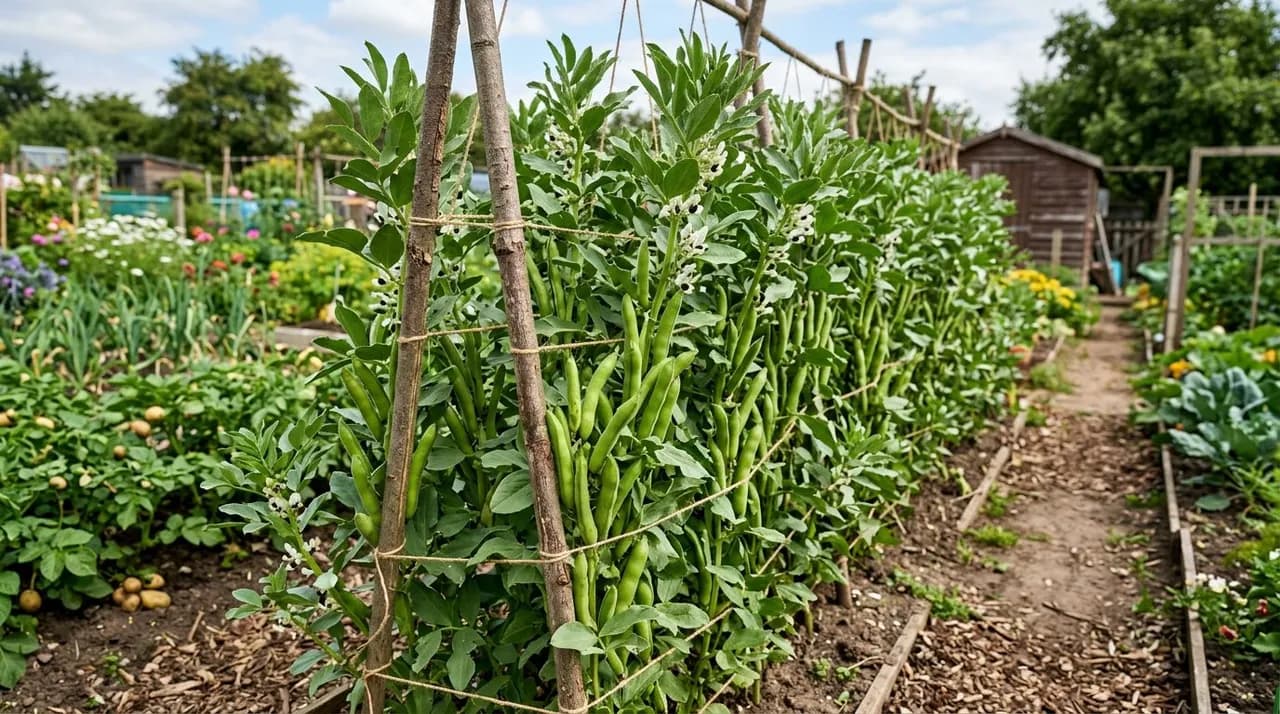
- Erect sturdy perimeter stakes and twine support grids to prevent tall, top-heavy stems from collapsing in spring gales.
- Pinch out the top 5 cm to 7 cm of growing tips once lower flower clusters set pods to deter black bean aphids organically.
Quick answer: To grow broad beans in the UK, sow hardy cultivars in autumn or start seeds in modules in February for early spring planting. Position plants in full sun with fertile, well-draining soil, provide sturdy twine supports, and pinch out growing tips once the lower pods set to knock back blackfly.
Broad beans, known botanically as Vicia faba (and known elsewhere as fava beans), are cold-hardy legumes that have nourished growers across the British Isles for thousands of years.
Broad beans are uniquely suited to the maritime British climate. Unlike heat-sensitive summer legumes like French beans and runner beans, broad beans germinate in chilly soils and withstand hard frost — 'Aquadulce Claudia' comes through most UK winters down to around -10°C. Because they partner with symbiotic Rhizobium bacteria in the soil to fix atmospheric nitrogen, they actively enrich your soil biology while producing heavy yields of tender, nutty beans.
Whether you sow seeds in autumn to bridge the hungry gap in late spring or start modular trays in February, broad beans need straightforward care: select reliable cultivars, support tall stems against wind, manage blackfly, and harvest before pods toughen.
Sowing calendars: autumn vs spring timings
British growers enjoy two distinct opportunities to sow broad beans, each offering specific horticultural advantages:
1. Autumn sowing (October to November)
Sowing in late autumn allows seedlings to establish strong, cold-hardened root systems before winter dormancy:
- Best varieties: Choose proven winter-hardy longpod cultivars, most notably 'Aquadulce Claudia' or 'Super Aquadulce'.
- Advantages: Autumn-sown crops emerge rapidly in early spring, flowering by April and yielding harvests in May, up to four weeks earlier than spring-sown crops. Early pod development completes before black bean aphid populations reach their summer peak.
- Site requirements: Autumn sowing works best on light, free-draining sandy loam. On cold, heavy, waterlogged clay, large seeds often rot over winter; growers on heavy ground should opt for late winter module sowings instead.
2. Late winter and spring sowing (February to April)
Spring sowing provides reliable establishment across all UK soil types:
- Indoor module sowing (February to March): Sow seeds 5 cm deep in deep root trainers or 9 cm pots filled with peat-free multi-purpose compost inside an unheated greenhouse or cold frame. For step-by-step guidance on seasonal timings, see what to plant in february uk.
- Direct outdoor sowing (March to April): Direct sow once outdoor soils reach at least 6°C to 8°C and dry out sufficiently to allow raking into a fine tilth.
- Top spring cultivars: 'Masterpiece Green Longpod' (superb table flavour), 'Bunyards Exhibition' (reliable heirloom yield), and 'The Sutton' (compact dwarf variety growing only 30 cm to 45 cm tall, ideal for windy allotments and container growing).
Soil preparation and planting mechanics
Broad beans are adaptable but perform best in moisture-retentive, well-aerated soils with a neutral pH (6.5 to 7.0).
- Bed preparation: In late winter or prior to autumn sowing, fork over the bed and incorporate a generous layer of garden compost or well-rotted farmyard manure. Avoid high-nitrogen chemical feeds, which encourage soft, leafy growth prone to fungal diseases like chocolate spot.
- Sowing depth and spacing: Plant seeds 5 cm deep. Arrange plants in traditional double rows: space seeds 20 cm to 25 cm apart within each row, with 20 cm to 25 cm between the two rows of the pair. Leave a working path of 60 cm to 75 cm between adjacent double rows.
- Staggering sowings: An autumn sowing starts the season in late May; successive sowings four weeks apart from February to April then carry the harvest through June and July.
For growers planning multi-year rotational systems, integrating legumes with perennial vegetables for UK gardens and managing disease-prone plots alongside club root brassica management creates a balanced, highly productive plot layout.
Building sturdy wind supports
As broad bean plants mature, they develop thick, upright, hollow stems reaching 1 to 1.5 metres in height. Once these stems become laden with heavy clusters of full pods, sudden spring downpours and gusty winds will cause the entire crop to collapse into a tangled, muddy heap.
Collapsed stems suffer reduced airflow, encourage slug damage, and make plants highly susceptible to fungal rot.
Constructing a perimeter staking grid
- Drive sturdy 5 cm x 5 cm timber stakes or thick hazel posts (1.5 metres tall) firmly into the ground at each corner of the double row, plus intermediate stakes every 1.5 to 2 metres along long beds.
- Tie strong, rot-resistant garden twine around the perimeter stakes at a height of 30 cm above the ground.
- Add a second horizontal tier of twine at 60 cm, and a third tier at 90 cm as the plants gain height.
- Run diagonal strings across the interior of the bed between opposite stakes to create a supporting mesh framework that keeps individual stems upright during storms.
For dwarf cultivars like 'The Sutton', a simple system of short bamboo canes and single horizontal strings is sufficient.
Managing pests and diseases organically
Broad beans are hardy, but two specific biological challenges require attentive organic management during the UK growing season:
1. Black bean aphid (Aphis fabae)
Blackfly colonies multiply quickly during warm, humid spells in May and June, smothering tender growing tips, sucking sap, and covering the plant in sticky honeydew that leads to black sooty mould.
- The Pinching-Out Method: This classic horticultural technique is the most effective organic defense. As soon as the lowest four to six clusters of white-and-black flowers have dropped their petals and formed small, visible green bean pods (roughly 2 cm to 3 cm long), snap off the top 5 cm to 7 cm of the growing tip on every stem.
- Why it works: Aphids colonize the soft, succulent apical meristem tissue. Removing the tender tips removes their primary food source, toughens the remaining foliage, and redirects the plant's metabolic energy directly into swelling the lower pods.
- Culinary bonus: Fresh broad bean tips are tender; steam or sauté them lightly with garlic and butter.
- Natural predators: Plant nectar-rich flowers nearby, such as poached egg plant (Limnanthes douglasii), calendula, and sweet alyssum. These attract hoverflies, lacewings, and ladybirds whose larvae consume hundreds of aphids daily. For comprehensive non-chemical pest suppression, consult our guide on how to get rid of aphids and explore plants for pollinators.
2. Chocolate spot (Botrytis fabae)
Chocolate spot is a fungal condition that manifests as reddish-brown, chocolate-colored specks across leaves and stems, expanding into larger necrotic patches during prolonged wet, humid weather.
- Prevention: Ensure generous spacing between rows to promote rapid air circulation. Avoid overly damp, shaded microclimates.
- Action: If chocolate spot appears during damp spring spells, strip off and bin heavily infected lower leaves to slow the spread. Most healthy, well-spaced plants will continue swelling their pods despite minor leaf spotting.
Harvesting and kitchen preparation
Knowing when to pick broad beans dictates the flavour and culinary texture of your harvest:
- Baby beans (early pickings): In late May and early June, harvest whole young pods when they are 7 cm to 10 cm long. At this juvenile stage, the entire pod is tender and can be cooked whole like mangetout or sugar snap peas.
- Prime shelling stage: Pick pods when the seeds are clearly visible swelling against the outer pod wall, but before the pod skin turns tough and leathery. The inner beans should be bright green and roughly the size of a thumbnail.
- Checking the hilum (bean scar): Open a pod and examine the small scar (hilum) where the bean attaches to the pod lining. If the scar is white or pale green, the bean is at its peak of sweetness and tenderness. If the scar has turned dark brown or black, the beans are mature and starchy; these older beans should be double-podded (removing the tough outer skin after blanching for 60 seconds) or dried for winter stews.
- Harvesting mechanics: Always pick pods with a downward twisting motion, or cut them away with secateurs. Never pull upwards on the stem, which tears the stem skin and snaps off lateral fruiting side shoots.
Post-harvest root care: leaving nitrogen in the soil
When your broad bean harvest concludes in midsummer, do not yank the entire root system out of the ground.
Cut the spent stems off at ground level using loppers or a sharp sickle, and add the disease-free green foliage to your compost heap. Leave the underground root system undisturbed in the soil. As the roots and their Rhizobium nitrogen nodules decompose naturally over the following weeks, they release locked atmospheric nitrogen directly into the rhizosphere.
This leaves broad bean beds nutrient-rich for following autumn brassicas, winter leeks, or leafy autumn greens.