Key takeaways
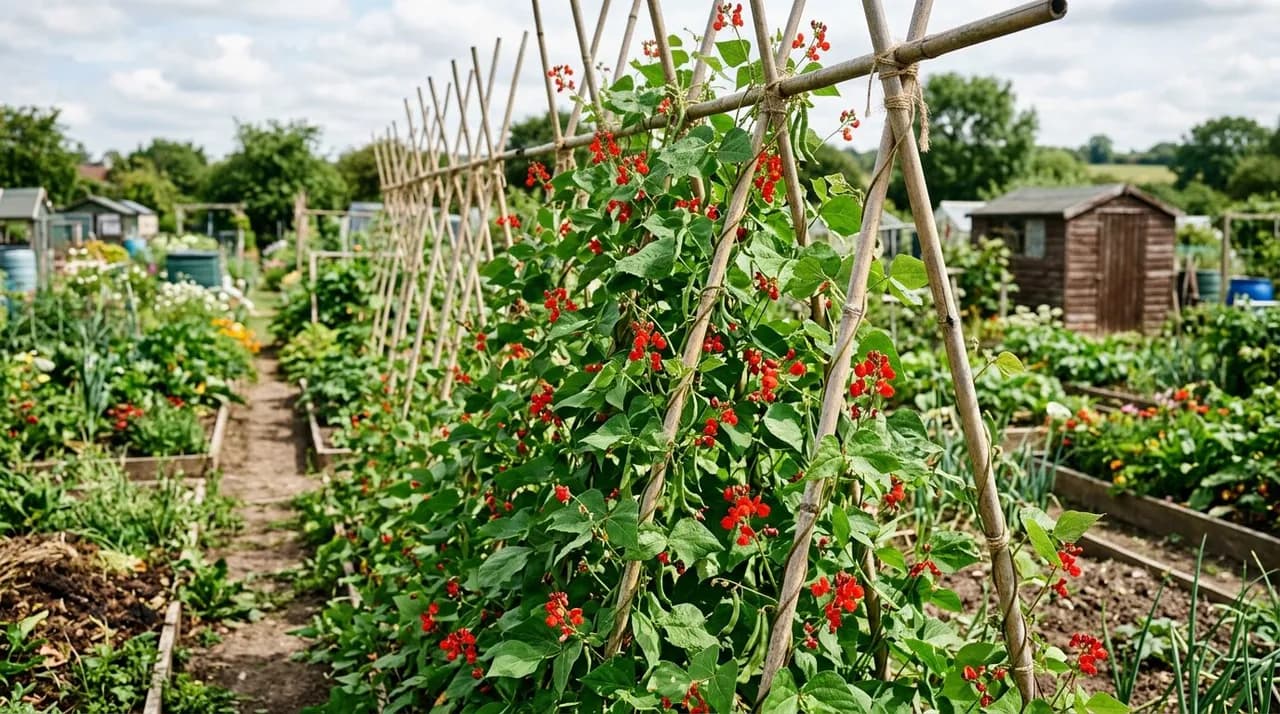
- Runner beans (Phaseolus coccineus) are vigorous, climbing perennial legumes cultivated as tender annuals across UK allotments.
- Prepare a traditional moisture-retentive bean trench in autumn or early spring filled with well-rotted manure, compost, and shredded paper.
- Erect sturdy 2.4-metre bamboo cane A-frames or wigwams tied securely with twine and braced against strong prevailing winds.
- Sow indoors in April or direct sow outdoors 5 cm deep in late May and June after all frost risk has passed.
- Poor flower set ("runner beans not setting") is caused by dry roots, high heat above 28°C, or lack of bee pollination; soak root bases in the evening.
Quick answer: To grow runner beans successfully in the UK, plant seeds 5 cm deep in late May or transplant hardened-off seedlings at the base of a sturdy 2.4-metre cane frame. Provide deep, moisture-retentive soil rich in organic matter, water heavily at the base during flowering, and pick pods regularly while young.
The runner bean (Phaseolus coccineus) is a traditional British allotment crop. Grown for its scarlet, white, or bicoloured flowers and yields of long, tender pods, a row of runner beans provides both garden colour and a productive harvest.
Unlike common French beans, runner beans are native to the high-altitude, cool subtropical regions of Central America, making them naturally well-suited to the mild, temperate conditions of British summers.
However, runner beans have high water demands and sensitive flowers. Good soil preparation, sturdy cane supports, and steady root moisture during summer heat provide continuous harvests from July until the first autumn frosts.
Preparing the traditional bean trench: soil and moisture
Runner beans develop extensive, thirsty root systems that demand deep, moisture-retentive soil rich in organic humus:
+-----------------------------------------------------------------------+
|                    THE TRADITIONAL BEAN TRENCH                        |
+-----------------------------------------------------------------------+
|  Topsoil Layer (15-20 cm): Mixed with well-rotted garden compost      |
|  -------------------------------------------------------------------  |
|  Organic Core (15-20 cm): Aged horse manure, damp cardboard/paper     |
|  -------------------------------------------------------------------  |
|  Subsoil Base: Forked over to loosen compaction and ensure drainage   |
+-----------------------------------------------------------------------+
Why the trench method works
Runner beans require constant moisture around their root zone to sustain rapid vine growth and encourage flower fertilization. In light or sandy soils that dry out quickly, creating a dedicated trench creates a spongy, subterranean moisture reservoir that holds water through summer dry spells.
How to build a bean trench
- Timing: Dig the trench in late autumn or early spring (between November and March).
- Excavation: Dig a straight trench roughly 60 to 90 cm wide and 30 to 40 cm deep along your planned planting line.
- Organic Base Layer: Fill the bottom half of the trench with a mixture of well-rotted farmyard manure, homemade garden compost, and damp, unprinted shredded cardboard or newspaper. Cardboard absorbs and stores subsoil moisture like a sponge.
- Backfill: Backfill the trench with the excavated topsoil, mixing in additional aged compost, and allow the ground to settle naturally before planting in May. To learn more about building compost, read our guide on composting.
Building sturdy cane supports: A-frames vs wigwams
Runner bean vines grow vigorously, easily reaching heights of 2.4 to 3 metres (8 to 10 feet) by midsummer. A full crop of foliage and beans catches strong winds like a sail, requiring a sturdy structural frame:
[ Option A: The A-Frame ]              [ Option B: The Wigwam ]
   / \   / \   / \   / \                      / |   /   \ /   \ /   \ /   \                    /  |   /**___\/_\/____\                  /**_|___(Horizontal ridge cane + braces)       (Center cane + radial canes)
1. The double-row A-frame (best for allotment rows)
- Drive two parallel rows of 2.4 m (8 ft) bamboo canes spaced 60 to 75 cm apart, with 25 to 30 cm between canes in each row.
- Angle the canes inward so they cross roughly 15 cm below their tops.
- Lay a long horizontal ridge cane across the intersections and lash every crossing point tightly with tarred garden twine.
- Wind Bracing: Attach diagonal brace canes at both ends of the row and anchor them firmly into the ground to prevent the entire structure from collapsing under strong westerly summer gales.
2. The freestanding wigwam (best for small gardens and borders)
- Push six to eight 2.4 m canes into the ground in a circle measuring 1 metre in diameter.
- Bring the tops together at the center and tie securely with soft twine.
- Wigwams occupy a compact footprint and add attractive architectural height to mixed vegetable and flower borders.
Sowing and planting out runner beans
Timing your sowing accurately avoids late spring frosts while establishing strong, pest-resistant plants:
[ Method 1: Indoor Sowing (April) ]   -----> 7.5 cm pots, 15-20°C, plant out late May
[ Method 2: Outdoor Sowing (May/June) ]-----> Direct sow 5 cm deep at base of canes
Method 1: Sowing indoors under cover (recommended)
Starting seeds indoors produces sturdy seedlings that resist early slug damage:
- Sow seeds individually 5 cm (2 inches) deep into 7.5 cm pots or deep modular root trainers filled with quality peat-free compost in mid-to-late April.
- Maintain temperatures between 15°C and 20°C. Seeds germinate rapidly within 7 to 10 days.
- Grow seedlings in bright light to keep stems thick and sturdy.
- Harden off plants gradually for 7 to 10 days in early May.
- Transplant one seedling at the base of each cane in late May or early June after all frost risk has passed. For substrate details, see our guide on peat free compost.
Method 2: Direct sowing outdoors
- Direct sow in late May or early June once soil temperatures exceed 12°C.
- Plant two seeds 5 cm deep at the base of each cane.
- If both seeds germinate, thin to the single strongest seedling when plants reach 10 cm in height.
Review companion seasonal plantings in our guide on what to plant in May in the UK.
Why runner beans fail to set pods and how to fix it
One of the most frequent frustrations for allotment holders is a vine covered in bright scarlet flowers that wither and drop without forming bean pods ("runner beans not setting"):
+-----------------------------------------------------------------------+
|                    CAUSES OF POOR RUNNER BEAN SET                     |
+-------------------+-----------------------+---------------------------+
| PRIMARY CAUSE     | MECHANISM             | PRACTICAL FIX             |
+-------------------+-----------------------+---------------------------+
| Dry Roots         | Water stress triggers | Soak base heavily in the  |
|                   | flower abscission     | evening (10-15 L per cane)|
| High Temperatures | Temps >28°C impair    | Mist foliage; plant self- |
|                   | pollen viability      | fertile cross cultivars   |
| Low Pollination   | Wind prevents bumble- | Grow bee-attracting herbs |
|                   | bee visits            | near the bean structure   |
+-------------------+-----------------------+---------------------------+
1. Root zone drought
Runner bean flowers will drop off cleanly if the root system lacks steady moisture. During the flowering period (July and August), irrigate the base of the plants heavily two to three times per week, applying roughly 10 to 15 litres of water per metre of row in the cool of the evening.
2. Summer heatwaves (>28°C)
Extreme daytime heat reduces pollen viability, preventing flower fertilization. Syringe or mist the flowering vines with a fine hose spray on warm evenings to raise local humidity and cool the floral canopy.
3. Selecting self-fertile cultivars
Traditional runner bean varieties require insect pollination (primarily by long-tongued bumblebees) to set fruit. Modern British breeding has produced semi-self-fertile French-runner bean crosses that set heavy crops even in hot, windy, or bee-scarce conditions:
- 'Moonlight': White-flowered, smooth tender pods, high self-fertility.
- 'Firestorm': Scarlet-flowered, thick fleshy pods, sets reliably through heatwaves.
Harvesting, maintenance, and seasonal cleanup
Keep your runner bean crop producing tender, stringless pods throughout the season:
- Pick Young and Often: Harvest pods when they are 15 to 20 cm (6 to 8 inches) long, smooth, and flexible, before the internal seeds swell. Picking every two to three days prevents seeds from maturing, signaling the plant to continue producing fresh floral flushes until autumn frosts.
- Pinching the Growing Tips: When the climbing vines reach the top of the cane frame (roughly 2.4 metres), pinch off the growing tips. This halts vertical climbing and diverts the plant's energy into lateral flowering shoots lower down the stem.
- Autumn Soil Enrichment: When winter frosts terminate the vines in October, cut the stems down at soil level. Leave the fleshy tuberous roots in the ground to rot down; as legume roots, they release stored nitrogen and organic matter into the soil profile. To plan crop rotation for the following season, see our guide on how to grow potatoes.