Key takeaways
- Avoid unpainted white Schedule 40 plumbing PVC for sun-exposed hoops: UV radiation yellows and embrittles it in 2–4 seasons, risking sudden snap failure under arch tension. Use gray UV-stabilized UL-651 electrical PVC or galvanized EMT steel instead.
- Galvanized 3/4-inch EMT conduit costs $40–$55 more upfront on a 4×8 ft bed than PVC, but never sags at 105°F+ ambient temperatures and delivers a lower 10-year cost per season.
- Match shade density to crop physiology: university extension trials confirm 30%–40% shade maximizes tomato and pepper yields by cutting blossom drop without starving PAR light, while 50%–60% delays bolting in lettuce and spinach.
- Always call 811 before driving 12–18 inch rebar anchor stakes into the ground, leave open sides for airflow and pollinators, and attach cloth with quick-release ball bungees so you can strip the canopy ahead of 35+ mph storms.
- Never drape shade cloth directly onto leaves—keep 12–24 inches of vertical clearance above mature canopy height to prevent contact scorch and trapped fungal humidity.
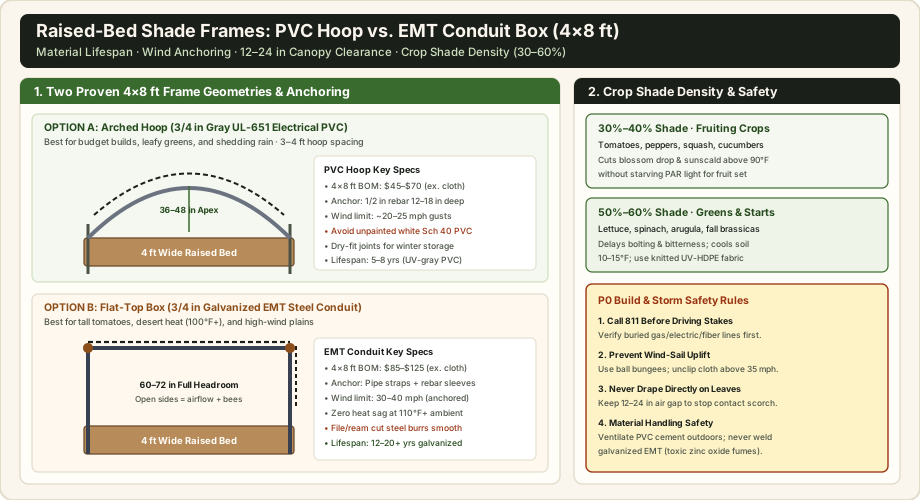
Quick answer: For a 4×8 ft raised bed, choose 3/4-inch gray UL-651 electrical PVC conduit ($45–$70 for the frame, 5–8 year UV lifespan) when building a budget arched hoop over greens or short crops, and choose 3/4-inch galvanized EMT steel conduit ($85–$125, 12–20+ year lifespan) for tall tomatoes, 100°F+ desert heat, or 30+ mph winds. Skip unpainted white Schedule 40 plumbing PVC because UV light turns it brittle under bend tension. Pair your frame with 30%–40% knitted HDPE shade cloth for fruiting crops (tomatoes, peppers, squash) or 50%–60% for lettuce and spinach, keeping 12–24 inches of air gap above foliage.
Why Raised Beds Overheat Faster—and When Shade Cloth Pays Off
Raised wooden and steel beds warm up rapidly in spring, which is an advantage in April and a liability in July. Because air circulates around all four sidewalls, soil in a 12-to-18-inch raised bed routinely runs 8°F to 14°F warmer than adjacent in-ground plots. Once air temperatures hold above 90°F, cool-season greens like lettuce and spinach bolt within days—a physiological response detailed in our guide to why crops bolt from heat and day length.
Warm-season fruiting crops suffer too. According to University of Delaware Cooperative Extension and Penn State Extension heat-stress guidance, pollen viability in tomatoes and peppers drops sharply when daytime highs exceed 90°F–95°F and night temperatures stay above 75°F, triggering blossom drop and leathery white sunscald patches on exposed shoulders. A suspended shade frame drops leaf-surface and soil temperatures by 10°F to 15°F while cutting evaporative moisture loss by 20% to 30% when paired with deep morning summer container and bed watering and organic mulch.
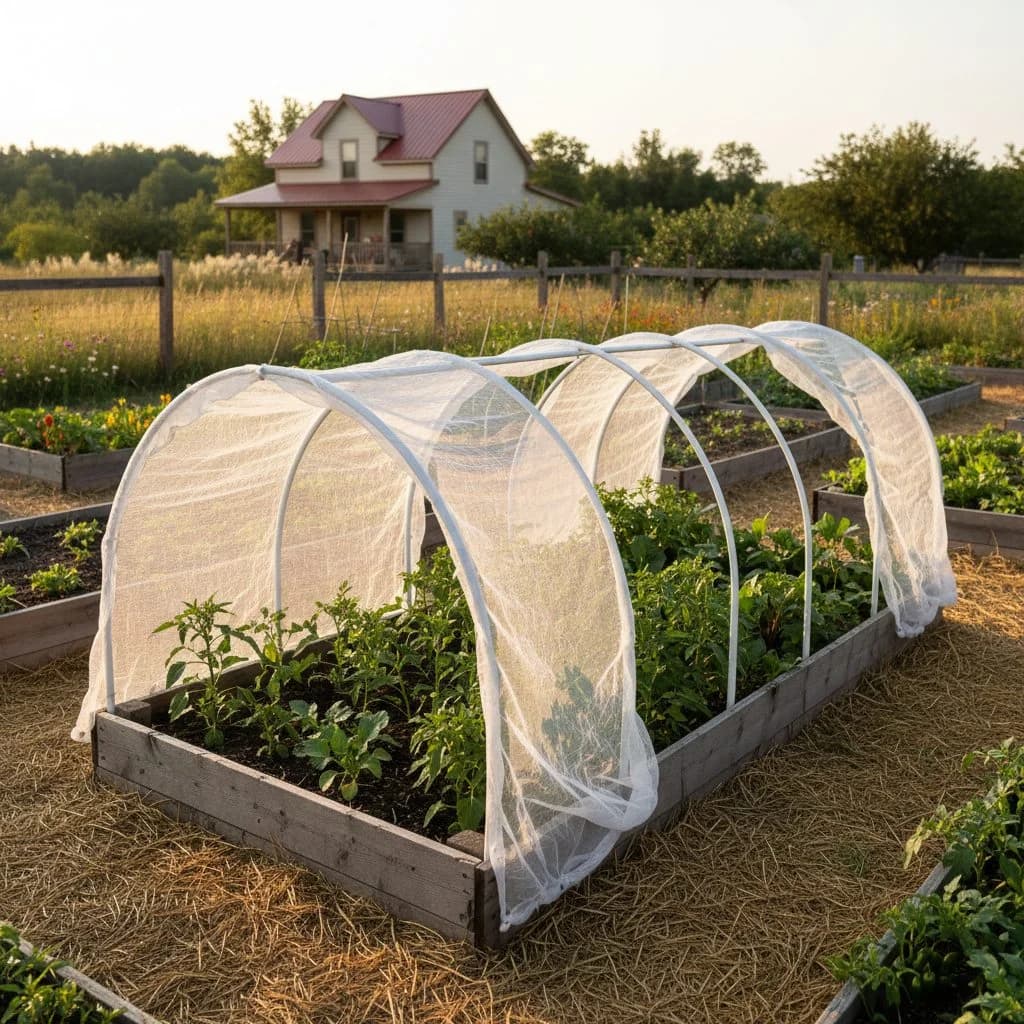
Shade structures are not limited to desert Southwest gardens in USDA Zones 9 and 10. Growers across the Midwest, Mid-Atlantic, and Southeast (Zones 6–8) use removable frames during July–August heat domes and again in late August to establish tender fall cabbage and cauliflower transplants. If you already run a DIY hoop house for spring frost protection, the exact same backbone converts to a summer shade frame in ten minutes by swapping 6-mil greenhouse film for knitted shade cloth.
White PVC vs. Gray Electrical PVC vs. Galvanized EMT Conduit
Most DIY tutorials lump all plastic pipe together as generic PVC, which leads to cracked arches and sagging rooflines by year two. Three distinct conduit and pipe materials sit side by side at every US home center, and they behave very differently under UV load, 100°F+ heat, and summer thunderstorm gusts.
Engineering & 10-Year Cost Comparison for a 4×8 ft Raised-Bed Shade Frame (Excluding Cloth)
Specification | White Sch 40 Plumbing PVC (3/4 in) | Gray UL-651 Electrical PVC (3/4 in) | Galvanized EMT Steel Conduit (3/4 in) |
|---|---|---|---|
Upfront 4×8 ft Frame Cost | $38–$55 | $45–$70 | $85–$125 (with structural connectors) |
UV & Outdoor Lifespan | 2–4 years (yellows, turns brittle) | 5–8 years (UV-inhibitor formulated) | 12–20+ years (zinc-galvanized steel) |
10-Year Cost of Ownership | $115–$165 (2–3 rebuilds) | $60–$95 (1–2 builds) | $85–$125 (single build) |
Heat-Sag Resistance (100°F+) | Poor (softens and sags above 100°F) | Fair (needs 3–4 ft hoop spacing) | Excellent (zero thermal sag) |
Anchored Wind Gust Rating | 15–20 mph (snap risk when aged) | 20–25 mph (flexes safely when new) | 30–40 mph (rigid with rebar + straps) |
Best Frame Geometry | Short-term budget hoops only (paint exterior) | Arched low/mid hoops (36–48 in apex) | Flat-top box frames (60–72 in tall) & high-wind beds |
Required Tools | Ratcheting PVC cutter or hacksaw | PVC cutter or hacksaw; dry-fit or PVC cement | Tubing cutter/hacksaw, metal file/reamer, hex key |
Why gray UL-651 electrical PVC beats white plumbing PVC
Standard white Schedule 40 plumbing pipe is formulated for buried or indoor pressurized water lines—not continuous ultraviolet exposure. After two summers in direct sun, UV photodegradation breaks polymer chains, turning the pipe chalky and brittle. Bending aged white PVC into a tight arch over a 4-foot bed can cause a sudden brittle fracture. Gray Schedule 40 electrical PVC conduit (marked UL 651, sunlight resistant) costs only $1 to $2 more per 10-foot stick, includes built-in UV stabilizers, and comes with a flared belled end that lets you join sticks cleanly without extra couplings. If you already own white PVC, brush on two coats of exterior water-based acrylic latex paint to block UV rays.
When galvanized EMT conduit is worth the extra $45
Electrical Metallic Tubing (EMT) is thin-walled galvanized steel sold in 10-foot sticks at $7 to $11 each for 3/4-inch diameter. Unlike PVC, EMT never softens when summer air hits 105°F in Texas, Arizona, or California's Central Valley. Paired with steel structural clamp connectors (90-degree elbows and T-connectors) instead of electrical set-screw fittings, 3/4-inch EMT builds a rigid 5-to-6-foot-tall flat-top box over indeterminate tomatoes that doubles as an overhead trellis bar for stringing vines. Skip 1/2-inch pipe for both PVC and EMT on 8-foot spans—the modest $12–$18 savings is not worth the mid-span sag.
P0 Material Safety—PVC Solvents and Galvanized Steel Fumes: If you glue PVC joints, apply primer and cement outdoors or in cross-ventilated shade while wearing nitrile gloves—tetrahydrofuran and MEK vapors are hazardous in enclosed garages. Better yet, dry-fit your shade frame and pin joints with removable 1/4-inch clevis pins or self-tapping screws so you can disassemble and store the frame indoors each winter. For EMT conduit, always file or ream freshly cut steel ends smooth so burrs do not slice hands or shred shade cloth, and NEVER weld or torch-heat galvanized EMT (heating zinc coating releases toxic zinc-oxide fumes that cause metal fume fever).
Choosing the Right Shade Cloth Percentage by Crop
A sturdy frame still underperforms if you drape the wrong shade percentage over it. Shade cloth is rated by the fraction of incoming sunlight it blocks: a 30% cloth blocks 30% of solar radiation and transmits 70% Photosynthetically Active Radiation (PAR). Over-shading fruiting vegetables with 60%–70% fabric is one of the most common backyard mistakes; plants respond by stretching into tall, weak stems with fewer blossoms and lower fruit sugar.
Extension-Verified Shade Cloth Density & Clearance by Vegetable Group
Crop Group | Recommended Shade % | Min Clearance Above Mature Canopy | Key Horticultural Benefit & Caveat |
|---|---|---|---|
Fruiting warm-season (tomatoes, peppers, eggplant) | 30%–40% (up to 40%–50% only in 105°F+ desert heat) | 18–24 in (total frame height 60–72 in) | Cuts blossom drop & fruit sunscald without starving PAR light; keep sides open for vibration/bee pollination |
Vining cucurbits (cucumbers, summer squash, melons) | 30%–40% | 12–18 in (higher if trellised) | Prevents midday leaf flagging; leave east/west skirts open so honeybees and squash bees reach flowers |
Cool-season leafy greens (lettuce, spinach, arugula, chard) | 50%–60% | 12–18 in (total frame height 36–48 in) | Delays bolting and bitterness; lowers soil surface temp 10°F–15°F for summer succession sowing |
Fall brassica seedlings & fresh transplants (broccoli, kale, cabbage) | 50%–60% for first 7–14 days, then remove or drop to 30% | 12–18 in | Prevents transplant shock during August heatwaves; transition to full sun once established |
Root crops (carrots, beets, radishes) | 30%–50% during germination, then 30% | 12 in | Keeps top 1/2 in soil crust moist so slow-germinating carrot seed does not bake out |
Knitted vs. woven HDPE cloth—and why color rarely justifies a premium
Always specify UV-stabilized knitted high-density polyethylene (HDPE) shade cloth rather than woven polypropylene. Knitted lock-stitch mesh will not unravel when you cut custom widths with shears, resists tearing at grommet points, and breathes freely so trapped heat escapes upward. University of Delaware shade trials comparing black, white, red, and reflective aluminized cloths found that standard black knitted HDPE cools vegetable canopies just as effectively as specialty colored fabrics at a fraction of the cost. White or aluminized cloth reflects slightly more infrared heat in enclosed high tunnels, making it worth the 15%–25% premium only in triple-digit desert zones.
Avoid mixing tomatoes and lettuce under a single blanket shade percentage. If both share an 8-foot bed, clip a 4×6 ft panel of 50% cloth over the north end for greens and a 30% panel over the south end for fruiting crops. On cool, overcast weeks, unclip and roll the cloth back to the north rail so plants capture full daylight.
Exact 4×8 ft Cut List, Step-by-Step Build & Anchoring
Both designs below fit a standard 4×8 ft raised bed with 10-foot conduit sticks so you minimize waste cuts. Measure your bed's exact outside width before cutting—dimensional lumber beds built from 2×12 boards measure 48 inches wide, while corrugated wicking beds or modular kits vary from 42 to 50 inches.
Complete Bill of Materials for a 4×8 ft Raised-Bed Shade Frame
Component | Option A: Arched Gray PVC Hoop (42 in Apex) | Option B: Rigid EMT Flat-Top Box (60 in Tall) |
|---|---|---|
Primary Pipe / Conduit | 4× 10-ft sticks of 3/4 in gray UL-651 PVC (3 hoops + 1 ridge pole) | 6× 10-ft sticks of 3/4 in galvanized EMT (6 posts, 2 top rails, 3 crossbars) |
Connectors / Fittings | 3× 3/4 in PVC crosses or 4-way tees (or UV zip ties for ridge) | 4× 90° structural corner connectors + 2× T-connectors (for middle posts) |
Anchoring Hardware | 6× 24-in lengths of 1/2 in steel rebar OR 12× two-hole 3/4 in pipe straps | 6× 24-in lengths of 1/2 in rebar sleeves + 12× galvanized 3/4 in pipe straps |
Shade Cloth Size | 8 ft × 12 ft knitted UV-HDPE (allows drape + tuck) | 6 ft × 10 ft top panel (+ optional 4 ft × 8 ft west afternoon skirt) |
Fasteners | 16–20× 3/4 in greenhouse snap clamps or 6-in ball bungee cords | 16–20× 6-in UV ball bungee cords (quick storm release) |
P0 Safety Rule—Call 811 Before Driving Rebar Stakes: Buried natural gas lines, irrigation mains, fiber-optic cables, and low-voltage electrical conduits frequently sit 6 to 18 inches below backyard soil. Before hammering rebar anchor stakes around a raised bed, call 811 (free nationwide in the US) at least 48 to 72 hours in advance so utility locators mark buried lines. If your raised bed sits on a patio or over shallow utilities, skip ground rebar entirely and bolt two galvanized pipe straps per post directly into the timber bed walls.
Building Option A: Arched 3/4-inch gray PVC hoop frame (60 minutes)
- Mark three hoop stations along the 8-foot bed: one at each end (4 inches in from the corners) and one dead center at 48 inches. Spacing hoops 4 feet apart stops knitted shade cloth from pocketing rain or sagging onto plants.
- Drive six 24-inch lengths of 1/2-inch rebar 14 to 16 inches into the soil along the inside corners and midpoints of the bed, leaving 8 to 10 inches exposed vertically. Alternatively, screw two 3/4-inch galvanized two-hole pipe straps vertically onto the inside wooden wall at each station, spaced 8 inches apart.
- Slide one end of a 10-foot stick of 3/4-inch gray electrical PVC over a rebar stake, bend it smoothly across the 4-foot bed width, and seat the opposite end over the matching rebar. A 10-foot stick over a 4-foot span creates a 42-to-46-inch center apex—plenty of clearance for spinach, lettuce, carrots, and bush beans.
- Cut the fourth 10-foot stick to 8 feet 2 inches and lash or tee-fit it horizontally along the top apex of all three arches as a spine ridge pole. Without a ridge pole, wind pushes the arches sideways like dominoes.
- Drape the shade cloth over the hoops, pull it evenly taut without distorting the arch, and lock it down with 3/4-inch greenhouse snap clamps or ball bungees every 18 to 24 inches.
Building Option B: Rigid 3/4-inch EMT flat-top box frame (2 hours)
- Cut six vertical posts to 60 inches (or 72 inches for tall indeterminate tomatoes and trellised cucumbers), two 96-inch top side rails, and three 48-inch top crossbars using a rotary tubing cutter or 24-TPI hacksaw blade.
- Ream and file every cut end smooth with a half-round metal file so zero sharp burrs remain to snag skin or slice shade cloth.
- Anchor the six vertical posts by slipping them over 14-inch-deep rebar sleeves AND clamping each post to the wooden raised-bed sidewall with two 3/4-inch galvanized pipe straps. On metal raised beds where you cannot screw into walls, drive rebar 18 inches deep inside the bed corners and add a lower perimeter brace rail.
- Connect the two 96-inch side rails and three 48-inch crossbars across the top using structural EMT clamp connectors tightened with a 5 mm hex key. Dry-check that the rectangle is square.
- Attach the 6×10 ft shade cloth across the roof using 6-inch UV ball bungee cords looped through brass grommets and around the EMT rails. In hot western exposures, clip a second drop-curtain panel along the west side only to block brutal 2:00 PM–6:00 PM sun while leaving the east, north, and south sides wide open for cross-breezes and pollinators.
Wind-Sail Physics, Pollinator Access & Seasonal Maintenance
A 6×10 ft shade canopy presents 60 square feet of sail area. Even knitted 40% mesh catches substantial lift during 35–50 mph summer thunderstorm outflows. Never use permanent steel wire or heavy zip ties to lock shade cloth onto an unbraced frame—if a sudden squall hits, you want the fasteners to give or be removable in under two minutes rather than ripping the entire frame out of the raised bed and snapping your plants.
- Use 6-inch UV-stabilized ball bungee cords as your primary fasteners: they absorb gust shock without tearing grommets and unhook in 60 seconds when severe thunderstorm or monsoon warnings issue.
- Keep at least 12 to 24 inches of vertical clearance between the highest leaves and the shade fabric. Contact between sun-heated black HDPE and foliage causes localized leaf scorch and traps humid micro-pockets that accelerate early blight and powdery mildew—problems we diagnose in yellow tomato leaves decoded and tomato and cucurbit wilting during fruit set.
- Leave the lower 2 to 3 feet of side walls open whenever possible. Enclosed four-sided shade boxes cut wind-driven cooling, raise relative humidity, and block bumblebees and native solitary bees from pollinating cucumbers, squash, and peppers.
- Pair overhead shade with 2 to 3 inches of straw or shredded-leaf mulch and deep early-morning irrigation; see watering transplants in summer heat and watering at the wrong time doubles usage for schedules that cut water waste further.
- Strip and fold the shade cloth dry in autumn once afternoon highs drop reliably below 80°F. Storing both knitted HDPE cloth and dry-fit gray PVC out of winter UV and snow load doubles service life.
If you garden in a cooler northern climate and want your frame to pull double duty in spring and autumn, swap the shade cloth for frost fabric or 6-mil greenhouse film and follow our cold frame gardening and drip irrigation for sandy soil guides to automate moisture under cover.