Key takeaways
- Prioritize consistent incorporation of organic matter to improve water and nutrient retention in sandy soils.
- Select vegetable varieties specifically bred for heat tolerance, drought resilience, and disease resistance in warm climates.
- Implement extensive mulching with materials like pine bark or straw to conserve soil moisture and regulate soil temperature.
- Utilize efficient irrigation methods such as drip systems to deliver water directly to plant roots, reducing waste by 30-50%.
- Understand and adapt to Florida’s unique growing seasons, which often allow for two or more planting cycles per year.
- Regularly test soil pH and nutrient levels to make precise amendments, as sandy soils can leach nutrients quickly.
Quick answer: To garden successfully in Florida’s sandy soils, consistently incorporate organic matter to improve water and nutrient retention, select heat-tolerant vegetable varieties, and utilize efficient irrigation methods like drip systems.
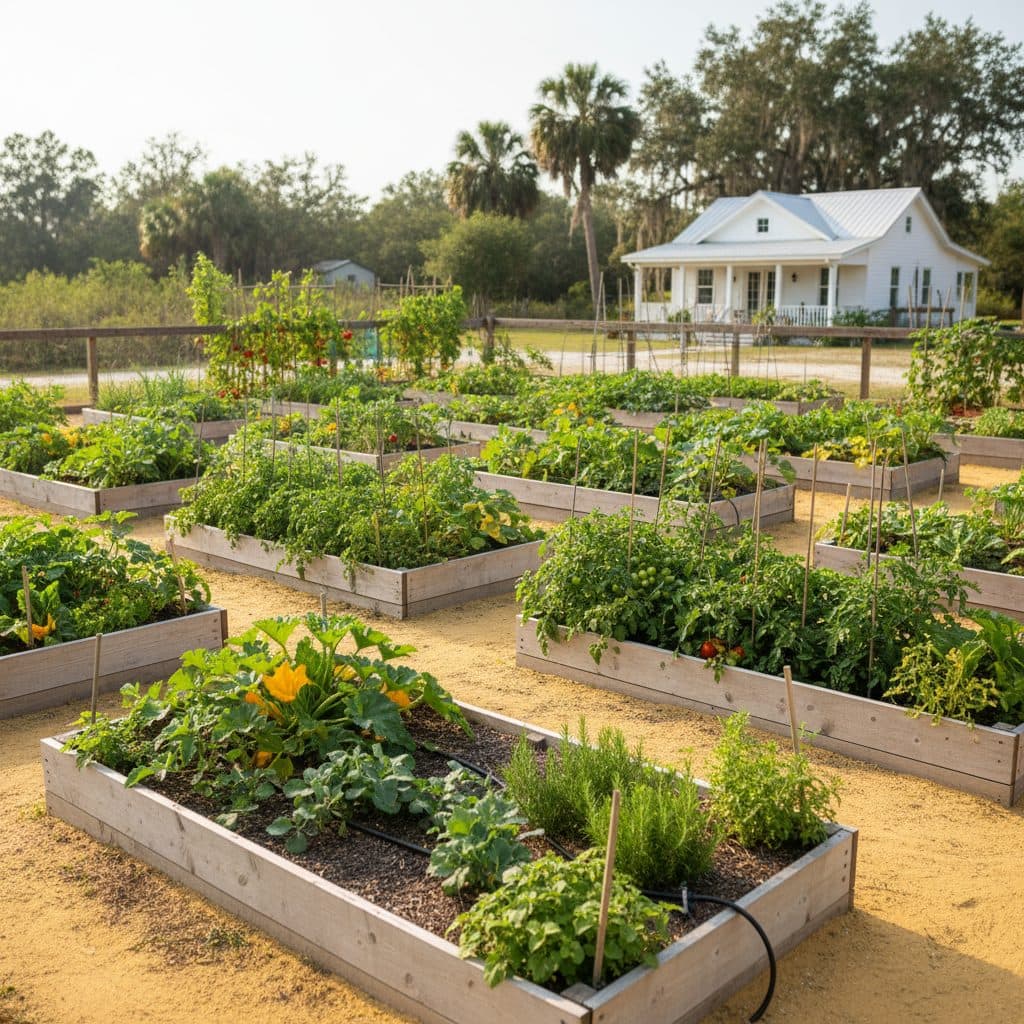
Gardening in Florida presents a unique set of challenges, primarily due to its subtropical climate and predominantly sandy soils. Across much of the state, from USDA zone 8b in the panhandle down to zone 11 in the Keys, gardeners contend with soils that drain quickly, retain few nutrients, and often have low organic matter content, sometimes less than 1% [6]. Despite these hurdles, Florida’s long growing seasons—often extending over nine months of the year—offer incredible opportunities for productive vegetable gardens, yielding multiple harvests annually [5].
Successfully growing vegetables in this environment requires a focused approach on soil improvement and careful plant selection. By understanding the specific needs of sandy soils and choosing varieties adapted to the heat and humidity, growers can cultivate thriving gardens. This guide will walk you through practical strategies for amending your soil and selecting resilient vegetable varieties that can withstand Florida’s distinctive conditions.
Understanding Florida’s sandy soils
Florida’s native soils are largely derived from marine sediments, resulting in a high percentage of sand particles—often exceeding 90% [1]. This composition means the soil has large pore spaces, leading to excellent drainage but poor water and nutrient retention. A typical sandy soil might hold less than 10% of its weight in water, compared to a loam soil that can hold 30% or more [1]. This rapid drainage means essential nutrients, particularly nitrogen and potassium, can leach out of the root zone quickly, requiring more frequent fertilization or, preferably, significant soil amendments. The natural pH of these soils can also vary, but many are slightly acidic, ranging from 5.5 to 6.5, which is generally suitable for most vegetables.
the challenge of low organic matter
One of the most significant characteristics of Florida’s sandy soils is their low organic matter content, frequently below 1% [6]. Organic matter acts like a sponge, improving the soil’s capacity to hold both water and nutrients. Without sufficient organic matter, plants struggle to access the moisture and fertility they need, especially during dry spells or heavy rains. This deficiency also impacts soil structure, making it less hospitable for beneficial microorganisms and earthworms. Amending these soils is not a one-time task but an ongoing process, often requiring several inches of added material each season to build a healthy, productive growing medium over a period of three to five years.
- Sandy soils drain rapidly, often losing water within hours of irrigation.
- They have low cation exchange capacity (CEC), meaning nutrients leach out quickly.
- Organic matter content is typically below 1%, hindering water and nutrient retention.
- Soil temperatures can fluctuate widely due to poor insulation.
- Beneficial microbial activity is often limited in unamended sandy soils.
Building soil fertility with organic matter
The cornerstone of successful vegetable gardening in Florida’s sandy soils is the consistent addition of organic matter. Materials like compost, well-rotted manure, and cover crops are essential for transforming barren sand into a fertile growing medium. Research from 1942 highlighted that adding 1 inch of compost could significantly improve soil structure and water holding capacity [2]. Over time, these amendments increase the soil’s ability to retain moisture and nutrients, reducing the need for frequent watering and fertilization. For new garden beds, aim to incorporate 4 to 6 inches of high-quality compost or aged manure into the top 6 to 8 inches of soil.
incorporating cover crops and aged amendments
Beyond initial amendments, maintaining soil health requires ongoing effort. Planting cover crops during off-seasons, such as sunn hemp or cowpeas in summer, can add substantial organic matter when tilled into the soil. These crops also help suppress weeds and prevent erosion. For continuous improvement, a yearly application of 1 to 2 inches of compost or other aged organic materials, like pine bark fines or mushroom compost, is highly beneficial [4]. This regular replenishment helps counteract the rapid decomposition of organic matter that occurs in Florida’s warm, humid climate. For more detailed guidance on feeding your soil, refer to our article on organic gardening fertilizer, which emphasizes nourishing the soil’s living components.
- Compost improves soil structure and provides a slow release of nutrients.
- Aged manure adds nitrogen, phosphorus, and beneficial microbes.
- Cover crops like sunn hemp or cowpeas enrich soil and prevent erosion.
- Pine bark fines improve drainage while adding long-lasting organic matter.
- Leaf mold offers a rich source of carbon and improves soil tilth.
Smart watering and mulching strategies
These building soil fertility points carry into this section, too.
Given the rapid drainage of sandy soils, efficient watering matters for Florida vegetable gardens. Overwatering with overhead sprinklers can lead to significant water waste—up to 50% through evaporation and runoff—and increased nutrient leaching. Drip irrigation systems or soaker hoses deliver water directly to the plant’s root zone, minimizing waste and ensuring plants receive adequate moisture. These systems can reduce water usage by 30% to 50% compared to traditional methods [5]. Monitoring soil moisture with a tool like a soil moisture meter can help determine when to water, preventing both underwatering and overwatering.
the power of mulching
Mulching is another indispensable practice for sandy soils in Florida. A 2 to 4 inch layer of organic mulch, such as pine straw, cypress bark, or shredded leaves, offers multiple benefits. Mulch significantly reduces evaporation from the soil surface, potentially cutting water needs by 25% to 35% [4]. It also helps regulate soil temperature, keeping roots cooler during hot summer months (reducing soil temperature by up to 10°F) and warmer during occasional cold snaps. Furthermore, mulch suppresses weed growth by up to 70%, reducing competition for water and nutrients, and breaks down over time to contribute valuable organic matter to the soil. For more on this, explore our guide on mulch for organic gardening.
- Drip irrigation conserves water by delivering it directly to roots.
- Soaker hoses provide slow, consistent moisture to the soil.
- A 2-4 inch layer of organic mulch reduces evaporation by 25-35%.
- Mulch helps stabilize soil temperature, protecting roots from extremes.
- Proper mulching can suppress up to 70% of weed growth.
Selecting resilient vegetable varieties
That work on smart watering and sets up what follows here.
Choosing the right vegetable varieties matters most for success in Florida’s climate. Many common garden vegetables, bred for temperate zones, struggle with the state’s intense heat, high humidity, and sandy soils. Instead, focus on heat-tolerant and drought-resistant varieties, often those with a longer history in subtropical regions. For instance, Southern peas (like ‘California Blackeye’ or ‘Pinkeye Purple Hull’) thrive in temperatures above 80°F, producing well when other legumes fail [1]. Sweet potatoes, okra, and many types of peppers also perform exceptionally well in Florida’s warm conditions, often yielding over several months.
varieties for florida’s unique seasons
Florida’s growing seasons are distinct, with a primary fall/winter season (September to May) and a more challenging, but still productive, spring/summer season (April to August). During the cooler months, gardeners in USDA zones 9 and 10 can grow a wide array of crops including broccoli, cabbage, carrots, and lettuce. However, for the hot summer months, selecting specific resilient varieties is key. Consider ‘Everglade’ tomatoes, ‘Florida Broadleaf’ mustard, or ‘Seminole’ pumpkins, which are known for their ability to withstand high temperatures and humidity [5]. For more plant ideas, including drought-tolerant options, see our guide on drought-tolerant trees and shrubs by USDA zone, which offers principles applicable to vegetable selection. Even for beginners, understanding these seasonal nuances can significantly improve garden productivity, as detailed in vegetable gardening for beginners: your questions answered.
- Southern peas and okra are excellent choices for summer heat, tolerating temperatures above 80°F.
- Sweet potatoes (‘Beauregard’ or ‘Centennial’) yield well in sandy soils and heat.
- Malabar spinach and New Zealand spinach are heat-tolerant leafy greens.
- ‘Everglade’ tomatoes are known for their resilience in Florida’s hot, humid summers.
- ‘Seminole’ pumpkins and various types of peppers thrive in warm conditions.
Nutrient management and pH adjustment
This builds directly on selecting resilient vegetable.
Managing nutrients in Florida’s sandy soils requires a proactive and consistent approach. Because nutrients leach quickly, a single large application of fertilizer is often ineffective. Instead, gardeners should opt for slow-release organic fertilizers or frequent, smaller applications of liquid feeds. Regular soil testing, ideally every one to two years, helps you understand the current nutrient levels and pH. Many Florida soils are naturally slightly acidic, with a pH between 5.5 and 6.5, which is suitable for most vegetables. However, if the pH drops below 5.5, adding agricultural lime can raise it, typically at a rate of 5 to 10 pounds per 100 square feet, depending on the soil test results [5].
maintaining ideal soil conditions
Beyond macronutrients, sandy soils can also be deficient in micronutrients like boron, zinc, and magnesium. These can be supplied through compost, kelp meal, or specific micronutrient supplements. The goal is to feed the soil, not just the plant, by supporting a healthy soil food web that naturally cycles nutrients. Incorporating worm castings or compost tea regularly can introduce beneficial microorganisms that improve nutrient availability and plant uptake. For example, adding 1 gallon of compost tea per 10 square feet every two to four weeks can significantly boost microbial activity and nutrient cycling. A healthy soil ecosystem, built over time with organic matter, will naturally buffer pH fluctuations and provide a steady supply of nutrients, reducing reliance on synthetic inputs by 20% or more.
- Apply slow-release organic fertilizers or small, frequent liquid feeds.
- Test soil pH and nutrient levels every 1-2 years to guide amendments.
- Adjust acidic soils (below pH 5.5) with agricultural lime at 5-10 lbs per 100 sq ft.
- Supplement with micronutrients using compost, kelp meal, or specific products.
- Incorporate worm castings or compost tea to boost microbial activity.
Organic Matter Boost: Adding 4 inches of compost to sandy soil can increase its water-holding capacity by up to 20% and improve nutrient retention by 15% [4].
Water Savings: Drip irrigation systems can reduce water usage by 30-50% compared to overhead sprinklers, especially useful in rapidly draining sandy soils [5].
Frequently asked questions
What is the best time to plant vegetables in Florida?
Florida typically has two main planting seasons: a primary cool season from September to May, ideal for many temperate vegetables, and a warm season from April to August for heat-tolerant crops. Southern Florida (USDA zone 10+) can often grow year-round, while northern Florida (USDA zone 8b) has a shorter cool season, usually from October to March.
How often should I water my sandy soil vegetable garden?
Sandy soils drain quickly, so frequent, deep watering is generally more effective than shallow, daily watering. Aim to water deeply two to three times per week, delivering 1 to 1.5 inches of water per application, especially during dry periods. A soil moisture meter can help determine exact needs, often indicating watering when the top 2-3 inches feel dry.
What organic matter is best for amending Florida sandy soils?
High-quality compost, well-rotted animal manure, and pine bark fines are excellent choices. Compost and manure provide a broad spectrum of nutrients and beneficial microbes, while pine bark fines offer a longer-lasting source of organic matter, improving soil structure over several years. Aim to incorporate 2 to 4 inches annually.
What are some good heat-tolerant vegetable crops for Florida summers?
For Florida’s hot summers, consider planting okra, sweet potatoes, Southern peas (like black-eyed peas), Malabar spinach, New Zealand spinach, and certain varieties of peppers and eggplant. ‘Seminole’ pumpkin is also a resilient choice, thriving in temperatures often exceeding 85°F.
How can I prevent nutrient leaching in my sandy garden soil?
To prevent nutrient leaching, consistently incorporate organic matter, which improves the soil’s cation exchange capacity. Use slow-release organic fertilizers, apply mulch heavily (2-4 inches deep), and consider planting cover crops during fallow periods to capture residual nutrients. Regular soil tests, every 1-2 years, will also guide precise nutrient management.
What USDA hardiness zones cover Florida?
Florida spans several USDA hardiness zones, ranging from zone 8b in the northern panhandle to zone 11 in the southernmost parts, including the Florida Keys. Most of central and south Florida falls within zones 9b to 10b, allowing for extended or year-round growing seasons for many vegetables.
References
- Vegetable Gardening in Florida (2000). Vegetable Gardening in Florida.
- PREPARING THE GARDEN SOIL (1942). PREPARING THE GARDEN SOIL.
- Subtropical Gardening in Florida (1952). Subtropical Gardening in Florida.
- Organic Vegetable Gardening in Florida (2013). Organic Vegetable Gardening in Florida.
- Florida Vegetable Gardening Guide (2015). Florida Vegetable Gardening Guide.
- USDA Natural Resources Conservation Service (2024). USDA Natural Resources Conservation Service.