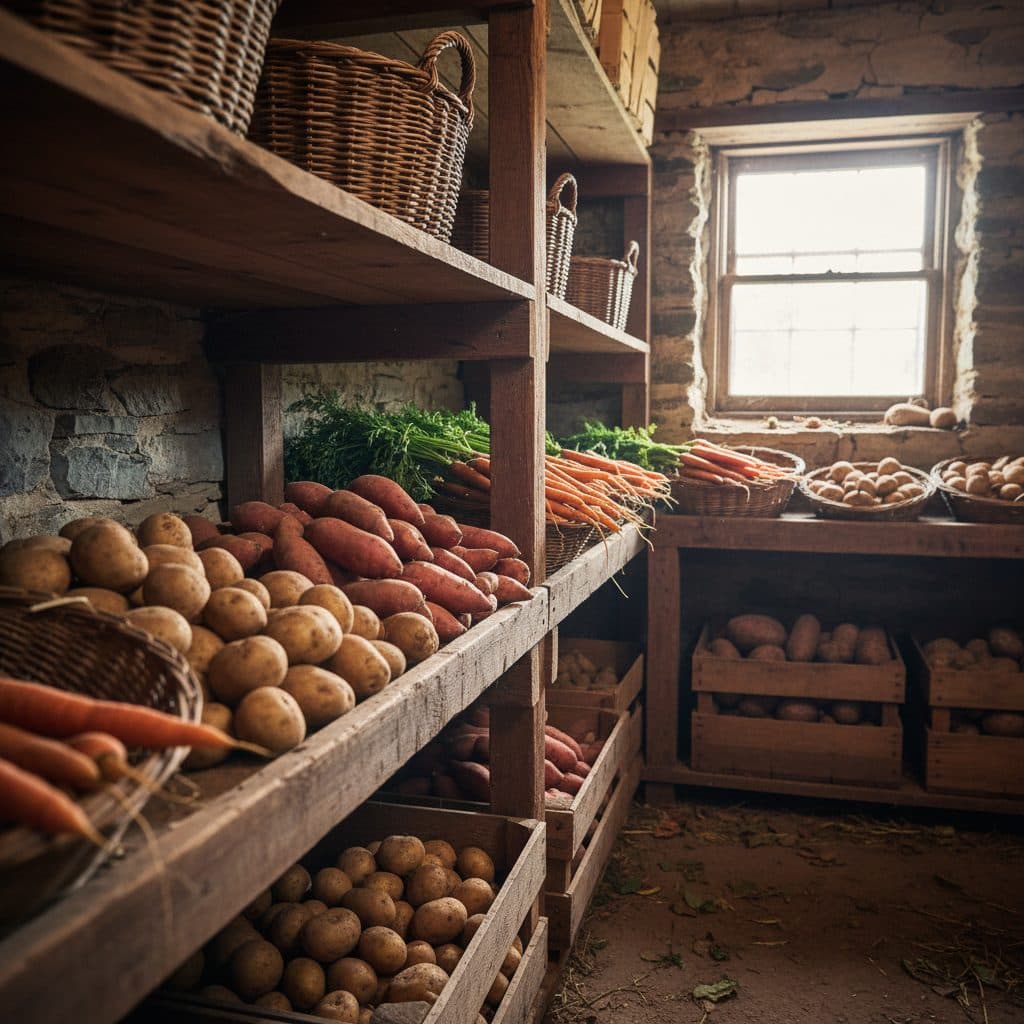
Key takeaways
- Curing sweet potatoes at 80-85°F and 85-90% humidity for 5-10 days significantly improves their storage life.
- Potatoes store best in dark, humid conditions around 38-40°F, ideally in a root cellar or insulated bin.
- Carrots thrive in cool, moist environments, often lasting 4-6 months when packed in damp sand or sawdust.
- Proper ventilation for all stored root crops prevents rot and extends shelf life.
- Field clamps offer an effective, low-cost solution for storing large quantities of root vegetables outdoors, especially in cooler climates.
- Regular inspection, about once every 2 weeks, helps remove spoiled produce before it affects the entire batch.
Quick answer: Proper storage can extend the life of root crops like potatoes, sweet potatoes, and carrots by several months, often up to 8 months, by controlling temperature, humidity, and light to prevent spoilage and sprouting.
For growers across the United States, from the humid summers of Georgia to the cold winters of Minnesota, extending the harvest of root crops like potatoes, sweet potatoes, and carrots saves food and money. Without proper storage, a significant portion of your hard work can spoil within weeks. For instance, an uncured sweet potato might only last 1-2 weeks at room temperature, but with the right approach, you can preserve the harvest for 6-8 months to supply fresh produce through the winter.
Historically, farmers have relied on methods that don’t require electricity, such as root cellars, sand storage, and outdoor clamps, to keep their harvests viable. These techniques, some dating back over a century, leverage specific environmental conditions to slow down spoilage and maintain quality. Long before refrigeration, growers understood that controlling temperature and moisture was the difference between a stocked cellar and a season’s losses. Understanding these principles saves time and money, and keeps your pantry stocked with homegrown food.
Curing and preparing sweet potatoes for long-term storage
Sweet potatoes, unlike their white potato counterparts, require a specific curing process immediately after harvest to heal wounds and develop their characteristic sweetness and storage potential. This critical step, often overlooked, can extend their storage life from a few weeks to 6-8 months. According to a 1943 bulletin, sweet potatoes should be cured at a temperature of 80-85°F with 85-90% relative humidity for 5-10 days [1]. This warm, moist environment encourages the conversion of starch to sugar and toughens the skin, making the tubers more resistant to decay during subsequent storage. Without curing, sweet potatoes are highly susceptible to rot and chilling injury.
post-curing storage conditions
After curing, the ideal storage conditions for sweet potatoes shift dramatically. They need a cooler, but still warm, environment compared to white potatoes. A consistent temperature of 55-60°F and 75-80% relative humidity is recommended for long-term storage [1]. Temperatures below 50°F can cause chilling injury, leading to internal discoloration and a hard core, while temperatures above 60°F can encourage sprouting and shriveling. In USDA zone 7 and warmer, this might be a cool pantry or an unheated closet. For those in colder regions like USDA zone 4, a dedicated root cellar or insulated storage room is often necessary. Ensure good air circulation around the stored tubers to prevent moisture buildup, which can lead to fungal growth.
- Harvest sweet potatoes carefully to avoid bruising.
- Cure at 80-85°F and 85-90% humidity for 5-10 days.
- Store cured tubers at 55-60°F and 75-80% humidity.
- Inspect regularly, about every 2 weeks, for any signs of spoilage.
- Avoid washing sweet potatoes until just before use to maintain skin integrity.
Storing potatoes in bins and root cellars
White potatoes, a staple crop across much of the US, from the potato fields of Idaho to the home gardens of Ohio, have different storage requirements than sweet potatoes. For optimal long-term storage, potatoes need a cool, dark, and humid environment. A temperature range of 38-40°F is ideal for keeping potatoes dormant, coupled with 85-90% relative humidity. Potatoes held that cold undergo cold-induced sweetening (starch converts to sugar, which makes them taste sweet and darken when fried or roasted), so bring them to room temperature for a week or two before cooking. These conditions significantly slow down the metabolic processes that lead to sprouting and shriveling. Storing potatoes in light can cause them to turn green and produce solanine, a bitter compound that is toxic in large quantities. A well-ventilated bin or a dedicated root cellar provides these conditions effectively.
constructing a simple storage bin
A simple storage bin can be constructed from slatted wood, allowing for air circulation around the tubers. For smaller quantities, a cardboard box lined with newspaper and placed in a cool basement or garage in USDA zone 5 or 6 can suffice. The key is to prevent light exposure and maintain consistent temperature and humidity. Avoid storing potatoes near apples or other fruits that produce ethylene gas, as this can accelerate sprouting. A 1910 guide on storing seed potatoes recommended storing them in a cool, dark place to prevent premature sprouting, noting that temperatures above 40°F would encourage growth [3]. Regular inspection, perhaps once a month, is important to remove any potatoes showing signs of rot, which can quickly spread to healthy tubers.
- Store potatoes in a dark, cool place, 38-40°F.
- Maintain 85-90% relative humidity to prevent shriveling.
- Use slatted bins or breathable containers for good airflow.
- Keep potatoes away from light to avoid greening and solanine development.
- Do not wash potatoes before storage; brush off excess dirt.
Using sand for carrot storage
Carrots are excellent candidates for long-term storage, often lasting 4-6 months when stored correctly. The primary goal is to keep them cool and moist, preventing them from drying out or freezing. While a root cellar is ideal, packing carrots in damp sand is a time-tested method that can be replicated in a cool basement, garage, or even an unheated porch in regions like the Pacific Northwest, where humidity is naturally higher. The sand acts as an insulator, maintaining a consistent temperature and high humidity around the carrots, which prevents moisture loss and shriveling. A 5-gallon bucket can hold 10-15 pounds of carrots when layered properly.
the sand layering technique
To store carrots in sand, first trim off the green tops, leaving about 1/2 inch of stem to prevent moisture loss from the root. Do not wash the carrots; simply brush off any excess dirt. Find a sturdy container, such as a plastic tote, wooden crate, or galvanized steel bin. Layer about 2-3 inches of clean, slightly damp play sand or builder’s sand at the bottom. Place a single layer of carrots on the sand, ensuring they don’t touch each other. Cover them with another 2-3 inches of sand, then repeat the layering process until the container is full, leaving about 2 inches of sand on top. The sand should be damp enough to form a ball when squeezed but not so wet that water drips out. Check the sand moisture every 3-4 weeks and re-dampen if necessary. This method maintains a stable environment, often around 35-40°F, which helps prevent spoilage.
- Trim carrot tops to 1/2 inch, but do not wash the roots.
- Use clean, slightly damp (not wet) sand to layer carrots.
- Ensure carrots do not touch each other within the layers.
- Store containers in a cool, dark place, ideally 35-40°F.
- Monitor sand moisture every 3-4 weeks and add water as needed.
Outdoor clamps for bulk storage
For growers with a substantial harvest, especially in regions with consistent cool temperatures like the upper Midwest or New England, outdoor clamps offer an economical and effective way to store large quantities of root crops without needing a dedicated building. A clamp, essentially an insulated mound of vegetables buried in the ground, leverages the earth’s natural insulating properties to maintain a stable, cool temperature. This method is particularly suitable for potatoes, carrots, and even some types of sweet potatoes in warmer climates, provided they are well-cured. A properly constructed clamp can store hundreds of pounds of produce for 4-6 months, often maintaining temperatures between 35-45°F even when outside temperatures drop below freezing.
building a successful clamp
To build a clamp, choose a well-drained site, ideally on a slight slope to prevent water accumulation. Dig a shallow trench, about 6-12 inches deep and 3 feet wide, to form the base. Line the trench with straw or hay, about 6 inches thick, to provide insulation and drainage. Pile the prepared root crops, brushed clean but not washed, into a conical or ridge shape on top of the straw. Cover the vegetables with another 8-12 inches of straw, ensuring complete coverage. Finally, cover the straw with 6-12 inches of soil, leaving a small vent opening at the top for air circulation, which can be protected from rain by an inverted bucket or tile. In very cold regions, an additional layer of straw or manure can be added as temperatures drop below 20°F. Drainage decides whether a clamp keeps or rots: a mound built on ground that holds water will fail no matter how well it is insulated.
- Select a well-drained site on a slight slope for clamp construction.
- Line the trench with 6 inches of straw for insulation and drainage.
- Pile unwashed, clean root crops in a conical shape.
- Cover with 8-12 inches of straw, then 6-12 inches of soil.
- Include a small, protected vent at the top for air circulation.
Monitoring and troubleshooting common storage issues
Regardless of the storage method chosen, regular monitoring is essential to prevent widespread spoilage. Even in ideal conditions, a small percentage of crops, perhaps 2-5%, may still succumb to rot or disease. Stored roots also lose eating quality over time even under good conditions, so use the most perishable crops first. Inspect your stored produce at least once every 2 weeks. Look for any soft spots, mold, sprouts, or signs of pest activity. Early detection allows you to remove compromised vegetables before they affect the entire batch. In a full bin of potatoes, removing a single rotten tuber early can save the tubers packed around it.
maintaining ideal conditions
Maintaining consistent temperature and humidity is the biggest challenge in long-term storage. If your root cellar or storage area becomes too warm, around 50°F or higher, potatoes and carrots will start to sprout, while sweet potatoes may shrivel. If it’s too dry, all crops will lose moisture and become soft. For dry conditions, a bucket of water or damp sawdust can increase humidity. For excess moisture, improving ventilation or adding a desiccant like cat litter (unscented) in a separate container can help. In outdoor clamps, ensure the vent is clear but protected from rain. A 1945 report on sweet potato storage in Zanzibar emphasized the importance of ventilation to prevent excessive humidity and subsequent spoilage, even in tropical climates [5]. Adjustments to storage conditions based on observation can significantly extend the viability of your harvest by several weeks or even months.
- Inspect stored crops every 2 weeks for signs of spoilage.
- Remove any rotten, soft, or sprouting vegetables immediately.
- Monitor temperature and humidity with a thermometer and hygrometer.
- Increase humidity by adding a pan of water or damp sawdust.
- Improve ventilation to reduce excess moisture and prevent mold growth.
Comparison of Root Crop Storage Methods
Method | Ideal Crops | Temperature Range | Humidity Range | Pros | Cons |
|---|---|---|---|---|---|
Root Cellar / Insulated Bin | Potatoes, Carrots, Beets, Cured Sweet Potatoes | 38-60°F (crop dependent) | 75-90% | Consistent environment, easy access, long-term storage (6-8 months) | Requires dedicated space/construction, initial cost |
Sand Storage | Carrots, Beets, Parsnips, Turnips | 35-40°F | 85-95% (from damp sand) | Simple, low-cost, prevents shriveling, effective for 4-6 months | Messy, requires space for containers, sand needs monitoring |
Outdoor Clamp | Potatoes, Carrots, Cabbage, Beets (large quantities) | 35-45°F | 80-90% (from earth/straw) | Very low cost, stores large volumes, no electricity, 4-6 months storage | Weather dependent, labor-intensive to build, less convenient access, risk of pests |
Sweet Potato Curing: Curing sweet potatoes at 80-85°F and 85-90% humidity for 5-10 days can extend their shelf life by up to 6 months [1].
Potato Storage Temp: Potatoes store best at a consistent temperature of 38-40°F, which holds them dormant through the winter; warm them at room temperature for a week or two before cooking.
Carrot Sand Moisture: Storing carrots in slightly damp sand can keep them fresh for 4-6 months by maintaining over 85% humidity.
Frequently asked questions
Can I store different root vegetables together in a root cellar?
Yes, many root vegetables can be stored together, but sweet potatoes need a warmer temperature (55-60°F) than potatoes and carrots (38-40°F). Keep ethylene-producing fruits like apples away from potatoes to prevent premature sprouting, which can reduce potato storage life by several weeks.
What is the best way to prevent potatoes from sprouting?
The most effective way to prevent potatoes from sprouting is to store them in a cool, dark place at 38-40°F with high humidity, around 85-90% [3]. Warmer storage shortens dormancy, so potatoes kept above this range will begin sprouting sooner, though how quickly depends on the variety.
How often should I check my stored carrots in sand?
You should check your carrots stored in sand approximately every 3-4 weeks. This allows you to monitor the sand’s moisture level and re-dampen it if needed so the carrots remain crisp for up to 6 months.
Is it safe to eat green potatoes?
Potatoes that have turned green contain solanine, a toxic compound. While small green spots can be trimmed, potatoes that are significantly green or have a bitter taste should not be eaten. Storing potatoes in darkness prevents this greening, preserving food safety and quality.
Can I store sweet potatoes in a regular refrigerator?
No, storing sweet potatoes in a regular refrigerator is not recommended. Temperatures below 50°F can cause chilling injury, leading to a hard core, internal discoloration, and off-flavors, significantly reducing their quality within 1-2 weeks.
What is the ideal humidity for root crop storage?
Most root crops, including potatoes and carrots, prefer high humidity, typically 85-95%, to prevent shriveling and moisture loss. Sweet potatoes, after curing, also prefer high humidity, around 75-80%, at a slightly warmer temperature of 55-60°F [1].
References
- Storing Sweet Potatoes (1943). Storing Sweet Potatoes.
- Potatoes, sweet potatoes and other starchy roots as food (1917). Potatoes, sweet potatoes and other starchy roots as food.
- Selecting, scoring and storing seed corn and potatoes (1910). Selecting, scoring and storing seed corn and potatoes.
- Antioxidant Activities and Phenolic Acids in Different Raw and Boiled Potatoes and Sweet Potatoes (2023). Antioxidant Activities and Phenolic Acids in Different Raw and Boiled Potatoes and Sweet Potatoes.
- Storing Sweet Potatoes in Zanzibar (1945). Storing Sweet Potatoes in Zanzibar.
- USDA Natural Resources Conservation Service (2024). USDA Natural Resources Conservation Service.