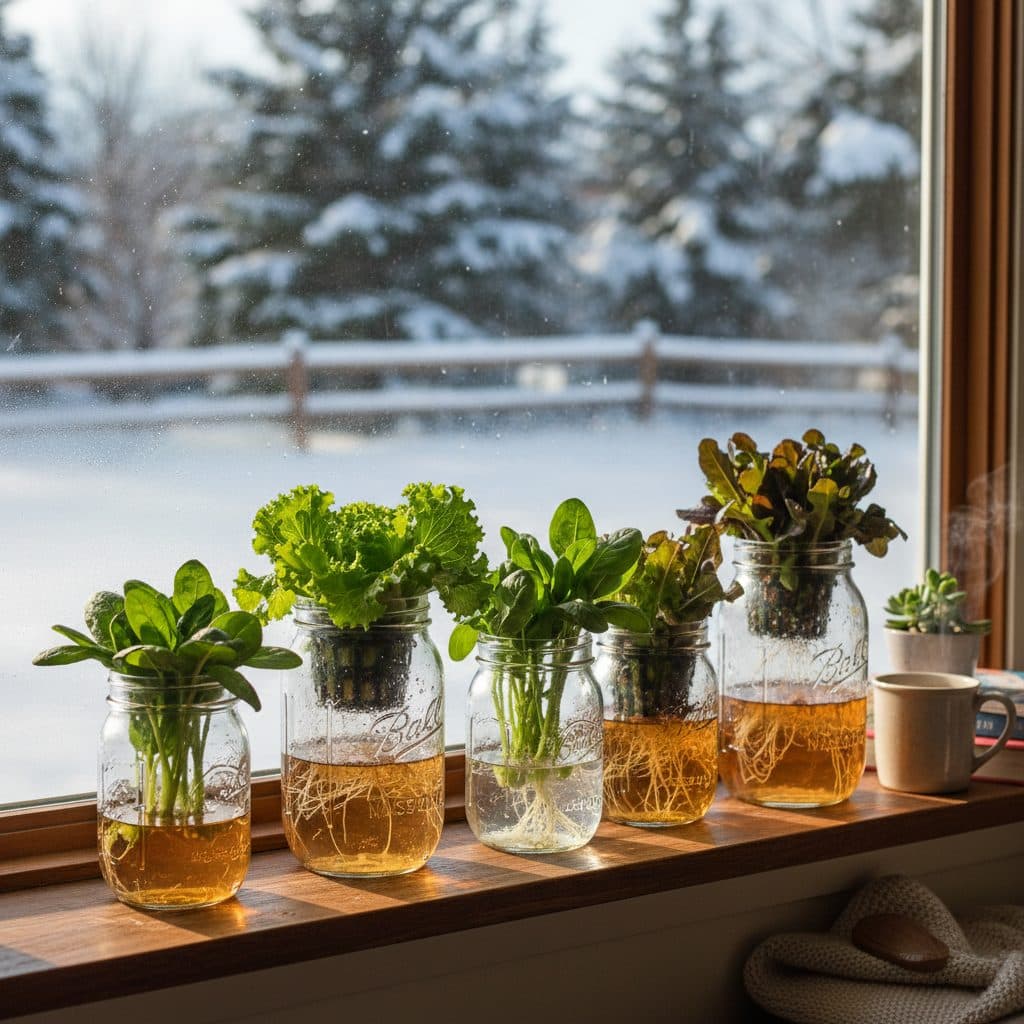
Key takeaways
- The Kratky method is a passive hydroponic system requiring no pumps or electricity, ideal for small indoor spaces.
- Suitable crops for windowsill Kratky include lettuce, spinach, and mustard greens, maturing in 30-45 days.
- Supplemental lighting, such as a 60-watt LED grow light, is often necessary to achieve 12-16 hours of light in northern USDA zones.
- Maintaining nutrient solution pH between 5.5 and 6.5 ensures plant health and nutrient uptake.
- A typical 30-inch windowsill can comfortably host two to three one-gallon Kratky jars, yielding a continuous harvest.
- Winter growing indoors can extend fresh produce availability by up to five months in USDA zones 3-6.
Quick answer: Growing winter greens indoors with Kratky jars in USDA zones 3-6 involves using a passive hydroponic system with supplemental LED lighting and maintaining nutrient solution pH between 5.5 and 6.5. This method allows for continuous harvests of leafy greens like lettuce and spinach for up to five additional months.
For many growers in northern states like Minnesota or Maine, where winter temperatures routinely drop below 0°F, the outdoor growing season can feel frustratingly short, often just 120 to 150 days. But the desire for fresh, home-grown produce doesn’t disappear with the first hard frost. Bringing the garden indoors, especially to a sunny windowsill, offers a practical solution. The Kratky method, a passive hydroponic technique, allows for continuous harvests of leafy greens even when snow covers the ground outside, providing fresh food for an additional 90 to 150 days.
This article focuses on running Kratky jars indoors, specifically tailored for conditions found in USDA zones 3 through 6. Setting up simple systems with readily available materials provides crisp lettuce or spicy mustard greens throughout the winter. With basic supplies and daily observation, a 2-foot windowsill yields several pounds of greens each season.
Understanding the kratky method for indoor use
The Kratky method is a non-circulating hydroponic system that requires no pumps, air stones, or electricity, making it an excellent choice for a low-cost, low-maintenance indoor setup. Developed by Dr. Bernard Kratky at the University of Hawaii, the plant’s roots gradually consume the nutrient solution to leave an air gap that supplies oxygen. In USDA zones 3-6, where outdoor growing ceases for up to six months, this method offers a simple way to extend your harvest season by 100% or more.
setting up your first kratky jar
To begin, you will need a container: a one-gallon glass jar or a dark plastic bucket works well to prevent algae growth. For each jar, you’ll also need a net pot (typically 2-3 inches in diameter) and a suitable growing medium like rockwool or coco coir. Fill the jar with a pre-mixed hydroponic nutrient solution, ensuring the bottom of the net pot and the seedling’s roots are submerged by about one inch. A typical setup for a 30-inch windowsill can accommodate two to three one-gallon jars, providing a steady supply of greens. The initial investment for three jars and associated supplies often falls under 50 dollars.
- Container selection: Use opaque containers like painted mason jars or dark plastic buckets to block 99% of light from the root zone.
- Net pot size: A 2-inch or 3-inch net pot is ideal for most leafy greens, supporting the plant as it grows.
- Growing medium: Rockwool cubes or coco coir plugs provide initial support and moisture for seedlings, holding 80% water by volume.
- Nutrient solution: A balanced hydroponic nutrient solution, mixed according to package directions, supports plant health, often at 500-800 PPM for leafy greens.
- Seedlings: Start seeds in a separate tray or directly in net pots, transplanting when they are 2-3 inches tall with established roots.
Choosing the right greens and providing adequate light
Not all greens are equally suited for windowsill Kratky growing, especially in the lower light conditions prevalent during winter in USDA zones 3-6. Fast-growing, compact leafy greens are your best bet. Varieties of lettuce like ‘Black Seeded Simpson’ or ‘Buttercrunch’ perform exceptionally well, maturing in as little as 30-40 days. Spinach, arugula, and mustard greens are also excellent choices, often ready for harvest within 45 days. These plants generally require 12-16 hours of light per day for optimal growth, a challenge for many northern windowsills.
supplemental lighting strategies
In winter, a south-facing windowsill in Ohio might only receive 4-6 hours of direct sunlight, which is often insufficient for vigorous plant growth. To compensate, supplemental lighting is almost always necessary. A simple 60-watt LED grow light, positioned 6-12 inches above your plants, can provide the additional 8-12 hours of light needed. These lights consume minimal electricity, typically costing less than five dollars per month to run for 16 hours a day. For more extensive indoor setups, consider a reflective indoor grow tent to maximize light efficiency and control environmental factors.
- Lettuce varieties: ‘Buttercrunch’, ‘Romaine’, and ‘Oakleaf’ are excellent for their compact growth and quick maturity, often yielding 0.5 pounds per plant.
- Spinach and arugula: These greens thrive in cooler indoor temperatures (60-70°F) and are ready for cutting in about 35-45 days.
- Mustard greens: Varieties like ‘Red Giant’ add a spicy kick and grow quickly, reaching harvestable size in 30 days.
- Herbs: Basil, mint, and cilantro can also be grown, though they may require slightly more light than leafy greens, about 14 hours daily.
- Microgreens: While not strictly Kratky, microgreens offer a quick harvest (7-14 days) and can supplement your windowsill production in low-light conditions.
Nutrient solutions and environmental control
Maintaining the correct nutrient solution is paramount for Kratky success. A balanced hydroponic fertilizer, designed for leafy greens, should be mixed according to the manufacturer’s instructions, typically resulting in a parts per million (PPM) reading between 500 and 800. The pH of your solution is equally important; keep it between 5.5 and 6.5 for nutrient uptake. In regions like USDA zone 4, where tap water can be quite alkaline, you may need to use a pH down solution to adjust your water before adding nutrients, often requiring 1-2 ml per gallon.
managing temperature and humidity
Indoor temperatures in most US homes during winter are typically between 65-72°F, which is ideal for many leafy greens. However, windowsills in colder zones like USDA zone 3 can experience significant temperature drops at night, sometimes falling below 50°F. While some greens tolerate this, consistent cold can slow growth. Humidity is generally not a major concern for windowsill Kratky setups, as the plant transpiration and open water surface provide sufficient moisture. However, ensuring good air circulation, perhaps with a small USB fan running for 12 hours a day, can prevent fungal issues and strengthen plant stems.
- Nutrient concentration: Aim for an Electrical Conductivity (EC) of 1.0-1.6 mS/cm, or 500-800 PPM, for most greens.
- pH adjustment: Use a pH test kit or meter to check the solution weekly, adjusting with pH up or down as needed to stay within 5.5-6.5.
- Water quality: Filtered tap water or reverse osmosis water is preferred, as high chlorine levels can harm beneficial microbes.
- Room temperature: Maintain ambient temperatures between 60°F and 75°F for consistent growth rates.
- Air circulation: A small oscillating fan prevents stagnant air to reduce the risk of powdery mildew and strengthen stems.
Troubleshooting common issues and extending your harvest
Even with the simplicity of the Kratky method, growers may encounter a few common issues. Yellowing leaves, for example, often indicate a nutrient deficiency or incorrect pH. If your plants are growing slowly or appear stunted, it could be a sign of insufficient light, especially during the short days of winter in USDA zone 6. Regularly observing your plants (at least once every two days) allows for early detection and correction of these problems to keep harvests productive.
continuous harvesting and rotation
To ensure a continuous supply of fresh greens, employ a staggered planting approach. Start a new batch of seedlings every one to two weeks. When a plant in a Kratky jar is ready for harvest, you can either remove the entire plant or practice ‘cut-and-come-again’ harvesting, taking only the outer leaves. This method allows the plant to continue producing for an additional two to three weeks. Once a jar is spent, wash it out, sanitize with a 10% bleach solution, then rinse thoroughly with clean water and let it air-dry before starting a new cycle. This rotation strategy can provide fresh greens for up to 150 days of winter, a significant extension compared to the 120-day outdoor season in many northern states. For those looking to expand beyond a windowsill, exploring four-season greenhouse designs can offer year-round growing capabilities.
- Yellowing leaves: Check pH and nutrient strength; adjust as needed to ensure plants receive essential minerals.
- Slow growth: Increase light duration to 14-16 hours or move the light closer to the plants (6-8 inches).
- Algae growth: Ensure containers are fully opaque; algae compete with your plants for nutrients and oxygen.
- Root rot: This is less common in Kratky but can occur if roots are constantly submerged without an air gap; ensure proper initial water level.
- Pest control: Inspect plants daily for common indoor pests like aphids or fungus gnats; use insecticidal soap or neem oil for control.
Beyond the windowsill: expanding your winter growing
While a windowsill Kratky setup is an excellent starting point for winter greens, some growers in USDA zones 5 and 6 might find themselves wanting more. The principles learned from these small systems (nutrient management, light requirements, and environmental observation) transfer directly to larger indoor hydroponic setups or small greenhouses. For instance, understanding the light needs for lettuce (12-16 hours daily) is consistent whether you’re growing one jar or fifty. Your state's cooperative extension service publishes local frost dates and seasonal climate data that can inform decisions for more advanced growing.
integrating with outdoor gardening
For those who also maintain an outdoor garden, indoor winter growing can bridge the gap between seasons. You can start seedlings indoors in your Kratky jars or other small hydroponic systems, giving them a head start of 4-6 weeks before transplanting them outside when the weather warms. This can significantly extend your outdoor harvest, especially for crops that benefit from an early start. Conversely, as winter approaches, you might bring in smaller, cold-hardy plants from your outdoor garden, like certain herbs, to continue their production indoors. This integrated approach maximizes your yield across the entire year, allowing for fresh produce for up to 300 days annually. Understanding plant hardiness guides these choices, as explored in articles about cold-hardy fruit and nut trees.
- Seedling starts: Use your Kratky setup to start seedlings 4-6 weeks early for outdoor transplanting.
- Herb propagation: Cuttings from outdoor herbs like mint or rosemary can be rooted in Kratky jars to provide fresh herbs all winter.
- Succession planting: Maintain a continuous cycle of planting and harvesting indoors, ensuring a steady supply of greens for 150+ days.
- Learning curve: The small scale of windowsill Kratky allows for learning hydroponic basics without significant investment, often under $100.
- Year-round produce: Combining indoor winter growing with outdoor summer gardening can provide fresh produce for 10-11 months of the year.
Kratky vs. traditional soil growing (winter indoors)
Feature | Kratky Hydroponics | Traditional Soil (Pots) |
|---|---|---|
Water Usage | Up to 90% less water than soil, as the solution stays in the jar and leaves mainly through the plant. | Requires frequent watering; significant evaporation from soil surface. |
Growth Rate | Often faster growth, because roots reach dissolved nutrients directly. | Slower growth, dependent on soil nutrient availability and root search. |
Pest Issues | Fewer soil-borne pests like fungus gnats; occasional aphids. | Higher risk of soil-borne pests and diseases. |
Mess & Cleanliness | Clean, no soil spills; occasional nutrient solution drips. | Soil mess, potential for spills and dirt. |
Yield per Square Foot | Higher yield, often 2-3 times more produce in the same space. | Lower yield, constrained by soil volume and nutrient depletion. |
Nutrient Control | Precise control over nutrient delivery and pH levels. | Nutrient availability varies; less precise control over uptake. |
Winter Light Needs: A northern windowsill delivers only 4-6 hours of usable winter light, so plan on 8 or more hours of supplemental LED to reach the 12-16 hours leafy greens want.
Kratky Water Savings: The Kratky method uses up to 90% less water compared to traditional soil gardening, making it highly efficient for indoor cultivation.
Quick Harvest Cycle: Most leafy greens grown with the Kratky method can be harvested within 30-45 days from transplanting, providing a rapid turnaround for fresh produce.
Frequently asked questions
What are the best plants for a winter windowsill Kratky system?
Fast-growing leafy greens like ‘Buttercrunch’ lettuce, spinach, arugula, and mustard greens are ideal. These plants typically mature in 30-45 days and thrive in the consistent indoor temperatures found in most US homes, around 65-72°F.
How much light do my Kratky plants need during winter?
Most leafy greens require 12-16 hours of light per day. In USDA zones 3-6, natural winter sunlight is usually insufficient (4-8 hours), so a 60-watt LED grow light providing an additional 8-10 hours of light is recommended for healthy growth.
How often do I need to change the nutrient solution in a Kratky jar?
For most leafy greens, the initial nutrient solution will last for the entire growth cycle, typically 30-45 days. You should only need to top it off if the roots dry out prematurely, which is rare if the initial fill is about 0.75 gallons.
Can I use tap water for my Kratky system?
Yes, tap water can be used, but it’s advisable to let it sit for 24 hours to allow chlorine to dissipate. Also, test its pH and adjust it to between 5.5 and 6.5 before adding nutrients, as tap water in many regions can be quite alkaline, sometimes above 7.5 pH.
What temperature range is best for indoor Kratky growing?
An ambient room temperature between 60°F and 75°F is optimal for most leafy greens. While plants can tolerate temperatures as low as 50°F, growth is steadier and harvests come sooner in the warmer range.
How can I prevent algae growth in my Kratky jars?
To prevent algae, use opaque containers that block 100% of light from reaching the nutrient solution. If using clear jars, paint them or cover them with dark fabric. Algae compete with your plants for nutrients and oxygen.