Key takeaways
- Moringa (Moringa oleifera) is a fast-growing edible tree, while neem (Azadirachta indica) is an evergreen hardwood valued for natural pest control and medicine.
- Moringa produces edible protein-rich leaves, culinary pods (drumsticks), edible flowers, and water-purifying seeds.
- Neem foliage and seeds contain bitter azadirachtin compounds used worldwide to manufacture biological insect growth regulators and organic soil amendments.
- In agroforestry, moringa is a rapid chop-and-drop biomass source, whereas neem provides a long-lived windbreak, shade canopy, and pest-repellent perimeter.
- Both species thrive in warm, frost-free tropical and subtropical climates, demonstrating high tolerance for seasonal heat and drought.
Quick answer: The main difference between moringa and neem is their primary function. Moringa is a fast-growing, edible tree whose leaves, pods, and flowers provide dense human nutrition and living chop-and-drop mulch. Neem is a large, bitter evergreen tree whose foliage and seed oil yield azadirachtin, a natural compound used for organic garden pest control.
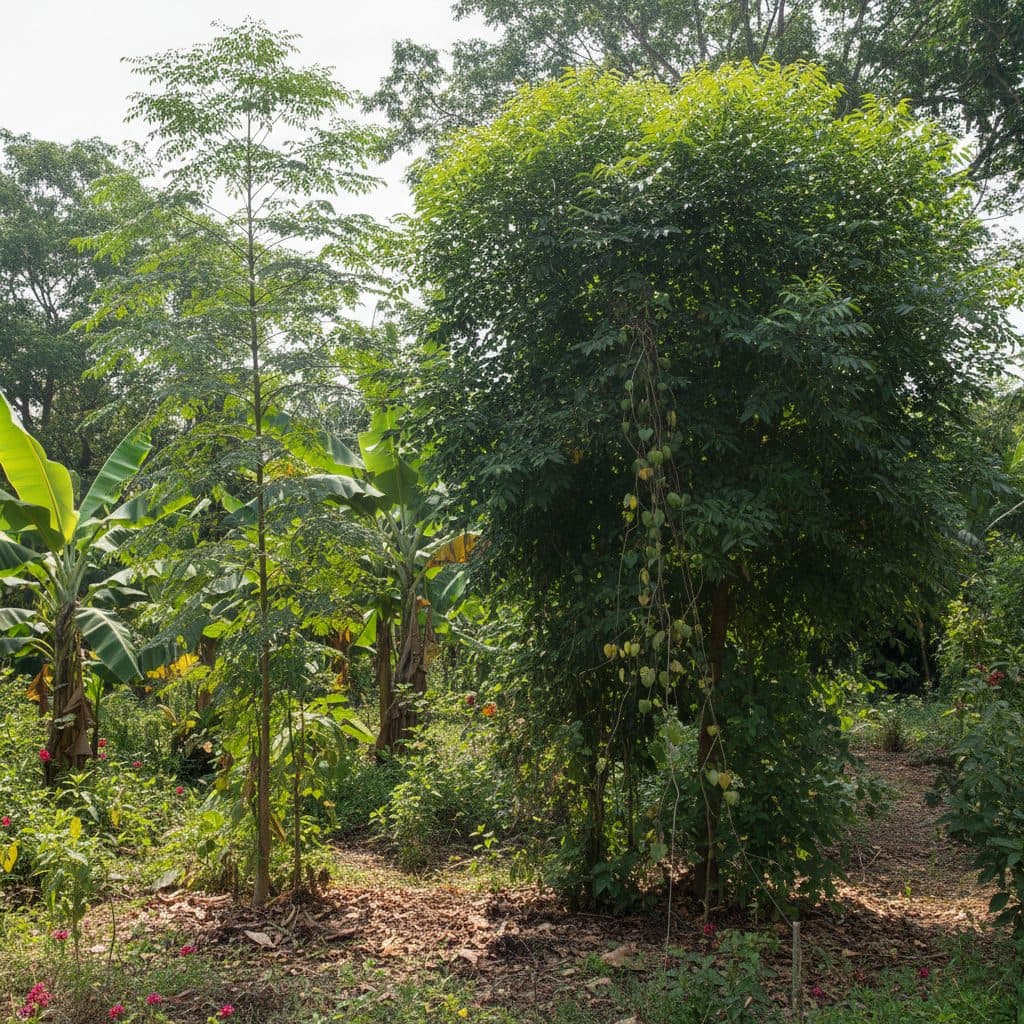
Across tropical and subtropical homesteads, two multipurpose trees see widespread use: moringa and neem. While both species originated on the Indian subcontinent and share a reputation for hardiness and drought tolerance, their ecological roles, culinary uses, and management differ.
Gardeners and agroforestry designers often confuse the two species due to their overlapping native ranges and feathery tropical foliage. However, mistaking moringa vs neem can lead to disappointing results in the kitchen and the landscape. While moringa provides daily green vegetables and fast biomass, neem produces bitter, non-edible leaves used for biological control of garden insect pests.
Understanding their unique botanical characteristics, growth habits, and practical applications allows you to integrate both species into a productive, self-regulating landscape.
+-----------------------------------------------------------------+
|              MORINGA VS NEEM COMPARISON MATRIX                  |
|                                                                 |
|   FEATURE          MORINGA OLEIFERA       AZADIRACHTA INDICA    |
|   -------          ----------------       ------------------    |
|   Common Names     Drumstick Tree         Margosa, Indian Lilac |
|   Botanical Family Moringaceae            Meliaceae (Mahogany)  |
|   Primary Role     Nutritional Food       Pest Control / Shade  |
|   Leaf Edibility   Highly Edible          Bitter / Non-Edible   |
|   Wood Structure   Soft, Brittle Wood     Dense Hardwood        |
|   Growth Rate      Fast (3-5 m / year)    Moderate (1 m / year) |
|   Lifespan         Short (15-25 years)    Long-lived (100+ yrs) |
+-----------------------------------------------------------------+
What are the botanical differences between moringa and neem?
Distinguishing moringa from neem is simple once you examine leaf architecture, bark texture, and flowering structures:
+-------------------------------------------------------------+
|              LEAF MORPHOLOGY COMPARISON                     |
|                                                             |
|   MORINGA (*M. oleifera*):                                  |
|   Tripinnate compound leaf with small, rounded, smooth oval |
|   leaflets (0.5 to 1.5 cm wide) on soft green petioles.     |
|                                                             |
|   NEEM (*A. indica*):                                       |
|   Pinnate compound leaf with curved, lanceolate, serrated   |
|   leaflets (5 to 8 cm long) with sharp toothed margins.     |
+-------------------------------------------------------------+
1. Moringa (Moringa oleifera)
- Foliage: Produces delicate, tripinnate compound leaves made up of dozens of tiny, rounded, soft oval leaflets. The foliage is bright lime-green and tender.
- Canopy and wood: A slender, fast-growing deciduous or semi-evergreen tree reaching 8 to 12 m (26 to 39 ft) in height. The wood is soft, spongy, and brittle, easily pruned with hand shears.
- Flowers and pods: Bears fragrant, creamy-white flowers year-round in warm climates, followed by long, ribbed, three-sided seed pods measuring 30 to 60 cm (12 to 24 in) in length, resembling hanging drumsticks.
2. Neem (Azadirachta indica)
- Foliage: Produces pinnate compound leaves consisting of 20 to 30 curved, lance-shaped leaflets with distinctly serrated (toothed) edges. The foliage is dark, glossy green and possesses an intensely bitter taste.
- Canopy and wood: A broad, dense, spreading evergreen canopy reaching 15 to 20 m (50 to 65 ft) tall. The timber is dense, termite-resistant hardwood.
- Flowers and fruit: Bears small, white, sweet-scented floral panicles that develop into oval, olive-like green berries that turn yellow when ripe, containing a single oil-rich seed kernel.
To check climatic limits and hardiness thresholds for drumstick trees, see growing moringa by zone.
How do their culinary and nutritional profiles compare?
The nutritional utility of moringa contrasts sharply with the medicinal and protective nature of neem.
+-----------------------------------------------------------------+
|              NUTRITIONAL & CULINARY PROFILES                    |
|                                                                 |
|   TREE PART        MORINGA UTILIZATION    NEEM UTILIZATION      |
|   ---------        -------------------    ----------------      |
|   Leaves           Fresh greens, powder   Bitter traditional use|
|   Immature Pods    Curries, stews, sambar Inedible              |
|   Mature Seeds     Edible oil, water prep Cold-pressed biocide  |
|   Flowers          Cooked in teas, dishes Traditional tonics    |
+-----------------------------------------------------------------+
Moringa: the complete food tree
Almost every part of the moringa tree is edible and exceptionally nutritious:
- Leaves: Contain complete plant protein (all nine essential amino acids), along with high concentrations of vitamin A, vitamin C, calcium, potassium, and iron. Fresh leaves are simmered in soups or dehydrated and ground into fine green nutritional powder.
- Drumstick pods: Harvested while young and tender, the green pods are a celebrated culinary staple in South Asian curries, braises, and stews.
- Seeds and water purification: Crushed mature moringa seeds contain positively charged water-soluble proteins that bind to silt, clay, and bacteria in turbid water, settling impurities to the bottom as a natural, low-cost water clarifying agent.
Neem: the biological medicine tree
Neem is not consumed as a staple table food due to its extreme bitterness and high concentration of bioactive triterpenoids.
- In traditional wellness systems, minute amounts of tender young neem shoot tips are consumed in spring tonics or herbal teas.
- However, neem's primary value lies in its topical antimicrobial, dental (traditional neem chewing twigs), and therapeutic applications. Neem oil is not for internal use — it is toxic if swallowed, and particularly hazardous for infants and young children.
How are moringa and neem used in organic garden management?
Both trees offer indispensable functions in ecological garden design, but operate in different ways:
+-----------------------------------------------------------------+
|              AGROECOLOGICAL ROLES IN PERMACULTURE               |
|                                                                 |
|   SYSTEM ROLE      MORINGA OLEIFERA       AZADIRACHTA INDICA    |
|   -----------      ----------------       ------------------    |
|   Pest Defense     Companion barrier      Direct biopesticide   |
|   Soil Building    Rapid chop-and-drop    Neem cake amendment   |
|   Canopy Function  Filtered dappled light Dense windbreak canopy|
|   Livestock Feed   High-protein fodder    Non-palatable         |
+-----------------------------------------------------------------+
1. Neem as an organic bio-pesticide and soil amendment
Check local status first — neem is a declared or environmental weed in parts of northern Australia and in some other tropical regions, where planting it is restricted or inadvisable.
Neem seed kernels contain azadirachtin, a complex natural limonoid that disrupts insect hormonal systems.
- Foliar spray: Cold-pressed neem oil (mixed at 5 ml per litre of water with a mild emulsifier) acts as an anti-feedant, repellent, and insect growth regulator. Spray at dusk or early morning when pollinators are not foraging, and keep spray off open flowers: wet neem harms bees and soft-bodied beneficials on contact, although the dried residue is low-risk. For companion planting strategies, see polyculture interplanting for pest control.
- Neem cake soil amendment: The solid residue remaining after seed oil extraction (neem cake or neem khali) is incorporated into vegetable beds. It helps suppress harmful root-knot nematodes and subterranean grubs while releasing slow, organic nitrogen.
2. Moringa as a living fertilizer and animal fodder
Moringa grows quickly, frequently adding 3 to 5 metres (10 to 16 feet) of height in a single warm growing season.
- Chop-and-drop biomass: Coppicing moringa trees back to 1 metre (3.3 feet) three to four times per year yields substantial amounts of leafy organic matter rich in nitrogen, phosphorus, and plant growth hormones (zeatin). Spread this biomass directly across garden beds as living mulch. For multi-species biomass planning, see syntropic chop-and-drop species by zone.
- Livestock forage: Moringa leaves provide high-protein supplemental feed for poultry, goats, sheep, and cattle, boosting daily weight gain and milk production.
To compare nitrogen-fixing tree species with non-legume accumulator canopies, see our guide to nitrogen-fixing trees.
What are the growing requirements and climate tolerances?
Both trees thrive across tropical, subtropical, and warm arid environments, but have distinct soil and water preferences:
In arid and semi-arid climates:
- Neem (Azadirachta indica) develops a massive, deep taproot system capable of extracting subterranean moisture from rocky, compacted, and poor soils. Once established, mature neem trees survive prolonged droughts with zero supplemental irrigation and thrive in areas with as little as 400 mm (16 in) of annual rain.
In humid tropical and subtropical climates:
- Moringa (Moringa oleifera) requires sandy, loose, well-draining soil with a neutral to slightly acidic pH. While moringa is drought-resistant thanks to its swollen tuberous root system, moringa rots quickly in waterlogged soil, so it needs free drainage — even short periods of standing water can kill it.
Both species are sensitive to frost. Light frosts will kill tender foliage back to the main trunk, while sustained freezes below -2°C (28°F) can kill root crowns. In cooler marginal zones, moringa is often grown as an annual or cut back to ground level in autumn and heavily mulched to resprout in spring.