secondary
Cacao tree
Theobroma cacao
International hardiness
- USDA 11-12
- RHS H1a
- AU: Tropical
Where it grows — regional guide
| Zones / rating | Regional notes |
|---|---|
USDA 11-12 | Viable outdoors only in USDA Zone 11+ in Hawaii and sheltered, warm microclimates of southern Florida; severely injured below 10 °C (50 °F). |
| Zones / rating | Regional notes |
|---|---|
H1a (above 15C, heated glasshouse) | No region-specific data yet |
| Zones / rating | Regional notes |
|---|---|
Tropical | Grown commercially in the wet tropical belt of northern Queensland around Cairns; provide continuous wind protection and moist understorey canopy shade. |
| Zones / rating | Regional notes |
|---|---|
USDA 11-12 (USDA scale) Canada uses its own zone system; Canadian zones run roughly one lower than USDA. | No region-specific data yet |
| Zones / rating | Regional notes |
|---|---|
No region-specific data yet | No region-specific data yet |
Cacao tree (Theobroma cacao) is a small, broadleaf evergreen tree in the mallow family (Malvaceae), formerly classified within Sterculiaceae. Indigenous to the deep understorey of the Amazon and Orinoco river basins in tropical South America, the species was domesticated thousands of years ago in Mesoamerica. Linnaeus named the genus from the Greek words theos (god) and broma (food), immortalising cacao as the "food of the gods". Today, cacao is cultivated globally throughout equatorial regions for its seeds, which undergo fermentation, drying, and roasting to produce cocoa butter, cocoa solids, and chocolate.
In syntropic agroforestry and multistorey food forests, cacao is an archetypal secondary-stratum shade crop. Adapted to low light levels on the rainforest floor, it thrives beneath high-canopy climax trees like palms or alongside mid-storey nurse species like banana. The extensive leaf fall provides nutrient cycling, while ground-hugging legumes such as centro fix atmospheric nitrogen. However, successful homestead cultivation demands exact microclimatic control, protection from chilling winds, and strict separation of harvested beans from household pets.
Growing cacao tree
Cacao trees demand an equatorial climate, restricted to USDA Hardiness Zones 11 through 12 and holding an RHS rating of H1a. The species is utterly intolerant of cold. Chilling injury begins at temperatures below 10 °C (50 °F), causing leaf chlorosis and premature drop, while any exposure to freezing temperatures kills the tree. Ideal day temperatures range between 22 and 30 °C (72 and 86 °F), with minimum night temperatures never dropping below 18 °C (64 °F). Annual rainfall must be between 1,500 and 2,500 mm (59 and 98 in), evenly distributed throughout the year, with no dry period exceeding three months without irrigation. Relative humidity should remain above 70 percent. Strong, drying winds rapidly scorch the tender, paper-thin leaves, making sheltered valley locations or dense windbreaks mandatory.
Light management changes as the tree matures. Young saplings require 40 to 60 percent shade to prevent photochemical destruction of chlorophyll. In mature orchards, filtered shade of 30 to 40 percent optimises yield while maintaining tree health and buffering against moisture stress. Soils must be deep, friable, organically enriched sandy loams or clay loams with a minimum rootable depth of 1.5 m (5 ft). A slightly acidic to neutral pH of 5.5 to 7.0 is ideal. The root system requires copious moisture but cannot survive standing water or poorly drained subsoils, which trigger catastrophic root suffocation.
Propagation is achieved through seed or vegetative budding. Seeds are recalcitrant, remaining viable for only seven to ten days after extraction from the pod. Sow fresh seeds vertically in deep, well-draining nursery bags, leaving the rounded apex level with the soil surface. At temperatures between 25 and 30 °C (77 and 86 °F), germination takes place within ten to fourteen days. To maintain fine-flavour genetics and dwarf tree stature, commercial growers employ patch budding or side veneer grafting onto vigorous seedling rootstocks. Space standard orchard trees 3 by 3 m (10 by 10 ft) or 3.5 by 3.5 m (11.5 by 11.5 ft) apart. Seedling trees bear initial pods after four to five years, whereas grafted selections begin producing within two to three years.
Harvest and uses
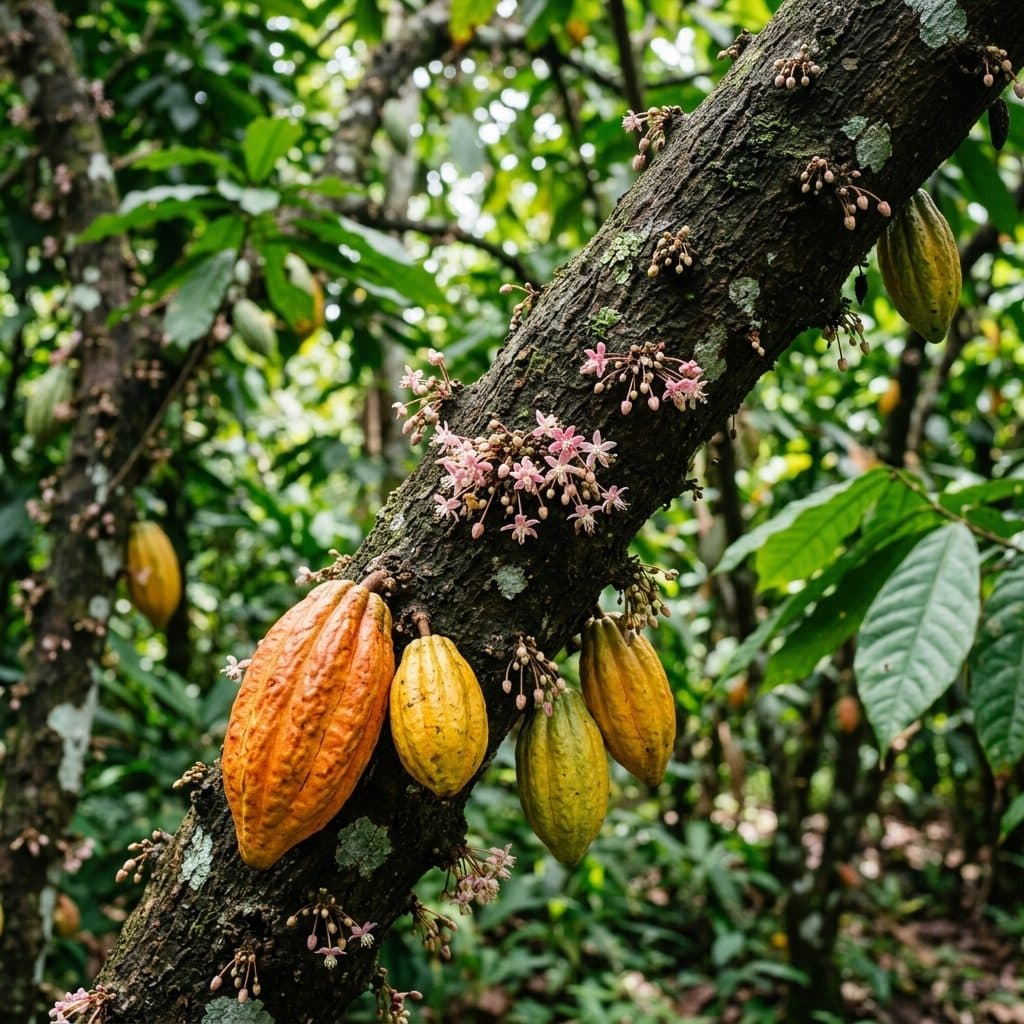
Cacao exhibits cauliflory, bearing flowers and pods directly on the older woody tissue of the trunk and main scaffold branches. Tiny biting midges (Ceratopogonidae) pollinate the delicate blossoms. Pods require five to six months to mature following successful pollination, ripening in two main annual flushes.
Harvest pods when the thick outer rind changes colour completely from green or purple to golden-yellow, bright orange, or deep scarlet. Use sharp, sterilised pruning shears to sever the woody pedicel. Never pull, twist, or tear pods from the tree; doing so damages the sensitive floral cushion, permanently destroying future flowering sites.
To process chocolate, crack the harvested pods within a week of picking using a blunt wooden mallet or wooden wedge. Each pod yields 20 to 50 oval seeds embedded in a thick, sweet, mucilaginous white pulp. This raw pulp possesses a delightful citrus-mango flavour and can be eaten fresh or pressed into sweet beverages.
The seeds and pulp are packed into wooden sweatboxes or heaped between banana leaves for fermentation lasting five to seven days. Microorganisms consume sugars in the pulp, raising internal heap temperatures to 45 to 50 °C (113 to 122 °F). This heat terminates seed germination and initiates biochemical transformations that neutralise bitter polyphenols and synthesise complex chocolate aroma precursors. Following fermentation, spread the beans on wooden drying platforms under full sun for seven to ten days until moisture drops to 7 percent. Cured beans are roasted at 120 to 140 °C (248 to 284 °F), winnowed to remove the thin papery husks, and ground into chocolate liquor. A mature homestead tree yields 20 to 40 pods annually, producing roughly 1 to 2 kg (2.2 to 4.4 lb) of dry cured beans.
Identifying cacao tree
Theobroma cacao displays distinct vegetative and reproductive characteristics:
- Form and branching: A small understorey tree reaching 4 to 8 m (13 to 26 ft) in cultivation, occasionally up to 12 m (40 ft) in wild rainforests. The vertical trunk (orthotropic stem) grows upright to 1 to 2 m (3.3 to 6.6 ft) before terminating in a whorl of three to five spreading lateral branches (plagiotropic shoots), a structural transition known as the "jorquette".
- Leaves: Alternate, simple, leathery, oblong-elliptic leaves measuring 15 to 40 cm (6 to 16 in) in length and 5 to 12 cm (2 to 4.7 in) in width. Leaves have entire, undulating margins and an acuminated tip. Emerging foliage flushes soft copper-pink and hangs limply before maturing into stiff, glossy dark green.
- Flowers: Minute, delicate, odourless flowers measuring 1 to 1.5 cm (0.4 to 0.6 in) across, emerging in clusters directly from old wood cushions on the trunk and main branches. Each blossom features five rose-pink or whitish sepals, five yellowish cup-shaped petals with slender ribbon-like tips, and ten stamens.
- Fruit: Large, oblong to ellipsoid, heavily 10-ribbed woody berries (cacao pods) measuring 15 to 30 cm (6 to 12 in) long and 7 to 10 cm (2.8 to 4 in) in diameter. The outer rind is thick, leathery, and grooved, ripening to brilliant yellow, bright orange, red, or purple.
The species is distinguished from related Theobroma grandiflorum (cupuaçu) by its smaller, ribbed pods lacking dense, brown, velvety scurf, and from Pachira species by its cauliflorous flowering habit and non-palmate foliage.
Cautions
Cultivating cacao presents several critical toxicological, pathological, and environmental cautions:
- Fatal theobromine toxicity in pets: Cacao seeds, raw nibs, cocoa powder, and bean husks contain high concentrations of the methylxanthine alkaloid theobromine (1.5 to 3 percent dry weight) and smaller amounts of caffeine. Domestic dogs, cats, horses, and birds lack the specific hepatic enzymes needed to metabolise theobromine rapidly. Ingestion causes acute toxicosis, marked by vomiting, diarrhoea, severe cardiac arrhythmias, muscle spasms, epileptic seizures, and cardiac arrest. Cacao bean shell mulch, frequently sold for garden beds, is highly attractive and lethal to dogs. Keep raw pods, fermenting heaps, and processing waste securely inaccessible to household animals.
- Destructive fungal diseases: Cacao is notoriously susceptible to aggressive fungal pathogens. Black pod rot (Phytophthora palmivora and Phytophthora megakarya) causes water-soaked brown lesions that rapidly engulf pods, rotting the beans inside. Witches' broom (Moniliophthora perniciosa) and frosty pod rot (Moniliophthora roreri) cause severe vegetative brooming and chalky white pod mummification. Control requires strict orchard sanitation, weekly removal and burial of infected pods, and pruning to maintain internal airflow.
- Severe cold sensitivity: The tree suffers irreversible chilling stress below 10 °C (50 °F). Extended exposure to cool conditions halts root activity and induces defoliation, while frost is universally lethal.
- Windthrow and leaf desiccation: Due to a relatively shallow fibrous root mat surrounding its short taproot, cacao trees in unprotected, exposed sites suffer windthrow and foliar desiccation during severe storms.
Sources
- Royal Botanic Gardens, Kew. Theobroma cacao L. Plants of the World Online.
- Missouri Botanical Garden. Theobroma cacao
- USDA PLANTS Database. Theobroma cacao L.
- Plants For A Future. Theobroma cacao - L.