pioneer
Inga ice-cream bean
Inga edulis
International hardiness
- USDA 9-12
- RHS H1c
- AU: Tropical, Subtropical
Where it grows — regional guide
| Zones / rating | Regional notes |
|---|---|
USDA 9-12 | Limited to frost-free microclimates in South Florida, southern Texas, and Hawaii (Zones 10 to 12); monitor spread near waterways and protect saplings from frost. |
| Zones / rating | Regional notes |
|---|---|
H1c (5 to 10C) | No region-specific data yet |
| Zones / rating | Regional notes |
|---|---|
Tropical, Subtropical | Thrives in tropical Queensland, the Northern Territory, and coastal New South Wales; prune regularly to prevent canopy shading and seed spread near waterways. |
| Zones / rating | Regional notes |
|---|---|
USDA 9-12 (USDA scale) Canada uses its own zone system; Canadian zones run roughly one lower than USDA. | No region-specific data yet |
| Zones / rating | Regional notes |
|---|---|
No region-specific data yet | No region-specific data yet |
Inga ice-cream bean (Inga edulis), known across South America as guaba or pacay, is a fast-growing, nitrogen-fixing leguminous tree belonging to the mimosoid clade of the legume family (Fabaceae). Native to riverbanks and forests of the Amazon basin, its distribution extends from Mexico to Argentina. Celebrated by indigenous Amazonian communities for its large pods containing sweet, cottony white pulp, Inga edulis is widely planted in tropical agroforestry and syntropic farming systems.
In agricultural plantings, the tree is an exceptional pioneer. It couples rapid vertical expansion with a spreading umbrella crown that closes canopy gaps quickly. Forming efficient symbioses with nitrogen-fixing bacteria and mycorrhizal fungi, Inga edulis thrives on degraded, acidic soils where sensitive fruit trees like custard apple or bael struggle. For homestead growers in warm climates, growing Inga edulis provides sweet dessert fruit, firewood, and tonnes of nitrogen-rich coppice mulch that rebuilds depleted topsoil alongside root crops like elephant foot yam.
Growing Inga ice-cream bean
Inga edulis is a tropical and warm-subtropical species adapted to frost-free environments. The tree is reliably perennial in USDA Zones 10 to 12, with mature specimens surviving brief drops toward 0 °C (32 °F) in microclimates of Zone 9b. Frost kills young leafy shoots, and sustained freezing temperatures below -2 °C (28 °F) kill the tree to the ground. The species thrives under mean annual temperatures between 20 and 30 °C (68 and 86 °F) and annual precipitation ranging from 1,000 to 3,000 mm (40 to 120 in), though mature specimens endure dry seasons lasting three to four months.
The tree adapts to a wide range of soils. It establishes on acidic oxisols and ultisols with pH values as low as 4.0, as well as sandy coastal alluviums. Full sun is essential: seedlings planted under heavy forest shade languish, whereas those in full sunlight grow rapidly, adding 2 to 4 m (6.5 to 13 ft) of height in their first twelve months.
Propagation is carried out exclusively from seed. The seeds of Inga edulis are recalcitrant: they possess no natural dormancy and cannot be dried or stored. In humid conditions, seeds frequently begin germinating while still encased within the moist pulp inside the pod. Harvested seeds must be extracted from the white aril and planted immediately into well-drained nursery containers. Germination occurs within two to four days. Seedlings grow vigorously and are ready for outplanting within ten to twelve weeks, when they reach 30 to 40 cm (12 to 16 in) in height.
In orchard settings, space trees 6 to 8 m (20 to 26 ft) apart. In alley-cropping systems, space trees 1 to 2 m (3.3 to 6.5 ft) apart within hedgerows spaced 4 to 6 m (13 to 20 ft) apart. Trees begin flowering and setting fruit within two to three years from seed.
Harvest and uses
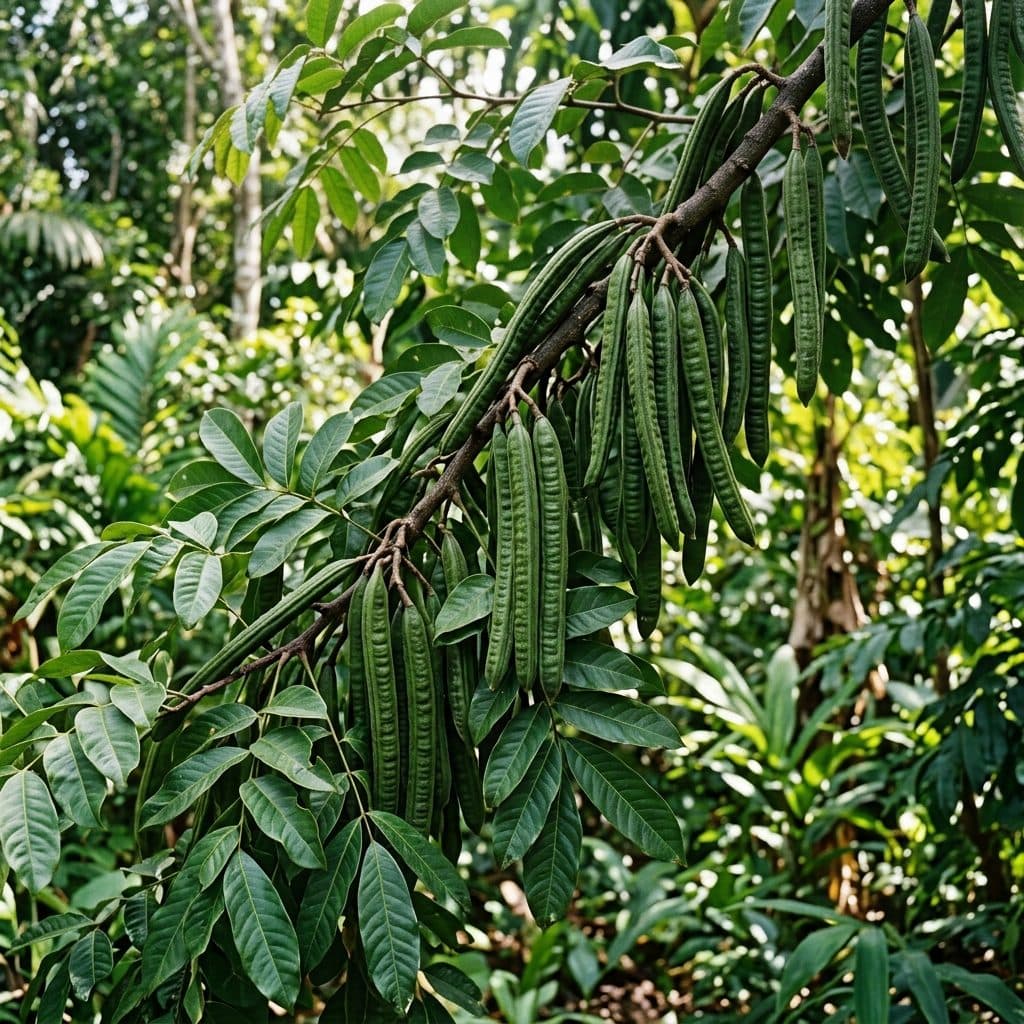
The primary edible harvest consists of large seed pods. Pods mature four to five months after flowering, turning from dark green to ribbed, yellowish-green. Pods measure 30 to 100 cm (12 to 39 in) long and 3 to 5 cm (1.2 to 2 in) in diameter, displaying deep longitudinal furrows. Harvest heavy pods by cutting them cleanly from the branch with pole pruners before they fall.
To consume the fruit, crack the tough outer rind open along its sutures. Inside, a row of large, dark purple-black seeds is encased in a fluffy, snow-white fibrous pulp (the aril). This pulp is pulled away and eaten fresh out of hand. It is sweet, moist, and possesses a subtle flavour resembling rich vanilla cream. While the sweet pulp is eaten raw, the seeds inside are not eaten raw; indigenous communities boil or roast them with salt as a starchy side dish.
Beyond its fruit, Inga edulis is also used for tropical soil restoration through alley cropping. Agroforestry farmers plant trees in dense contour hedgerows. Before annual crops are sown, trees are pollarded down to 1.5 m (5 ft). The pruned leafy branches are spread across the soil between rows. Because foliage contains substantial nitrogen and decomposes steadily, it forms a protective mulch mat that smothers aggressive weeds, conserves soil moisture, and restores soil fertility. When coppiced twice annually, hedgerows produce 5 to 10 tonnes of dry biomass per hectare each year.
The wood of Inga edulis is moderately dense, straight-grained, and seasons rapidly. Pruned branches provide excellent domestic firewood that burns cleanly with minimal smoke. The tree's fragrant white brush-like flowers secrete abundant nectar from extrafloral nectaries, making it valuable for apiculture.
Identifying Inga ice-cream bean
Inga edulis is identified in the field by several distinctive morphological characteristics:
- Tree architecture: A medium to large evergreen tree reaching 15 to 20 m (50 to 65 ft) in height with an umbrella-like spreading canopy and smooth pale greyish-brown bark.
- Leaves: Alternate, paripinnately compound leaves 20 to 30 cm (8 to 12 in) long, typically bearing 4 to 6 pairs of large, opposite leaflets. Leaflets are ovate-elliptic to lanceolate, 8 to 18 cm (3 to 7 in) long and 4 to 8 cm (1.5 to 3 in) wide, deep glossy green above and finely pubescent along the veins beneath.
- Winged rachis: The central leaf axis between each pair of leaflets is prominently winged and flattened, giving the leaf stem a leafy appearance.
- Extrafloral nectaries: A conspicuous, raised, cup-shaped green gland is positioned on the upper surface of the winged rachis directly between each pair of opposite leaflets. These glands secrete sweet nectar that attracts predatory ants and wasps.
- Flowers: Inflorescences borne in compact spikes; flowers feature small green calyces dominated by dozens of showy, brush-like white stamens measuring 4 to 5 cm (1.6 to 2 in) long.
- Fruit: Massive, cylindrical to flattened-cylindrical pods 30 to 100 cm (12 to 39 in) long and 3 to 5 cm (1.2 to 2 in) wide, marked by distinct longitudinal ribs, containing large black seeds surrounded by sweet white pulp.
The species is distinguished from Inga feuilleei by its deeply furrowed, cylindrical pods (which are flat in Inga feuilleei) and from Inga vera by its distinctly winged leaf rachises and larger floral heads.
Cautions
Growers incorporating Inga edulis into agroforestry designs must account for specific management considerations:
- Recalcitrant seed limitations: Because seeds have zero desiccation tolerance and germinate within days of pod ripening, they cannot be stored. Growers must sow them immediately upon pod opening. Sourcing seed across long distances via dry post leads to total mortality.
- Raw seed anti-nutritional compounds: While the sweet white aril is entirely safe to eat raw, the large raw seeds encased within contain anti-nutritional compounds, including trypsin inhibitors. Ingesting large quantities of raw seeds can cause digestive cramping. Discard the seeds or boil them thoroughly before eating.
- Excessive shading in multi-layer food forests: Unmanaged, an individual Inga edulis tree forms a dense canopy 10 to 15 m (33 to 50 ft) across, casting deep shade that stunts understory crops. In agroforestry, annual pollarding must be scheduled to maintain light penetration to lower strata.
- Potential weediness in disturbed tropical wetlands: In moist tropical island environments with warm year-round rainfall, Inga edulis can naturalise along riverbanks and forest gaps. Its rapid growth can suppress native pioneer seedlings. Prune trees regularly to manage seed production near waterways.
- Regulatory note: Regulated in some jurisdictions as a non-native agroforestry tree; check local land management guidelines before establishing large-scale plantings.
Sources
- Royal Botanic Gardens, Kew. Inga edulis Mart. Plants of the World Online.
- World Agroforestry (ICRAF). Inga edulis Mart. Agroforestree Database.
- Plants For A Future. Inga edulis - Mart.
- USDA PLANTS Database. Inga edulis Mart.