secondary
Hazelnut tree
Corylus avellana
International hardiness
- USDA 4-8
- RHS H6
- AU: Cool temperate, Warm temperate
Where it grows — regional guide
| Zones / rating | Regional notes |
|---|---|
USDA 4-8 | Cultivated in the Pacific Northwest across USDA Zones 4 to 8; highly susceptible to Eastern Filbert Blight unless planting resistant modern cultivars. |
| Zones / rating | Regional notes |
|---|---|
H6 (-20 to -15C) | Ancient native woodland species rated RHS H6; cornerstone of traditional hurdle-making and hedgerows, producing reliable edible cobnuts by September. |
| Zones / rating | Regional notes |
|---|---|
Cool temperate, Warm temperate | Grown successfully in southern Victoria, Tasmania, and the southern tablelands; requires 800 to 1,200 chill hours and protection from scorching desiccating winds. |
| Zones / rating | Regional notes |
|---|---|
USDA 4-8 (USDA scale) Canada uses its own zone system; Canadian zones run roughly one lower than USDA. | Hardy in southern Ontario and coastal British Columbia; cold-hardy to -30 °C (-22 °F), though late winter frosts can damage emerging male catkins. |
| Zones / rating | Regional notes |
|---|---|
No region-specific data yet | No region-specific data yet |
Hazelnut tree (Corylus avellana), widely known across Britain and Europe as common hazel or cobnut, is a vigorous, multi-stemmed deciduous large shrub or small tree in the birch family (Betulaceae). Native across Europe, western Asia, and North Africa, the species forms an essential structural component of ancient deciduous woodlands, hedgerows, and oak-ash forest understoreys. For millennia, hazel has served as one of the most culturally significant plants in temperate agrarian history; its nutritious, calorie-dense nuts sustained Mesolithic societies, while its flexible, fast-growing stems formed the foundation of traditional coppice crafts, hurdles, thatch spars, and living hedgerows. In contemporary food forests and permaculture homesteads, Corylus avellana represents a premier dual-purpose crop delivering delicious edible nuts alongside an abundant supply of rot-resistant poles and carbon-rich mulch.
Within integrated agroforestry layouts, common hazel works well as a secondary-canopy nut producer, a windward shelterbelt element, or an intensively cycled rotational coppice under standard timber trees. It integrates harmoniously alongside companion orchard plantings of apple and native nitrogen-fixers such as red clover, which build ground fertility in the root zone. In late winter, before foliage emerges, hazel transforms the dormant landscape with pendulous golden male catkins that release abundant wind-borne pollen to nourish early-foraging bees on mild afternoons.
Growing hazelnut trees
Corylus avellana is adapted to temperate maritime and moderate continental climates, growing reliably across USDA Hardiness Zones 4 through 8 and holding an RHS hardiness rating of H6. Fully dormant vegetative wood survives sub-zero drops down to -30 °C (-22 °F) without structural injury. However, because hazel flowers in mid to late winter (typically January through March in the northern hemisphere), open catkins and delicate red female stigmas are sensitive to severe late freezes; male catkins tolerate temperatures down to approximately -9 °C (16 °F), while female flowers survive down to -11 °C (12 °F). To ensure consistent nut set, shrubs require between 800 and 1,200 hours of winter chilling below 7 °C (45 °F). Annual precipitation of 600 to 1,000 mm (24 to 39 in) supports optimal growth, although mature bushes possess expansive root systems capable of weathering moderate summer droughts.
Hazelnut bushes thrive in fertile, moist, freely draining soils with a neutral to slightly acidic pH between 6.0 and 7.0. They tolerate alkaline chalk and limestone soils reasonably well, but struggle in stagnant, waterlogged ground or compacted shallow clays that induce root asphyxiation. While bushes tolerate partial shade beneath open-canopy forest trees, maximum flowering and heavy nut production require full sun exposure receiving at least six hours of unobstructed light.
Cross-pollination is essential for heavy nut production. Corylus avellana is monoecious—bearing separate male and female flowers on the same plant—but inherently self-incompatible and dichogamous, meaning male catkins shed pollen either before or after female flowers on that specific bush become receptive. Consequently, growers must plant at least two or three genetically distinct, compatible cultivars (such as 'Cosford', 'Webb's Prize Cob', or 'Halls Giant') within 15 to 20 m (50 to 65 ft) of one another to ensure wind pollination. Named fruiting varieties are propagated by simple mound layering, stooling, or grafting onto non-suckering rootstocks like Corylus colurna. Space multi-stemmed bushes 4 to 5 m (13 to 16 ft) apart in orchard grids, or 1 to 1.5 m (3.3 to 5 ft) apart in dense perimeter windbreaks. Layered or grafted trees produce their first commercial nuts within three to four years.
Harvest and uses
Hazelnuts mature in late summer to early autumn, typically from late August through October. The edible nut is an oval to globose, hard-shelled achene measuring 15 to 25 mm (0.6 to 1.0 in) long, enveloped in an open, leafy, deeply lobed husk or involucre. As ripening concludes, the leafy involucre turns yellow-brown and dries out, releasing the nuts to fall naturally to the ground. In commercial orchards and homestead settings, nuts are gathered promptly from cleared ground or hand-picked from branches as soon as husks turn brown to prevent losses to squirrels, jays, and field mice.
Freshly harvested nuts should be husked immediately and spread in a single layer in a warm, dry, well-ventilated area for two to three weeks to cure. This curing process drops nut moisture content from roughly 20 percent down to 8 to 10 percent, preventing mould development, hardening the inner kernel, and developing the signature sweet, buttery aroma.
In the pantry, hazelnuts are exceptionally versatile. The crisp, nutrient-dense kernels are rich in monounsaturated fats (particularly oleic acid), dietary fibre, vitamin E, and magnesium. They are consumed raw by the handful, dry-roasted, or ground into rich praline pastes, nut flours, and velvety dessert spreads blended with cocoa. Extracted hazelnut oil possesses an exquisite roasted fragrance and a high smoke point, making it a celebrated gourmet finishing oil. Beyond human nourishment, hazel foliage serves as nutritious fodder for sheep and goats. Mature fruiting bushes yield 2 to 5 kg (4.4 to 11 lb) of dried nuts annually.
Identifying hazelnut trees
Corylus avellana is easily identified throughout the seasons by several characteristic botanical features:
- Habit and bark: A deciduous, large suckering shrub or multi-stemmed small tree typically reaching 3 to 6 m (10 to 20 ft) in height with an expansive, rounded crown. The bark on young stems is smooth, glossy, reddish-brown, and marked with horizontal yellow-orange lenticels, developing shallow grey-brown fissures with age.
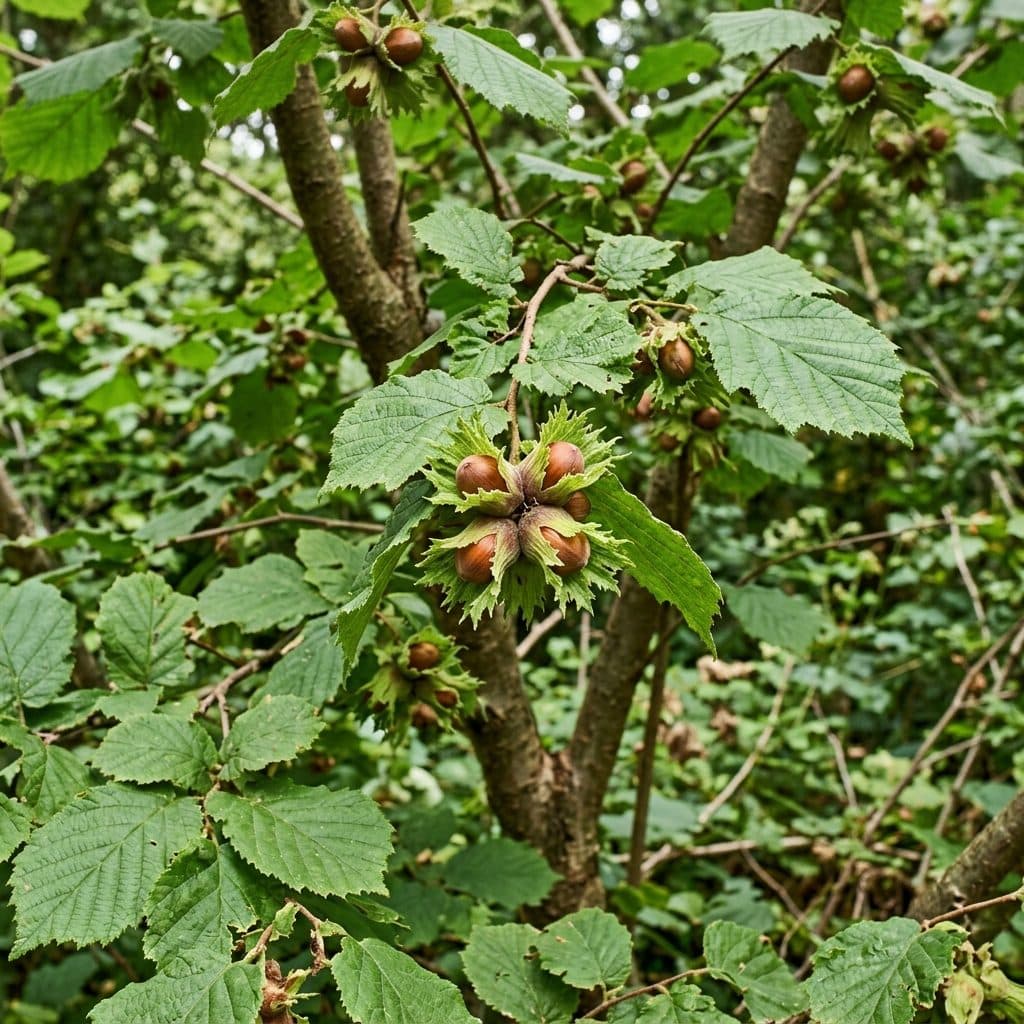
- Leaves: Alternate, simple, rounded to broadly obovate leaves measuring 6 to 12 cm (2.4 to 4.7 in) long and nearly as wide. The leaf base is distinctly cordate (heart-shaped), while the apex tapers to a short, sharp point. Margins are sharply and doubly serrated. The upper leaf surface is matte green and lightly downy, while the paler underside is softly pubescent, especially along vein axils.
- Flowers: Late-winter flowers appear long before leaf break. Male flowers are borne in pendulous, cylindrical catkins measuring 4 to 8 cm (1.6 to 3.1 in) long, turning pale golden-yellow as they shed powdery pollen. Female flowers are tiny, bud-like structures nestled along twigs, identifiable only by a tuft of thread-like crimson styles protruding from the apex.
- Fruit: Hard-shelled, woody brown nuts borne in clusters of one to four, partly enveloped by a green, leafy, deeply cut tubular husk that splits open at maturity.
Common hazel is distinguished from American hazelnut (Corylus americana) by its shorter, open husk that barely covers the nut, whereas C. americana possesses a significantly longer, tightly tubular husk that completely encloses the nut twice its length.
Cautions
When cultivating Corylus avellana, homesteader orchardists must account for several major agronomic, allergenic, and biosecurity considerations:
- Severe tree nut allergen: Hazelnuts contain potent storage proteins (such as Cor a 1, Cor a 8, and Cor a 9) that are classified among the most prevalent triggers of tree nut allergies. Ingestion can provoke acute allergic reactions ranging from oral allergy syndrome to fatal anaphylactic shock in sensitised individuals. Always clearly label harvested homestead produce.
- Eastern Filbert Blight (Anisogramma anomala): In North America, European hazelnut cultivars are exquisitely vulnerable to this native ascomycete fungus. The disease causes elongated black pustules (stromata) along twigs, followed by rapid branch cankering, canopy dieback, and total tree death within three to five years. In regions where Eastern Filbert Blight is present, growers must exclusively plant modern, gene-resistant cultivars (such as 'Jefferson', 'Yamhill', or 'Dorris').
- Aggressive basal suckering: Hazel naturally produces numerous vigorous water sprouts and basal suckers from the crown every spring. In bush or single-stem orchard production, these suckers must be pruned flush to the root collar three to four times per season to prevent the bush from degenerating into an impenetrable thicket of non-fruiting vegetative canes.
- Hazelnut weevil (Curculio nucum): In Europe and western Asia, adult weevils puncture immature nut shells in early summer to deposit eggs. The resulting larvae consume the developing kernel from within, boring a neat circular exit hole through the hard shell before dropping to pupate in the soil, often spoiling up to 50 percent of an unmanaged crop.
Sources
- Royal Botanic Gardens, Kew. Corylus avellana L. Plants of the World Online.
- USDA PLANTS Database. Corylus avellana L.
- Plants For A Future. Corylus avellana - L.
- North Carolina State Extension Gardener Plant Toolbox. Corylus avellana