Key takeaways
- Agroforestry deliberately integrates woody perennials with agricultural crops or livestock on the same land parcel to create synergistic ecological yields.
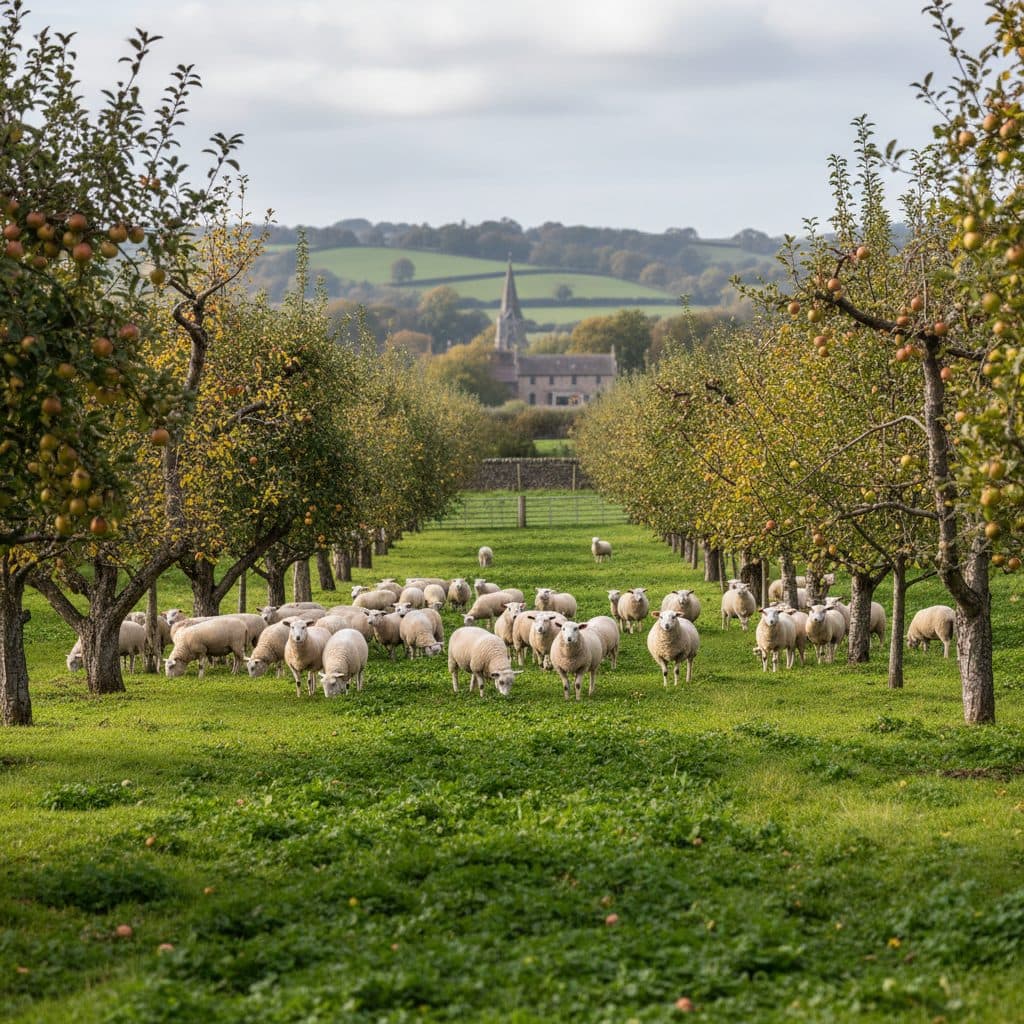
- Silvopasture combines timber or fruit trees with pasture grazing, providing livestock shelter, reducing heat stress, and extending the grazing season.
- Silvoarable systems arrange tree rows between arable crop alleys, moderating field microclimates and reducing wind erosion across open ground.
- Grant funding across England, Scotland, Wales, and Northern Ireland increasingly supports agroforestry establishment under post-CAP environmental schemes.
- Proper tree spacing, root pruning, and species selection prevent excessive canopy shading and root competition with annual understorey crops.
Quick answer: Agroforestry in the United Kingdom involves deliberately integrating trees and shrubs into livestock pastures (silvopasture) or arable crop fields (silvoarable). This multifunctional land-use practice improves soil structure, captures carbon, enhances animal welfare, and diversifies farm revenue through fruit, nuts, and timber. Supported by government environmental land management grants, UK growers design agroforestry systems tailored to local rainfall, topography, and soil conditions.
Integrating trees into productive agricultural landscapes represents one of the most effective approaches to modern UK land management. Rather than separating forestry and farming into isolated blocks, agroforestry treats the interactions between trees, soils, crops, and animals as a unified productive ecosystem.
Across England, Wales, Scotland, and Northern Ireland, smallholders and commercial farmers face shifting weather patterns, soil degradation, and rising input costs. Trees planted within field systems slow driving winds, cycle deep subsoil nutrients, and capture heavy rainfall before it causes surface runoff.
Transitioning to agroforestry requires careful spatial planning, financial analysis, and species selection. By examining established silvopastural and silvoarable models, navigating regional grant opportunities, and implementing sound planting techniques, UK land managers can establish resilient systems that yield ecological and financial dividends.
Core agroforestry systems in the British landscape
Agroforestry in the UK is primarily categorized into two major configurations, alongside smaller specialist systems like hedgerow browse and riparian forest buffers.
+------------------------+-----------------------------------+-----------------------------------+
| Agroforestry System    | Core Components                   | Primary Benefits in the UK        |
+------------------------+-----------------------------------+-----------------------------------+
| Silvopasture           | Trees + Pasture + Livestock       | Livestock shade, extended grazing |
| Silvoarable            | Trees in rows + Arable Crop Alleys| Windbreak, microclimate, soil C   |
| Forest Gardening       | Multi-layered perennial polyculture| High diversity yield in small area|
| Riparian Buffers       | Trees along streams and rivers    | Bank stabilization, runoff filter |
+------------------------+-----------------------------------+-----------------------------------+
Silvopasture: trees and grazing animals
Silvopasture integrates livestock, such as cattle, sheep, or poultry, with timber, fruit, or fodder trees. In wet UK winters, tree root systems improve soil percolation, reducing surface poaching and waterlogging. In summer, the canopy provides critical shade, lowering ambient temperatures beneath the canopy and preventing heat stress in grazing herds.
Trees can be planted in widely spaced parkland grids (such as traditional wood pasture) or arranged in fenced contour lines across sloping pasture.
Silvoarable: trees and cropping alleys
Silvoarable systems divide arable fields into wide crop alleys separated by linear tree rows. Standard agricultural equipment continues to cultivate cereals, legumes, or vegetables within the alleys, while the tree rows provide wind protection and long-term timber or fruit crops.
Alley widths typically range from 12 m to 36 m (with an 18 m to 24 m worked example shown below), sized to match standard machinery working widths (such as sprayer booms or seed drills).
+-------------------------------------------------------------------+
|               SILVOARABLE ALLEY CROPPING LAYOUT                   |
+-------------------------------------------------------------------+
| [Tree Row]   Fruit / Timber / Nut Trees + Perennial Understorey   |
| <=========   18 to 24 m Arable Crop Alley (Cereals / Veg)  =======>|
| [Tree Row]   Fruit / Timber / Nut Trees + Perennial Understorey   |
| <=========   18 to 24 m Arable Crop Alley (Cereals / Veg)  =======>|
| [Tree Row]   Fruit / Timber / Nut Trees + Perennial Understorey   |
+-------------------------------------------------------------------+
Selecting suitable tree species for UK agroforestry
Matching tree species to soil type, exposure, and production goals ensures long-term system success.
Fruit and top orchard trees
Apples and plums on semi-dwarfing rootstocks crop within about four to six years. Perry pears and standard-rootstock cider trees are a much longer game - often a decade or more before meaningful yield - so match rootstock choice to how soon you need the income. Sourcing robust rootstocks and learning how to plant fruit tree correctly during the dormant winter window reduces establishment losses across large acreage.
Proper winter maintenance and structural branch training ensure long-term fruit yield, following established guidelines on how to prune fruit trees.
Timber and native broadleaf species
- English Oak (Quercus robur): Long-term hardwood timber, exceptional biodiversity support, deep taproot system that minimizes surface competition.
- Wild Cherry (Prunus avium): Fast-growing valuable timber, spring blossom for beneficial pollinators.
- Sweet Chestnut (Castanea sativa): Durable rot-resistant timber for fencing posts, edible nut production, vigorous coppicing response. Sweet chestnut blight (Cryphonectria parasitica) is present at sites in England and is subject to statutory action - buy only UK-grown, traceable stock from a Plant Healthy certified nursery, check the current Forestry Commission position before planting, and report suspect cankers.
- Silver Birch (Betula pendula): Pioneer nurse species, rapid biomass accumulation, light canopy permitting good grass growth beneath.
Across all species, buy only UK-grown, traceable stock from a Plant Healthy certified nursery.
Both oak and cherry carry livestock risks. In heavy acorn years, fence stock off oaks or provide ample supplementary feed, as acorns and oak leaves cause tannin poisoning in cattle, sheep and horses. Never leave cherry prunings or storm-broken Prunus branches in a grazed paddock - wilted leaves release cyanide and are lethal to ruminants; remove and burn or stack them out of reach.
Nitrogen-fixing and biomass trees
Incorporating species like Italian Alder (Alnus cordata) or Common Alder (Alnus glutinosa) fixes atmospheric nitrogen into the soil biology, enriching neighbouring crop alleys. These principles align closely with global methods explored in syntropic farming.
Government grants and funding schemes
Establishing agroforestry in the UK is supported by evolving agricultural transition schemes that reward public goods and environmental stewardship.
England: environmental land management (ELM)
Under the Sustainable Farming Incentive (SFI) and Countryside Stewardship (CS) Capital Grants, farmers in England can access funding for agroforestry design, tree planting, maintenance, and tree protection. Payments include specific capital grants for tree stock and protective guards, as well as recurring multi-year management payments per hectare.
Devolved administrations: Scotland, Wales, and Northern Ireland
- Scotland: The Forestry Grant Scheme includes dedicated Agroforestry Options for both sheep and arable systems.
- Wales: the Sustainable Farming Scheme includes tree and woodland measures, but the tree-cover requirements changed during the scheme's finalisation - check the current Welsh Government scheme rules before committing to a planting plan.
- Northern Ireland: tree and woodland establishment is funded through DAERA Forest Service schemes rather than the agri-environment route; check the current DAERA guidance for what applies to agroforestry planting.
Because scheme terms, payment rates, and eligibility criteria update periodically, land managers should consult the relevant agricultural department (such as Defra, Scottish Forestry, or Rural Payments Wales) before purchasing planting stock.
Ground preparation, planting, and tree protection
Successful agroforestry establishment requires robust protection against livestock, deer, and rodents.
Protecting young trees
+------------------------+-----------------------------------+-----------------------------------+
| Protection Type        | Target Hazard                     | Application Context               |
+------------------------+-----------------------------------+-----------------------------------+
| Mesh Tree Guards (1.2m)| Rabbits, Hares, Roe Deer          | Arable alleys, sheep grazing      |
| Timber Post & Rail Box | Cattle, Horses                    | Heavy livestock silvopasture      |
| Electric Fencing Strips| Cattle, Sheep, Pigs               | Linear tree belts during growth   |
| Spiral Guards (60 cm)  | Voles, Mice, Field Rabbits        | Broadleaf timber plantings        |
+------------------------+-----------------------------------+-----------------------------------+
Without rigid physical protection, cattle and sheep will browse leader shoots, strip bark, and rub against young trunks, causing severe mortality.
Managing root and light competition
To ensure arable crops and pastures thrive alongside maturing trees, manage interactions proactively:
- Orientation: Align tree rows north-to-south whenever possible to ensure both sides of the crop alley receive equal sunlight throughout the day.
- Canopy Pruning: Undertake regular formative pruning and lower branch lifting to maintain light penetration to the field floor.
- Subsoil Root Slicing: Use a subsoiler shank along the margin of the tree row to sever shallow lateral tree roots, encouraging roots to grow downward rather than competing with crop fertilizers in the top 20 cm of soil. Do this in the dormant season, keep the shank at least a metre out from the trunks, and go easy on shallow or exposed sites - repeated severing of lateral roots reduces anchorage and raises windthrow risk.
For smallholders designing intensive perennial food systems, scaling down these concepts into a home plot is detailed in our guide on how to create a forest garden and exploring multi-layered canopy structures in forest garden design.