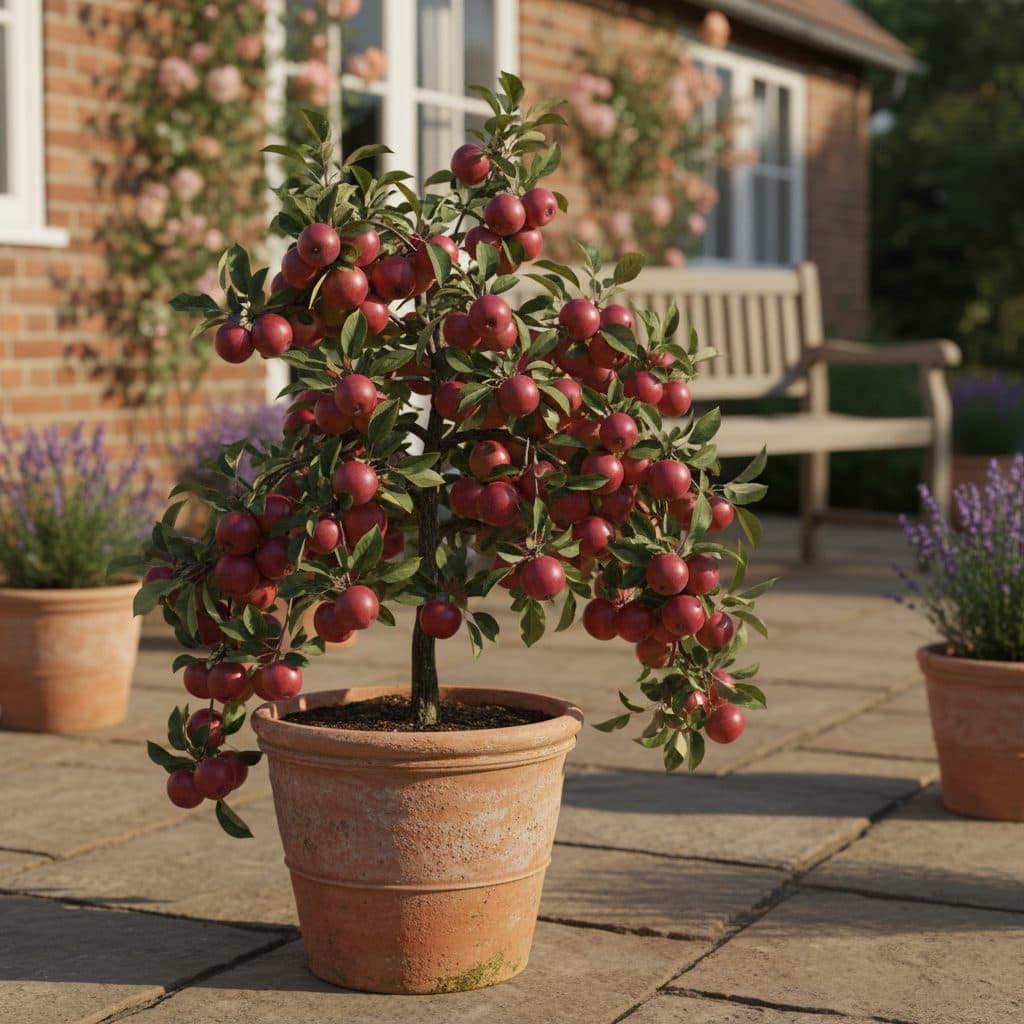
Key takeaways
- Tree size, precocity and vigour are set mainly by the rootstock, though a naturally vigorous or triploid scion such as 'Bramley's Seedling' will still make a larger tree on the same stock.
- Choose M27 rootstocks for patio pots and small courtyard borders (1.2 to 1.8 metres) or M9 for productive allotment cordons and bushes (2.0 to 2.5 metres).
- Dwarf rootstocks have brittle, shallow root systems that require permanent, lifetime stake support against prevailing UK winds.
- Pot-grown trees require heavy, loam-based John Innes No. 3 compost instead of lightweight multi-purpose peat-free media.
- Prune dwarf trained forms in summer to restrict vegetative vigour and encourage fruiting spur formation.
- Ensure cross-pollination by selecting compatible cultivars within the same flowering group or by planting a family tree (several cultivars grafted on one rootstock) or a genuinely self-fertile cultivar.
Quick answer: For small UK gardens and patios, plant fruit trees grafted onto dwarfing rootstocks such as M27 or M9 for apples, Quince C for pears, and Gisela 5 for cherries. Grow in deep, well-drained soil or 45 to 50 cm containers filled with loam-based John Innes No. 3 compost, provide permanent staking, and perform summer pruning to maintain compact, productive trees.
Cultivating fresh, orchard-quality fruit does not require acres of land. Thanks to centuries of horticultural breeding at British research stations like East Malling and Long Ashton, home gardeners can harvest heavy crops of apples, pears, plums, and cherries from trees that stand no taller than a person.
Successfully cultivating dwarf fruit trees in the UK climate hinges on understanding rootstocks. A dwarf fruit tree consists of a fruiting cultivar (the scion) grafted onto a dwarfing root system that restricts water and nutrient flow, channelling energy away from timber growth into early flower and fruit production.
Whether you plan an intensive cordon along an allotment fence, an espalier on a sunny brick wall, or potted patio trees, this guide explains rootstock codes, container soil management, staking essentials, and seasonal pruning.
+-------------------------------------------------------------+
|              UK DWARF FRUIT TREE ROOTSTOCK SCALE            |
|                                                             |
|   ROOTSTOCK      TYPICAL HEIGHT    BEST USE / FORM          |
|   ---------      --------------    ---------------          |
|   M27            1.2 - 1.8 m       Patio pots, tiny borders |
|   M9             2.0 - 2.5 m       Allotment bushes, cordons|
|   M26            2.5 - 3.5 m       Small garden standalone  |
|   MM106          3.5 - 4.5 m       Traditional half-standard|
+-------------------------------------------------------------+
How do rootstocks control tree size and fruiting?
Every named fruit tree sold by UK nurseries consists of two distinct plant parts joined at the graft union (the visible swelling near the base of the trunk):
- The scion: The upper section that produces the branches, leaves, blossoms, and specific fruit variety (such as 'Cox's Orange Pippin', 'Discovery', or 'Conference').
- The rootstock: The lower root system that dictates ultimate height, vigour, soil tolerance, and how quickly the tree begins bearing fruit (precocity).
+-------------------------------------------------------------+
|                     GRAFT ANATOMY DIAGRAM                   |
|                                                             |
|               \   |   /  (Fruiting Canopy: Scion)           |
|                \  |  /                                      |
|                 \ | /                                       |
|                   |                                         |
|                 ( # )    <--- Graft Union (5-10 cm above)   |
|                   |                                         |
|                 =====    <--- Soil Level                    |
|                /  |  \   (Dwarf Root System: Rootstock)     |
+-------------------------------------------------------------+
Planting rule: Always plant fruit trees with the graft union positioned 5 to 10 cm above the soil surface. If the graft union is buried beneath the earth, the scion variety will throw out its own roots into the soil ("scion rooting"), bypassing the dwarfing rootstock and growing into a full-sized 8-metre standard tree.
Which dwarf rootstocks should you choose for UK gardens?
Selecting the correct rootstock depends on your available space, soil type, and whether you are planting into the ground or into containers:
+-------------------------------------------------------------+
|             ROOTSTOCK SPECIFICATIONS ACROSS FRUITS          |
|                                                             |
|   FRUIT      ROOTSTOCK    HEIGHT       KEY ATTRIBUTES       |
|   -----      ---------    ------       --------------       |
|   Apple      M27          1.2 - 1.8 m  Extreme dwarf; pots  |
|   Apple      M9           2.0 - 2.5 m  Standard dwarf; bush |
|   Apple      M26          2.5 - 3.5 m  Semi-dwarf; espalier |
|   Pear       Quince C     2.5 - 3.0 m  Dwarf pear standard  |
|   Plum/Gage  Pixy         2.5 - 3.0 m  Compact plum / damson|
|   Cherry     Gisela 5     2.5 - 3.0 m  Dwarf sweet cherry   |
+-------------------------------------------------------------+
Apple rootstocks
- M27 (Very Dwarf): Ideal for 45 cm patio containers and micro-gardens. Trees reach roughly 1.5 metres and begin cropping in their second year. Requires rich soil and lifetime staking.
- M9 (Dwarf): The commercial orchard standard across Europe. Excellent for compact bushes, oblique cordons, and step-over edgings. Yields heavy crops of large fruit but has brittle roots that need permanent support.
- M26 (Semi-Dwarf): Sturdier than M9, suitable for poorer soils and trained forms like espaliers or fans.
- MM106 (Semi-Dwarf): Traditional half-standard (3.5 to 4.5 m); avoid on wet or poorly drained ground (collar rot).
Pear, plum, and cherry rootstocks
- Quince C (Pear): Brings vigorous pear scions (like 'Conference' and 'Concorde') into early bearing at a manageable 2.5 to 3.0 metres. A few cultivars ('Doyenné du Comice', 'Williams\' Bon Chrétien' and 'Bristol Cross' among them) are incompatible with quince and must be bought double-worked on an interstem such as 'Beurré Hardy'.
- Pixy (Plum, Damson, Gage): Restricts naturally vigorous plum cultivars like 'Victoria' to around 2.5 to 3.0 metres, making netting against birds practical.
- Gisela 5 (Cherry): Keeps sweet cherries (such as 'Stella' or 'Sunburst') compact enough to net and pick without ladders.
When comparing intensive fruit systems with multi-layered food forest designs, see food forest vs orchard.
How do you plant and support dwarf fruit trees in the ground?
Dwarf rootstocks have a high ratio of fine feeding roots to structural anchorage roots. Because the root timber is brittle, unsupported trees can rock, loosen, or snap at the graft union during autumn gales.
+-------------------------------------------------------------+
|                 TREE STAKING CONFIGURATION                  |
|                                                             |
|           [ Tree Trunk ]     [ Tree Stake (Low 45 cm) ]     |
|                 |                   |                       |
|                 |==== Rubber Tie ===|                       |
|                 |    with Spacer    |                       |
|                 |                   |                       |
|           ============== Soil Surface =============         |
|                / \                 | |                      |
|               /   \                | | (Driven 30 cm deep)  |
+-------------------------------------------------------------+
Permanent staking protocol
- Use a short stake (roughly 1 metre long) driven 30 to 45 cm into the ground on the windward side of the tree before inserting the root ball.
- Fasten the trunk to the stake at a height of roughly 45 cm above ground level using an adjustable rubber tree tie fitted with a spacer collar to prevent trunk chafing.
- Low staking allows the upper trunk to flex in the breeze, stimulating trunk thickening while keeping the fragile root flare immovably anchored in the soil.
Soil and site preparation
- Plant bare-root trees during the dormant season between November and March, or container-grown specimens year-round.
- Dig a square planting hole twice the width of the root system but no deeper than the roots.
- Incorporate a handful of slow-release bonemeal or rock phosphate into the backfill soil to promote root establishment.
- Mulch the surface with a 7 cm ring of well-rotted compost, leaving a 10 cm bare zone around the bark.
To pair ground prep with perennial beds, see our guides on a no-dig allotment and early spring forcing rhubarb.
How do you manage dwarf fruit trees in patio containers?
Growing fruit trees in containers allows plot holders to manage soil chemistry precisely and move trees into sheltered spots during severe weather:
+-------------------------------------------------------------+
|                 PATIO CONTAINER CARE CHECKLIST              |
|                                                             |
|   COMPONENT         REQUIREMENT                             |
|   ---------         -----------                             |
|   Pot Size          45 to 50 cm diameter (minimum 40 litres)|
|   Compost           Loam-based John Innes No. 3             |
|   Drainage          Crocks over holes + elevated pot feet   |
|   Watering          Daily in summer heat; check root ball   |
|   Feeding           High-potassium feed every 2 wks in crop |
|   Top-Dressing      Replace top 5 cm compost each spring    |
+-------------------------------------------------------------+- Avoid multi-purpose compost: Standard peat-free multi-purpose compost degrades, shrinks, and loses structural integrity within two seasons. Always use a heavyweight, loam-based potting compost such as John Innes No. 3, which provides mineral weight, retains nutrients, and buffers moisture fluctuations.
- Drainage and pot feet: Stand containers on terracotta pot feet or timber blocks. Direct ground contact blocks drainage holes, leading to root asphyxiation during wet UK winters.
- Winter root protection: While fruit tops are frost hardy, container root balls are exposed to sub-zero winds. In freezing spells, wrap pots in hessian or bubble wrap, or move containers against a sheltered south-facing house wall.
For growers exploring vertical container techniques, see vining crops in pots and vertical setups.
How and when should you prune dwarf fruit trees?
Pruning strategy depends entirely on whether your goal is to stimulate vigour or restrict growth.
+-------------------------------------------------------------+
|                 WINTER VS SUMMER PRUNING                    |
|                                                             |
|   PRUNING TIMING    EFFECT ON VIGOUR     BEST FOR           |
|   --------------    ----------------     --------           |
|   Winter (Nov-Feb)  Stimulates growth    Young bush trees   |
|   Summer (July-Aug) Restricts vigour     Dwarf trained forms|
+-------------------------------------------------------------+
This winter/summer split applies to apples and pears. Never prune plums, gages, damsons or cherries in winter; prune them in late spring to mid-summer, in dry weather, to avoid silver leaf and bacterial canker.
Summer pruning for dwarf and trained forms
For dwarf bushes, cordons, and espaliers on M27, M9, or Quince C rootstocks, perform the main routine pruning in late summer (mid-July to August):
- Summer pruning removes leafy foliage while the tree is actively growing, reducing photosynthetic area and curbing vegetative excess.
- Cut back new current-season side shoots (laterals) originating from main framework branches to three leaves above the basal cluster of leaves.
- Cut sub-laterals (shoots emerging from existing fruiting spurs) back to one leaf above the basal cluster.
- Open up the centre of the canopy to allow sunlight to reach ripening fruit and improve air circulation against fungal scab and mildew.
For seasonal soil and air cues, see our guide on soil temperature for planting.