Key takeaways
- Bill Mollison's Permaculture: A Designers' Manual remains the comprehensive technical reference for whole-site water, soil, and ecological design.
- David Holmgren's Permaculture: Principles and Pathways Beyond Sustainability provides the foundational ethical and design framework for modern resilience.
- Ross Mars and Rosemary Morrow offer accessible, practical beginner guides tailored specifically to Australian rainfall and climatic regions.
- Australian permaculture literature goes deeper than most on extreme bushfire management, low-rainfall swale hydrology, and Mediterranean soil building.
- Pair broad design manuals with localized regional planting guides to match plant species to tropical, subtropical, temperate, and arid regions.
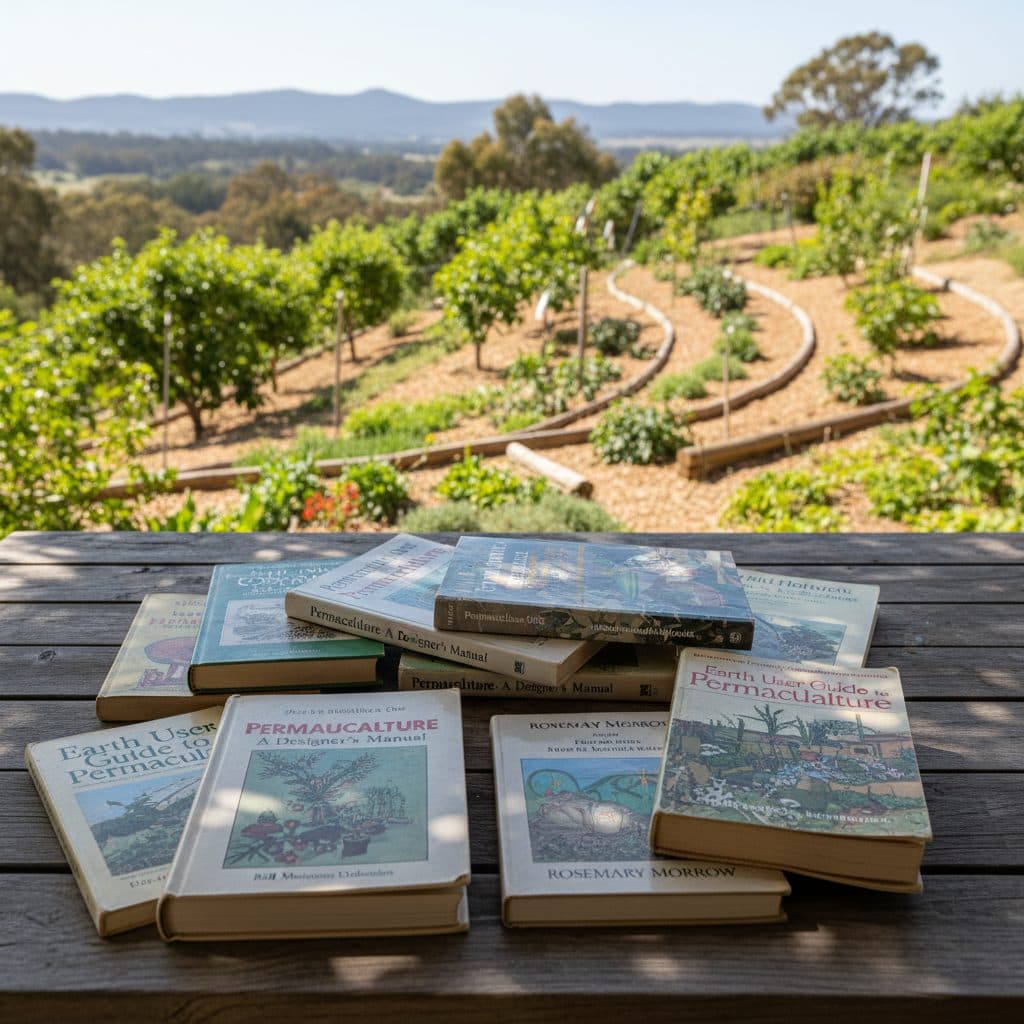
Quick answer: The best permaculture books for Australian conditions provide grounded, climate-specific design strategies originating directly from the movement's founders, Bill Mollison and David Holmgren. Essential reading spans foundational technical texts such as Permaculture: A Designers' Manual, practical home garden guides like Rosemary Morrow's Earth User's Guide to Permaculture, and modern regional resources focusing on Australian water harvesting, bushfire resilience, and Mediterranean soil ecology.
Permaculture originated in Australia during the 1970s, developed by Bill Mollison and David Holmgren in response to industrial agricultural degradation and resource depletion. Because the discipline was forged in the rugged landscapes of Tasmania and Victoria, Australian permaculture literature provides unmatched depth on managing extreme weather, prolonged drought, bushfire design, and weathered soils.
For Australian growers, homesteaders, and landscape designers, international gardening books often fail to translate to local conditions. European and North American texts assume regular summer rainfall, predictable winter snowpacks, and young glacial soils—conditions alien to the ancient, nutrient-depleted, flood-and-drought cycles of the Australian continent.
Reading the right Australian permaculture texts provides practical frameworks for building water-harvesting earthworks, establishing multi-layered food forests, and designing resilient homesteads across tropical, subtropical, temperate, and arid landscapes.
The foundational master texts
Every serious designer's library begins with the foundational works that defined the permaculture movement.
+------------------------+-------------------+-------------------+-------------------------------+
| Book Title             | Author            | Publication Scope | Best Suited For               |
+------------------------+-------------------+-------------------+-------------------------------+
| Permaculture: A        | Bill Mollison     | Comprehensive 576p| Professional designers, farm  |
| Designers' Manual      |                   | technical reference| scale planning, whole sites   |
| Permaculture:          | David Holmgren    | Theoretical and   | Big-picture design thinking,  |
| Principles & Pathways  |                   | ethical framework | societal & energy resilience  |
| Earth User's Guide to  | Rosemary Morrow   | Practical, stepped| Home gardeners, teachers,     |
| Permaculture           |                   | design workbook   | beginner design students      |
| RetroSuburbia: The     | David Holmgren    | Urban and suburban| Renters, suburban homeowners, |
| Downshifter's Guide    |                   | retrofitting guide| urban food production         |
+------------------------+-------------------+-------------------+-------------------------------+
1. Permaculture: A Designers' Manual (Bill Mollison)
Often revered as the "black book" of permaculture, Mollison's 1988 masterwork remains the definitive global textbook. Spanning 576 pages across 14 deep chapters, it covers broad-scale earthworks, pattern understanding, hydrology, aquaculture, arid land management, humid tropics, and cold climates.
Mollison's prose is direct, encyclopaedic, and unapologetically practical. While not a casual weekend read, it is an indispensable reference for anyone designing acreage, working with swales, or undertaking a Permaculture Design Course (PDC).
2. Permaculture: Principles and Pathways Beyond Sustainability (David Holmgren)
Where Mollison provided technical implementation, co-originator David Holmgren articulated the deep philosophical and systemic framework. Holmgren organises permaculture into 12 core design principles—such as Catch and Store Energy, Obtain a Yield, Use and Value Diversity, and Creatively Use and Respond to Change.
This text is essential reading for understanding how energy descent, ecological systems, and human design intersect over multi-decade time horizons.
Practical and home-scale Australian guides
For backyard growers and suburban plot holders seeking immediate, actionable planting and design advice, several Australian authors have translated broad theory into accessible garden practice.
+-------------------------------------------------------------------+
|               CORE DESIGN METHODOLOGY IN PRACTICE                 |
+-------------------------------------------------------------------+
|1. Space Planning:    Arrange elements by frequency of human visit |
|2. Sector Analysis:   Map wild energies (Sun, Wind, Fire, Flood)   |
| 3. Water Harvesting:  Catch water at highest point; slow & sink   |
| 4. Biological Guilds: Pair nitrogen fixers with dynamic miners    |
| 5. Soil Building:     No-till compost, sheet mulch, living roots  |
+-------------------------------------------------------------------+
3. Earth User's Guide to Permaculture (Rosemary Morrow)
Rosemary Morrow's classic text is arguably the most user-friendly introduction to practical permaculture ever published in Australia. Illustrated with clear, hand-drawn diagrams by Rob Allsop, Morrow breaks down complex ecological concepts into bite-sized exercises.
Her chapters on soil building, seed saving, water conservation, and integrated pest management are directly applicable to typical suburban quarter-acre blocks and rural properties alike.
4. RetroSuburbia: The Downshifter's Guide to a Resilient Future (David Holmgren)
Published in 2018, RetroSuburbia addresses the reality that most Australians live in suburban housing developments. Across 592 colour-rich pages, Holmgren details how to transform existing brick-veneer homes, quarter-acre lawns, and residential streets into productive, energy-efficient micro-farms.
The book is divided into three functional fields: the Built Environment (passive solar retrofits, greywater), the Biological Environment (veggie patches, orchards, small livestock), and the Behavioural Environment (household economics, community barter, shared living).
5. The Basics of Permaculture Design (Ross Mars)
Western Australian educator Ross Mars provides outstanding, no-nonsense guides focused heavily on Australian water-harvesting systems, greywater diversion, and arid soil rejuvenation. His books provide dimensioned technical drawings of swales, dams, and reed beds that suit low-rainfall Western Australia and South Australia conditions.
Specialized texts: water, food forests and bushfire design
Beyond general introductions, specialized permaculture books explore critical sub-disciplines for Australian land managers.
+------------------------+-----------------------------------+-----------------------------------+
| Specialized Topic      | Recommended Authors & Focus       | Core Takeaway                     |
+------------------------+-----------------------------------+-----------------------------------+
| Keyline Water Design   | P.A. Yeomans (Water for Every Farm)| Gravity-fed irrigation, subsoiling|
| Food Forest Guilds     | Dave Jacke & Eric Toensmeier, *Edible Forest Gardens* | Layered guild design and plant function - written for cold-temperate North America, so take the method, not the species lists |
| Bushfire Safety        | Joan Webster, *Essential Bushfire Safety Tips* | Household survival planning and preparation |
| Australian Foraging    | Tim Low (Wild Food Plants of Aus) | Positive ID of native edibles     |
+------------------------+-----------------------------------+-----------------------------------+
Keyline design and water harvesting
P.A. Yeomans' Water for Every Farm: Using the Keyline Plan predates formal permaculture but directly inspired Mollison and Holmgren. Yeomans showed how to rip subsoil in a pattern parallel to the keyline, deliberately off-contour, so that run-off drifts out of the wet valleys toward the dry ridges, and paired that with rapid topsoil building through deep-rooted pasture.
Explore hands-on design applications in our overview of permaculture design and practical backyard planning in permaculture gardening.
Designing for Australian climate extremes and bushfire
Australian permaculture texts place strong emphasis on managing sector energies that can threaten homestead survival:
- Bushfire Defence Planning: Designing inner domestic surrounds and outer orchard buffers with high-moisture succulent ground covers, deciduous fruit trees, and gravel paths to catch embers and reduce radiant heat. None of this substitutes for a bushfire survival plan. In bushfire-prone areas, defendable space and planting near a dwelling are regulated - work from your state fire authority (CFA, SA CFS, NSW RFS) and any BAL assessment on your site.
- Drought Hydrology: Sizing earth swales and keyline dams to absorb infrequent, torrential deluge rainstorms into subsoil aquifers rather than letting topsoil wash away into creeks.
- Soil Acidity and Salinity: Amending ancient, highly weathered Australian soils using biological sheet mulches and compost teas rather than heavy synthetic inputs.
How to choose the right book for your growing context
Selecting the most relevant permaculture text depends on your land scale, climate region, and current level of experience:
- For Suburban Backyards: Start with Rosemary Morrow's Earth User's Guide to Permaculture and David Holmgren's RetroSuburbia.
- For Rural Acreage and Farms: Invest in Bill Mollison's Permaculture: A Designers' Manual and P.A. Yeomans' Water for Every Farm.
- For Perennial Orchards and Food Forests: Explore multi-layered plant guilds as explained in what is a food forest and regenerative biomass systems in syntropic farming.
Building a dedicated permaculture reference library equips Australian landholders with the knowledge needed to build thriving, self-sustaining landscapes that flourish for generations.