Key takeaways
- DIY soil tests (jar, perk, pH, squeeze) provide actionable insights into texture, drainage, and pH.
- Understanding soil texture helps predict water retention and nutrient holding capacity, impacting plant choice and amendment strategies.
- The perk test reveals drainage issues, which can prevent root rot and inform decisions about organic matter additions.
- Soil pH directly influences nutrient availability; most garden plants thrive between pH 6.0 and 7.0.
- Regularly adding 2-4 inches of organic matter, like compost, improves soil structure, water retention, and nutrient cycling.
- These simple tests point you to the specific amendments your soil actually needs, which shows up as healthier plants and better harvests.
Quick answer: You can understand your garden soil and boost yields by performing simple DIY tests for texture, drainage, and pH. These tests provide actionable insights to amend your soil effectively, leading to healthier plants and better harvests.
Across the United States, from the fertile river bottoms of the Mississippi Delta to the arid plains of Arizona, gardeners face a common challenge: understanding their soil. In many parts of the Midwest, for example, clay soils hold far more water than sandy soils, but also drain much slower, impacting root health. Knowing your soil’s characteristics is not just an academic exercise; it is a practical step toward healthier plants and better harvests, whether you are cultivating tomatoes in California or corn in Kansas.
This weekend, you can perform three straightforward, inexpensive tests to gain valuable insights into your garden’s texture, drainage, and pH. These DIY methods offer a foundational understanding, complementing more detailed lab analyses, and providing actionable information to amend your soil effectively. With just a few common household items, you can begin to diagnose issues and make informed decisions that will benefit your plants for seasons to come.
The jar test: understanding soil texture and composition
The soil you cultivate is a mix of mineral particles, organic material, water, and air. These mineral particles (sand, silt, and clay) determine your soil’s texture, influencing everything from water retention to nutrient availability. In a typical garden in central Pennsylvania, for instance, a balanced loam might contain 40% sand, 40% silt, and 20% clay. To perform the jar test, collect about two cups of soil from your garden, ensuring you remove any large rocks or organic debris. Place the soil in a clear, straight-sided jar, like a quart-sized canning jar, and fill it with water, leaving about 2 inches of headspace. Add one teaspoon of dish soap, which helps separate the particles. Shake the jar vigorously for one minute until all soil clumps are dissolved, then let it settle. The heaviest particles will settle first.
how to interpret your jar test results
After one minute, the sand particles will settle at the bottom, forming the first layer. After two hours, the silt layer will be visible above the sand. The clay particles, being the smallest, can take up to 24 hours, or even several days, to fully settle, often forming a cloudy layer at the top. Measure the height of each layer and calculate its percentage of the total soil column. For example, if your total settled soil is 4 inches, and the sand layer is 2 inches, you have 50% sand.
- Sandy soil: Drains quickly, warms fast in spring, but struggles to retain water and nutrients. You might find this in coastal areas of Florida.
- Silty soil: Feels smooth, holds water well, and is often fertile, common in river floodplains like those along the Missouri River.
- Clay soil: Feels sticky when wet, holds water and nutrients effectively, but can become compacted and drain poorly, a common challenge in parts of Texas.
- Loamy soil: An ideal balance of sand, silt, and clay, offering good drainage, water retention, and fertility, often sought after by growers in USDA zone 5.
- Heavy clay: Can be difficult to work, compacts easily, and may lead to waterlogging if not amended, especially in regions with high rainfall like the Pacific Northwest.
The perk test: assessing soil drainage and compaction
Good soil drainage supports plant health, preventing root rot and ensuring oxygen availability. In areas with heavy rainfall, like the Gulf Coast states, poor drainage can be a significant problem, leading to waterlogged beds. The perk test, or percolation test, directly measures how quickly water moves through your soil. To conduct this test, dig a hole in your garden about 6 inches wide and 12 inches deep. Fill the hole with water and allow it to drain completely; this saturates the surrounding soil. Once it has drained, immediately refill the hole with water and measure how much the water level drops over a 30-minute period.
interpreting your drainage rates
A drop of 1 to 2 inches in 30 minutes, or 2 to 4 inches per hour, indicates good drainage, suitable for most vegetables and flowers in USDA zone 7. If the water drains faster than 4 inches per hour, your soil is likely too sandy and may need amendments to improve water retention. Conversely, if the water level drops less than half an inch in 30 minutes, or 1 inch per hour, your soil has poor drainage, often due to high clay content or compaction. This can be a common issue in new construction sites where heavy machinery has compressed the soil.
- Excellent drainage (over 4 in/hr): Indicates very sandy soil; consider adding organic matter to improve water retention.
- Good drainage (2-4 in/hr): Ideal for most garden plants; common in well-amended loamy soils.
- Moderate drainage (1-2 in/hr): Acceptable for many plants, but monitor for signs of waterlogging during heavy rains.
- Poor drainage (less than 1 in/hr): Suggests heavy clay or compacted soil; requires significant amendment to prevent root problems.
- Very poor drainage (no drop in 30 min): Indicates severe compaction or very heavy clay; may require raised beds or extensive soil improvement over several seasons.
The pH test: understanding soil acidity and alkalinity
Soil pH is a measure of its acidity or alkalinity, expressed on a scale from 0 to 14. A pH of 7.0 is neutral; values below 7.0 are acidic, and values above 7.0 are alkaline. This measurement is critically important because it affects nutrient availability to plants. For instance, in very acidic soils below pH 5.0, aluminum can become toxic, while in highly alkaline soils above pH 8.0, iron and manganese become less available. Most vegetables, like common beans, thrive in a slightly acidic to neutral range, typically between pH 6.0 and 7.0, a range common in many parts of the eastern US. You can use a simple home pH test kit, available at most garden centers for under 15 dollars, or a digital meter.
using a soil pH kit or meter
To test, collect a soil sample from about 4 to 6 inches deep, avoiding the very surface. Mix the soil thoroughly and remove any organic debris. Follow the kit’s instructions, which usually involve mixing a small amount of soil with distilled water and adding a chemical indicator, or inserting the probe of a digital meter directly into moist soil. For a more comprehensive assessment, consider using a 3-in-1 soil pH, moisture, and fertility meter, which can give you multiple readings in one device. Remember to test in several spots across your garden, especially if you have different planting areas, as pH can vary by as much as 1.0 point within a single acre.
- Highly Acidic (pH 4.0-5.0): Ideal for blueberries, rhododendrons, and azaleas, common in the Pacific Northwest.
- Slightly Acidic (pH 5.5-6.5): Preferred by potatoes, strawberries, and most conifers.
- Neutral (pH 6.5-7.5): Optimal for most vegetables, fruits, and flowers, including garden peas and corn, found in many agricultural regions.
- Slightly Alkaline (pH 7.5-8.0): Tolerated by asparagus and some ornamental grasses, often in drier western states; most vegetables, including broccoli, do better below pH 7.0.
- Highly Alkaline (pH 8.0+): Can cause nutrient deficiencies; requires significant amendment for most garden plants, typical of desert soils in Nevada.
The squeeze test: evaluating soil structure and organic matter
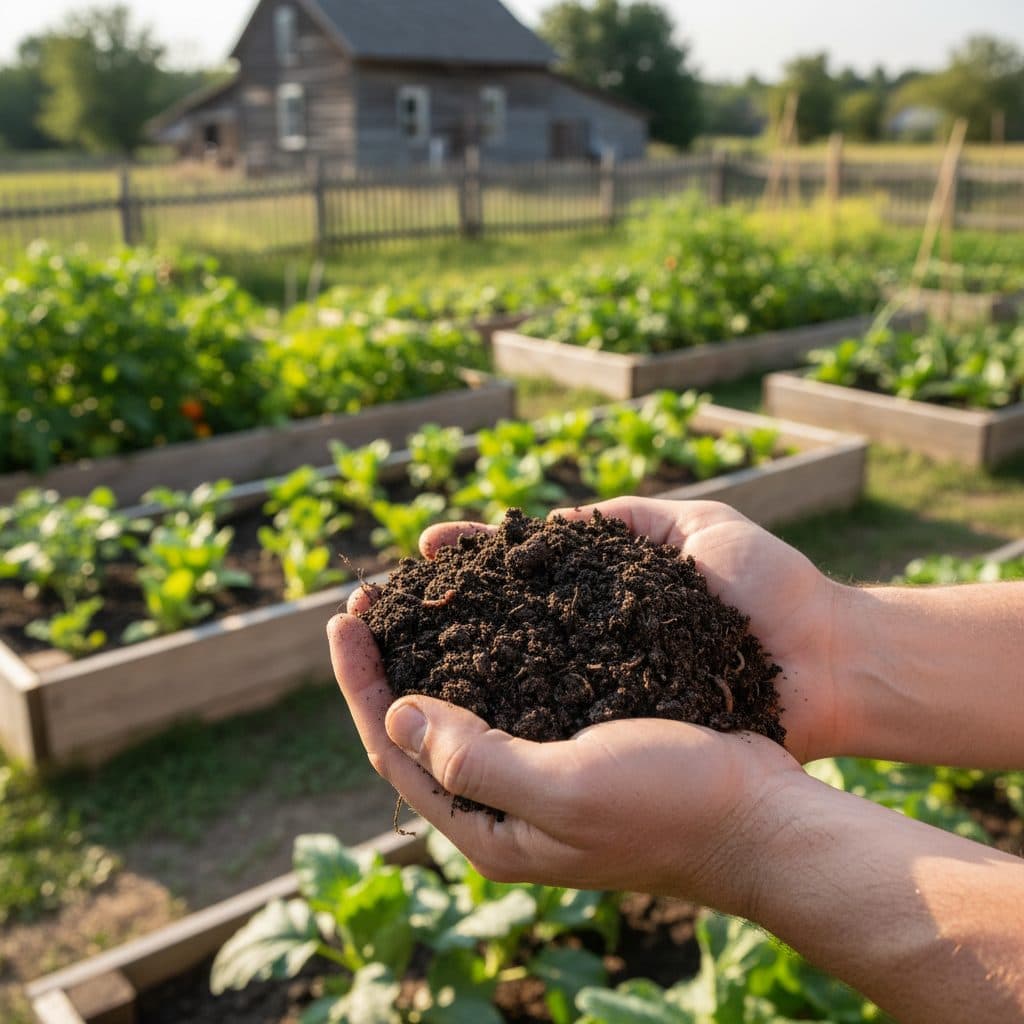
While not a precise measurement, the squeeze test provides a quick, tactile assessment of your soil’s structure and its organic matter content. Good soil structure is characterized by stable aggregates: clumps of soil particles bound together by organic matter, fungal hyphae, and microbial glues. These aggregates create pores for air and water movement, which is vital for root growth. In a well-managed garden in USDA zone 6, you might expect organic matter levels between 3% and 5%. To perform the squeeze test, grab a handful of moist (not wet) soil from your garden bed. Squeeze it firmly in your fist, then open your hand.
interpreting your squeeze test
If the soil forms a ball that holds its shape but crumbles easily when poked, you likely have good soil structure and adequate organic matter. This type of soil feels somewhat spongy and has an earthy smell. If the soil forms a hard, dense ball that does not crumble, it indicates high clay content or compaction, and often low organic matter. Conversely, if the soil falls apart completely, it suggests a very sandy texture or insufficient organic matter to bind the particles. Improving soil structure often involves increasing organic matter, for example, by incorporating compost or planting cover crops. Even a 1% increase in organic matter can significantly improve water retention and nutrient cycling in a typical garden plot.
- Forms a stable, crumbly ball: Excellent soil structure with good organic matter content, ideal for most plants.
- Forms a hard, dense ball: Indicates heavy clay or compaction; needs organic matter to improve aeration and drainage.
- Falls apart completely: Suggests sandy soil or very low organic matter; requires additions to improve water and nutrient retention.
- Forms a slimy, muddy ball: Soil is too wet; indicates poor drainage or testing after heavy rain, common in spring in the Pacific Northwest.
- Feels gritty and loose: High sand content, low organic matter; common in desert regions like Arizona, needs consistent organic amendments.
A comparison of DIY soil tests for home gardeners
Test Name | What It Measures | Key Takeaway for Gardeners |
|---|---|---|
Jar Test | Soil texture (sand, silt, clay percentages) | Identifies water retention and nutrient holding capacity. |
Perk Test | Soil drainage rate | Reveals how quickly water moves through soil, indicating compaction or excessive sand. |
pH Test | Soil acidity or alkalinity (pH level) | Determines nutrient availability and suitability for specific plants like blueberries or beans. |
Squeeze Test | Soil structure and organic matter content | Assesses soil aggregation, aeration, and overall health. |
Organic Matter Power: Every 1% of added organic matter measurably increases how much water your soil holds, which is what carries a bed through a dry week.
pH Impact: Iron availability drops sharply as pH rises — a bed reading 7.0 can show iron chlorosis while an otherwise identical bed at 6.0 does not.
Frequently asked questions
How often should I test my soil?
It is generally recommended to perform these DIY tests every one to three years, or whenever you notice a significant decline in plant health or before starting a new garden bed. For pH, annual testing is beneficial if you are actively amending your soil to change its acidity or alkalinity, especially in areas like the Southeast where soil pH can fluctuate.
What if my soil is too sandy?
If your soil is too sandy, meaning it drains too quickly and struggles to retain water and nutrients, you should focus on incorporating large amounts of organic matter. Adding 2 to 4 inches of compost or aged manure annually can significantly improve its water-holding capacity and structure over several seasons.
My soil is mostly clay; what can I do?
For heavy clay soils that drain poorly and compact easily, the primary solution is also adding organic matter, but consistently over time. Incorporate 2 to 3 inches of compost or well-rotted leaves into the top 6 to 8 inches of soil each year. This will improve aeration and drainage, making it easier for roots to penetrate.
How can I adjust my soil’s pH?
To raise acidic soil pH (make it more alkaline), add agricultural lime, typically at a rate of 5 to 10 pounds per 100 square feet, depending on your current pH and target. To lower alkaline soil pH (make it more acidic), incorporate elemental sulfur or peat moss, often at rates of 1 to 2 pounds of sulfur per 100 square feet. Always retest your pH after 3 to 6 months to monitor changes.
Are these DIY tests as accurate as a lab test?
These DIY tests provide valuable qualitative and semi-quantitative insights into your soil’s physical properties and pH, offering a good starting point for home gardeners. However, they are not as precise as a professional laboratory test, which can provide detailed nutrient analyses and exact percentages. For a comprehensive nutrient profile, especially if you’re experiencing persistent plant issues, a lab test costing around 20 to 50 dollars is recommended every 3 to 5 years.
Can I use these tests for potted plants?
Yes, you can adapt these tests for potted plants, though the scale will be smaller. The squeeze test and pH test are directly applicable. For drainage, observe how quickly water drains from the pot’s bottom holes. If water sits for more than 15 minutes after watering, your potting mix or drainage is likely insufficient, potentially leading to root problems for your indoor plants.
References
- Know Your Soil (2008). Know Your Soil.
- Know Your Ecosystem (2023). Know Your Ecosystem.
- USDA Natural Resources Conservation Service (2024). USDA Natural Resources Conservation Service.