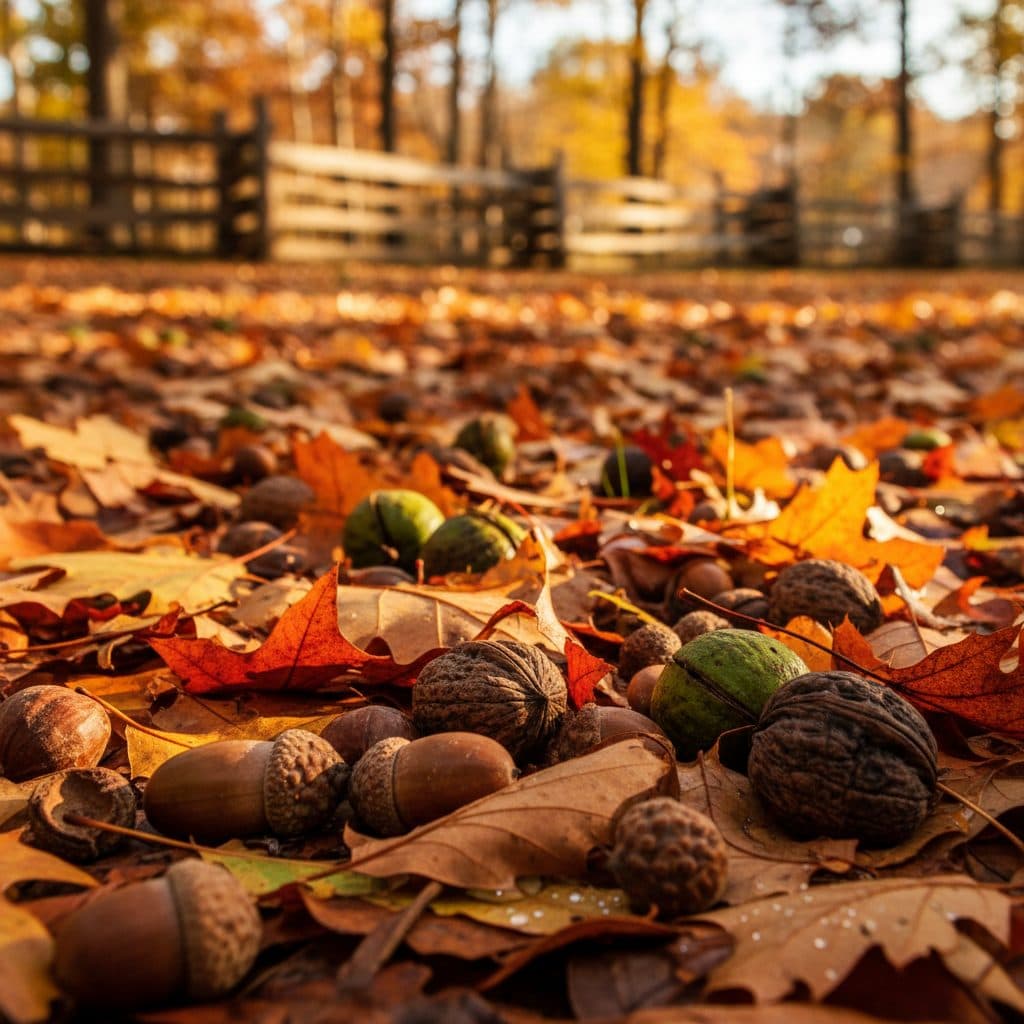
Key takeaways
- Acorn harvest windows are short, typically 2-4 weeks, beginning in mid-September in northern USDA zones.
- Hickory nuts drop from late September to late October, with shuck splitting being a primary ripeness indicator.
- Black walnuts are harvested from late September to early November, requiring hull removal and a 2-3 week drying period.
- American chestnuts, though rare, release ripe nuts from burs in late September through October across their native range.
- Regional climate variations can shift mast harvest timing by 2-3 weeks between southern and northern USDA zones.
- Proper storage, including drying nuts to 8-10% moisture content and refrigeration, ensures long-term viability for up to six months.
Quick answer: Fall mast season, including acorn, hickory, black walnut, and chestnut harvests, typically spans from mid-September to November across US USDA zones, with specific timing varying by species and regional climate.
In the northeastern United States, particularly across USDA zones 4 through 6, the arrival of cooler temperatures in late August signals the impending fall mast season. This period, often spanning from September into November, gives a bounty of wild edibles, including acorns, hickory nuts, black walnuts, and chestnuts. For those of us who appreciate the value of local, seasonal foods, understanding the precise timing for these harvests matters for yield and quality. A productive mast season can provide hundreds of pounds of nutrient-dense food for human consumption and many wildlife species.
Successful foraging hinges on accurate timing, which varies significantly based on species, local climate, and specific USDA hardiness zone. For example, a warm, wet summer, like that experienced in parts of the Midwest in 2022, can sometimes accelerate mast development by a week or more [1]. Conversely, a dry spell can delay it. Knowing when to look, what to look for, and how to process these useful resources can turn a casual walk in the woods into a substantial harvest, providing food security and a connection to the land that few other activities offer. We aim to clarify these windows for growers and foragers across the country.
Understanding mast drop and regional variations
The timing of mast drop—the falling of ripe nuts and fruits from trees—is influenced by a complex interaction of environmental factors. Primary among these are temperature, rainfall patterns, and tree species. For instance, a region receiving ample rain during the growing season typically sees a sturdy mast crop. However, extended drought conditions can stress trees, leading to smaller nuts or premature drops. Understanding these variables helps predict the best harvest windows across the country, from USDA zone 3 in northern Minnesota to USDA zone 10 in southern Florida.
Signs of mast ripeness
Observing specific cues is more reliable than relying solely on calendar dates. For most nut trees, the nuts begin to change color, and their husks or burs start to split open. For example, hickory nuts often show a distinct yellowing of their outer shuck before they drop. Another indicator is the presence of fallen nuts on the ground; a few early drops can signal that the main harvest is just days away. In many areas, the first significant frost, which can occur as early as late September in USDA zone 5, often triggers a mass drop for several species. Always remember to check for signs of insect damage, as a significant portion of early drops may be compromised. For beginners, learning to identify these trees and their ripe fruits is the first step in successful foraging, and resources like Foraging for beginners: identifying common wild edibles safely can provide a solid foundation.
- Husks splitting: A clear sign of ripeness for chestnuts and some hickory varieties.
- Nuts changing color: From green to brown or tan, indicating maturity.
- First significant drops: A few nuts on the ground signal the main harvest is near.
- Insect activity: Look for small holes or frass, indicating potential damage.
- Weather patterns: Cold snaps or heavy winds can accelerate drops, especially after mid-October.
Acorns: a staple harvest
Acorns, from various oak species, are one of the most abundant and widely distributed mast crops across the US, thriving in nearly all USDA zones from 3 to 10. White oak group acorns (e.g., white oak, bur oak) are generally preferred for their lower tannin content, making them less bitter. These typically drop earlier than red oak group acorns (e.g., red oak, black oak), which contain higher tannins and require more extensive leaching. In USDA zone 6, white oak acorns often begin to fall in mid-September, with the peak harvest lasting for about two to three weeks. Red oak acorns usually follow in early October, extending into November.
Harvesting and processing acorns
When harvesting, focus on collecting acorns that have recently fallen and appear plump and free of insect holes. A simple float test—submerging acorns in water—can help identify viable nuts; those that float are often infested or damaged and should be discarded, representing about 10-15% of a typical harvest. After collection, white oak acorns can be leached by boiling in several changes of water for 30-60 minutes each, or by cold water leaching for 2-3 days, changing the water twice daily. Red oak acorns may require more leaching, sometimes up to a week. Once leached, they can be dried at 150°F for 4-6 hours in a dehydrator or oven until brittle, then stored in airtight containers for up to six months. A single mature oak tree can produce hundreds of pounds of acorns in a good year, making them a significant food source.
- White oak group: Lower tannins, sweeter, drop mid-September to early October in USDA zone 6.
- Red oak group: Higher tannins, more bitter, drop early October to November in USDA zone 6.
- Float test: Discard acorns that float, as they are likely compromised.
- Leaching: Essential for tannin removal; boiling water for 30-60 minutes or cold water for 2-3 days.
- Drying: Dehydrate at 150°F for 4-6 hours to prevent mold and extend shelf life.
Hickory nuts and black walnuts: cracking the code
Hickory nuts, primarily from shagbark and shellbark hickory trees, are highly prized for their rich, buttery flavor. These trees are common across the eastern and central US, generally thriving in USDA zones 4 through 8. The nuts typically ripen and fall from late September through late October. The splitting of the thick, four-part husk, which reveals the hard-shelled nut inside, is one clear sign of ripeness. In USDA zone 5, this usually starts around the last week of September, with the bulk of the harvest occurring over the following three weeks. Black walnuts, another sturdy native nut, follow a similar timeline, often dropping from late September into early November. Gardeners should be aware that black walnut trees produce juglone, a chemical that can inhibit the growth of many nearby plants.
Processing and storage for long-term use
For hickory nuts, collection is straightforward: gather fallen nuts with split husks. Once collected, they can be stored in a cool, dry place for several months. Black walnuts, however, require a bit more effort due to their thick, staining hulls. These nuts are best harvested soon after they fall, before the hulls turn completely black and soft. Removing the hull is critical; a common method involves running them over a hard surface or using a specialized huller. After hulling, the nuts should be washed thoroughly to remove any remaining hull residue and then dried for 2-3 weeks in a single layer in a well-ventilated area, such as a garage or shed, at temperatures above 50°F. Proper drying is essential to prevent mold and ensure a good shelf life, often up to one year when stored in a cool, dark place. The kernel-to-shell ratio for black walnuts can be low, making them a labor-intensive but rewarding harvest.
- Hickory nut ripeness: Husks split open, revealing the nut; typically late September to late October.
- Black walnut ripeness: Nuts fall from the tree, often with green or slightly softened hulls; late September to early November.
- Hulling black walnuts: Essential to remove the strong-smelling, staining outer hull immediately after harvest.
- Drying: Air dry hulled black walnuts for 2-3 weeks in a single layer to prevent mold.
- Storage: Store dried nuts in their shells in a cool, dry place for up to one year.
The elusive chestnut: a hopeful return
The American chestnut (Castanea dentata), once a dominant species in eastern US forests, was decimated by blight in the early 20th century. While truly wild, blight-resistant American chestnuts are rare, hybrid varieties and Chinese chestnuts (Castanea mollissima) are now successfully grown across USDA zones 4 through 8, offering a taste of this historic nut. These trees typically drop their nuts from late September through October, often after the first hard frost, which can occur around October 15th in USDA zone 5. Unlike other nuts, chestnuts are highly perishable and require immediate attention after harvest.
Harvesting and handling chestnuts
Chestnuts are encased in spiny burs that split open when ripe, releasing one to three nuts. Collect them quickly after they fall, as they can mold or be consumed by wildlife within a few days. Wear thick gloves when handling the burs. Once collected, chestnuts should be cured for 2-3 days at room temperature to allow their starches to convert to sugars, improving flavor. After curing, they must be stored properly to prevent spoilage. Unlike other nuts, chestnuts have a high moisture content and a thin skin, making them prone to drying out or molding. Refrigeration at 35-40°F in perforated bags can extend their shelf life for up to two months. Freezing is also an option, allowing storage for six months or more. For those interested in growing their own cool-season crops, understanding optimal timing for harvests like How to grow spinach: cool-season timing, bolt avoidance, and cut-and-come-again harvest can complement foraging efforts.
- Ripeness indicator: Spiny burs split open, revealing shiny brown nuts inside.
- Harvest window: Late September through October, often after a hard frost.
- Perishability: Highly perishable, collect within 24-48 hours of falling.
- Curing: Cure at room temperature for 2-3 days to improve flavor.
- Storage: Refrigerate in perforated bags at 35-40°F for up to two months, or freeze for longer.
General storage and preparation for winter
Regardless of the specific nut, proper post-harvest handling is critical to ensure your efforts yield a usable product that lasts through the winter months. Most nuts, including acorns, hickories, and black walnuts, benefit from a thorough drying process after any initial processing like hulling or leaching. This reduces their moisture content to a safe level, which inhibits mold growth and rancidity. For example, drying nuts in a single layer on screens in a well-ventilated area for 2-4 weeks, or using a dehydrator at 100-110°F for 24-48 hours, can achieve this. This step is particularly important for nuts harvested in humid climates, such as those found in USDA zone 8, where ambient drying might be insufficient.
Long-term storage strategies
Once properly dried, nuts can be stored in various ways depending on their shell and intended use. In-shell nuts, like hickory and black walnuts, store well in mesh bags or breathable containers in a cool, dark, and dry place (e.g., a basement or unheated garage) for up to one year. Shelled nuts, including leached acorn meal or chestnut pieces, have a shorter shelf life and are best kept in airtight containers in the refrigerator for up to six months, or frozen for one year or more. Freezing is an excellent option for preserving the delicate oils in nuts, preventing them from turning rancid. Always label containers with the harvest date to ensure proper rotation and consumption within their optimal freshness window, typically within 12 months for most dried nuts. For additional wild edibles that can supplement your winter pantry, consider researching plants like Wild Himalayan Strawberry or Small-Leaved Wild Grape.
- Drying: Reduce moisture content to 8-10% to prevent mold and rancidity.
- Cool, dark storage: Ideal for in-shell nuts, extending shelf life to one year.
- Refrigeration: Essential for shelled nuts or those with higher moisture content, lasting up to six months.
- Freezing: Best for long-term storage (one year+) of shelled nuts, preserving oils.
- Labeling: Always include harvest date for inventory management and freshness tracking.
Acorn Tannin Reduction: White oak acorns often require 2-3 changes of boiling water for leaching, while red oak acorns may need 5-7 changes over 2-3 days due to higher tannin levels.
Black Walnut Yield: Only about 10-15% of a black walnut’s total weight is edible kernel, making it a labor-intensive but useful harvest.
Chestnut Perishability: Fresh chestnuts have a high moisture content of around 50% and should be consumed or processed within 2-3 weeks if refrigerated, or within 2-3 days at room temperature.
References
- Consistency in Chaos: 2022 Growing Season Weather + Fall/Winter Outlook (2022).
- Arrivals, departures mark Commission’s Fall season (2005).
- Lovett’s “gain-a-season” fall catalog : fall 1934 (1934).
- Lovett’s fall planting suggestions : save a season by planting this fall (1929).
- USDA Natural Resources Conservation Service (2024).