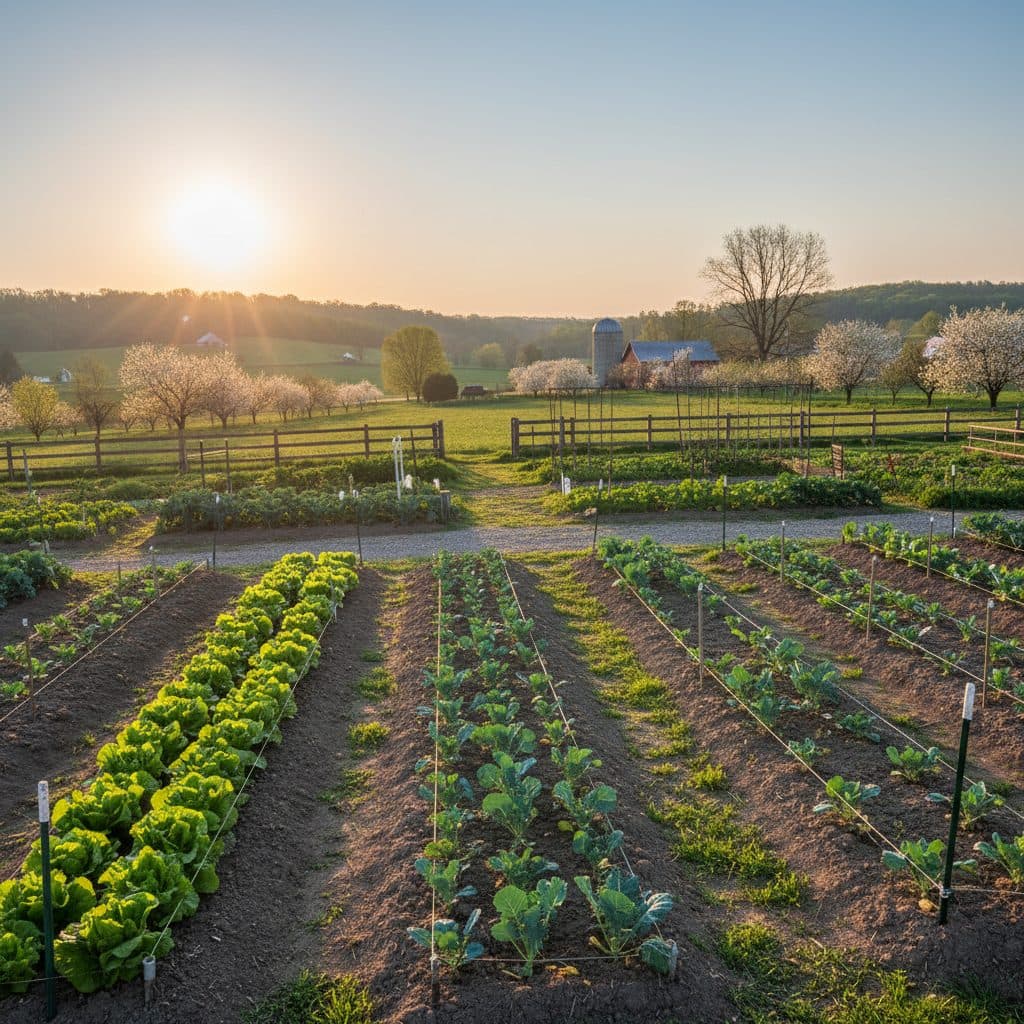
Key takeaways
- Identify your local average last spring frost and first fall frost dates to define your true growing season.
- Utilize online tools or historical data from NOAA to pinpoint frost probabilities for your specific location, commonly given at 10%, 50%, and 90% likelihoods.
- Calculate your frost-free period by subtracting the last frost date from the first frost date, which can range from 90 days in USDA zone 3 to over 300 days in zone 10.
- Implement crop rotation strategies based on your growing season length to improve soil health, manage pests, and maintain fertility over multiple years.
- Practice succession planting by staggering plantings of short-season crops like radishes or lettuce every 2-3 weeks to ensure continuous harvests.
- Consult USDA zone planting calendars to select appropriate crop varieties and plan planting times, considering both direct sowing and transplanting schedules.
Quick answer: To find your garden’s true growing season, identify your average last spring frost and first fall frost dates using online tools like NOAA. Calculate the frost-free period by subtracting the last frost date from the first, allowing for strategic planting.
In much of the US, understanding your local frost dates is the bedrock of a successful growing season. For instance, a gardener in Lincoln, Nebraska, residing in USDA zone 5b, might anticipate their average last spring frost around April 25, while their first fall frost could arrive as early as October 15. This roughly 170-day window dictates everything from when to start seeds indoors to the final harvest of heat-loving crops like tomatoes.
Knowing the average last spring frost and first fall frost allows you to calculate your frost-free period. This window guides crop rotation, succession planting, and seasonal garden planning.
Pinpointing your average last spring frost date
The average last spring frost date marks the typical end of freezing temperatures in your area, usually defined as 32°F or below. This date is crucial for knowing when to safely transplant tender seedlings like peppers and tomatoes outdoors without risk of damage. For a grower in northern Michigan, USDA zone 4b, this date might fall as late as May 20, whereas in southern California, USDA zone 9b, it could be as early as February 15, offering a much longer head start on warm-season crops.
Using historical data for accuracy
To find your specific date, you can use online tools that compile historical weather data from local stations. The National Oceanic and Atmospheric Administration (NOAA) provides average dates alongside probabilities; for example, the date by which there is only a 10% chance of another frost. This higher confidence level, often 10-14 days after the 50% probability date, is safer for sensitive plants. In a typical USDA zone 6 location, the 50% probability date might be April 20, but the 10% probability date could be May 5, giving you a more reliable window for transplanting. Last frost dates are not static, so check your local normals against recent data rather than relying on a date you memorized years ago.
- Consult NOAA’s National Centers for Environmental Information (NCEI) for local data.
- Look for the 10%, 50%, and 90% probability dates, and plant tender crops against the 10% date, which carries only a 10% chance of a damaging frost after it.
- Consider microclimates within your property; low-lying areas can run 3-5°F colder than higher ground on still, clear nights.
- Factor in elevation; for every 1,000 ft increase, the last frost date can shift later by several days.
- Observe local native plants for cues, such as when oak leaves reach the size of a squirrel’s ear, a traditional sign for corn planting.
Identifying your average first fall frost date
The average first fall frost date signals the typical start of freezing temperatures in autumn, marking the end of the growing season for many plants. Knowing this date helps you plan for final harvests, protect sensitive crops, and prepare beds for winter. For a gardener in northern Minnesota, USDA zone 3b, this date might be as early as September 10, necessitating quick-maturing varieties or season extension techniques. In contrast, a grower in central Florida, USDA zone 9b, may not see their first frost until late December or even January, allowing for a much longer harvest of many crops.
Planning for the end of the season
Similar to spring frosts, historical data provides average first fall frost dates and associated probabilities. A 30% probability date means there’s a 30% chance of frost before that date, so you might aim to harvest most of your warm-season crops by then. For example, in a USDA zone 7a garden, the 50% probability date might be November 1, but you might want to bring in your basil or protect your peppers by October 20 to be safe. Frost dates drift over time, so work from a recent climate normal rather than a date you learned years ago, and re-check it every few seasons as you plan.
- Use NOAA data to find your specific location’s first fall frost probabilities.
- Plan for a ‘light frost’ (32-36°F) which can damage tender leaves but not kill the plant.
- A ‘hard freeze’ (below 28°F) will typically kill most annuals and can damage perennials.
- Harvest frost-sensitive crops like tomatoes, peppers, and squash before the 30% probability date.
- Consider row covers or cold frames to extend the harvest of greens by 2-4 weeks past the first frost.
Calculating your real growing-season length
Once you have both your average last spring frost and first fall frost dates, you can calculate your frost-free period, which is your real growing-season length. This period is the number of days between the two dates. For example, if your last frost is May 1 and your first frost is October 15, you have approximately 167 frost-free days. This number is your guide for selecting appropriate crop varieties and planning your planting schedule. In USDA zone 8b, found across much of the Pacific Northwest and parts of the Southeast, this period can easily exceed 200 days, allowing for multiple successions of many vegetables.
Maximizing your frost-free days
Growing season length determines key planting decisions. If you have a short season, say 100-120 days in USDA zone 3, you’ll focus on quick-maturing varieties and start seeds indoors 6-8 weeks before your last frost, since a short season is exactly where a head start matters most. For longer seasons, like 250+ days in USDA zone 9, you can plan for multiple plantings of the same crop or experiment with long-season varieties. For instance, a typical pickling cucumber needs about 50-60 days to mature from sowing (check the days-to-maturity figure printed on your seed packet). Knowing your frost-free period helps you determine if you can fit in one, two, or even three plantings. This calculation also informs decisions about nitrogen-fixing trees or other long-term plantings, as their establishment period must fit within these windows.
- Subtract the last frost date from the first frost date to get your total frost-free days.
- Compare this number to the ‘days to maturity’ listed on seed packets.
- Adjust planting times for crops that can tolerate light frost, like kale or spinach.
- Factor in season extension techniques (row covers, cold frames) to add 2-4 weeks to your season.
- Consider starting seeds indoors 6-8 weeks before your last frost to gain a head start.
Planning crop rotation with your frost dates
Crop rotation is a fundamental practice for maintaining soil health, managing pests, and preventing disease buildup. By rotating different plant families through your garden beds over a 3-4 year cycle, you can significantly reduce the need for external inputs and improve overall garden productivity. Your frost dates and growing season length directly influence how you plan these rotations. For example, in a USDA zone 6 garden with a 180-day frost-free period, you might follow an early spring crop of peas with a summer planting of tomatoes, then a fall cover crop like clover.
Strategic sequencing for soil health
A well-planned rotation ensures that different crops utilize varying nutrients from the soil and break pest cycles. For example, following a heavy-feeding crop like corn with a legume cover crop such as crimson clover can replenish nitrogen, benefiting the next season’s leafy greens. In a USDA zone 7 garden, you might plant brassicas (cabbage, broccoli) in spring, followed by beans in summer, and then a winter rye cover crop. This strategy helps to build soil organic matter, which improves how much plant-available water your soil holds.
- Group crops by family (e.g., brassicas, legumes, solanaceae) for rotation planning.
- Avoid planting the same crop family in the same bed more than once every three years.
- Integrate cover crops into your rotation, especially after heavy feeders or in fallow periods.
- Use your first fall frost date to determine the latest you can plant a cover crop for establishment.
- Plan for soil amendments based on the needs of the crop family in each rotation slot.
Succession planting for continuous harvests
Succession planting is the practice of making multiple plantings of the same crop, or different crops, in sequence to ensure a continuous harvest throughout the growing season. This technique is particularly effective when you have a moderate to long frost-free period, allowing you to maximize your yield from a given garden space. For instance, in a USDA zone 7 garden with 210 frost-free days, you could plant lettuce every 2-3 weeks in spring and again from late summer into fall, pausing through the hottest weeks, since lettuce seed germinates poorly above about 80°F and standing plants bolt bitter.
Staggering plantings for yield
There are several ways to approach succession planting. You can make repeat plantings of fast-growing crops like radishes, spinach, or bush beans every 10-21 days. Another method is to plant different varieties of the same crop with varying maturity dates simultaneously, ensuring a staggered harvest. For example, planting early, mid, and late-season corn varieties at the same time can extend your fresh corn harvest by several weeks in a USDA zone 5 garden. This strategy helps to avoid a glut of produce all at once and provides a steady supply for your kitchen or market. Many common beans, Phaseolus vulgaris, can be succession planted every 2-3 weeks in zones 4-9 for continuous yields.
- Plant short-season crops like radishes or lettuce every 2-3 weeks for continuous supply.
- Follow early spring crops (e.g., peas) with warm-season crops (e.g., bush beans) in the same space.
- Use different varieties of the same crop with staggered maturity dates.
- Harvest crops like cut-and-come-again greens to encourage new growth for extended periods.
- Plan your last succession planting based on the ‘days to maturity’ and your first fall frost date, allowing for a 10-14 day buffer.
Frost-Free Shift: A shift of just 10 days in your last spring frost date can extend your growing season by 5-10%, allowing for more diverse planting options.
Microclimate Impact: Low-lying areas in your garden can experience temperatures 3-5°F colder than surrounding areas, increasing frost risk.
Frequently asked questions
What is the difference between a ‘light frost’ and a ‘hard freeze’?
A light frost occurs when temperatures drop to 32-36°F, causing damage to tender foliage but often sparing the plant’s roots. A hard freeze, typically below 28°F, will kill most annual plants and can severely damage or kill perennials, requiring more extensive protection or earlier harvest for many crops.
How does elevation affect my frost dates?
Generally, for every 1,000 feet increase in elevation, the average last spring frost date can be several days later, and the first fall frost date can be several days earlier. This shortens the growing season significantly; for example, a garden at 5,000 feet might have 30 fewer frost-free days than one at 1,000 feet in the same region.
Can I extend my growing season beyond the frost dates?
Yes, you can extend your growing season by several weeks using various techniques. Row covers can protect plants from light frosts down to 28°F, while cold frames or hoop houses can add 4-6 weeks to both ends of the season, allowing for earlier spring planting and later fall harvests.
Are frost dates the same every year?
No, frost dates are averages and can vary significantly from year to year due to climatic fluctuations. While historical data provides a good guideline, actual frost events can occur 1-2 weeks earlier or later than the average. Monitoring local weather forecasts, especially in spring and fall, allows for timely plant protection.
How do I choose crops for a short growing season?
For short growing seasons, typically less than 150 frost-free days in zones 3-4, prioritize ‘days to maturity’ on seed packets. Select fast-maturing varieties, start seeds indoors 6-8 weeks before your last frost, and focus on cool-season crops like radishes, lettuce, and spinach, which mature in 30-60 days.
References
- Analysis of the Climatic Characteristics of First, Last Frost Dates and Frost-Free Period in Recent 58 Years in Liupanshui (2022). Analysis of the Climatic Characteristics of First, Last Frost Dates and Frost-Free Period in Recent 58 Years in Liupanshui.
- Recent changes in first and last frost dates and frost-free period in Serbia (2017). Recent changes in first and last frost dates and frost-free period in Serbia.
- SPATIAL AND TEMPORAL VARIABILITY OF THE OCCURRENCE OF GROUND FROST IN POLAND AND ITS EFFECT ON GROWTH, DEVELOPMENT AND YIELD OF PICKLING CUCUMBER (Cucumis sativ (2010). SPATIAL AND TEMPORAL VARIABILITY OF THE OCCURRENCE OF GROUND FROST IN POLAND AND ITS EFFECT ON GROWTH, DEVELOPMENT AND YIELD OF PICKLING CUCUMBER (Cucumis sativ.