Key takeaways
- Cold frames are ideal for small-scale season extension, offering 4-6 weeks extra growing time for plants like lettuce in USDA zone 7.
- Low tunnels provide flexible protection for rows of crops, increasing soil temperature and extending harvests by weeks.
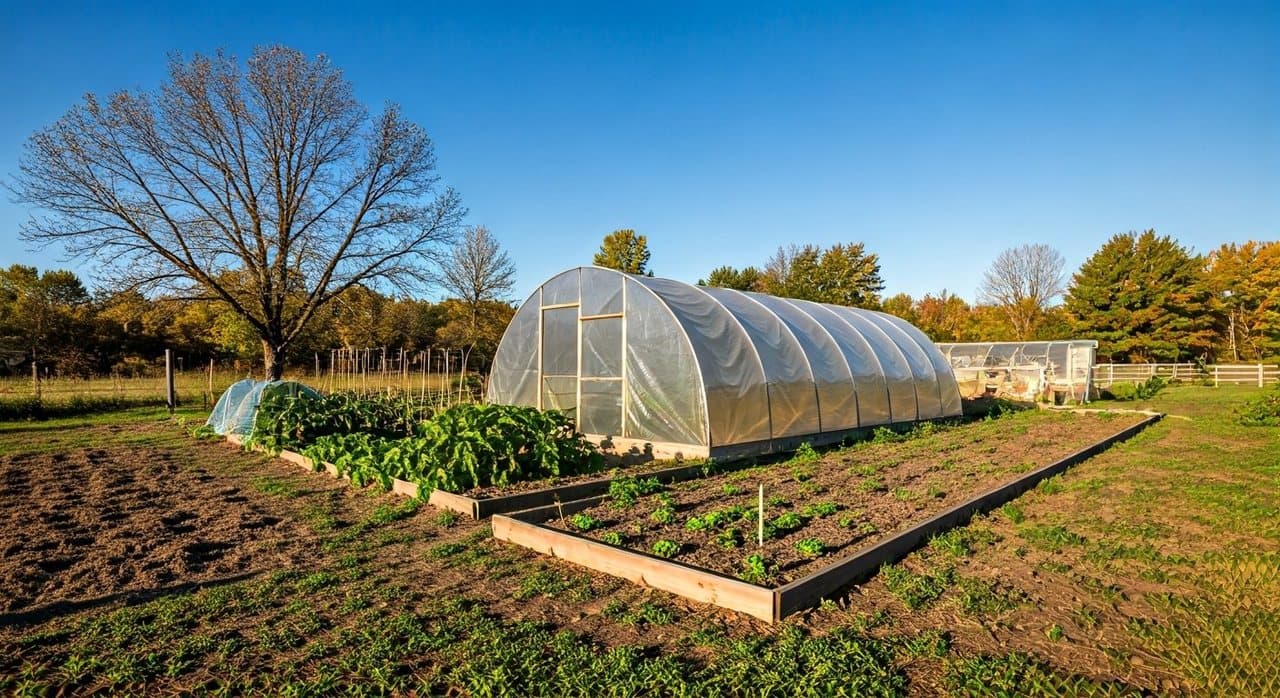
- Hoop houses, or high tunnels, offer walk-in access and significant season extension, allowing year-round production of cool-weather crops in many regions.
- Consider your budget (from low cost for a cold frame to a higher investment for a large hoop house), available space, desired crop volume, and local climate (e.g., average winter lows of 20°F) when selecting a structure.
- Integrating passive solar design or small solar-powered ventilation can improve performance, especially for larger structures, potentially boosting yields.
- Proper site selection, including southern exposure and protection from prevailing winds, can increase internal temperatures.
Quick answer: To extend your growing season by 60 days in USDA Zone 5, choose between cold frames, low tunnels, or hoop houses based on budget, space, and desired crop volume. These structures use passive solar gain to create warmer microclimates, protecting plants from cold and enabling earlier planting and later harvests.
In northern Michigan, where the growing season can be as short as 120 days, homesteaders often look for ways to extend their harvest. From early spring greens to late fall root vegetables, adding even 30 or 40 extra days can significantly impact food security and self-sufficiency. Choosing the right season extension structure – whether a cold frame, low tunnel, or hoop house – depends on your specific needs, available space, and the crops you aim to grow in your USDA zone 4 or 5 garden.
Each of these structures uses passive solar gain to warm the soil and air around plants, creating a microclimate that can be several degrees warmer than the outside ambient temperature. For instance, a well-placed cold frame can elevate internal temperatures by 10-20°F on a sunny 40°F day, protecting tender seedlings from a late spring frost or allowing a fall crop of spinach to continue producing into December. Understanding the differences in construction, cost, and utility is key to making an informed decision for your homestead.
Understanding season extension structures for your homestead
Extending the growing season is a core principle for self-sufficient homesteads, particularly in regions with shorter frost-free periods, such as USDA zone 5, which typically sees its last frost in mid-May and first frost in early October. These structures—cold frames, low tunnels, and hoop houses—all work by trapping solar radiation and insulating plants from cold air and wind, but they differ significantly in scale, cost, and the degree of protection they offer. For example, a simple cold frame can be low-cost and provide protection for a few dozen plants, while a 30 ft by 96 ft hoop house represents a larger investment and can accommodate hundreds of plants, allowing for commercial-scale production.
The core benefits of protected cultivation
Protected cultivation provides several advantages beyond just extending the season, leading to more reliable harvests and often higher quality produce. In areas like the Pacific Northwest, where heavy rainfall can be an issue, these structures also protect crops from excessive moisture, reducing disease pressure on plants like tomatoes and squash. The controlled environment can also deter pests, leading to a reduction in damage and a potential increase in marketable yield compared to open-field cultivation.
- Increased soil temperature promotes earlier germination.
- Protection from frost, extending the harvest season by weeks.
- Shielding plants from strong winds and heavy precipitation.
- Reduced pest and disease pressure in a more controlled environment.
- Opportunity for earlier planting and later harvesting, maximizing land use.
Cold frames: compact protection for early starts
A cold frame is essentially a bottomless box with a transparent lid, typically used to harden off seedlings or grow cool-season crops through mild winters. Its small footprint, often around 4 ft by 8 ft, makes it ideal for urban gardens or homesteads with limited space in USDA zone 6. Construction can be simple, using reclaimed materials like old windows for the lid and lumber or concrete blocks for the sides, keeping costs low for a DIY project. The lid is usually angled to capture maximum sunlight, often at a 30-degree slope towards the south, and hinged for easy access and ventilation on warmer days.
Optimizing cold frame performance
To maximize the benefits of a cold frame, strategic placement is key. Locating it on the south side of a building or wall can provide additional thermal mass and protection from northern winds, potentially increasing internal temperatures. On a sunny day with outside temperatures around 35°F, the interior of a cold frame can easily reach 60-70°F, allowing for the successful germination of seeds like kale and spinach as early as February in USDA zone 7. It’s critical to monitor internal temperatures, as they can quickly climb above 80°F on sunny days, requiring manual venting to prevent overheating and plant damage.
- Start seeds 4-6 weeks earlier than direct sowing outdoors.
- Harden off young plants gradually before transplanting to the garden.
- Grow cool-season vegetables like lettuce, spinach, and radishes into winter.
- Protect tender perennials from harsh winter winds and temperatures below 20°F.
- Store root vegetables like carrots and beets for extended periods.
Low tunnels: flexible protection for rows of crops
Low tunnels are essentially miniature hoop houses, designed to cover individual rows or small beds of crops. They consist of flexible hoops, typically made from PVC pipe, electrical conduit, or heavy-gauge wire, covered with a layer of clear plastic or row cover fabric. These structures are highly adaptable and cost-effective, with materials for a 20 ft long tunnel often being low-cost. They are particularly useful for protecting a variety of crops across a larger garden area in USDA zone 6, allowing for staggered planting and harvesting.
Constructing and managing low tunnels
Installation is straightforward: hoops are spaced 3-5 ft apart and pushed into the soil, then covered with a chosen material, which is secured at the ends and along the sides with clips, rocks, or soil. This simple design allows for quick deployment in early spring or late fall, providing weeks of extended growing time. For example, a low tunnel can protect a row of spinach from temperatures as low as 25°F, allowing for harvest well into December in many southern states. Ventilation is usually managed by lifting the sides of the plastic on warm days, which is often a manual process, though small, solar-powered fans could be adapted for automatic venting on longer tunnels.
- Protect tender crops like strawberries and peppers from late spring frosts.
- Extend the harvest of greens such as kale, chard, and arugula into winter.
- Warm soil for earlier planting of heat-loving crops like melons and cucumbers.
- Shield young seedlings from strong winds and heavy rainfall.
- Provide a barrier against certain insect pests, reducing crop damage.
Hoop houses: walk-in growing spaces for serious production
Hoop houses, also known as high tunnels, are larger, walk-in structures that offer the most extensive season extension and production capabilities. These structures are typically 10-30 ft wide and 20-100 ft long, providing hundreds or even thousands of square feet of growing space. While more expensive than cold frames or low tunnels, representing a larger investment, they can pay for themselves quickly through increased yields and extended market seasons. Many commercial growers in regions like the Central Valley of California use hoop houses to produce specialty crops year-round, generating significant revenue.
Managing a hoop house for year-round growth
Hoop houses are often constructed with galvanized steel hoops and covered with durable, UV-stabilized greenhouse film, typically 6 mil thick, which can last several years. Proper ventilation is critical to prevent overheating, especially in southern states where temperatures can soar above 90°F. Roll-up sides and end-wall vents are common, and automated systems powered by off-grid solar kits can manage temperature fluctuations efficiently. In USDA zone 5, a hoop house can extend the growing season by months, allowing for two or even three successions of crops like tomatoes and peppers, and year-round production of cold-hardy vegetables such as carrots and parsnips.
- Achieve year-round production of cool-season crops in many USDA zones.
- Grow heat-loving crops like tomatoes and peppers for an extended season.
- Protect high-value crops from extreme weather events and pests.
- Provide a comfortable working environment for growers during inclement weather.
- Increase overall farm profitability by extending market windows and crop diversity.
Choosing the right structure for your homestead
Deciding between a cold frame, low tunnel, or hoop house comes down to a few critical factors: your budget, the scale of your gardening ambitions, the specific crops you want to grow, and your local climate conditions. For a homesteader in USDA zone 4 looking to start a few flats of seedlings early, a simple cold frame costing under $50 might be the perfect solution. If you want to protect several rows of leafy greens across a 50 ft garden bed, a series of low tunnels might be more practical, costing around $200 for materials.
Matching structure to need and resources
However, if your goal is to grow tomatoes into November in USDA zone 6, or produce a significant amount of winter vegetables for market, a hoop house is the clear choice, despite its higher initial investment of $1,000 to $5,000+. Consider the labor involved: cold frames and low tunnels often require daily manual venting, while hoop houses can be equipped with automated systems. Also, think about the long-term commitment; a well-built hoop house can last many years, providing a substantial return on investment for years of abundant harvests. For larger structures, consider how solar panels can power essential ventilation and irrigation.
- Cost: Cold frames ($20-$200), Low Tunnels ($50-$300 per 50 ft), Hoop Houses ($1,000-$10,000+).
- Scale: Small batches (cold frame), multiple rows (low tunnel), large production (hoop house).
- Crop Type: Seedlings/hardy greens (cold frame), row crops (low tunnel), diverse/tender crops (hoop house).
- Season Extension: 4-6 weeks (cold frame), Weeks (low tunnel), Months or year-round (hoop house).
- Labor: High daily manual (cold frame/low tunnel), moderate with automation options (hoop house).
Integrating solar power for enhanced performance
While cold frames, low tunnels, and hoop houses primarily rely on passive solar gain, integrating active solar components can significantly improve their performance, especially for larger structures or in challenging climates. For instance, a small 10-watt solar panel on a shed can power an automatic vent opener for a cold frame so consistent temperature regulation without daily manual intervention. In a 30 ft by 96 ft hoop house, proper ventilation is critical to prevent temperatures from exceeding 90°F on a sunny day, which can damage crops. Solar-powered exhaust fans can move thousands of cubic feet of air per minute, maintaining optimal growing conditions.
Solar solutions for improved microclimates
Beyond ventilation, solar power can support other critical functions. Solar water heaters can provide warm water for irrigation, promoting faster plant growth and reducing transplant shock, especially in early spring when ground temperatures are low. Small off-grid solar systems can also power supplemental LED grow lights during short winter days so plants receive enough light for sturdy growth, potentially increasing winter yields. Even simple solar-powered thermometers and hygrometers can provide useful data, allowing growers to make informed decisions about managing their protected environments.
- Automate ventilation with solar-powered fans and vent openers, preventing overheating.
- Provide supplemental lighting during short winter days with solar-charged LED grow lights.
- Heat irrigation water using solar thermal systems, improving plant health and growth rates.
- Power small pumps for efficient drip irrigation systems within the structure.
- Monitor environmental conditions with solar-powered sensors for temperature and humidity.
Comparison of Season Extension Structures
Feature | Cold Frame | Low Tunnel | Hoop House |
|---|---|---|---|
Typical Size | 4 ft x 8 ft (32 sq ft) | 3 ft x 20 ft (60 sq ft) | 20 ft x 50 ft (1,000 sq ft) |
Cost Range (DIY/Kit) | $20 – $200 | Low to moderate (per 50 ft) | High |
Season Extension | 4-6 weeks | Weeks | Months or year-round |
Primary Use | Seed starting, hardening off, small greens | Row crop protection, early/late harvest | Large-scale production, diverse crops |
Ventilation | Manual lid propping | Manual side lifting | Roll-up sides, end-wall vents (often automated) |
Labor Intensity | High (daily monitoring) | Moderate (daily checking) | Moderate (less with automation) |
Durability | 5-10 years (wood/glass) | A few years (plastic film), several years (hoops) | Several years (film), many years (frame) |
Temperature Boost: A well-insulated cold frame can raise internal temperatures by 10-20°F on a sunny 40°F day, protecting seedlings from frost.
Hoop House Lifespan: With proper maintenance, the galvanized steel frame of a hoop house can last many years, while the 6 mil polyethylene film typically lasts several years.
Yield Increase: Protected cultivation in a hoop house can significantly increase crop yields compared to open-field growing, especially for high-value crops like tomatoes.
References
- Work Guidelines – Greenhouse/Hoop-house Work (2018).
- Timber frame and steel frame house construction (2013).
- Gardening indoors and under glass; a practical guide to the planting, care and propagation of house plants, and to the construction and management of hotbed, co (1912).
- USDA Natural Resources Conservation Service (2024).