Key takeaways
- Strawberries thrive across Australia, but optimal planting windows shift by hemisphere season and local climate zone.
- In subtropical and warm coastal regions (Queensland, northern NSW, Perth), plant runners in autumn (April to May) for a winter-to-spring harvest.
- In cool and temperate regions (Victoria, Tasmania, Adelaide, ACT), plant bare-root runners in late winter to early spring (July to September) for a summer harvest.
- Always plant strawberry crowns exactly level with the soil surface; burying the crown causes rot, while exposed roots dry out and die.
- Propagate free new stock in late summer by pegging daughter runners into small pots while still attached to the mother plant.
- Protect ripening fruit from protected native wildlife and birds using wildlife-safe exclusion netting with a mesh aperture under 5 mm.
Quick answer: In Australia, plant strawberries in autumn (April to May) in subtropical areas or late winter (July to September) in cool-temperate zones. Set crowns level with the soil in slightly acidic, compost-rich soil in full sun, mulch with pea straw or pine needles, feed with potassium-rich organic fertiliser, and protect ripening fruit with fine wildlife-safe netting.
Strawberries (Fragaria x ananassa) are one of the most productive, fast-yielding fruit crops you can plant in an Australian home garden. Whether grown in raised veggie beds, hanging baskets, terracotta strawberry planters, or balcony containers, a modest patch of twenty strawberry plants can supply fresh berries for months.
Achieving heavy crops when growing strawberries in Australia requires adapting your calendar to your specific climate zone. While growers in Victoria and Tasmania harvest berries throughout the warm summer months, growers in Queensland and coastal New South Wales produce their main strawberry crops during the mild, sunny days of winter and early spring.
This practical guide details planting calendars across Australian regions, soil preparation, runner propagation, and effective methods to protect your harvest from pests and wildlife.
+-------------------------------------------------------------+
|              AUSTRALIAN REGIONAL STRAWBERRY CALENDARS       |
|                                                             |
|   CLIMATE REGION      PLANTING WINDOW        HARVEST PERIOD |
|   --------------      ---------------        -------------- |
|   Subtropical / Med.  April to May (Autumn)  June to October|
|   (QLD/NSW/WA)                                              |
|   Temperate           July to August (Winter)Oct to Jan     |
|   (VIC/SA/NSW)                                              |
|   Cool                August to Sept (Spring)Nov to Feb     |
|   (TAS/Tablelands)                                          |
+-------------------------------------------------------------+
When should you plant strawberries across Australian climate zones?
Strawberry planting schedules in Australia differ markedly between the warm north and the cool south:
1. Subtropical and Mediterranean coastal zones (South East QLD, Northern NSW, Coastal WA)
- Planting window: April to late May (mid-autumn).
- Growing pattern: High summer heat and humidity trigger fungal leaf spot and fruit rot. Planting runners in autumn allows plants to establish quickly in cooling soil, producing sweet berries from June through October.
- Top varieties: Short-day varieties like 'Redlands Joy', 'Ruby Gem', and 'Camarosa'.
2. Temperate zones (Sydney, Melbourne, Adelaide, Inland NSW)
- Planting window: July to August (late winter) as bare-root runners, or September as potted seedlings.
- Growing pattern: Plants flower in early spring and produce heavy crops from October through December, with day-neutral varieties cropping intermittently through to March.
- Top varieties: Short-day 'Chandler' and 'Tioga' for a concentrated October-to-December crop; day-neutral 'Albion' and 'San Andreas' for lighter picking that continues into autumn.
3. Cool and cold zones (Tasmania, Victorian High Country, ACT)
- Planting window: August to September (early spring).
- Growing pattern: Late frosts dictate a spring planting schedule, yielding main summer crops from November through February.
- Top varieties: 'Red Gauntlet', 'Cambridge Favourite', and 'Albion'.
To explore broader botanical growing principles for berries, compare techniques in how to grow strawberries.
+-------------------------------------------------------------+
|              STRAWBERRY VARIETIES IN AUSTRALIA              |
|                                                             |
|   VARIETY TYPE     REPRESENTATIVE CULTIVARS  BEARING HABIT  |
|   ------------     ------------------------  -------------  |
|   Short-Day        'Camarosa', 'Chandler'    Heavy spring   |
|                                              or winter crop |
|   Day-Neutral      'Albion', 'San Andreas'   Continuous over|
|   (Ever-bearing)                             6 to 8 months  |
+-------------------------------------------------------------+
How do you prepare soil and set strawberry crowns correctly?
Strawberries have shallow, fibrous root systems that require free-draining, humus-rich soil in full sun (at least 6 to 8 hours of direct daily sunlight).
Soil preparation and pH targets
- Ideal pH: Strawberries prefer a slightly acidic soil pH between 5.8 and 6.5.
- Soil texture: Incorporate generous amounts of mature compost and well-rotted cow or sheep manure into the top 15 cm of soil. Heavy clay soils must be mounded into 15 to 20 cm raised ridges or timber beds to prevent winter root rot.
- Pre-planting fertiliser: Work in one light handful per square metre of blood and bone fertiliser two weeks before planting; it supplies phosphorus for root development along with some nitrogen, so apply it once at bed prep and do not repeat it once flowering starts. Use rock phosphate if you want phosphorus alone. Check beds for soil-dwelling curl grubs in Australian gardens before setting runners.
The critical crown planting rule
The main factor in planting strawberries is the depth of the central crown (the thick growing point where leaves emerge from the roots):
+-------------------------------------------------------------+
|              STRAWBERRY PLANTING DEPTH CRITERIA             |
|                                                             |
|   [ TOO DEEP ]        [ PERFECT LEVEL ]       [ TOO SHALLOW]|
|      =====                  =====                 =====     |
|     (     )                (     )               (     )    |
|   ----C--/-- Soil Line     \  C  /            ---|--C--|---|
|      | | |                ------/--- Soil Line   \     /   |
|      | | |                  / | \                  | | |    |
|   Crown buried;          Crown sits at         Roots exposed|
|   suffocates & rots      exact soil surface    dry out & die|
+-------------------------------------------------------------+- Set the crown flush: Spread the bare roots downward into a firm cone of soil and backfill so the base of the crown sits exactly level with the surface.
- Plant spacing: Space plants 30 cm apart along rows, with 40 to 50 cm between rows.
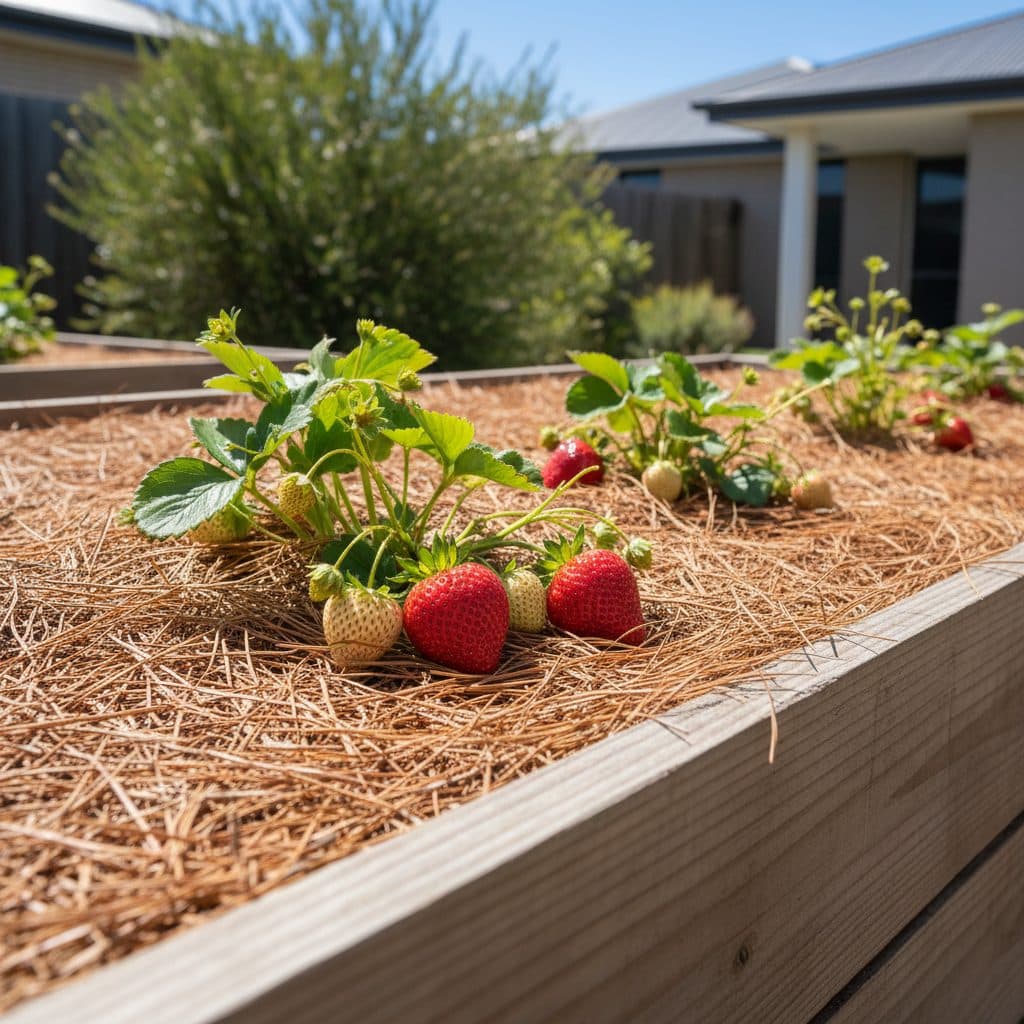
- Mulch immediately: Apply a 3 to 5 cm layer of pea straw, sugarcane mulch, or pine needles around the plants. Mulch keeps the fruit off damp bare soil (preventing grey mould, Botrytis), conserves soil moisture in summer, and suppresses weeds.
How do you propagate strawberry runners for free new plants?
During late spring and summer, established strawberry plants send out horizontal above-ground stems called runners (stolons).
+-------------------------------------------------------------+
|              STRAWBERRY RUNNER PROPAGATION                  |
|                                                             |
|   [ Mother Plant ]======(Stolon)======>[ Small Pot / Soil ] |
|                                             |               |
|                                        [ Wire Pin ]         |
|                                        (Peg runner in soil; |
|                                        snip after rooted)   |
+-------------------------------------------------------------+- Selective rooting: In fruiting plants, snip off all early summer runners so the plant directs energy into sweet fruit production. In late summer (February to March), allow strong, vigorous mother plants to produce runners for next year's stock.
- Potting down: Place small 7.5 cm pots filled with seed-raising mix or light potting mix directly beside the mother plant.
- Pegging in place: Lay the small plantlet at the end of the runner onto the pot surface and pin it in place with a bent piece of wire or paperclip.
- Severing the cord: Keep the pot moist. Within three to four weeks, the daughter plant will develop an independent root system. Snip the connecting runner stem cleanly with pruners, giving you a vigorous new plant ready to transplant into new beds.
How do you feed and water strawberries for sweet fruit?
- Watering: Strawberries require consistent soil moisture. Water at the base of the plants using drip irrigation or a watering can with a narrow spout to avoid wetting foliage and developing berries. Increase watering as berries swell in warm weather.
- Potassium feeding: Once flowering begins, feed fortnightly with an organic liquid seaweed tonic or sulphate of potash solution. Potassium is essential for sugar formation, fruit firmness, and drought tolerance.
- Avoid excess nitrogen: High-nitrogen liquid feeds produce massive dark green leaves but soft, tasteless berries that rot easily on the vine.
How do you protect berries from Australian wildlife and pests?
In Australian gardens, possums, native birds (lorikeets, bowerbirds, silvereyes), rodents, and slugs will target ripening red berries overnight.
Wildlife-safe exclusion netting
- Native ringtail and brushtail possums are protected native wildlife in every Australian state. Never harm them. Trapping or relocating a possum requires a permit and the conditions differ by state; check your state wildlife authority before doing anything but excluding them.
- Build a rigid timber, PVC pipe, or poly-hoop frame over your strawberry bed.
- Cover the frame with wildlife-safe white exclusion netting with a mesh aperture of 5 mm or less at full stretch (the standard used in state fruit-netting rules), pulled taut over the frame instead of draped loosely. Secure the netting tightly to the ground with timber battens or ground pegs so wildlife cannot crawl underneath or become entangled.
+-------------------------------------------------------------+
|              WILDLIFE-SAFE NETTING TUNNEL DESIGN            |
|                                                             |
|               .---''''''''''''''''''''---.                  |
|             /   Wildlife-Safe Mesh (< 5mm) \                |
|            |                                |               |
|            |   [Rigid Poly-Pipe Hoops]      |               |
|            |                                |               |
|            +================================+               |
|            | Strawberry Raised Bed (Mulched)|               |
+-------------------------------------------------------------+
Slugs, snails, and earwigs
- Keep mulch dry on top and clear decaying lower leaves regularly to eliminate damp hiding spots.
- Install shallow beer traps around the perimeter of the bed, or apply physical copper tape around the rim of timber raised beds and containers.
After your strawberry bed completes its third fruiting year, productivity naturally declines. Replace old mother plants with fresh, vigorous runners rooted into newly conditioned soil alongside winter rotations of broad beans in Australia to maintain abundant fruit harvests year after year.