Key takeaways
- Split WA and OR foraging by elevation and rain shadow: coastal and valley floors (USDA Zones 8–9) sprout 3–6 weeks ahead of Cascade slopes and east-side basins (Zones 5–7), extending winter chanterelles and oysters through mild coastal winters.
- Harvest stinging nettles (Urtica dioica) pre-flower in spring wearing heavy gloves, then blanch 2 minutes or dry to neutralize formic acid hairs and avoid gritty older cystoliths.
- Strictly ban amateur wild camas bulb digging: lethal Meadow Death Camas (Toxicoscordion venenosum) shares moist WA/OR meadows with blue Camassia and is fatal even in tiny doses before bloom.
- Cook ripe blue elderberry (Sambucus cerulea) thoroughly (>=180°F) to destroy cyanogenic glycosides; treat red elderberry (S. racemosa) with strict caution due to heightened gastrointestinal toxicity.
- Verify Pacific Golden Chanterelles (Cantharellus formosus) by solid white flesh, apricot scent, soil mycorrhizal growth, and blunt forked false ridges—never wood-growing Galerina marginata or Western Jack-o'-lanterns.
- Respect land-agency caps: Oregon State Parks cap personal berries and fungi at 1 gal/day and ban root/bulb digging under OAR rules; WA State Parks allow 2 gal/day, WA DNR 3 gal/species/day, and USFS Region 6 separates personal caps from commercial permits.
Quick answer: Pacific Northwest foraging follows two elevation clocks: Maritime Washington and Oregon lowlands flush stinging nettles, miner's lettuce, and Sitka spruce tips from March through May, ripen salmonberries and trailing blackberries by June, peak on salal, Oregon grape, and blue elderberry in August, and push Pacific Golden Chanterelles (Cantharellus formosus) from September into winter. Above 1,500–2,000 ft in the Cascades and east-side basins, spring greens and berries lag 3–6 weeks while frost ends autumn fungi early. Never dig wild camas bulbs near Meadow Death Camas (Toxicoscordion venenosum), cook ripe blue elderberry thoroughly while avoiding red elderberry, separate soil-grown chanterelles from Galerina marginata and Western Jack-o'-lanterns, and follow USFS, DNR, and State Park gallon caps.
Maritime West-Side vs. Cascade and Inland Rain-Shadow Clocks
Moisture off the Pacific Ocean splits Washington and Oregon into two distinct foraging calendars. The mild Maritime West-Side covers the Olympic and Oregon coasts, Puget Trough, and Willamette Valley (USDA Zones 8a–9b), staying wet and green through winter. East of the Cascade Crest, elevation and rain-shadow dryness drop winter temperatures into Zones 5a–7a across Wenatchee, Bend, the Blue Mountains, and the Palouse.
Every 1,000 feet of elevation gain delays spring emergence and berry ripening by 10 to 14 days. Lowland foragers harvest nettles in early March and salmonberries in late May while 4,500 ft Cascade ridgelines sit under snow until July—delivering peak huckleberries in August just as valley grass browns. Compare seasonal rhythms with our US foraging calendar and PNW Zone 7–8 guide.
Pacific Northwest Seasonal Foraging Calendar: Maritime Coast & Valleys vs. Cascades & Inland
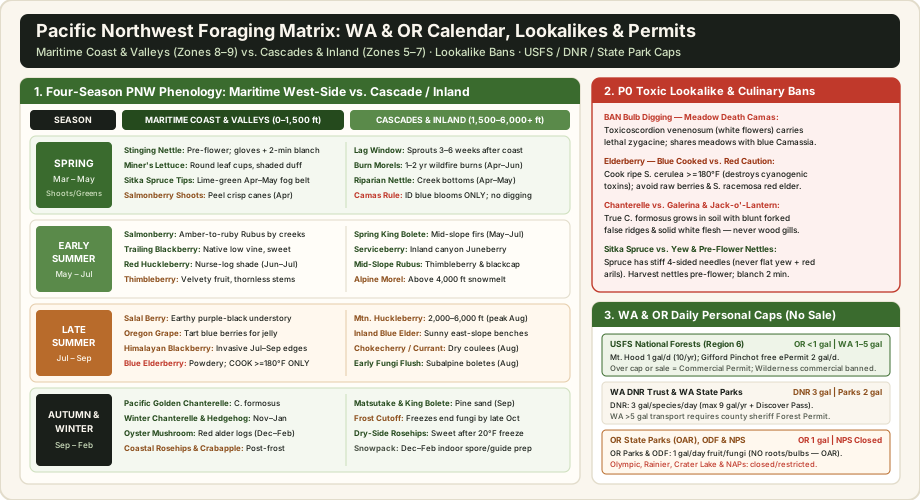
Season & Months | Maritime Coast & Lowlands (0–1,500 ft) | Cascades & Inland Basins (1,500–6,000+ ft) | Target Part & Field Prep Rule |
|---|---|---|---|
Spring (Mar–May) | Stinging nettle (Urtica dioica), miner's lettuce (Claytonia perfoliata), Sitka spruce tips (Picea sitchensis), salmonberry shoots | Burn-site & cottonwood morels (Morchella, Apr–Jun), canyon nettles (3–6 wk lag), blue Camassia ID only | Pick nettles pre-flower with gloves; blanch 2 min. Take <15% spruce tips per branch. Ban bulb digging. |
Early Summer (May–Jul) | Salmonberry (Rubus spectabilis), trailing blackberry (R. ursinus), red huckleberry (Vaccinium parvifolium), thimbleberry | Spring king bolete (Boletus rex-veris), snowmelt high-elevation morels, serviceberry (Amelanchier alnifolia), wild strawberry | Pack fragile salmonberries in shallow rigid trays; peel young salmonberry canes before thorns harden. |
Late Summer (Jul–Sep) | Salal (Gaultheria shallon), Oregon grape (Mahonia aquifolium), Himalayan blackberry (Rubus armeniacus), blue elderberry (Sambucus cerulea) | Black & oval-leaf mountain huckleberries (V. membranaceum, 2,000–6,000 ft, peak Aug), chokecherry, inland blue elderberry | Pick invasive Himalayan blackberries away from sprayed roadsides; cook blue elderberries >=180°F. |
Autumn (Sep–Nov) | Pacific Golden Chanterelle (Cantharellus formosus), lobster mushroom, king bolete, late coastal rosehips | Cascade pine matsutake (Tricholoma murrilli), early autumn boletes & chanterelles (Sep–mid-Oct before hard frost) | Cut or twist fungi clean from soil; carry in breathable mesh baskets; brush duff off outdoors. |
Winter (Dec–Feb) | Winter/yellowfoot chanterelle (Craterellus tubaeformis), hedgehog mushroom (Hydnum), oyster mushroom (Pleurotus on red alder) | Cold-sweetened rosehips on east-side fence rows; indoor drying, spore-key study, and pantry preservation | Inspect winter oysters and alder debris carefully to avoid deadly wood-rotting Galerina marginata. |
Spring Greens and Conifer Shoots: Nettles, Miner's Lettuce and Sitka Spruce
Lowland spring foraging begins weeks before garden soils warm. Three dependable staples dominate March through May when picked at strict pre-flower stages before heat or tough fibers develop.
Stinging nettles (Urtica dioica): pre-flower timing, gloves and blanching
In damp alder bottoms and rich creek banks, perennial stinging nettle emerges by late February along the coast and March inland. Hollow silica hairs inject formic acid, histamine, and serotonin on contact. Wear thick leather or nitrile-coated gloves with long sleeves, and snip strictly the top 4–6 inches (2–3 leaf pairs) before flower buds open.
Once nettles bolt into flowers in late spring, leaves form gritty calcium carbonate cystoliths that can irritate kidneys. Neutralize fresh tops in boiling water for 2 minutes (shock in ice water for pesto or drain for soup), steam, or dehydrate crisp. Pair ID and kitchen steps with our nettle identification guide, nettle neutralization guide, and nettle recipe collection.
Miner's lettuce (Claytonia perfoliata) and coastal Sitka spruce tips
Under shaded second-growth Douglas-fir and bigleaf maple, native miner's lettuce (Claytonia perfoliata) sends up fused circular leaf discs cradling tiny white five-petaled blossoms. Snap stems above ground without yanking roots and eat crisp discs raw in spring salads. Along the coastal fog belt, *Sitka spruce (Picea sitchensis)* flushes lime-green bud tips from April through May.
Sitka spruce vs. toxic Pacific yew needle check: Sitka spruce carries stiff, sharp, four-sided needles radiating around the twig (rolling between fingers), yielding bright citrus-tart spring tips. *Pacific yew (Taxus brevifolia)—whose bark, stems, and seeds contain lethal taxine alkaloids—shows flat, soft, two-ranked dark needles* on opposite sides of green twigs and fleshy red arils instead of cones. Harvest under 15% of spruce tips across mature branches so leaders stay healthy.
Damp lowland ditches also host invasive garlic mustard, dandelion, and clean-stream watercress away from pasture runoff.
Summer Wild Berries: Salmonberry, Salal, Oregon Grape and Elderberry Rules
From May through September, wild fruit ripens uphill from coastal streamsides into high Cascade clearings.
- *Salmonberry (Rubus spectabilis, May–Jul):* Magenta spring flowers yield glossy amber, orange, or ruby berries along damp creeks. Pick fruit that slips cleanly from the white core; pack in shallow rigid containers and cross-check related brambles in our wild Rubus guide.
- *Trailing blackberry (Rubus ursinus) vs. Himalayan blackberry (Rubus armeniacus, Jun–Sep): Low native R. ursinus creeps across forest edges with slender round prickly canes and trifoliate leaves, delivering intense sweet berries early. Invasive R. armeniacus* thickets fruit heavily July–September along sunny edges; harvest freely away from herbicide-sprayed roadsides.
- *Salal (Gaultheria shallon) & Oregon grape (Mahonia aquifolium, Aug–Sep):* Evergreen salal lines coastal conifers with leathery oval leaves and dark purple-black, earthy berries ideal for fruit leather and syrups. Spiny Oregon grape yields sour, seedy dusty-blue berries rich in natural pectin for deep purple jellies.
- *Mountain huckleberries (Vaccinium membranaceum & V. deliciosum, Jul–Sep): Above 2,000–6,000 ft in the Cascades, black and oval-leaf huckleberries peak in August (while red huckleberry, V. parvifolium*, fruits earlier on lowland nurse logs). Hand-pick rather than raking twigs to protect next season's buds, and carry bear spray.
Blue elderberry (Sambucus cerulea) cooked-only vs. red elderberry (S. racemosa)
Sunny valleys and river benches host *blue elderberry (Sambucus cerulea), bearing flat-topped umbels of powdery chalk-blue fruit in late summer. Shady coastal clearings host red elderberry (Sambucus racemosa)*, producing dome-shaped scarlet clusters. Read our safe elderberry guide and berry canning handbook, and plant native serviceberry, red currant, and elderberry in a PNW food forest.
P0 Lethal Lookalike Bans: Death Camas, Elderberry Toxins and Deadly Fungi
Serious Pacific Northwest poisonings happen when foragers dig unbloomed lily bulbs, eat raw or red elderberries, or sweep unidentified wood-rot mushrooms into chanterelle baskets.
P0 Pacific Northwest Toxic Lookalikes & Mandatory Culinary Prep Rules
Edible Target | Dangerous Lookalike / Toxin | Decisive Botanical / Mycological Separation | Mandatory Harvest & Prep Rule |
|---|---|---|---|
Common Camas (Camassia quamash / C. leichtlinii) | Meadow Death Camas (Toxicoscordion venenosum) — LETHAL | Camas has blue-violet 6-petal flowers; death camas has creamy-white star clusters with basal petal glands and grassy keeled leaves. | STRICT BAN on amateur bulb digging. Bulbs co-occur in meadows and look identical once blooms fade; tiny zygacine doses cause fatal bradycardia. |
Blue Elderberry (Sambucus cerulea) | Red Elderberry (S. racemosa) & raw cyanogenic glycosides | S. cerulea forms flat powdery-blue clusters; S. racemosa forms pyramidal scarlet clusters. Stems, leaves, bark, and raw fruit are toxic. | Strip ripe blue berries cleanly from stems and cook >=180°F for 15–20 min; strain seeds. Avoid raw berries and treat red elderberry as unsafe. |
Pacific Golden Chanterelle (Cantharellus formosus) | Deadly Galerina (G. marginata) — LETHAL AMATOXINS | Chanterelle grows in conifer soil with blunt forked false ridges and solid white flesh; Galerina is small, brown, on rotting wood with a stem ring and rusty spores. | Inspect every mushroom stem-by-stem; never scoop tiny brown wood-decaying mushrooms into chanterelle or winter chanterelle bags. |
Pacific Golden Chanterelle (Cantharellus formosus) | Western Jack-o'-lantern (Omphalotus olivascens) & False/Scaly Chanterelles | O. olivascens clusters tightly on wood with sharp blade-like true gills and orange flesh; Turbinellus floccosus has coarse dark scales and deep hollow funnel. | Verify 4 cues on every chanterelle: soil/duff habit, blunt forked ridges, solid white fibrous interior flesh, and fruity apricot aroma. |
Sitka Spruce & Wild Umbels | Pacific Yew (Taxus brevifolia) & Poison/Water Hemlock | Spruce needles are 4-sided vs. flat 2-ranked yew + red arils; hemlock shows hairless purple-blotched stems and bulbous water-edge roots. | Leave all wild white-umbel roots undisturbed; check our PNW lookalike guide and hemlock ID guide. |
Why Death Camas bans admit zero exceptions: Across Willamette prairies, Puget lowlands, and east-side meadows, *Meadow Death Camas (Toxicoscordion venenosum) grows intermingled with blue Camassia* and wild onions. Once flowers drop, bulbs cannot be told apart reliably, and Oregon State Parks outlaw bulb digging anyway. Review field traps in our death camas vs. wild onion guide and poisonous plant checklist.
Oregon's state mushroom—the *Pacific Golden Chanterelle (Cantharellus formosus)*—fruits after autumn rains beneath Douglas-fir, hemlock, and Sitka spruce. Study our chanterelle ID guide, morel ID guide, and deadly Amanita alert to exclude Galerina marginata, Hygrophoropsis aurantiaca, and Turbinellus floccosus. USDA Forest Service PNW Research Station long-term Mt. Hood plots confirm that clean cutting or gentle plucking leaves mycelial yields intact when duff is pressed back gently.
WA and OR Foraging Permits: USFS, WA DNR, State Parks and NPS Caps
Public-land foraging rules across Washington and Oregon depend strictly on agency jurisdiction. Personal-use allowances forbid selling, trading, or bartering your basket.
Washington & Oregon Foraging Permits and Daily Harvest Caps by Land Agency
Land Jurisdiction | Personal-Use Daily Cap | Permit & Pass Rules | Commercial & Digging Prohibitions |
|---|---|---|---|
USFS National Forests — Oregon (Region 6) | Under 1 gal/day free incidental use on most forests (Mt. Hood caps 1 gal/day, 10 gal/yr) | Deschutes, Willamette, Umpqua & Fremont-Winema require free-use permits (and often cap halving). Matsutake requires special permits. | Over 1 gal or selling requires Commercial Permit ($2/day, 10-day $20 min or $100/yr; age >=18). Commercial picking banned in Wilderness. |
USFS National Forests — Washington (Region 6) | 1–5 gal/day depending on forest (Gifford Pinchot caps 2 gal/day, 10 days/yr) | Gifford Pinchot requires free online ePermit; Mount St. Helens National Volcanic Monument is closed to mushroom picking. | Transporting >5 gal in WA triggers county-sheriff Specialized Forest Products permits; zero commercial harvest in Wilderness. |
Washington DNR State Trust Lands | Up to 3 gal of a single species per day (max 9 gal + 1 mushroom per year) | No paid picking permit within personal cap; trailhead parking requires a WA Discover Pass. | Banned in campgrounds, Natural Area Preserves (NAPs), and NRCAs; sales require regional WA DNR contracts. |
Washington State Parks | Up to 2 gal/person/day of mushrooms, berries, and fruits (unless posted) | Free for personal consumption in designated recreation zones with Discover Pass parking. | Commercial picking banned; prohibited inside Natural Area Preserves and signed restoration sites. |
Oregon State Parks (OPRD — OAR 736-021) | Up to 1 gal/person/day of mushrooms, berries, and fruits in day-use zones | No permit required for <=1 gal fruiting bodies; banned in overnight campgrounds and sensitive areas. | Commercial picking banned. OAR rules strictly forbid uprooting living plants or digging roots, bulbs, and tubers (including camas). |
Oregon Dept. of Forestry (ODF) & National Parks | ODF State Forests: 1 gal/vehicle/day; National Parks (Olympic, Rainier, Crater Lake): Closed | Verify local ODF district fire closures; NPS bans nearly all mushroom/plant harvest (rare posted 1-pt berry rules excepted). | Zero commercial harvest on ODF without state permits; federal citations apply inside all PNW National Parks. |
Review jurisdictional rules in our US foraging laws guide, build a field pack via our foraging gear checklist, and apply conservation ethics from foraging for beginners and sustainable mushroom stewardship.
Field Sanitation, Processing and Safe Preservation Through PNW Winters
Keep harvests clean by staying 50–100 feet away from paved highways, railroad corridors, timber spray units, and dog-walking loops where heavy metals and herbicides accumulate.
- Separate greens and fungi: Carry greens in breathable cotton totes and mushrooms in wide mesh bags or woven baskets—plastic bags sweat fungi into mush within hours.
- Trim dirt outdoors: Slice soil-caked mushroom bases cleanly over the mycelium and brush fir duff away before packing.
- Dry or freeze wild mushrooms: OSU Extension warns against home-canning low-acid wild mushrooms due to botulism risk. Dehydrate sliced chanterelles at 95–115°F until cracker-dry, or dry-sauté and freeze flat for 9–12 months.
- Preserve summer harvests safely: Follow tested acidity ratios for cooked elderberry syrups and Oregon grape jellies in our herb drying guide and PNW apple and pear preservation guide.