Key takeaways
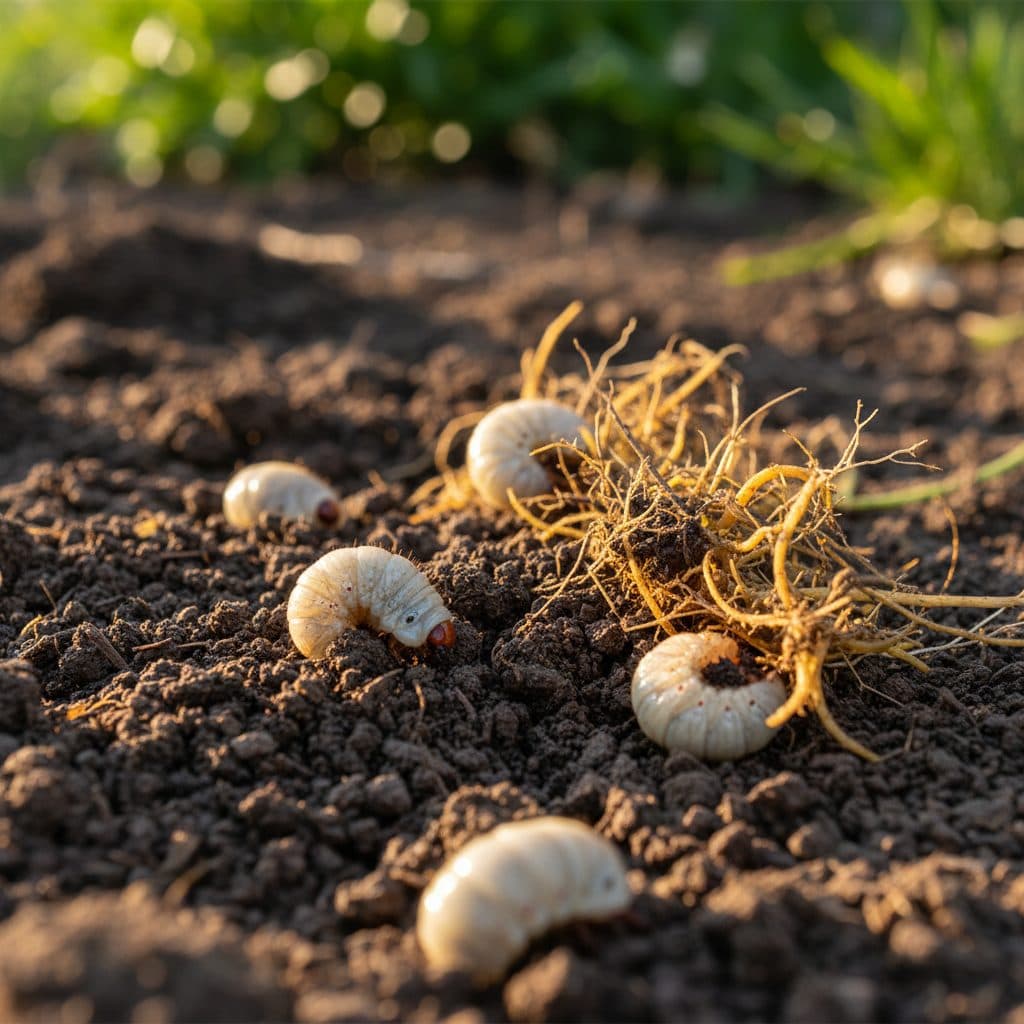
- Curl grubs are the fleshy, C-shaped white larvae of scarab beetles that feed voraciously on grass roots, seedlings, and potted plant roots across Australia.
- Major pest species include the introduced African black beetle (Heteronychus arator) and Argentine scarab, alongside native Christmas beetles.
- Distinct from wood-boring native witchetty grubs found in tree trunks, curl grubs reside strictly within the top 5 to 15 cm of soil and potting mix.
- Severe lawn infestations cause turf to turn yellow, feel spongy underfoot, and lift easily from the ground like loose carpet.
- Biological control using entomopathogenic nematodes (Heterorhabditis species) provides targeted grub mortality without harming beneficial earthworms.
- Cultural traps like laying wet hessian sacks overnight draw grubs to the surface where native magpies, butcherbirds, and backyard chooks can feast on them.
Quick answer: Curl grubs are C-shaped white beetle larvae that sever root systems in Australian lawns, pots, and veggie patches. Control them organically by applying parasitic nematodes (Heterorhabditis bacteriophora) to warm, moist soil in late spring or summer, repotting affected containers into fresh potting mix, or laying wet hessian bags overnight to draw grubs to the surface for birds and chooks to eat.
Finding fat, pale white grubs with light brown heads curled up tightly in your soil is one of the most common experiences in Australian gardening. Known collectively as curl grubs or white curl grubs, these underground larvae are the immature stages of scarab beetles (family Scarabaeidae).
While a small population in a biologically active compost pile is normal and breaks down organic matter, high densities in lawns, raised veggie beds, or container plants cause devastating root loss. Under heavy feeding pressure, lush green buffalo, couch, or kikuyu lawns develop dry, dead patches that fail to respond to watering, while tender potted citrus and vegetable seedlings suddenly wilt and collapse.
Identifying destructive scarab larvae distinguishes them from harmless native species and guides non-chemical treatments suited to Australian conditions.
+-------------------------------------------------------------+
|              AUSTRALIAN CURL GRUB IDENTIFICATION            |
|                                                             |
|   Body Shape:     Pronounced 'C' shape when exposed or held |
|   Colour:         Creamy-white to grey-white body           |
|   Head Capsule:   Hard, glossy reddish-brown to orange head |
|   Legs:           6 prominent articulated legs near head    |
|   Abdomen Tip:    Dark grey to black (digested soil contents)|
|   Size:           15 mm to 35 mm long depending on instar   |
+-------------------------------------------------------------+
How do you distinguish curl grubs from witchetty grubs?
In Australia, gardeners frequently confuse soil-dwelling curl grubs with traditional witchetty grubs. However, their taxonomy, habitat, and ecological impact are entirely different.
- Curl grubs (Scarab beetle larvae): Grow between 15 and 35 mm in length, have six distinct walking legs positioned near their head, and live exclusively in topsoil, lawn thatch, and container potting mix. When dug up, they immediately curl into a tight letter "C". Major pest species include the African black beetle (Heteronychus arator), pruinose scarab (Sericesthis geminata), and Argentine scarab (Cyclocephala signaticollis).
- Witchetty grubs (Cossid moth larvae): The witjuti grub (Endoxyla leucomochla, family Cossidae) feeds underground on the roots of witchetty bush (Acacia kempeana). Other Endoxyla wood moths tunnel in the trunks of eucalypts and wattles. Witjuti grubs never live loose in suburban lawn soil; they are an esteemed traditional bush tucker food and play an important role in native woodland ecology.
+-------------------------------------------------------------+
|              CURL GRUB VS WITCHETTY GRUB COMPARISON         |
|                                                             |
|   FEATURE           CURL GRUB                WITCHETTY GRUB |
|   -------           ---------                -------------- |
|   Adult Form        Scarab / Black Beetle    Cossid / Wood  |
|   Mature Length     15 to 35 mm              70 to 110 mm   |
|   Habitat           Soil, turf thatch, pots  Roots / Trunks |
|   Legs              6 prominent legs         Vestigial legs |
|   Garden Impact     Severe root feeder       Wood tunneller |
+-------------------------------------------------------------+
What are the warning signs of curl grub damage in Australian gardens?
Because curl grubs feed underground, damage often goes unnoticed until extensive root loss has already occurred.
+-------------------------------------------------------------+
|              SIGNS OF UNDERGROUND GRUB INFESTATION          |
|                                                             |
|   1. Spongy Turf:     Lawn feels springy and disconnected   |
|   2. Carpet Effect:   Dead turf rolls up freely by hand     |
|   3. Bird Digging:    Magpies & cockatoos tearing up lawn   |
|   4. Potted Wilt:     Potted plants wilting despite wet soil|
|   5. Night Activity:  Black beetles swarming around porch   |
+-------------------------------------------------------------+- Dead, yellowing turf patches: Irregular yellow or straw-brown patches appear in lawns during late spring, summer, and early autumn (November through March).
- The "carpet test": Grab a handful of dying turf and pull gently. If the grass lifts up easily like a rug, exposing severed root crowns and numerous white C-shaped grubs sitting in the top 3 cm of soil, you have a confirmed infestation.
- Intense bird activity: Flocks of Australian magpies, currawongs, noisy miners, or ibis vigorously pecking and tearing up sections of lawn in the early morning are a reliable indicator of high grub numbers beneath.
- Sudden potted plant failure: In container gardens, adult beetles fly in during warm summer evenings and lay eggs in moist potting mix. The hatching larvae consume the plant's fine feeder roots, causing the plant to wobble loosely in the pot and wilt despite regular watering.
For nocturnal garden surveillance methods, consult our guide to nighttime low-tech pest patrol.
What is the life cycle of the African black beetle in Australia?
Understanding the seasonal life cycle of scarab beetles allows you to time control measures for maximum effectiveness across Australian climate zones.
- Spring (September to November): Overwintered adult beetles emerge from the soil on warm, humid evenings to mate. Females burrow into moist turf or compost-rich garden beds to lay eggs.
- Summer (December to February): Eggs hatch within two to three weeks into tiny first-instar larvae. Over summer, grubs feed aggressively on tender root crowns, growing rapidly into large, fat third-instar larvae. This is when lawn and veggie patch damage peaks.
- Autumn (March to May): Mature grubs pupate in smooth earthen cells 10 to 20 cm underground, transforming into new adult beetles that emerge before winter.
- Winter (June to August): Adult beetles or late-stage pupae hibernate in the soil, awaiting spring warmth.
+-------------------------------------------------------------+
|              AUSTRALIAN SCARAB BEETLE LIFE CYCLE            |
|                                                             |
|   SEASON (AU)        STAGE            ACTIVITY              |
|   -----------        -----            --------              |
|   Spring (Sep-Nov)   Adults & Eggs    Mating flights, laying|
|   Summer (Dec-Feb)   Active Larvae    Peak root feeding     |
|   Autumn (Mar-May)   Pupation         Transition in soil    |
|   Winter (Jun-Aug)   Adult Dormancy   Sheltering in ground  |
+-------------------------------------------------------------+
How do you control curl grubs organically in lawns and garden beds?
Synthetic chemical drenches harm non-target earthworms, kill predatory ground beetles, and disrupt the soil microbiome. Instead, use targeted biological, physical, and cultural controls.
1. Beneficial entomopathogenic nematodes
Applying microscopic beneficial nematodes (Heterorhabditis bacteriophora) is the most effective biological treatment available:
- How they work: Nematodes actively seek out curl grubs in the soil, enter through natural body openings, and release symbiotic bacteria that kill the grub within 24 to 48 hours. The nematodes reproduce inside the cadaver and emerge in thousands to hunt remaining grubs.
- Application timing: Apply during warm weather (soil temperature above 15°C) in late spring or summer.
- Method: Water the lawn thoroughly beforehand. Mix nematode concentrate with clean water in a watering can and apply at dusk or on an overcast day (UV light kills nematodes). Keep the soil moist for two weeks following application.
2. The wet hessian bag or tarp trap
Scarab larvae dislike bright sunlight and dry soil, but are naturally drawn to warm surface moisture:
- Soak several coarse hessian sacks or an old thick towel in water and lay them flat over the infested lawn or garden bed just before sunset.
- By morning, curl grubs will have migrated upward into the surface thatch beneath the damp cover.
- Flip the sacks at sunrise to expose dozens of grubs. Allow local native birds (magpies and butcherbirds) or your backyard chickens to forage and devour them.
3. Biodegradable soapy water monitoring flush
For sampling and monitoring small lawn patches:
- Mix 30 ml of mild plant-based dishwashing liquid or agricultural potassium soap into a 9-litre watering can of water.
- Pour evenly over a 1 square metre section of affected lawn.
- The soapy solution irritates the grubs' breathing pores, forcing surface-active larvae and some grubs to surface within 10 to 15 minutes to confirm infestation. Collect them by hand or feed them to birds, and rinse the turf thoroughly with fresh water afterward. Use this method to monitor grub presence; repeated detergent drenches can damage turf.
To build broader ecological resistance across your property, review our foundational approach to prevention-first gardening pest control.
How do you rescue infested potted plants and veggie patches?
If a potted fruit tree, ornamental, or vegetable plant begins to fail due to curl grubs in the container:
+-------------------------------------------------------------+
|              POTTED PLANT CURL GRUB RESCUE PROTOCOL         |
|                                                             |
|   Step 1: Submerge entire pot in bucket of water for 30 min |
|   Step 2: Collect surfaced grubs as oxygen depletes         |
|   Step 3: If severe, unpot plant and wash roots in water    |
|   Step 4: Repot into fresh mix with organic fertiliser      |
|   Step 5: Drench with nematodes if grubs persist in beds    |
+-------------------------------------------------------------+- Submersion rescue: Submerge the entire pot in a large tub of water for 20 to 30 minutes. As oxygen in the potting mix is displaced, grubs will crawl to the surface to breathe, where they can be removed.
- Repotting: For heavy infestations, gently knock the plant out of its pot, shake off the old potting mix into a bucket, and manually pick out all grubs. Trim away rotted or severed roots, and repot in fresh potting mix enriched with slow-release organic amendments. Learn how to replenish soil nutrients with our guide on blood and bone fertiliser in Australia.
- Veggie patch protection: When planting out autumn crops like broad beans in Australia, dig over the top 10 cm of planting furrows with a hand fork to expose any lingering grubs before direct sowing large seeds.
Combining predatory nematodes, physical flushing, and good soil management keeps curl grub numbers below damaging levels in lawns and gardens.