Key takeaways
- Solar drying reduces food waste by up to 30% annually for homesteaders in USDA zones 4 through 9.
- Optimal drying conditions involve temperatures between 100°F and 140°F, with relative humidity below 60% and consistent airflow.
- Pre-treating produce with blanching or an ascorbic acid dip can reduce spoilage and extend shelf life by several months.
- Achieving a final moisture content of 10-20% is important for preventing mold and bacterial growth in dried foods.
- Case-hardening, a common issue, is mitigated by maintaining moderate temperatures and ensuring adequate air circulation within the dryer.
- Indirect solar dryers offer better temperature control and protection from direct sun, improving product quality and safety.
Quick answer: Food-safe solar drying involves maintaining temperatures between 100-140°F, relative humidity below 60%, and consistent airflow to prevent mold, case-hardening, and spoilage. Pre-treating produce and achieving 10-20% final moisture content are also crucial for long-term preservation.
In the high desert of Eastern Oregon, where summer temperatures often reach 95°F with relative humidity as low as 15%, solar drying offers a reliable method for preserving seasonal harvests. For homesteaders across USDA zones 4 through 9, harnessing the sun’s energy can significantly extend the shelf life of fruits, vegetables, and culinary herbs, reducing food waste annually.
Successful solar drying requires careful management to prevent common pitfalls like mold growth, case-hardening, and spoilage. Understanding the science behind moisture removal and airflow produces a safe, high-quality dried product that can last for six months to over a year in proper storage.
The science of solar drying: heat, airflow, and humidity
Effective solar drying hinges on a delicate balance of three primary factors: heat, airflow, and humidity. Sunlight provides the necessary heat to evaporate moisture from food items, typically raising the internal temperature of a well-designed dryer to between 100°F and 140°F, which is sufficient to inhibit microbial growth without cooking the food too quickly. In regions like the arid Southwest, ambient temperatures can reach 110°F, making solar drying highly efficient, while in more humid areas, supplemental airflow becomes even more critical. Research from 2024 emphasizes that adequate air circulation is paramount for carrying away the evaporated water vapor, preventing the air inside the dryer from becoming saturated [4]. Without this constant exchange, the drying process slows dramatically, creating conditions ripe for mold.
Optimizing your drying environment
To optimize your drying environment, consider the typical relative humidity in your region. In the humid Southeast, where summer humidity often exceeds 70%, a forced-air solar dryer might be more effective than a passive design. A study from 1986 on food commodities in Zimbabwe found that drying times could be significantly reduced with improved airflow compared to simple open-air methods. For homesteaders, this means designing or selecting a dryer that facilitates a steady flow of air, perhaps through strategically placed vents or even a small, solar-powered fan. For insights on powering such systems, consider reading about solar panels for off-grid living. The goal is to maintain the internal humidity of the dryer below 60% relative humidity, allowing moisture to continually move from the food into the air and out of the system.
- Maintain a steady temperature between 100°F and 140°F.
- Ensure constant airflow to remove moist air.
- Monitor relative humidity within the dryer, aiming for below 60%.
- Position dryer for maximum sun exposure for at least eight hours daily.
Preventing mold and spoilage: critical controls
Mold and spoilage are the primary concerns for any homesteader venturing into solar drying. The key to prevention lies in careful preparation, achieving the correct final moisture content, and proper storage. Before drying, most fruits benefit from a pre-treatment step, such as blanching vegetables for two to five minutes or dipping fruit slices in an ascorbic acid solution (one tablespoon per quart of water) to prevent enzymatic browning and bacterial growth. This can extend the safe storage period by several months. In community solar drying projects in Afghanistan, careful pre-treatment and hygiene were found to be critical for producing safe, marketable dried goods [3].
Achieving safe moisture levels and storage
The ultimate goal is to reduce the food’s moisture content to a level where microorganisms cannot thrive, typically between 10% and 20% by weight, depending on the food type. For instance, dried apples should be around 15% moisture, while dried herbs might be as low as 5%. You can test for adequate dryness by cooling a few pieces and checking if they are leathery and pliable, not brittle or soft. If you live in a humid climate, like coastal Louisiana, you might need to finish drying in a conventional oven at 150°F for 30 minutes to one hour to reach the target moisture level. Once dried, allow the food to cool completely before packaging it in airtight containers, such as glass jars with rubber seals or vacuum-sealed bags. Store these containers in a cool, dark place below 70°F for optimal shelf life, which can be up to one year for many products. For general homesteading advice, consider our article on off-grid living.
- Pre-treat produce with blanching or acid dips to inhibit enzymes and bacteria.
- Slice food uniformly to 1/4 to 1/2 inch thick for even drying.
- Aim for 10-20% final moisture content to prevent microbial growth.
- Condition dried food in jars for several days before long-term storage.
- Store in airtight containers in a cool, dark place below 70°F.
Battling case-hardening: temperature and airflow management
Case-hardening is a common issue in solar drying, particularly with high-sugar fruits and thick root-vegetable slices. It occurs when intense heat with poor humidity exhaust dries the outer skin far faster than interior moisture can diffuse outward, forming a tough, sealed crust that traps water inside and triggers hidden mold spoilage within weeks. (Note: Never attempt to dry meat or jerky in a solar dryer — variable solar heat cannot meet USDA FSIS pathogen lethality standards.)
Dryer design and operation for even drying
To avoid case-hardening, homesteaders should focus on two main strategies: moderate temperatures and consistent, gentle airflow. An indirect solar dryer, which heats air in a separate collector before it passes over the food, is particularly effective for preventing case-hardening. A 2022 study on indirect solar drying of pears showed that this method resulted in a more uniformly dried product compared to direct sun exposure, maintaining a more even moisture gradient within the fruit [5]. The ideal temperature range for preventing case-hardening is typically between 105°F and 130°F. If your dryer reaches 140°F or more, consider partially shading it or increasing airflow. Ensuring adequate airflow helps prevent the surface from drying too quickly. You might even consider a small, off-grid fan system; explore options for off-grid and hybrid solar systems for powering such additions.
- Maintain moderate drying temperatures between 105°F and 130°F.
- Ensure consistent, gentle airflow to prevent rapid surface drying.
- Consider an indirect solar dryer for better temperature control.
- Avoid overloading trays to allow for proper air circulation around each piece.
- Rotate trays periodically to ensure even exposure to heat and airflow.
Dryer designs for the homestead: direct, indirect, and hybrid systems
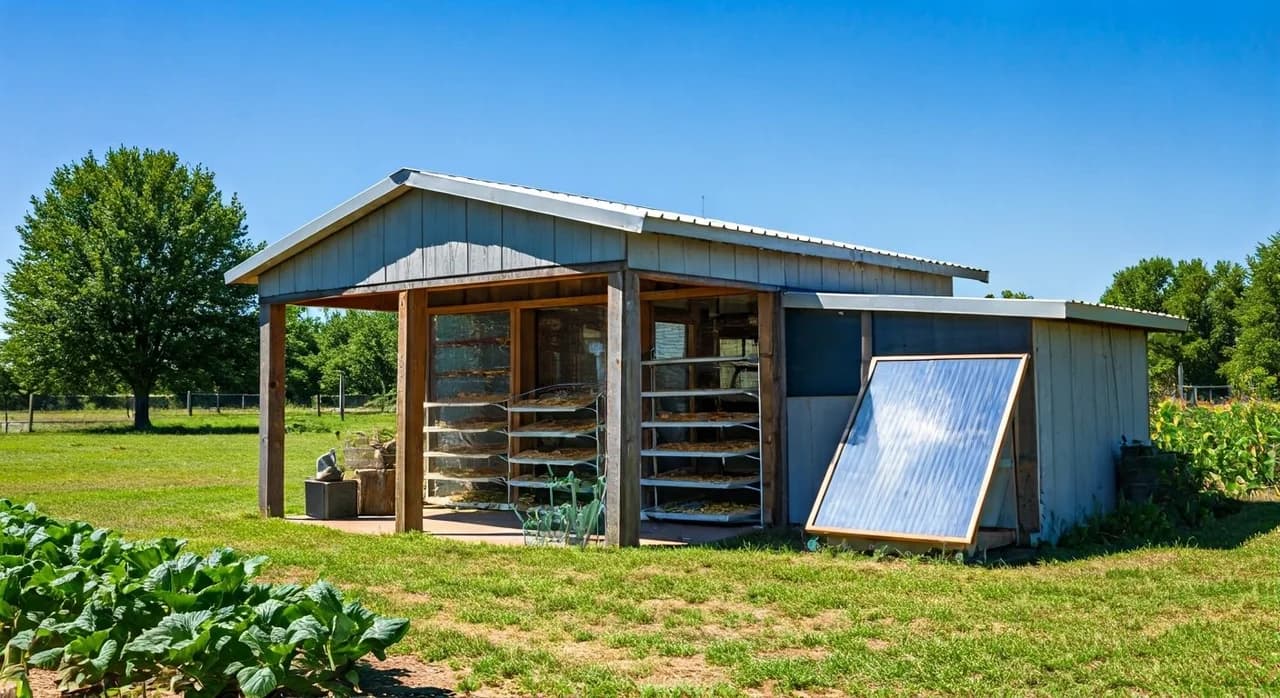
Choosing the right solar dryer design is fundamental to achieving food-safe results on your homestead. There are three main categories: direct, indirect, and hybrid systems, each with distinct advantages and disadvantages. Direct solar dryers, often simple box designs, expose food directly to sunlight. They are inexpensive to build, costing as little as $50 for materials, and can reach temperatures of 130°F to 150°F in sunny climates like Arizona. However, direct exposure can lead to uneven drying, color degradation, and increased risk of case-hardening, especially for delicate items. A 2024 review of open-air and solar drying methods notes that direct dryers are best for items that can tolerate high heat and direct UV, like herbs or hot peppers [4].
Indirect and hybrid dryer advantages
Indirect solar dryers, like the single-compartment model used in a 2022 study on pears, separate the solar collector from the drying chamber [5]. Air is heated in the collector, then flows into the chamber where the food is placed, protected from direct sun and dust. This design offers superior temperature control, more uniform drying, and reduced risk of case-hardening and nutrient loss, making it ideal for fruits, vegetables, and meats. Building an indirect dryer might cost $200 to $500, but the improved quality and safety of the dried product are often worth the investment. Hybrid systems combine solar energy with a small electric heater or fan, often powered by a solar setup for tiny homes or sheds, to ensure consistent drying during cloudy periods or at night. This can reduce drying times and provide greater control over the drying process, especially in regions with fluctuating weather patterns, such as the Pacific Northwest.
- Direct dryers are simple and inexpensive, good for robust items.
- Indirect dryers offer better control, uniform drying, and protect food.
- Hybrid systems combine solar with supplemental heat/airflow for reliability.
- Consider local climate: humidity levels dictate dryer needs.
- Material costs range from $50 for basic direct to $500+ for advanced indirect.
Specific crops and considerations for safe drying
Different foods require specific approaches to ensure food-safe solar drying. For fruits like apples, peaches, and mangoes, slicing them 1/4 inch thick and pre-treating with an ascorbic acid dip is essential. Mangoes, for example, can be dried effectively in solar dryers, offering a significant opportunity to preserve nutrients like Vitamin A, as highlighted by a 2025 study focused on Sub-Saharan Africa [6]. Vegetables such as carrots, corn, and green beans benefit from blanching for two to three minutes before drying to stop enzyme action and preserve color. These items typically dry in one to three days in a well-functioning solar dryer in a sunny climate like Southern California.
Why meat requires electric drying (and how to solar-dry herbs safely)
Critical food-safety boundary: Never dry raw beef, venison, poultry, or fish jerky in a solar dehydrator. Passing clouds, afternoon shade, and shifting humidity allow solar chambers to dip into the 40°F–140°F bacterial danger zone, where Salmonella and enterohemorrhagic E. coli O157:H7 survive curing salts and become heat-tolerant as tissue dries. Per USDA Food Safety and Inspection Service (FSIS) jerky guidance, meat strips must be heated to 160°F internal temperature (165°F for poultry) BEFORE dehydration and dried in a thermostat-controlled electric dehydrator at a constant 130°F–140°F. Reserve solar dryers strictly for fruits, blanched vegetables, and culinary herbs dried below 100°F in an indirect shaded chamber to preserve volatile oils.
- Fruits: Slice 1/4 inch, pre-treat with ascorbic acid, dry at 120-135°F.
- Vegetables: Blanch 2-3 minutes, slice 1/4 inch, dry at 125-140°F.
- Meats & Poultry (Safety Boundary): Never solar-dry raw meat or jerky; USDA FSIS requires pre-heating meat to 160°F (165°F for poultry) and drying in a thermostat-controlled electric unit at 130–140°F.
- Herbs: Dry below 100°F, in shade or indirect dryer, to preserve oils.
- Root vegetables: Can be grated or sliced 1/8 inch, blanched, and dried at 130-145°F.
Comparison of Solar Dryer Types for Homestead Use
Feature | Direct Solar Dryer | Indirect Solar Dryer | Hybrid Solar Dryer |
|---|---|---|---|
Cost to Build | Low ($50-$150) | Moderate ($200-$500) | High ($400-$1000+) |
Temperature Control | Limited, prone to overheating (130-150°F) | Good, stable temperatures (105-135°F) | Excellent, precise control (95-140°F) |
Risk of Case-Hardening | High | Low | Very Low |
Food Protection | Direct sun, dust exposure | Protected from sun, dust, pests | Protected, consistent environment |
Drying Time | 1-4 days (weather dependent) | 2-5 days (weather dependent) | 1-3 days (consistent) |
Best For | Herbs, peppers, simple fruits | Fruits, vegetables, meats | All foods, especially in humid climates |
Moisture Target: For most dried foods, a final moisture content between 10% and 20% is essential to inhibit microbial growth, extending shelf life up to one year.
Temperature Range: Optimal solar drying temperatures typically range from 100°F to 140°F, effectively removing water without cooking the food.
Airflow Importance: Maintaining adequate airflow in a medium-sized dryer can reduce drying times and prevent mold.
Discover solar drying solutions
References
- Solar Drying of Selected Food Commodities in Zimbabwe (1986).Solar Drying of Selected Food Commodities in Zimbabwe.
- Community Solar Food Drying in Afghanistan (2021).Community Solar Food Drying in Afghanistan.
- Open-air and Solar Drying (2024).Open-air and Solar Drying.
- Indirect solar dryer with a single compartment for food drying. Application to the drying of the pear (2022).Indirect solar dryer with a single compartment for food drying. Application to the drying of the pear.
- Solar Drying of Mangoes: Opportunities for Combating Vitamin A Deficiency in Sub-Saharan Africa (2025).Solar Drying of Mangoes: Opportunities for Combating Vitamin A Deficiency in Sub-Saharan Africa.