Key takeaways
- Always use fresh seed bought in the current season, as parsnip seed viability declines drastically after twelve months.
- Delay sowing until soil temperatures reach at least 8°C to 10°C in March or April rather than sowing into cold, waterlogged February mud.
- Station-sow three seeds every 15 cm along shallow drills, thinning to the single strongest seedling after emergence.
- Grow in deep, stone-free, unmanured soil to prevent roots from forking, splitting, or fanning into misshapen prongs.
- Prevent parsnip canker by choosing resistant cultivars, maintaining a soil pH near 6.5, and avoiding physical damage to the root crowns.
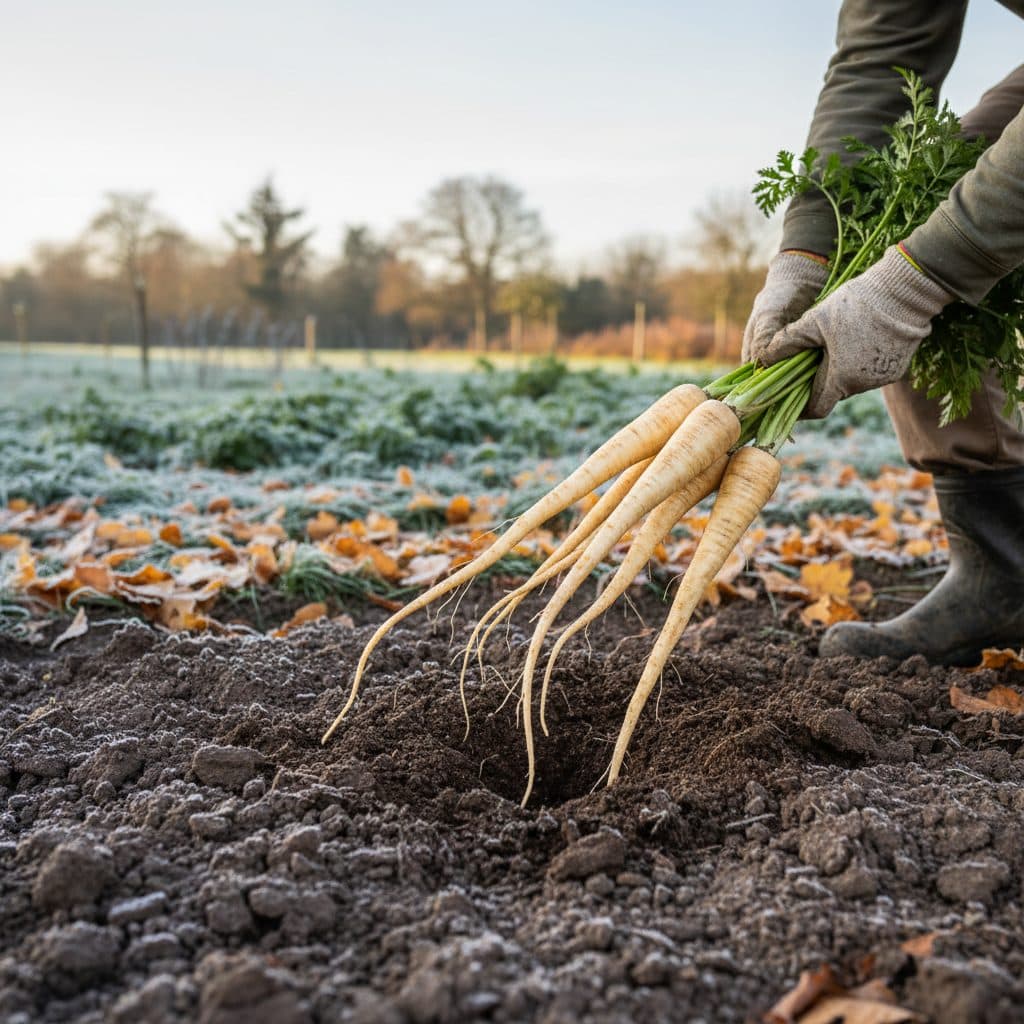
- Leave roots in the soil through the first winter frosts to allow cold temperatures to convert root starches into natural sugars.
Quick answer: To grow sweet parsnips successfully in the UK, sow fresh current-year seeds into deep, loose, stone-free soil from mid-March to late April once the ground warms. Keep the seedbed consistently moist during their slow three-to-four week germination, thin seedlings to 15 cm apart, and harvest after the first winter frosts for maximum sweetness.
Parsnips (Pastinaca sativa) are a cornerstone of the traditional British Sunday roast and a staple winter crop for allotment plots across the country. Known for their earthy, nutty sweetness and hardiness, parsnips can stand in frozen ground throughout winter without losing quality.
Despite their hardiness once established, parsnips have a reputation among growers for erratic and slow germination. Understanding how soil temperature, seed age, and moisture levels affect early root development allows you to achieve high germination rates and produce long, smooth, unblemished roots season after season.
Sowing parsnips: seed viability and germination tips
The single most common cause of failed parsnip crops is using old seed. Unlike tomato or brassica seeds that remain viable for four to five years, parsnip seeds contain short-lived oils and lose germination vigor rapidly after their first year. Always purchase fresh seed packets each spring.
+-------------------------------------------------------------+
|                 PARSNIP GERMINATION TIMELINE                |
|                                                             |
|   Day 0: Sow fresh seed in warm, moist soil (8-10°C+)       |
|         |                                                   |
|   Days 1-14: Seed absorbs moisture; cell division begins    |
|         |                                                   |
|   Days 15-28: Primary taproot emerges downward              |
|         |                                                   |
|   Days 18-30: First slender seed leaves break soil surface  |
+-------------------------------------------------------------+
When to sow parsnips in the UK
Traditional gardening folklore suggests sowing parsnips in February, but in modern UK climates this often results in seed rotting in cold, waterlogged ground. Parsnip seeds require a minimum soil temperature of 8°C to germinate reliably, with 10°C to 15°C being ideal.
Region | Recommended Sowing Window | Target Germination Time | Expected Harvest |
|---|---|---|---|
Southern England & Coast | Mid-March to mid-April | 18–24 days | October to February |
Midlands & East Anglia | Late March to late April | 21–28 days | November to March |
Northern England & Wales | Early April to early May | 21–28 days | November to March |
Scotland & High Ground | Mid-April to mid-May | 24–30 days | December to March |
Pre-germination trick for stubborn seed
If you garden on heavy clay or experience slow spring warming, pre-germinate your seeds indoors:
- Dampen a sheet of kitchen paper with clean, lukewarm water and place it on a shallow plate.
- Scatter parsnip seeds thinly across the damp paper and slide the plate into a clear polythene bag.
- Keep the plate in a warm room (18°C to 20°C) for 7 to 10 days, inspecting daily.
- As soon as the tiny white root tips begin to emerge from the seed coats, carefully transfer the germinated seeds into your outdoor garden drills using tweezers, spacing them 15 cm apart. Water them in gently.
Soil preparation: preventing forked and fanged roots
Parsnips produce a long, tapered taproot that penetrates 30 cm to 45 cm deep into the subsoil. Any physical obstruction or concentrated pocket of nutrients causes the root tip to split, producing misshapen, forked roots.
+-------------------------------------------------------------+
|                PARSNIP ROOT DEVELOPMENT IN SOIL             |
|                                                             |
|       IDEAL SOIL                       OBSTRUCTED SOIL      |
|   (Deep, loose, unmanured)          (Stones, fresh manure)  |
|                                                             |
|          \     /                           \     /          |
|         ( Taproot )                       ( Taproot )       |
|          \       /                         \   / \  /       |
|           \     /                           \ /   \/        |
|            \   /                             |     |        |
|             \ /                            (Forked Roots)   |
|              V                                              |
|    Single straight root                   Misshapen prongs  |
+-------------------------------------------------------------+- Avoid fresh manure: Never apply fresh animal manure to a bed destined for parsnips. High nitrogen concentrations encourage the taproot to divide into multiple fleshy prongs. Grow parsnips in soil that was manured for a previous crop, such as following potatoes or brassicas in your rotation.
- Clear stones and debris: Fork the bed thoroughly to a depth of 30 cm, breaking up dense clods and removing stones, roots, and hard rubble.
- Soil drainage percolation: Parsnips dislike standing water in winter. Test your ground following our guide to soil drainage percolation test to verify proper water movement.
- Growing in containers: If your plot consists of intractable, stony clay, you can grow shorter-rooted varieties in deep tubs following the principles in growing carrots and root vegetables in containers.
Step-by-step outdoor sowing method
- Create shallow drills: Mark straight lines across your prepared bed using a garden line. Draw shallow drills 1.5 cm deep, spacing the rows 30 cm to 38 cm apart.
- Water the drill base: If the soil surface is dry, run water along the bottom of the open drill before sowing so moisture reaches the seed zone.
- Station sowing: Drop a cluster of three seeds every 15 cm along the drill. Station sowing ensures you achieve regular spacing without wasting precious seed.
- Cover and firm down: Cover the seeds with 1.5 cm of fine, sieved soil or compost. Gently press the soil down using the back of a rake to ensure good seed-to-soil contact.
- Intercrop with radishes: Because parsnips take up to four weeks to emerge, mark the rows by sowing quick-growing radish seeds along the same drill. The radishes germinate within five days, marking the row for easy hoeing, and are harvested before the parsnips need the space.
- Thinning: When parsnip seedlings reach 2.5 cm tall with true leaves showing, carefully thin each cluster to leave the single strongest seedling, discarding the weaker extras.
- Handling safety: Parsnip leaves and stems contain compounds that react with sunlight and cause painful blistering burns on skin. Wear gloves and long sleeves when thinning, weeding among the tops, or lifting on a sunny day, and wash any sap off promptly and keep the area covered.
Managing parsnip canker and pests organically
Parsnips are generally trouble-free through summer, but autumn weather brings specific challenges.
Parsnip canker
The most common disease affecting parsnips is canker, caused by fungal pathogens (Itersonilia, Phoma, or Mycocentrospora species). It manifests as orange, reddish-brown, or black rotting around the crown and upper shoulder of the root.
- Prevention: Maintain soil pH close to 6.5 to 7.0 by applying garden lime to acidic soils. Avoid sowing too early in cold soils. Choose canker-resistant cultivars such as 'Gladiator', 'Tender and True', 'Javelin', or 'Countess'. Avoid hoeing too close to the crowns, as physical wounds allow fungal spores to enter.
Carrot fly (Chamaepsila rosae, formerly Psila rosae)
The larvae of the carrot fly also attack parsnip roots, burrowing rusty-brown tunnels through the lower skin and introducing secondary rots.
- Prevention: Cover the bed with insect barrier netting from May to September, or build a 60 cm high vertical barrier around the bed, as adult flies fly low to the ground. Netting or a barrier is what actually works. Companion planting to mask the scent is often suggested, but it has not held up well in trials — do not rely on it in place of a cover.
For broader soil and bed care guidance, refer to our overview of organic gardening soil principles.
Harvesting and the frost sweetening effect
Parsnips take roughly 30 to 34 weeks to reach full maturity. While roots can be harvested from September onwards, leaving them in the ground until late autumn improves their flavour substantially.
Why frost improves flavour
As autumn temperatures drop and frost freezes the topsoil, the parsnip plant initiates a natural defense mechanism. It produces enzymes that convert stored, insoluble starches in the root into soluble sugars (sucrose and glucose), lowering the freezing point of the plant's cells. This natural antifreeze mechanism transforms an ordinary root into an intensely sweet, flavourful winter vegetable.
Lifting tips:
- Use a long-tined garden fork inserted 10 cm away from the root line. Lever backward slowly while lifting from the crown with your other hand to avoid snapping the long taproot.
- Leave the remaining roots in the ground and harvest fresh as needed throughout winter. Cover the row with a 15 cm layer of straw or dry leaves in November to prevent the ground from freezing solid above the crowns.
By using fresh seed, preparing loose, stone-free beds, and allowing winter frosts to sweeten the roots, you can enjoy a continuous supply of homegrown parsnips from autumn through to early spring.