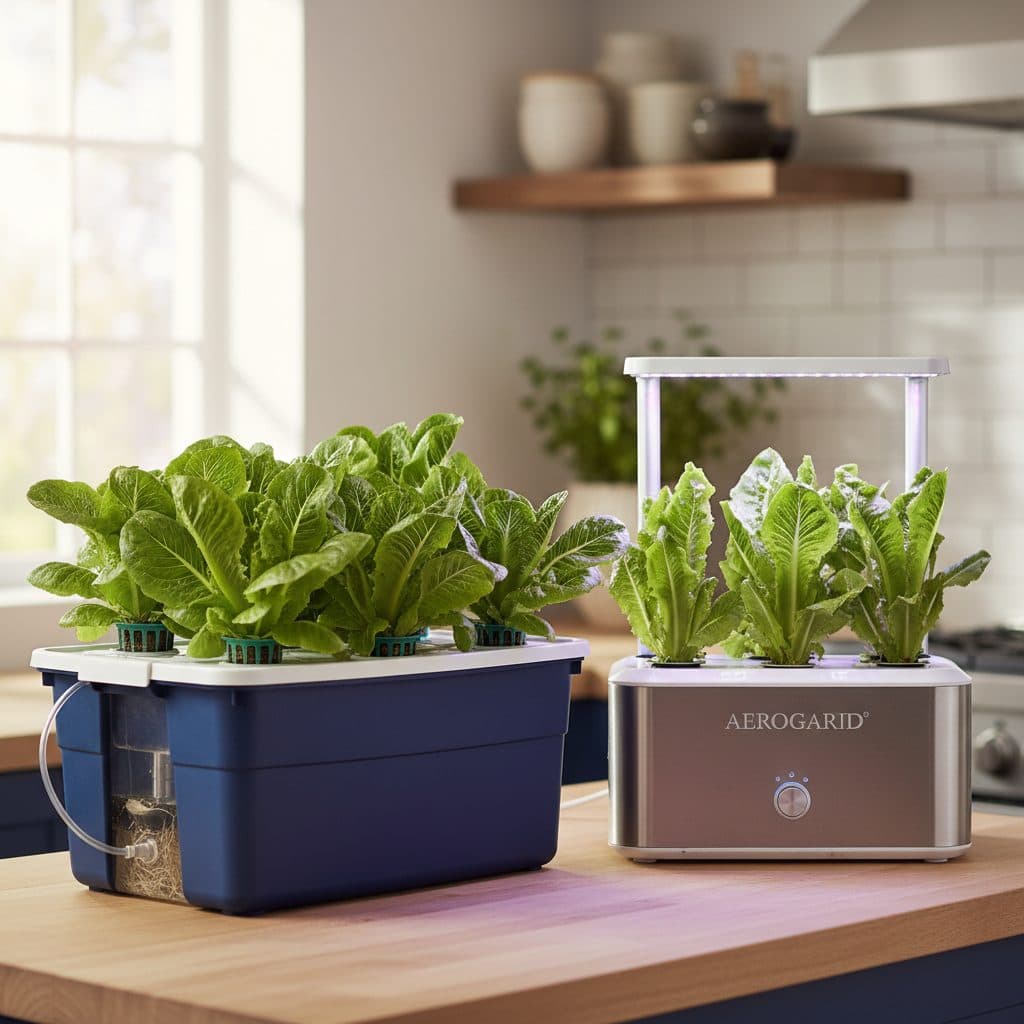
Key takeaways
- Kratky systems offer a low entry cost, often under $20 for a single plant setup, making them accessible.
- AeroGarden and similar countertop units provide automation and convenience but typically cost $100 to $400 or more.
- Yields for common leafy greens like lettuce are comparable per plant in both systems under optimal conditions.
- The Kratky method requires more manual attention to nutrient and water levels compared to automated units.
- Both systems are best suited for leafy greens, herbs, and small fruiting plants, not large, heavy feeders.
- Choosing between them depends on your budget, desired level of automation, and time commitment to plant care.
Quick answer: Kratky systems offer a low-cost, passive hydroponic option under $20, while automated AeroGarden units provide convenience at $100-$400+. Both are suitable for leafy greens and herbs, with choice depending on budget and desired automation.
In many homes across the United States, from a small apartment kitchen in Seattle, Washington, to a spacious sunroom in rural Georgia, folks are looking to grow their own food. Countertop hydroponics offers a way to do this without soil, bringing fresh herbs and greens closer to the dinner table. Two popular approaches for indoor growers are the passive Kratky method and the more automated countertop units, like those from AeroGarden.
A basic Kratky setup for one plant can be assembled for less than $20, whereas an entry-level AeroGarden unit typically starts around $100. This means an AeroGarden unit can be 400% or more expensive than a single-plant Kratky setup, though per-plant costs can vary with multi-plant units.
The Kratky method explained: simple, passive, and effective
Dr. Bernard Kratky developed and published this passive, non-circulating hydroponic method in the 1990s.
Setting up a Kratky system is straightforward and inexpensive, often costing less than $20 for materials for a single plant. You might use a clean 1-gallon pickle jar or a 2-liter soda bottle as a reservoir, a 3-inch net pot, and some inert growing medium like rockwool or coco coir. The simplicity means fewer points of failure and minimal ongoing costs beyond nutrients and seeds. However, it’s best suited for plants with a relatively short growth cycle, such as lettuce, which can mature in 30 to 45 days, or herbs like basil and mint, which thrive in this consistent environment.
components for a basic kratky setup
- A light-proof reservoir, often a painted jar or plastic container, typically 1 to 2 gallons in volume.
- A net pot, usually 2 to 3 inches in diameter, to hold the plant.
- An inert growing medium, such as rockwool cubes or coco coir, to support the seedling.
- Hydroponic nutrient solution, mixed according to manufacturer instructions, for example, 5 milliliters per gallon of water.
- Seeds or small plant starts, like a head of romaine lettuce.
AeroGarden and other countertop units: automated convenience
Countertop hydroponic units, exemplified by brands like AeroGarden, offer a more automated and often aesthetically pleasing approach to indoor growing. These systems typically integrate a water reservoir, a submersible pump for water circulation, and built-in LED grow lights with automatic timers. The AeroGarden Harvest, for example, is a six-pod countertop unit; reservoir volume varies considerably across the range, so check the spec sheet for the model you are considering. This automation means less daily intervention from the grower, making them popular for busy individuals or those new to hydroponics.
The initial investment for these units is considerably higher than a Kratky setup, ranging from $100 for smaller models to over $400 for larger, more advanced units. They often use proprietary seed pods and nutrient formulations, which can add to ongoing costs. However, the convenience of automated lighting cycles, nutrient reminders, and consistent water circulation can lead to reliable yields of herbs, leafy greens, and even small fruiting plants like cherry tomatoes or peppers. These systems are designed to fit neatly on a kitchen counter, often measuring less than 15 inches wide and 10 inches deep, providing fresh produce within arm’s reach.
common features of countertop hydroponic units
- Integrated LED grow lights, typically consuming 20 to 50 watts, with automatic timers.
- A water reservoir, often between 0.5 and 1.5 gallons in capacity, with a clear fill line.
- A submersible pump for circulating nutrient solution to the plant roots.
- A control panel or digital display for managing light cycles and nutrient reminders.
- Proprietary seed pods and liquid nutrient formulations, designed for specific plant types.
Cost comparison: initial investment and ongoing expenses
When considering the financial aspect, the Kratky method stands out for its minimal initial investment. For a single plant, you might spend $5 on a plastic container, $2 on a net pot, $10 on a bag of rockwool, and $15 for a 1-liter bottle of concentrated hydroponic nutrients, which will last for many growing cycles. This totals around $32 for a setup that can grow multiple plants over time, and because the rockwool and the bottle of nutrients carry over, later plantings cost only a few dollars each. This makes it an excellent choice for budget-conscious growers or those just starting out.
Conversely, an AeroGarden Harvest model, designed for 6 plants, typically costs between $100 and $180 upfront. Larger models can easily exceed $300. Beyond the initial purchase, ongoing costs include replacement seed pods, which can be $15 to $25 for a 6-pack, and electricity for the integrated lights and pump. A 30-watt LED light running 16 hours a day would consume about 14.4 kWh per month, adding $1.50 to $3.00 to your electricity bill, depending on local rates in a state like Texas. While the convenience is high, the financial outlay is significantly greater, often 5 to 10 times more than a comparable Kratky setup for the same number of plants.
ongoing costs for hydroponic growing
- Nutrient solution, purchased as a concentrate, costing $15 to $30 for a 1-liter bottle.
- Seeds or seed pods, with seed packets often under $5 and proprietary pods ranging from $15 to $25 for a 6-pack.
- Electricity for pumps and lights, typically adding $1.50 to $5.00 per month for automated units.
- Replacement parts, such as air stones or pumps, which might be needed every 2 to 3 years for active systems.
- Growing media, like rockwool cubes or coco coir, costing $10 to $20 for a bulk pack.
Yield and plant suitability: what grows best where?
Both Kratky and automated countertop units excel at growing leafy greens and herbs. For instance, a single Kratky container can produce a full head of lettuce, weighing 150 to 200 grams, in about 30 to 45 days. The yield per plant is quite comparable to what you’d get from an AeroGarden, assuming optimal conditions in both systems. However, the Kratky method’s passive nature means it’s less forgiving for plants with very long growth cycles or high nutrient demands, as the single nutrient fill needs to last the entire plant’s life.
AeroGarden and similar units, with their consistent water circulation and optimized lighting, can sometimes push yields slightly higher for certain crops or support a wider variety of plants, including small fruiting varieties like mini bell peppers or cherry tomatoes. A 6-pod AeroGarden can produce a continuous harvest of herbs or several heads of lettuce over a 2 to 3 month period. For example, a basil plant in an AeroGarden can grow to 12-18 inches tall and provide continuous clippings for many weeks. When considering how to grow okra, for instance, neither system is ideal due to the plant’s size and nutrient needs, but for smaller produce, they are quite effective.
best plants for countertop hydroponics
- Leafy greens: Varieties like romaine lettuce, butterhead lettuce, and spinach thrive in both systems, maturing in 30 to 45 days.
- Herbs: Basil, mint, cilantro, and parsley grow vigorously and provide continuous harvests.
- Small fruiting plants: Cherry tomatoes and mini bell peppers can be grown in larger, more powerful countertop units, though yields may be modest.
- Strawberries: Some varieties can be grown, particularly in systems with good light and nutrient control.
- Microgreens: While not typically grown in these systems, microgreens offer a high-yield, fast-turnaround alternative for small spaces.
Maintenance and user experience: hands-on vs. hands-off
The maintenance demands of Kratky versus automated countertop units present a clear distinction in user experience. With a Kratky system, the primary maintenance is observation: you fill the reservoir once at planting and let the level fall on its own. The widening air gap is what keeps the upper roots oxygenated, so topping the jar back up mid-cycle re-submerges those air roots and invites the brown, slimy root rot the method otherwise avoids. You’ll also need to clean the reservoir thoroughly between grow cycles, which might take 10 to 15 minutes. This hands-on approach requires a bit more attention and understanding of plant needs, but it offers a direct connection to the growing process.
Automated units like AeroGarden simplify many tasks. They often include indicators for when to add water or nutrients, and their pumps and lights run on timers. However, they are not entirely maintenance-free. You’ll still need to refill the water reservoir every 1 to 2 weeks, add nutrients every 14 days, and replace seed pods periodically. Cleaning is also necessary between crops, often involving disassembling parts and scrubbing, which can take 20 to 30 minutes. While more convenient, these systems introduce more components that can potentially fail, such as pumps or lights, which might need replacement after 2 to 3 years of continuous use. For those interested in larger scale operations, considering a reflective indoor grow tent might be a next step, but it’s a different league of commitment.
factors influencing user experience
- Time commitment: Kratky systems require 5-10 minutes of attention weekly, while automated units might need 10-20 minutes every 1-2 weeks.
- Learning curve: Kratky is simple in principle but requires understanding nutrient ratios; automated units are more plug-and-play.
- Noise level: Kratky systems are silent; automated units have a slight hum from the pump, typically under 40 decibels.
- Aesthetics: Countertop units are often designed to be attractive kitchen appliances, whereas Kratky setups can be more utilitarian.
- Troubleshooting: Fewer components in Kratky mean easier diagnosis of problems; automated units can have electrical or pump issues.
Kratky vs. AeroGarden: A Side-by-Side Comparison
Feature | Kratky Method | AeroGarden/Countertop Units |
|---|---|---|
Initial Cost (1-6 plants) | $10 – $50 | $100 – $400+ |
Automation Level | None (passive) | High (lights, pump, timers) |
Electricity Use | Zero | 20-50 watts (lights, pump) |
Maintenance | One nutrient fill per cycle, no top-offs; reservoir cleaned between crops | Automated reminders, water/nutrient top-offs every 1-2 weeks, system cleaning every 2-3 months |
Best For | Leafy greens, herbs, budget-conscious growers | Leafy greens, herbs, small fruiting plants, convenience-focused growers |
Yield Per Plant (Lettuce) | 150-200 grams | 170-220 grams |
Learning Curve | Moderate (understanding nutrient ratios) | Low (follow prompts) |
Kratky Savings: A basic one-plant Kratky setup costs under $20 to assemble; an entry-level AeroGarden starts around $100.
AeroGarden Capacity: The popular Harvest model grows six plants at a time; reservoir volume varies by model, so check the spec before buying.
Frequently asked questions
What is the main difference between Kratky and AeroGarden systems?
The main difference lies in automation and cost. Kratky is a passive, non-circulating system with a very low initial cost, often under $20 for a single plant. AeroGarden units are active, automated systems with pumps and lights, costing $100 to $400 or more, offering greater convenience for a higher price.
Which system is better for beginners in hydroponics?
Both systems have merits for beginners. The Kratky method is excellent for learning basic hydroponic principles due to its simplicity and low cost. AeroGarden units are often considered more user-friendly due to their automation and guided prompts, though they come with a higher financial commitment of at least $100.
Can I grow fruiting plants like tomatoes in these systems?
Small fruiting plants like cherry tomatoes or mini bell peppers can be grown, especially in larger AeroGarden models with sufficient light. However, neither system is ideal for large, heavy-feeding fruiting plants due to space and nutrient limitations, with yields often being modest, perhaps 10-15 small fruits per plant.
How often do I need to add nutrients to each system?
For a Kratky system, you typically add a single batch of nutrient solution at the beginning of a growth cycle, which lasts 2 to 4 weeks for leafy greens. AeroGarden units usually prompt you to add liquid nutrients every 14 days, alongside regular water top-offs.
What are the typical ongoing costs for each system?
Ongoing costs for Kratky are minimal, mainly for seeds and bulk nutrients, potentially less than $2 per month per plant. AeroGarden ongoing costs include proprietary seed pods ($15-$25 for a 6-pack) and electricity for lights and pumps, which typically adds $1.50 to $3.00 a month.
Do I need special grow lights for a Kratky system?
Yes, if you’re growing indoors without significant natural light, you will need a separate grow light for a Kratky system. A basic LED grow light can cost $20 to $50 and typically consumes 10-30 watts, providing the necessary light spectrum for plant growth.