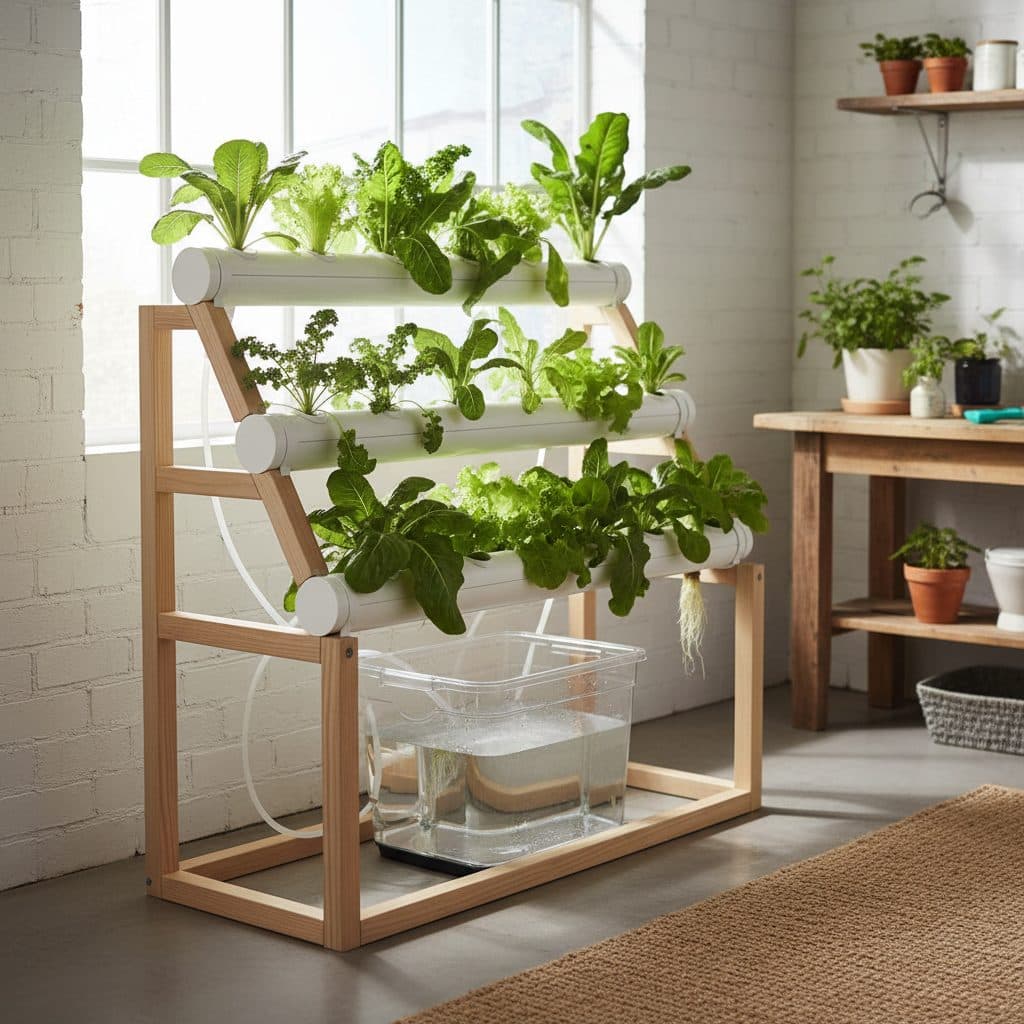
Key takeaways
- NFT systems use a shallow film of nutrient solution, typically 0.04 to 0.12 inches deep, flowing continuously over plant roots.
- Building a home NFT setup requires food-grade PVC channels, a reservoir, a submersible pump, and a basic plumbing network.
- Optimal nutrient solution management, including pH between 5.5 and 6.5 and EC levels from 1.2 to 2.0 mS/cm, is crucial for plant health.
- Leafy greens like lettuce, spinach, and herbs thrive in NFT systems.
- Proper channel slope, typically 1:30 to 1:100, ensures adequate drainage and oxygenation for root zones.
- Regular maintenance, including reservoir cleaning every two to three weeks, prevents algae growth and nutrient imbalances.
Quick answer: The Nutrient Film Technique (NFT) is a hydroponic method where a shallow film of nutrient solution flows continuously over plant roots. Building a home NFT system involves food-grade channels, a reservoir, a pump, and managing pH and EC for optimal plant growth.
In the arid landscapes of the American Southwest, where water conservation is paramount, hydroponic methods like the Nutrient Film Technique (NFT) offer a compelling alternative to traditional gardening. Because the solution recirculates rather than draining away into the soil, a small NFT system uses far less water than a conventional garden bed of the same size. This efficiency makes NFT an attractive option for home growers looking to maximize yield with minimal resource input.
The Nutrient Film Technique, developed by Dr. Allen Cooper in the United Kingdom during the 1960s and 1970s, has become a method for soilless cultivation [1, 4]. It involves a continuous, shallow stream of nutrient-rich water flowing over the bare roots of plants, providing them with essential elements and oxygen. With careful planning and a few common materials, you can construct a productive, recirculating NFT channel system right in your own home.
Understanding the nutrient film technique
The core principle of NFT is elegantly simple: plants sit in channels, and a very thin film of nutrient solution flows continuously over their roots. This film is typically between 0.04 and 0.12 inches (one to three millimeters) deep, ensuring that the upper surface of the root mass remains exposed to air, which is vital for oxygen uptake [3]. The constant flow, often maintained at about one liter per minute per channel, delivers a steady supply of water, nutrients, and oxygen, preventing the root zone from becoming waterlogged or depleted.
Unlike deep water culture (DWC) systems where roots are submerged, NFT allows for better oxygenation, reducing the risk of root diseases. The system is recirculating, meaning the nutrient solution drains back into a reservoir, gets re-oxygenated, and is pumped back through the channels. This closed-loop design minimizes water and nutrient waste. For example, a well-maintained NFT system can operate with a nutrient solution turnover rate of once every 15 to 30 minutes, ensuring consistent delivery to all plants.
key components of an nft system
A functional NFT setup relies on several interconnected parts to deliver nutrients effectively to plants. The channels themselves, often made from food-grade PVC or ABS, are sloped to allow gravity to return the solution to the reservoir. A small submersible pump, typically rated for 100 to 300 gallons per hour for a home system, drives the solution from the reservoir to the highest point of the channels. The nutrient solution, a carefully balanced mix of minerals, is the lifeblood of the system, tailored to the specific needs of the plants being grown.
- Channels: Sloped troughs, 4 to 6 inches wide, often made of PVC, where plants reside.
- Reservoir: A container, usually 10 to 20 gallons for a small home system, holding the nutrient solution.
- Submersible Pump: Moves the nutrient solution from the reservoir to the channels.
- Delivery and Return Lines: Tubing and piping to transport the solution, often 0.5 to 1.5 inches in diameter.
- Net Pots or Rockwool Cubes: Support for seedlings, typically 2 to 3 inches in diameter.
Designing your home nft system
Careful design is the foundation of a successful home NFT system, which supports efficient nutrient delivery and optimal plant growth. Begin by determining the available space; a typical six-channel system for leafy greens might occupy an area of 4 feet by 3 feet, producing 18-24 plants at once. The channels themselves should be a plastic rated for food contact or potable water, with a recommended width of 4 to 6 inches for most leafy greens. Vinyl fence post is the common budget substitute, but it is extruded for weathering and is not sold with a food-contact rating — check the manufacturer’s specification before you circulate nutrient solution through it and eat what grows in it. The length of each channel can vary, but 4 to 6 feet is manageable for indoor setups.
The slope of your channels is critical for proper drainage and oxygenation. A gentle slope of 1:30 to 1:100 (meaning a one-inch drop for every 30 to 100 inches of length) is generally advised [3]. Too steep, and the film becomes too thin; too shallow, and water can pool, leading to root rot. Your reservoir size should be adequate for the number of plants; a 10-gallon reservoir can support 12-18 small plants for a few days before needing a top-up, while a 20-gallon tank offers more stability. Consider using a reflective indoor grow tent if you’re growing indoors to optimize light distribution and temperature control.
calculating pump and flow rates
Selecting the right pump is essential. It needs enough head pressure to lift the water to the highest channel and sufficient flow rate to maintain the thin film. For a small home system with channels 4 to 6 feet long, a submersible pump with a flow rate of 150 to 300 gallons per hour (GPH) is usually sufficient. You’ll want to ensure the pump can deliver approximately 0.25 to 0.5 gallons per minute (GPM) per channel, depending on channel width and plant density. For example, a system with four 4-foot channels might require a pump capable of delivering at least 1 GPM total flow at its operating height.
- Determine Channel Length: Typically 4 to 6 feet for home systems.
- Calculate Channel Slope: Aim for a 1:30 to 1:100 ratio for optimal flow [3].
- Size the Reservoir: A 10-gallon reservoir for 12 plants, or 20 gallons for 24 plants.
- Select Pump GPH: 150-300 GPH for most home setups to achieve 0.25-0.5 GPM per channel.
- Plan Plant Spacing: 6 to 12 inches between plant sites for leafy greens.
Building the nft channels and plumbing
Once your design is finalized, the construction phase begins, typically requiring a few hours of focused work. Start by cutting your chosen channel material, such as 4-inch square PVC fence posts, to the desired lengths, often 4 to 6 feet for a manageable home system. Next, use a hole saw, usually 2 to 3 inches in diameter, to drill holes for your net pots. These holes should be spaced 6 to 12 inches apart, depending on the mature size of your target plants like lettuce or basil. Ensure the holes are slightly smaller than the net pot rim to prevent them from falling through.
For the nutrient return, you’ll need to create end caps for each channel. One end cap will be sealed, while the other will have a hole drilled to accommodate a 1.5-inch or 2-inch PVC drain pipe. This drain pipe connects all channels and directs the used nutrient solution back to the reservoir. Use food-grade silicone sealant or PVC cement to ensure all connections are watertight, preventing leaks that could waste precious solution. A small home system might require 10 to 15 feet of 1.5-inch PVC pipe for the return manifold.
assembling the system components
With channels prepared, assemble the support structure. This can be a simple wooden frame or metal shelving that provides the necessary slope for each channel. Position your reservoir below the lowest point of the return manifold. Install the submersible pump in the reservoir and connect it to a smaller diameter (0.5 to 0.75-inch) flexible tubing that runs to the highest end of each channel. You might use small drip emitters or a manifold with holes to evenly distribute the nutrient solution into each channel. For more detailed instructions on various hydroponic setups, explore resources like DIY hydroponic systems: Kratky, DWC, and NFT you can build cheap.
- Cut Channels: Measure and cut PVC channels to lengths of 4 to 6 feet.
- Drill Plant Holes: Use a 2 to 3-inch hole saw, spacing holes 6 to 12 inches apart.
- Install End Caps: Seal one end, drill for drain pipe on the other.
- Assemble Return Manifold: Connect channels with 1.5 to 2-inch PVC pipe, directing flow to the reservoir.
- Connect Pump and Supply Lines: Install pump in reservoir, run 0.5 to 0.75-inch tubing to channels.
Nutrient management and plant care
Effective nutrient management is the cornerstone of a thriving NFT system. The nutrient solution must provide all essential macro and micronutrients in the correct proportions. For most leafy greens and herbs, a general-purpose hydroponic nutrient formula works well. The two most critical parameters to monitor are pH and Electrical Conductivity (EC). The ideal pH range for most hydroponic crops is between 5.5 and 6.5, which allows for optimal nutrient absorption [3]. You can measure this with a simple pH meter, and adjust it using pH Up or pH Down solutions, adding small amounts, often 5-10 milliliters at a time, until the desired level is reached.
EC measures the total dissolved solids (TDS) or the concentration of nutrients in the solution. For vegetative growth of plants like lettuce, an EC range of 1.2 to 2.0 mS/cm (or 600-1000 ppm) is generally appropriate [3]. Use a dedicated EC or TDS meter for this — a 3-in-1 soil probe cannot read EC at all, and its pH needle is built for contact with moist soil, not for standing in a nutrient solution. It’s important to refresh your nutrient solution every two to three weeks, as nutrient ratios can shift and salts can build up over time. A 10-gallon reservoir might need 15-20 milliliters of a two-part nutrient solution every few days to maintain proper EC.
choosing plants and providing light
NFT systems are particularly well-suited for fast-growing, shallow-rooted plants. Leafy greens such as lettuce (Romaine, butterhead, loose leaf), spinach, kale, and various herbs (basil, mint, cilantro) are excellent choices. Fruiting plants like tomatoes or cucumbers can be grown, but they require more robust support structures and higher nutrient concentrations, often reaching EC levels of 2.5 mS/cm or more [4]. For indoor growing, providing adequate light is paramount. Full-spectrum LED grow lights are efficient, offering a Daily Light Integral (DLI) of 12-17 mol/m²/day for lettuce, typically achieved with 14-16 hours of light per day.
- Monitor pH: Maintain solution pH between 5.5 and 6.5 for optimal nutrient uptake [3].
- Check EC/TDS: Keep EC between 1.2 and 2.0 mS/cm for most leafy greens [3].
- Refresh Solution: Change the entire nutrient solution every two to three weeks.
- Choose Suitable Plants: Focus on leafy greens, herbs, and small fruiting plants.
- Provide Adequate Light: Ensure 14-16 hours of full-spectrum light daily for indoor setups.
Troubleshooting common nft issues
Even well-designed NFT systems can encounter issues, but most are manageable with prompt attention. One common problem is algae growth, particularly if light penetrates the channels or reservoir. Algae compete with plants for nutrients and can clog pumps and lines. To prevent this, ensure all components are opaque and cover the reservoir. If algae appear, a thorough cleaning with a 3% hydrogen peroxide solution can help, followed by a complete nutrient change. Maintaining a solution temperature below 70°F also inhibits algae growth.
Root rot, characterized by brown, slimy roots and stunted growth, often results from insufficient oxygen or overly warm nutrient solution. Ensure your pump is running continuously and that the nutrient film is shallow enough to expose roots to air. Adding an air stone to the reservoir can boost oxygen levels, especially in warmer climates like those in USDA zone 9. Nutrient deficiencies or toxicities can manifest as discolored leaves or abnormal growth patterns. Regularly monitoring pH and EC with a reliable meter, and adjusting as needed, will prevent most nutrient-related problems. For example, yellowing lower leaves might indicate a nitrogen deficiency, requiring a slight increase in nutrient concentration.
addressing pump failures and blockages
Pump failures are a critical issue, as they can quickly lead to plant death without a constant nutrient supply. Always have a backup pump on hand, especially for larger systems or if you plan to be away for more than 24 hours. Regular cleaning of the pump impeller, every two to four weeks, prevents mineral buildup and extends its lifespan, which is typically two to five years for a quality submersible pump. Blockages in the supply or return lines can also halt nutrient flow. Inspect tubing and channels periodically for root intrusion, mineral deposits, or debris. A simple pipe cleaner or a flush with plain water can often clear minor blockages, while more severe cases may require disassembling sections of the system.
- Prevent Algae: Keep light out of channels and reservoir; maintain solution below 70°F.
- Combat Root Rot: Ensure continuous flow, proper film depth, and adequate oxygenation.
- Monitor Nutrient Levels: Regularly check pH (5.5-6.5) and EC (1.2-2.0 mS/cm) to prevent deficiencies.
- Prepare for Pump Failure: Have a backup pump and clean the primary pump every 2-4 weeks.
- Clear Blockages: Inspect lines for root intrusion or mineral buildup, flush with water or use a pipe cleaner.
Water Savings: Because the solution recirculates instead of draining away, NFT uses far less water than the same crop grown in the ground.
Frequently asked questions
What types of plants grow best in an NFT system?
NFT systems are ideal for fast-growing, shallow-rooted plants. Leafy greens such as various types of lettuce, spinach, kale, and herbs like basil, mint, and cilantro thrive in these setups. You can expect to harvest lettuce in as little as 30-45 days from transplanting.
How often do I need to change the nutrient solution?
For optimal plant health and to prevent nutrient imbalances, it is recommended to completely change the nutrient solution in your reservoir every two to three weeks. Between full changes, top up with plain water as the level drops and recheck EC after each top-up, since evaporation concentrates the salts that are left behind.
What is the ideal pH range for an NFT system?
The ideal pH range for most plants grown in an NFT system is between 5.5 and 6.5. Maintaining this range ensures that plants can efficiently absorb all necessary nutrients from the solution. A pH outside this range, for example, above 7.0, can lead to nutrient lockout.
Can I use tap water in my NFT system?
Yes, you can use tap water, but it’s crucial to understand its quality. Tap water often contains chlorine or chloramines, which should be allowed to off-gas for 24 hours, and may have varying levels of dissolved minerals. Test your tap water’s initial pH and EC; if the EC is above 0.5 mS/cm, you might need to adjust your nutrient formula accordingly.
How much light do plants need in an indoor NFT system?
Indoor NFT systems require sufficient artificial lighting. For leafy greens like lettuce, a Daily Light Integral (DLI) of 12-17 mol/m²/day is recommended, typically achieved with 14-16 hours of full-spectrum LED light per day. This supports steady photosynthesis.
References
- Analisis Penyerapan Larutan Hara Tanaman Pakchoy dan Selada Romaine pada Sistem Hidroponik Nutrient Film Technique (2026). Analisis Penyerapan Larutan Hara Tanaman Pakchoy dan Selada Romaine pada Sistem Hidroponik Nutrient Film Technique.
- Nutrient Film Technique and Substrates, XXI IHC (1983). Nutrient Film Technique and Substrates, XXI IHC.
- Nutrient Film Technique (NFT) (2006). Nutrient Film Technique (NFT).
- NUTRIENT UPTAKE BY TOMATOES IN NUTRIENT FILM TECHNIQUE HYDROPONICS (1984). NUTRIENT UPTAKE BY TOMATOES IN NUTRIENT FILM TECHNIQUE HYDROPONICS.
- Nutrient film technique (1980). Nutrient film technique.
- USDA Natural Resources Conservation Service (2024). USDA Natural Resources Conservation Service.