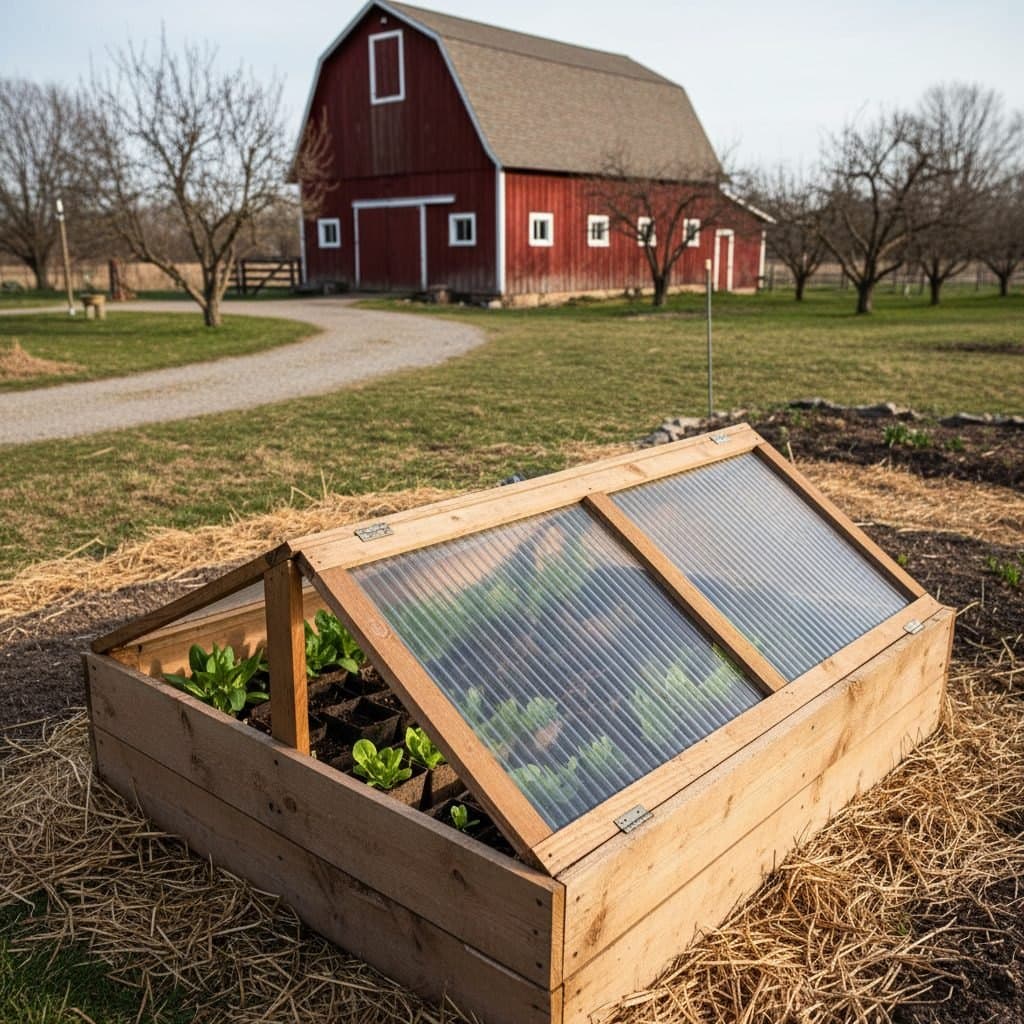
Key takeaways
- Site cold frames facing true south, ideally with a windbreak, to maximize winter solar gain and minimize heat loss.
- Orient glazing at an angle between 30 and 45 degrees relative to horizontal for effective winter sun capture in most US latitudes.
- Implement automatic venting systems that open at 70 degrees F to prevent rapid temperature spikes, which protects plant health.
- Utilize thermal mass, such as 5-gallon water jugs, inside the cold frame to absorb excess heat during the day and release it at night.
- Choose glazing materials like twin-wall polycarbonate for good light transmission and insulation, offering an R-value of 1.5 to 2.0.
- Monitor internal temperatures diligently, especially in regions like USDA zone 6, where spring days can fluctuate from 30 to 80 degrees F.
Quick answer: Prevent cold frame overheating by strategic siting, orienting it true south with windbreaks, and using a 30-45 degree glazing angle. Implement automatic venting at 70°F and utilize thermal mass to regulate internal temperatures.
In USDA zone 6, a spring day can transition from a frosty 30 degrees F morning to a sunny 75 degrees F afternoon. For a cold frame, these temperature swings present a significant challenge: how to capture enough solar energy to keep plants warm at night without cooking them during the day. Overheating is a common problem for homestead growers, often leading to plant stress, bolting, or outright death if internal temperatures climb past 90 degrees F.
Successful cold frame operation hinges on three primary considerations: strategic siting, an appropriate glazing angle, and reliable ventilation. Ignoring any of these factors can turn a useful season extender into a plant oven. Understanding these principles allows a grower in, say, central Kansas, to consistently harvest cool-season crops weeks earlier and later than open-field planting permits.
Strategic siting for maximum solar gain and wind protection
The location of your cold frame affects its effectiveness, influencing both solar gain and protection from harsh weather. For optimal winter performance across the US, a cold frame should ideally face true south, allowing it to capture the maximum amount of low-angle winter sunlight. In regions like northern Montana, where winter sun angles are particularly low, this orientation helps maintain internal temperatures above 40 degrees F. A slight deviation from true south is generally acceptable, but greater angles will reduce solar exposure.
Considering windbreaks and proximity to structures
Wind protection is another main factor. Cold frames lose considerable heat through convection when exposed to strong winds. Siting your cold frame on the lee side of a building, a dense hedge, or a sturdy fence can significantly reduce wind chill. For example, placing a 4 ft x 8 ft cold frame within 10 feet of a south-facing barn wall in a windy area like the Oklahoma panhandle can drastically improve its thermal performance. However, ensure that nearby structures do not cast excessive shade on the cold frame during critical sun hours, especially between 10 AM and 3 PM. For larger homestead operations, similar principles apply to solar farm design, where row spacing and orientation are calculated for maximum efficiency.
- True south orientation: Maximizes winter solar gain.
- Windbreak integration: Reduces convective heat loss by up to 50%.
- Avoidance of shade: Ensures full sun exposure during peak hours.
- Proximity to buildings: Can offer passive heat retention or wind protection.
- Drainage: Site on well-drained ground to prevent waterlogging.
Optimizing glazing angle for seasonal sun capture
The angle of your cold frame’s glazing matters for capturing solar energy efficiently throughout the seasons. For most US latitudes, an angle between 30 and 45 degrees from horizontal is effective for maximizing winter sun exposure. In southern states like Florida (around 25-30 degrees N latitude), a flatter angle of 30 degrees might be sufficient, while in northern states like Minnesota (around 45-50 degrees N latitude), an angle closer to 45 degrees will better capture the lower winter sun. This angle allows sunlight to strike the surface more perpendicularly, reducing reflection and increasing heat absorption. Research on double glazing units shows they can withstand various bending forces, suggesting flexibility in design [1].
Adjusting for latitude and season
A fixed angle works well for season extension, but an adjustable lid can offer even greater control, allowing you to fine-tune the angle for specific times of the year. For instance, a cold frame in central Oregon might benefit from a 40-degree angle in winter, but a flatter angle of 20 degrees in early spring to prevent overheating as the sun climbs higher. A common rule of thumb for solar gain is to angle a surface based on latitude. For a homestead in USDA zone 5, with a latitude of approximately 40 degrees N, a winter angle of 55 degrees would be ideal, but 45 degrees is a practical compromise for cold frames. This principle is also fundamental in sizing solar panel arrays for off-grid living, where tilt angles are chosen for year-round or seasonal peak performance.
- Winter optimal: Latitude plus 15 degrees for maximum solar gain.
- Spring/Fall compromise: 30 to 45 degrees from horizontal for general use.
- Adjustable lids: Offer flexibility for varying sun angles and ventilation.
- Reduced reflection: Steeper angles minimize reflection of low winter sun.
- Glazing material considerations: Angle can affect structural integrity and snow shedding.
The role of venting in preventing overheating
Overheating is the most common cause of plant failure in cold frames, especially on sunny days when outside temperatures are still cool. Even when the ambient air is 40 degrees F, direct sunlight can quickly raise the internal temperature of a closed cold frame to over 100 degrees F in less than an hour. This rapid temperature increase can cause delicate seedlings to wilt, scorch, or bolt prematurely. Effective ventilation is necessary for healthy plant growth. Manual venting requires constant vigilance, opening the lid when temperatures rise above 70 degrees F and closing it as they drop below 50 degrees F.
Automatic venting systems and thermal mass
For homesteaders, an automatic vent opener is a worthwhile investment, providing peace of mind and consistent temperature regulation. These devices use a wax-filled cylinder that expands and contracts with temperature changes, mechanically lifting the cold frame lid. A typical unit begins to open around 68-70 degrees F and fully opens by 80 degrees F, preventing internal temperatures from soaring. This passive system requires no electricity, making it ideal for off-grid homesteads. To further stabilize internal temperatures, incorporate thermal mass inside the cold frame. Black-painted 5-gallon water jugs or dark-colored rocks can absorb heat during the day, slowly releasing it at night to help keep plants warmer. This strategy is also employed in solar livestock water heaters to maintain consistent temperatures without active heating.
- Rapid temperature spikes: Can exceed 100 degrees F in minutes on sunny days.
- Automatic vent openers: Open around 70 degrees F, fully by 80 degrees F.
- Thermal mass: Water jugs or rocks absorb heat, raising night temperatures by 5-10 degrees F.
- Manual venting vigilance: Requires frequent monitoring and adjustment.
- Air circulation: Prevents fungal diseases by reducing humidity.
Choosing glazing materials and monitoring internal conditions
The material you choose for your cold frame’s glazing significantly impacts its performance, affecting both light transmission and insulation. Twin-wall polycarbonate is a popular choice, offering good light diffusion (around 80-85% transmission) and an R-value of 1.5 to 2.0, providing better insulation than single-pane glass. This helps maintain warmer nighttime temperatures, which can extend the growing season in USDA zone 4. Single-pane glass, while offering excellent light transmission (90%+) and clarity, has a low R-value (around 0.9) and can lead to greater heat loss, making it less suitable for extreme cold without additional insulation. For full-height glazing in other structures, GRP-clad frames are used, demonstrating material strength [2, 3].
Monitoring and maintenance
Regardless of your chosen material, consistent monitoring of internal conditions is essential. A simple maximum/minimum thermometer placed inside the cold frame will track temperature fluctuations over a 24-hour period, providing data for adjusting your venting strategy. Aim to keep daytime temperatures below 80 degrees F and nighttime temperatures above 35 degrees F for most cool-season crops. In regions like the Pacific Northwest, where spring can be consistently overcast, light transmission becomes a primary concern, favoring clearer materials. Regular cleaning of the glazing material, perhaps once a month during peak use, ensures maximum light penetration and can increase solar gain. This attention to detail is similar to the careful planning required for solar power for a shed, where every component choice impacts overall efficiency.
- Twin-wall polycarbonate: R-value 1.5-2.0, 80-85% light transmission.
- Single-pane glass: R-value ~0.9, 90%+ light transmission.
- Max/min thermometer: Essential for tracking daily temperature swings.
- Target temperatures: Below 80 degrees F daytime, above 35 degrees F nighttime.
- Regular cleaning: Improves light transmission by 10-15%.
Cold Frame Glazing Material Comparison
Material | Light Transmission | R-Value (Insulation) | Durability |
|---|---|---|---|
Twin-wall Polycarbonate | 80-85% | 1.5 – 2.0 | Good, impact resistant |
Single-pane Glass | 90%+ | ~0.9 | Good, but brittle |
Fiberglass (FRP) | 70-80% | ~1.0 | Fair, yellows over time |
Acrylic | 85-90% | ~1.0 | Good, less impact resistant than poly |
Ideal Venting Temp: Automatic cold frame vents typically begin opening when internal temperatures reach 68-70 degrees F.
Thermal Mass Benefit: Adding 5-gallon water jugs as thermal mass can help raise nighttime cold frame temperatures.
Polycarbonate R-Value: Twin-wall polycarbonate glazing gives an R-value of 1.5 to 2.0, providing better insulation than single-pane glass.
Explore Off-Grid Living Guides
References
- Investigations on the Cold Bending Behaviour of a Double Glazing Unit with a Rigid Edge-Spacer Frame (2022).
- 15 Full-height glazing with GRP-clad structural frame (2016).
- 15 Full-height glazing with GRP-clad structural frame (2013).
- 15. Full-height glazing with GRP-clad structural frame (2018).
- GZ BEARING ANGLE ERROR RESULTING FROM SENSOR SITING ERROR (1963).
- USDA Natural Resources Conservation Service (2024).