Key takeaways
- Perennial vegetables live and produce for three to twenty years, eliminating annual seed sowing, soil tilling, and repetitive nursery bed preparation.
- Temperate and cool Australian regions excel with classic cool-climate perennials such as asparagus, globe artichoke, rhubarb, and horseradish.
- Subtropical and tropical zones support vigorous, heat-hardy perennials including native warrigal greens, choko, Queensland arrowroot, and perennial leafy greens.
- Integrating perennial crops builds resilient food forest understories that anchor topsoil, conserve moisture, and cycle deep soil minerals.
- Establishing perennial beds requires generous upfront compost and deep mulching, as root systems remain undisturbed for years once planted.
Quick answer: The best perennial vegetables for Australian gardens include asparagus, globe artichoke, and rhubarb for temperate and cool zones, alongside native warrigal greens, choko, and Queensland arrowroot for warm and subtropical regions. Planted once into fertile, deeply mulched soil, these species yield continuous harvests for years with minimal maintenance.
Standard Australian vegetable patches require continuous seasonal labour: tilling, raising seedlings in punnets, transplanting, and clearing spent annual crops every few months. Incorporating perennial vegetables into your garden establishes plantings that produce nutritious harvests year after year.
Unlike annual crops that invest their short lives into rapid seed production, perennial vegetables develop extensive root systems. These deep roots reach subterranean moisture and minerals that annuals cannot access, making perennial edibles resilient against Australian summer heatwaves, dry spells, and seasonal windstorms.
From cool-climate Victorian asparagus beds to subtropical Queensland choko arbours and arid-zone native greens, perennial crops provide dependable kitchen harvests while enriching garden ecology.
+-----------------------------------------------------------------+
|              AUSTRALIAN PERENNIAL EDIBLES MATRIX                |
|                                                                 |
|   SPECIES         CLIMATE SUITABILITY     PRODUCTIVE LIFESPAN   |
|   -------         -------------------     -------------------   |
|   Asparagus       Temperate / Cool        15 to 20+ years       |
|   Globe Artichoke Temperate / Arid        5 to 7 years          |
|   Rhubarb         Temperate / Cool        8 to 10+ years        |
|   Warrigal Greens Coastal / frost-free    Perennial; self-seeds |
|   Choko           Warm / Subtropical      5 to 10+ years        |
|   Qld Arrowroot   Subtropical / Tropical  Permanent clump       |
+-----------------------------------------------------------------+
Which classic perennial vegetables thrive in cool and temperate Australia?
Southern Australia, including Victoria, Tasmania, southern South Australia, and upland New South Wales, provides the winter chilling hours necessary for temperate perennial classics.
1. Asparagus (Asparagus officinalis)
Asparagus is among the longest-lived cool-climate perennials. Plant one-year-old dormant crowns into deep trenches enriched with well-rotted manure in late winter. While you must resist harvesting spears during the first two seasons to let the root crowns strengthen, a mature bed will produce succulent spears daily for eight to ten weeks every spring for over two decades.
2. Globe artichoke (Cynara cardunculus var. scolymus)
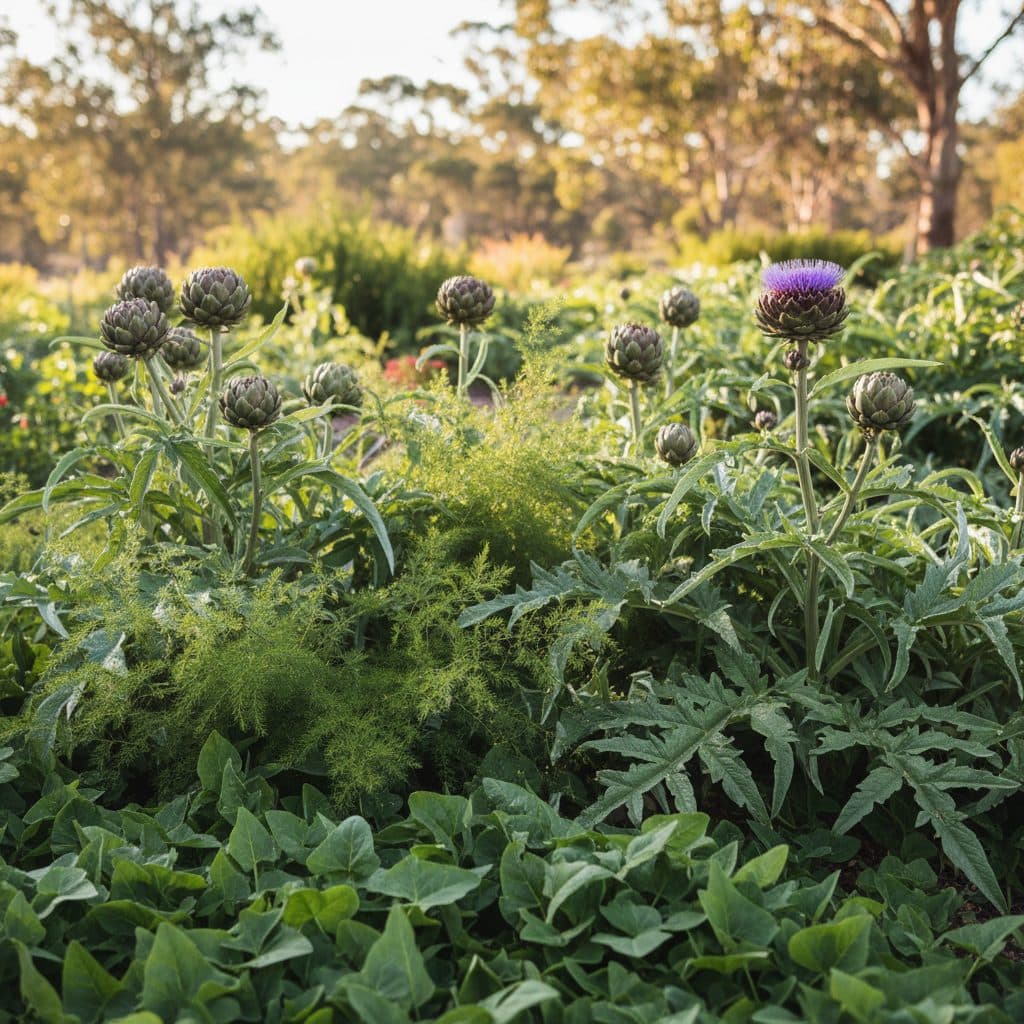
Globe artichokes produce silver-grey, deeply serrated foliage reaching up to 1.5 metres in height. They thrive in temperate and semi-arid conditions, producing edible flower buds in spring and early summer. Harvest the plump flower heads while scales remain tightly closed before the purple thistle flowers open.
3. Rhubarb (Rheum rhabarbarum)
Rhubarb produces thick, tart red and green stems from early spring through autumn. Plant crowns in a sunny position with rich, moist, well-draining soil and topdress annually with generous compost. Remember that only the leaf stems (petioles) are edible: the large leaf blades contain oxalic acid at toxic concentrations and must never be eaten; compost or bin them.
+-------------------------------------------------------------+
|              TEMPERATE PERENNIAL BED CALENDAR               |
|                                                             |
|   LATE WINTER: Plant dormant asparagus and rhubarb crowns   |
|   SPRING:      Harvest tender asparagus spears & artichokes |
|   SUMMER:      Allow asparagus ferns to mature; mulch crowns|
|   AUTUMN:      Feed beds and topdress with compost          |
+-------------------------------------------------------------+
To coordinate seasonal plantings across southern states, reference our Melbourne vegetable planting guide.
Which perennial vegetables suit subtropical, tropical, and arid zones?
In frost-free and warm climates across New South Wales, Queensland, Western Australia, and the Northern Territory, tropical and native perennial edibles produce vigorous growth and abundant biomass.
1. Native warrigal greens (Tetragonia tetragonioides)
Warrigal greens are native to the Australian coastline and are among the toughest, most versatile perennial leafy greens available.
- Growing habit: Sprawls as a dense, weed-smothering ground cover over sandy, clay, or rocky soils.
- Culinary preparation: The succulent diamond-shaped leaves substitute for English spinach or silverbeet. Because warrigal greens contain natural oxalates, always blanch leaves in boiling water for one to two minutes before using in quiches, stir-fries, and pasta dishes.
2. Choko / chayote (Sechium edule)
Choko is a common Australian backyard vine capable of covering fences, sheds, and pergolas. A single mature vine can produce dozens of crisp, pale green fruits from late summer into autumn. Beyond the fruit (which can be roasted, pickled, or added to curries), the young vine shoot tips make tender steamed greens, and mature vines develop edible, starchy root tubers. Both spread readily in warm, high-rainfall districts; keep choko vines and canna clumps away from bushland boundaries, pick up fallen choko fruit, and check your state or council weed list before planting.
3. Queensland arrowroot (Canna indica, often sold as C. edulis)
Queensland arrowroot produces dense clumps of broad purple-green leaves reaching two metres tall.
- Edible rhizomes: The thick, starchy rhizomes are harvested, peeled, and roasted like potatoes or grated to extract fine baking starch.
- Permaculture utility: The giant leaf stems provide chop-and-drop biomass, livestock fodder, and living windbreaks for food forest edges. Both spread readily in warm, high-rainfall districts; keep choko vines and canna clumps away from bushland boundaries, pick up fallen choko fruit, and check your state or council weed list before planting.
For further zone-by-zone breakdowns of long-lived greens, review our guide to perennial edible greens by zone.
+-----------------------------------------------------------------+
|              SUBTROPICAL PERENNIAL STRATIFICATION               |
|                                                                 |
|   VINE CANOPY:      Choko on timber trellises and boundary wire |
|   HERBACEOUS LAYER: Queensland arrowroot & sweet potato         |
|   GROUND COVER:     Warrigal greens smothering garden soil      |
+-----------------------------------------------------------------+
How do you prepare soil for long-term perennial beds?
Because perennial vegetables occupy the same ground for five to twenty years, you cannot rely on annual digging or rotational soil fixes. Thorough soil preparation before planting supports long-term productivity.
- Select a dedicated permanent position: Place perennial beds along garden edges, fence lines, or dedicated food forest guilds where they will not be disturbed by annual crop changes.
- Loosen deep subsoil: Aerate compacted soil with a broadfork to a depth of 30 to 40 cm without inverting the soil layers.
- Incorporate generous organic matter: Blend in 5 to 10 cm of well-rotted farmyard manure, aged compost, and worm castings to build moisture-holding humus.
- Correct drainage: On heavy clay, build raised mounds and work in plenty of organic matter. Gypsum helps only if a simple dispersion test shows the clay is sodic. Do not add sand to clay, which sets the two together instead of opening the soil.
- Apply a thick organic mulch: Cover the bed with 8 to 10 cm of sugar cane mulch or lucerne to suppress weeds and maintain cool soil temperatures.
+-------------------------------------------------------------+
|              PERENNIAL SOIL PREPARATION SEQUENCE            |
|                                                             |
|   1. Aerate subsoil 30-40 cm deep without turning layers    |
|   2. Work in 10 cm mature compost and well-rotted manure    |
|   3. Ensure free drainage for crown rot prevention          |
|   4. Topdress with 8-10 cm sugar cane or lucerne mulch      |
+-------------------------------------------------------------+
How do you maintain perennial vegetable patches year-round?
Perennial vegetable beds require minimal day-to-day intervention compared to annuals, but an orderly seasonal routine maintains vigor and heavy cropping.
- Annual autumn topdressing: After harvesting concludes in autumn, apply a 3 to 5 cm layer of fresh compost over the entire bed. Earthworms will work these nutrients down to the root zones over winter.
- Winter dormancy maintenance: In cool regions, cut dead asparagus ferns and dying rhubarb foliage down to ground level once they turn yellow in late autumn. Mulch the crowns deeply to protect them from severe frost.
- Clump division: Every four to six years, lift and divide crowded clumps of globe artichokes, rhubarb, and Queensland arrowroot in late winter. Replant vigorous outer suckers into newly prepared ground and share surplus divisions with neighbouring gardeners.
- Summer hydration and pest care: Provide deep weekly watering during hot spells. For managing extreme summer conditions, read our guide on summer vegetables in Australia, and explore coastal growing advice in our Sydney vegetable planting guide.