Key takeaways
- Australian summers (December to February) bring intense ultraviolet radiation and frequent 40°C heatwaves that stall traditional temperate crops.
- Heat-hardy staples like okra, sweet potato, snake beans, eggplants, capsicums, and native warrigal greens thrive in intense summer sunshine.
- Installing 30% to 50% white or green shade cloth over growing beds lowers leaf canopy temperatures and prevents blossom drop and sunscald.
- Apply a 7 to 10 cm layer of coarse organic mulch (such as sugar cane or lucerne) to insulate soil biology and reduce surface evaporation.
- Water deeply at ground level in the early morning so moisture reaches the root zone before intense midday heat causes thermal stress.
Quick answer: The best summer vegetables to grow in Australia are heat-tolerant varieties including okra, eggplants, snake beans, sweet potato, capsicums, amaranth, and warrigal greens. Success during peak summer (December to February) relies on protecting beds with 30% to 50% shade cloth, applying thick sugar cane mulch, and watering at soil level early in the morning.
Managing a summer veggie patch in Australia presents distinct climatic challenges. Between December and February, scorching northerly winds, prolonged dry spells, and ambient temperatures exceeding 35°C to 40°C can quickly wither tender garden beds.
Many beginner gardeners make the mistake of planting delicate cool-season leafy greens or unshaded tomatoes in midsummer, only to watch them bolt to seed, drop blossoms, or suffer severe fruit sunscald. Cultivating summer vegetables australia requires shifting your crop selection toward heat-loving perennials and tropical annuals adapted to thrive under total solar radiation and high ambient temperatures.
By pairing genuine heat-tolerant cultivars with practical microclimate interventions—such as shade covers, thick organic mulching, and deep root hydration—you can maintain continuous kitchen harvests through the hottest months of the year.
+-------------------------------------------------------------+
|              AUSTRALIAN SUMMER CROPPING MATRIX              |
|                                                             |
|   CROP             HEAT TOLERANCE      WATER DEMAND         |
|   ----             --------------      ------------         |
|   Okra             Exceptional (40°C+) Moderate             |
|   Snake Beans      High (35°C+)        Low - Moderate       |
|   Sweet Potato     High (35°C+)        Moderate             |
|   Eggplant         High (32°C - 38°C)  Moderate - High      |
|   Capsicum         Moderate - High     Moderate             |
|   Warrigal Greens  Exceptional         Low                  |
+-------------------------------------------------------------+
Which vegetables genuinely thrive in extreme Australian summer heat?
When summer heat peaks, standard European vegetables shut down metabolic activity. In contrast, tropical and subtropical edibles continue producing foliage and fruit under relentless sun.
1. Okra (Abelmoschus esculentus)
Okra loves intense heat and humidity. Once established, plants produce large, hibiscus-like yellow flowers followed by tender edible pods every two to three days. Harvest pods when 7 to 10 cm long to ensure continuous flowering.
2. Snake beans (Vigna unguiculata)
While traditional English climbing beans drop their flowers when temperatures exceed 30°C, yard-long snake beans thrive between 30°C and 40°C. Grown on a sturdy trellis, they produce crisp, slender pods up to 45 cm long that resist summer pests.
3. Sweet potato (Ipomoea batatas)
Sweet potato vines function as a dual-purpose crop. The vigorous foliage acts as a living ground cover that cools the soil surface, while the young leaves and shoot tips provide delicious, mild greens for stir-fries. Deep below, energy is stored in rich, nutritious storage roots harvested in late autumn.
4. Eggplant / Brinjal (Solanum melongena)
Eggplants tolerate high temperatures significantly better than tomatoes. Varieties such as 'Black Beauty' and slender Lebanese types continue setting fruit throughout January and February provided their roots receive consistent moisture.
5. Native warrigal greens (Tetragonia tetragonioides)
Also known as Botany Bay greens or New Zealand spinach, this native Australian ground cover is completely drought-hardy and impervious to searing summer heat. Blanch the thick, triangular leaves briefly in boiling water before eating to remove natural oxalates.
+-------------------------------------------------------------+
|              REGIONAL SUMMER TIMING ACROSS AUSTRALIA        |
|                                                             |
|   CLIMATE ZONE     SUMMER FOCUS (DEC - FEB)                 |
|   ------------     ------------------------                 |
|   Tropical         Monsoon season: Asian greens, sweet pot  |
|   Subtropical      Snake beans, okra, ginger, capsicums     |
|   Warm Temperate   Eggplants, capsicum, melons, basil       |
|   Cool Temperate   Tomatoes, zucchini, corn, bush beans     |
|   Arid / Inland    Shade-cloth cropping, wicking beds       |
+-------------------------------------------------------------+
For city-specific calendars and planting windows, check our detailed Melbourne vegetable planting guide and Sydney vegetable planting guide.
How do you protect summer crops from sunburn and heat stress?
Even heat-tolerant crops benefit from physical protection during extreme heatwaves when hot, drying winds strip moisture from plant tissues.
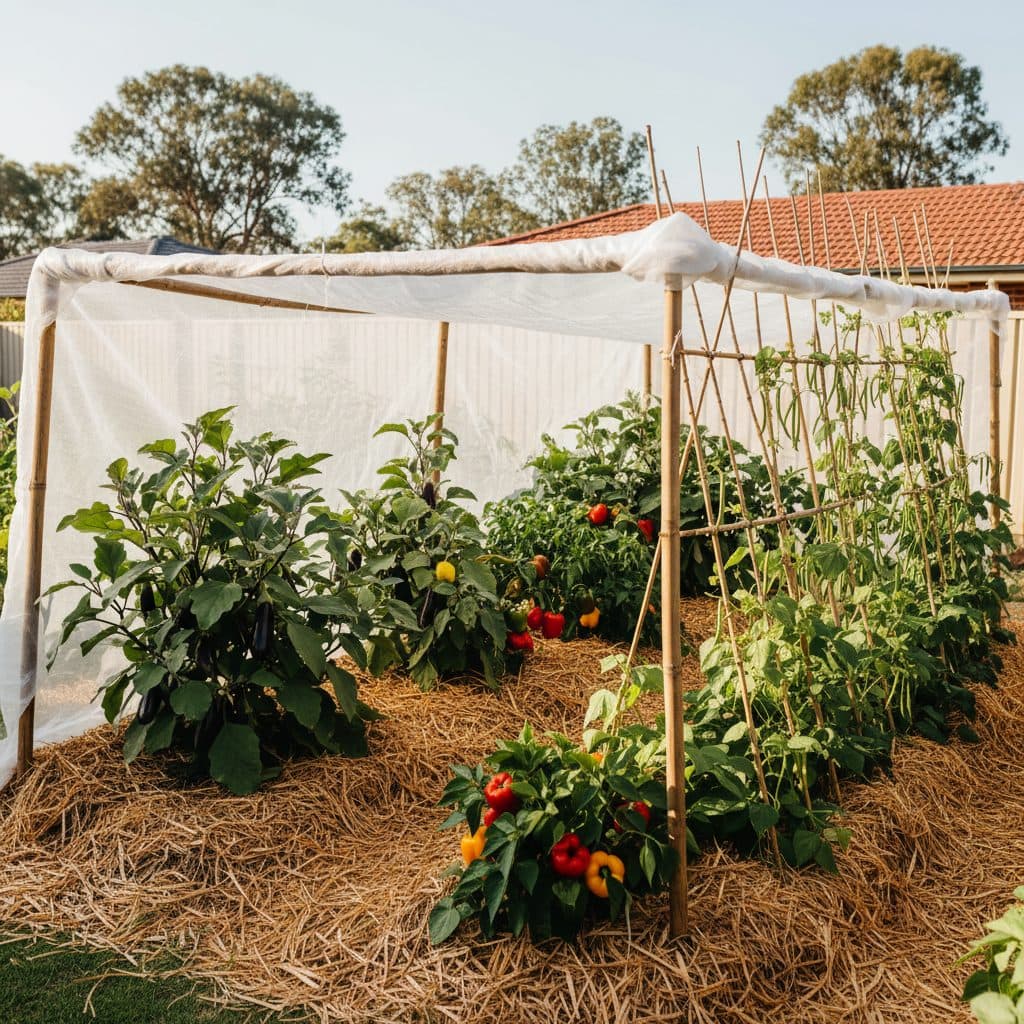
Deploying shade cloth
Erecting temporary shade structures reduces solar radiation and heat stress around your plants by 3°C to 6°C and prevents intense sunlight from scorching fruit skins.
- Use 30% to 50% knitted white or green shade cloth to reduce thermal stress and leaf-scorch. Avoid 70% or heavy architectural cloths, which block too much photosynthetically active radiation and cause plants to become leggy.
- Suspend the cloth 30 to 50 cm above the crop canopy to ensure hot air vents freely out the sides.
- Pull shade covers over beds before morning temperatures spike on forecast 35°C+ days. For broader summer bed protection, explore shade and hydration strategies for extreme heat in our Melbourne vegetable planting guide.
+-------------------------------------------------------------+
|              SUMMER SHADE CANOPY STRUCTURE                  |
|                                                             |
|   ====== 30-50% KNITTED SHADE CLOTH (SUSPENDED) =========== |
|         |                                           |       |
|         v (30-50 cm Airflow Gap)                    v       |
|   [ Eggplants / Capsicums / Summer Veggies ]                |
|   ========================================================= |
|   [ 7-10 cm Sugar Cane / Lucerne Mulch Layer ]              |
+-------------------------------------------------------------+
Mulching the root zone
Bare Australian soil can reach temperatures exceeding 50°C in direct sun, effectively boiling shallow root hairs and killing beneficial mycorrhizal fungi.
- Spread a 7 to 10 cm layer of organic sugar cane mulch, pea straw, or lucerne over all exposed soil.
- Keep mulch 3 to 5 cm away from direct contact with woody plant stems to prevent fungal collar rot during warm, humid nights.
What is the best watering routine for Australian summer heat?
How and when you apply water makes the difference between thriving plants and fungal disease outbreaks during hot weather.
- Water early in the morning: Irrigate between 5:00 AM and 8:00 AM. Morning watering allows moisture to soak deeply into the soil before the sun heats the ground, so plants stay hydrated before midday heat stress. Watering in the evening leaves foliage wet overnight, encouraging downy mildew, anthracnose, botrytis, and bacterial leaf spots. Blossom end rot is a physiological calcium-uptake disorder caused by uneven soil moisture, not a bacterial disease.
- Water deeply and infrequently: Shallow daily sprinkling encourages roots to stay near the scorching surface. Apply slow, deep soaking twice or three times per week to force roots deep into cooler subsoil strata.
- Use drip lines or porous weeping hoses: Deliver water directly to the soil surface beneath the mulch layer. Overhead watering loses substantial moisture to evaporation and wind drift during hot weather. For newly planted seedlings, review guidelines on watering transplants in summer heat.
+-------------------------------------------------------------+
|              SUMMER WATERING BEST PRACTICES                 |
|                                                             |
|   TIMING:     Early morning (5:00 AM - 8:00 AM)             |
|   METHOD:     Drip line or soaker hose beneath mulch        |
|   FREQUENCY:  2-3 deep soakings weekly rather than shallow  |
|   VOLUME:     Ensure water penetrates 15-20 cm deep         |
+-------------------------------------------------------------+
How do you manage summer pests and native wildlife responsibly?
Australian summers bring intense insect pressure, particularly fruit flies, and visiting wildlife seeking food and moisture.
Fruit fly management (Qfly and Medfly)
Fruit fly pressure is split regionally across Australia:
- Queensland fruit fly (Qfly, Bactrocera tryoni): The primary fruit fly pest across eastern and northern Australia, extending into parts of Victoria and South Australia.
- Mediterranean fruit fly (Medfly, Ceratitis capitata): The primary threat in Western Australia, where Qfly is absent under strict quarantine boundaries.
- Inspect state biosecurity regulations regarding the transport and control of fruit in declared exclusion zones.
- Cover entire garden beds or individual fruit clusters with fine insect exclusion netting (mesh size 1 mm or smaller) as soon as blossoms drop and fruit begins to form.
Native wildlife protection
Possums, flying foxes, and cockatoos frequent summer vegetable gardens in search of water and succulent greens.
- Common brushtail and ringtail possums are protected native wildlife across all Australian states and territories. Never harm, trap without a statutory licence, or relocate native animals.
- Protect your harvest using sturdy physical barriers: enclose veggie patches with rigid timber frames fitted with heavy-gauge wire mesh, or secure weighted netting over garden hoops. Provide a clean dish of water on your boundary fence away from the patch to satisfy thirsty wildlife safely.
To nourish heavy summer croppers without burning tender root systems in hot weather, explore our advice on organic fertilisers for hot weather vegetables.