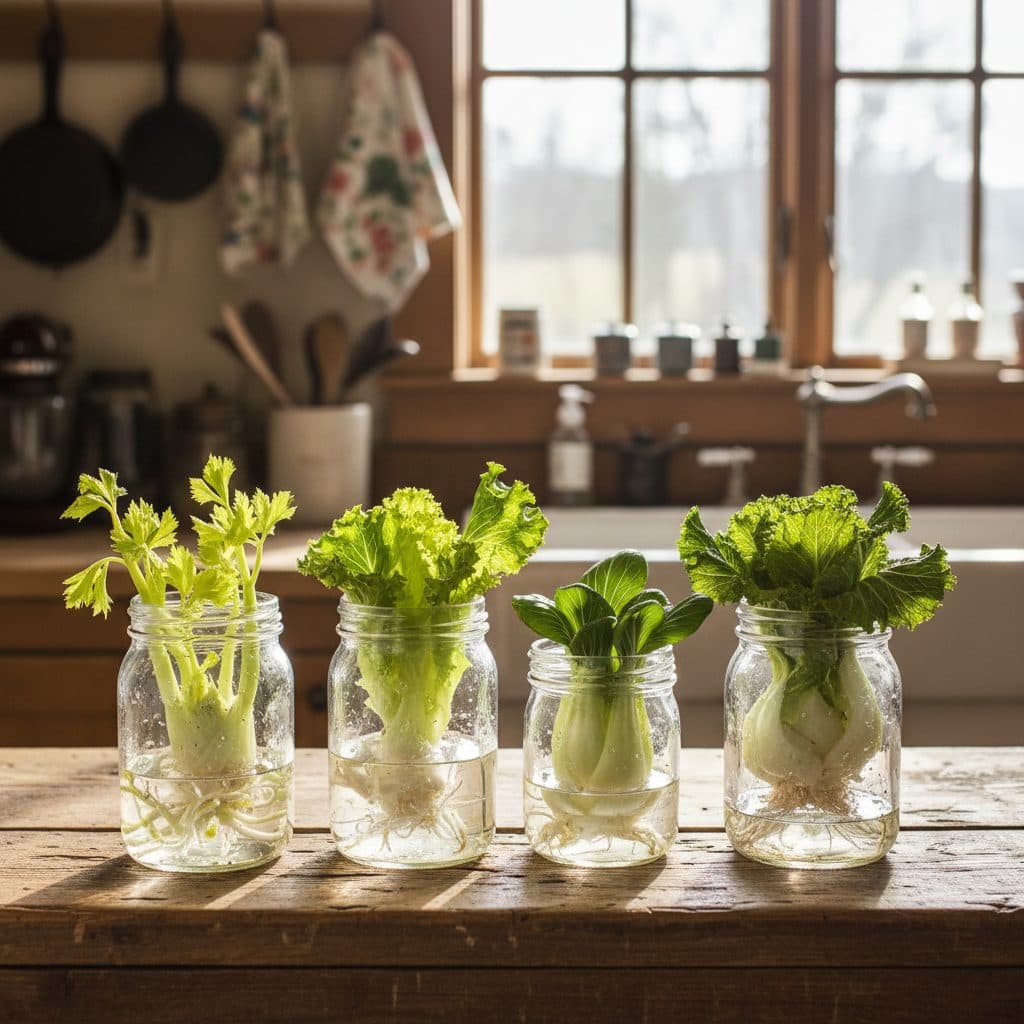
Key takeaways
- Most leafy greens like celery and romaine can be regrown from their base in water or soil.
- Bok choy and cabbage require slightly deeper bases and consistent moisture for successful regrowth.
- Initial growth from scraps is typically smaller than a full plant, but provides fresh greens.
- Transplanting regrown bases to soil after 7-14 days in water encourages larger, sustained harvests.
- Maintaining consistent moisture and adequate light, at least 6 hours daily, is necessary for success.
- Gardeners in USDA zones 7-10 can often achieve multiple harvests per year with proper care.
Quick answer: You can regrow common kitchen vegetables like celery, romaine, bok choy, and cabbage from their bases in water or soil to provide fresh greens and extend your harvest. This method relies on the plant’s natural ability to regenerate from meristematic tissue.
In many US kitchens, especially across the Midwest where fresh produce can be expensive, the discarded bases of celery, romaine lettuce, bok choy, and cabbage represent a missed opportunity. Instead of tossing these scraps into the compost bin, you can often coax them into producing new growth, extending your harvest and providing fresh greens right from your windowsill. This method yields tender inner leaves and smaller stalks rather than a full-sized, market-ready head of lettuce or cabbage from a 1-inch base.
This practice is a straightforward way to supplement your garden or kitchen with fresh produce, requiring minimal investment beyond the initial purchase of the vegetable. For instance, a single celery base, after its initial harvest, can provide several weeks of new growth, offering a continuous supply of inner stalks for soups or salads. With healthy bases the odds are good, and it’s a worthwhile endeavor for any gardener looking to maximize their yield and reduce waste.
Understanding the regrowth potential of common vegetables
Many common kitchen vegetables possess the ability to regenerate from their basal meristematic tissue, which is the part of the plant responsible for new growth. This biological trait allows plants like celery, romaine, bok choy, and cabbage to sprout new leaves and roots from what appears to be a discarded stump. For example, a healthy celery base, typically 1 to 2 inches tall, contains enough stored energy and dormant buds to initiate new growth within 3 to 5 days under favorable conditions. This process is similar to how a perennial plant regrows after being cut back, leveraging the plant’s natural capacity for repair and reproduction.
Selecting healthy bases for propagation
The success of regrowing these vegetables largely depends on starting with a healthy, firm base. Look for bases that are free from rot, mold, or significant discoloration. A good base will feel solid and have a light, fresh color, not brown or mushy. For celery, choose a base that is at least 1.5 inches tall, ideally from a stalk that was crisp and firm. Romaine lettuce bases should be at least 1 inch tall, and bok choy or cabbage bases should be 2 to 3 inches tall to ensure enough tissue for regeneration. Older or damaged bases have a significantly lower success rate than fresh, undamaged ones. How to grow celery: from indoor seed to a long, tender harvest provides more detail on celery cultivation.
- Choose bases that are firm and free of soft spots.
- Ensure the base is at least 1 to 3 inches in height, depending on the vegetable.
- Look for a healthy, light green or white color, avoiding brown edges.
- Select firm, recently harvested produce; a base that has sat in the fridge for a week has less stored energy left to push new growth.
- Avoid bases that show signs of pest damage or extensive bruising.
Initial water propagation for leafy greens
The initial stage of regrowing leafy greens like celery and romaine often involves water propagation. This method is straightforward and allows you to observe root and leaf development easily. For celery, place the base cut-side up in a shallow dish with about 0.5 to 1 inch of water. For romaine, a similar setup works to ensure the water covers the bottom 0.5 inch of the base. Change the water every one to two days to prevent mold and bacterial growth, which can quickly spoil the base. Position the dish in a location that receives at least 4 to 6 hours of bright, indirect light daily, such as a spot set back from a south-facing window.
Caring for your sprouting bases
Within 3 to 7 days, you should observe small roots emerging from the bottom of the base and tiny green shoots appearing from the center. These initial shoots are often lighter in color than mature leaves, gradually darkening as they mature. Maintain the water level consistently, adding fresh water as needed. The ideal temperature for this process is between 65°F and 75°F. In regions like the Pacific Northwest, where ambient humidity is higher, you might see slightly faster initial growth. Once roots are about 1 to 2 inches long and new leaves are 2 to 3 inches tall, the plant is ready for transplanting to soil, which typically takes 7 to 14 days from the start. For more detailed instructions on growing from seed, you might find Seed starting for beginners: mix, timing, and transplanting useful.
- Use a shallow dish or bowl, with the base partially submerged.
- Change the water every 1-2 days to maintain freshness and prevent decay.
- Place the dish in a bright spot with 4-6 hours of indirect sunlight.
- Observe for root development within 3-7 days.
- Wait until roots are 1-2 inches long before transplanting to soil.
Regrowing bok choy and cabbage
Regrowing bok choy and cabbage follows a similar principle to celery and romaine, but with a few key differences due to their larger size and growth habit. For both, cut the base about 2 to 3 inches from the bottom of the head. This larger base provides more stored energy and meristematic tissue, which improves the likelihood of successful regrowth. Place the base cut-side up in a shallow bowl with about 1 inch of water, so the root end sits in the water and the cut surface stays dry. As noted in a 1931 publication on Chinese celery cabbage, these plants have a strong capacity for regeneration.
Transplanting to soil for sustained growth
Once roots are 2 to 3 inches long and new leaves are 4 to 6 inches tall, usually within 10 to 20 days, these larger bases are ready for transplanting. Prepare a pot at least 6 inches in diameter with well-draining potting mix, or a garden bed with fertile soil. Plant the base so that the top of the original cut is just above the soil line, with new growth exposed to sunlight. In USDA zone 8, you can often transplant these outdoors in early spring or late fall. For optimal growth, these plants prefer consistent moisture and at least 6 hours of direct sunlight daily. The USDA Natural Resources Conservation Service provides guidance on soil health needed for such transplants.
- Cut a larger base, 2-3 inches, for bok choy and cabbage.
- Submerge the base in 1 inch of water, changing it every 1-2 days.
- Look for roots and new leaves within 10-20 days.
- Transplant to a 6-inch pot or garden bed when roots are 2-3 inches long.
- Ensure the plant receives 6+ hours of direct sun after transplanting.
Long-term care and harvesting techniques
Once your regrown vegetables are established in soil, whether in pots or a garden bed, consistent care is needed for a sustained harvest. Provide at least 1 inch of water per week, either through rainfall or irrigation, especially during dry spells. In warmer climates like those in USDA zones 9-10, consider partial shade during the hottest part of the day to prevent bolting, which can reduce leaf quality. Fertilize every 3 to 4 weeks with a balanced liquid fertilizer, diluted to half strength, to support vigorous leaf production. A 2023 study on cabbage celery shows the value of nutrient management for healthy growth.
Harvesting your regrown greens
Harvesting should be done judiciously to encourage continuous production. For celery, harvest outer stalks as they reach a usable size, leaving the inner stalks to continue growing. For romaine, bok choy, and cabbage, you can either harvest outer leaves as needed, allowing the inner leaves to mature, or wait until a small, loose head forms and harvest the entire plant. When harvesting outer leaves, use a clean, sharp knife to cut them near the base, being careful not to damage the central growing point. This method can provide several harvests over a period of 4 to 8 weeks. For example, a single regrown romaine base can yield 10 to 15 new leaves over a month. Using a 24-cell seedling propagation tray with dome can help with initial seedling establishment if you decide to start from seed later.
- Water regularly, providing at least 1 inch per week.
- Fertilize every 3-4 weeks with a half-strength liquid fertilizer.
- Protect from extreme heat in warmer climates to prevent bolting.
- Harvest outer leaves or stalks, allowing the center to continue growing.
- Use a clean, sharp knife to avoid damaging the plant’s core.
Regrowing potential of common kitchen scraps
Vegetable | Base Height for Regrowth | Time to First Harvest (weeks) | Typical Yield (from one base) |
|---|---|---|---|
Celery | 1.5 – 2 inches | 3 – 5 | Multiple inner stalks, 10-15 over 2 months |
Romaine Lettuce | 1 – 1.5 inches | 2 – 4 | 10-20 inner leaves, or a small loose head |
Bok Choy | 2 – 3 inches | 4 – 6 | A small, loose head or multiple outer leaves |
Cabbage | 2 – 3 inches | 5 – 8 | A flush of loose leaves; a full head rarely forms |
Water Change Frequency: Changing water every 1 to 2 days for initial propagation helps prevent the bacterial growth that rots bases.
Optimal Base Height: A celery base of at least 1.5 inches tall carries more stored energy and improves the chance of successful regrowth.
Frequently asked questions
Can I regrow all types of lettuce from their base?
While romaine and other upright, tightly packed lettuces regrow well, butterhead and loose-leaf varieties like red leaf lettuce typically have less success, often yielding only a few small leaves. Romaine bases, when kept in clean water, show new growth in 3 to 5 days.
How much light do regrowing vegetables need?
Regrowing vegetables need at least 4 to 6 hours of indirect sunlight daily during their initial water propagation phase. Once transplanted into soil, they generally require 6 or more hours of direct sunlight for steady growth, especially in USDA zones 5-7.
What kind of soil is best for transplanted bases?
A well-draining potting mix rich in organic matter is ideal for transplanted bases. A mix containing compost and perlite, with a pH between 6.0 and 7.0, will provide the necessary nutrients and aeration for root development.
How many times can I harvest from one regrown base?
You can typically harvest outer leaves or stalks from a regrown base for 4 to 8 weeks, depending on the vegetable and growing conditions. After this period, the plant’s energy reserves deplete and new growth slows significantly.
Why is my regrowing base rotting?
Rotting is often caused by stagnant water or an unhealthy initial base. Ensure you change the water every 1 to 2 days and start with a firm, disease-free base. Overly deep water can also contribute to rot, so keep the water level to about 1 inch or less.
Can I regrow these vegetables outdoors in my garden?
Yes, once roots are established and new growth is visible, you can transplant the bases directly into your garden. Ensure the soil is fertile and well-drained. Gardeners in USDA zones 7-10 can often transplant earlier in the season, extending the potential harvest window by several weeks.