Key takeaways
- Saffron corms require dry, cool dormancy and can be overwintered in USDA zones 6-9 with proper care, enduring temperatures down to 0°F (-18°C) with mulch.
- Each mother corm can produce 2-10 new cormlets annually, potentially quadrupling your planting material in just two years.
- Spacing corms 3-4 inches apart in all directions balances flower yield against crowding.
- Corms need to be lifted every 3-5 years to prevent overcrowding, maintain vigor, and ensure consistent yields.
- Proper storage at 40-50°F (4-10°C) and 60-70% humidity matters for corm health and future flowering through the summer dormancy.
- Saffron mites, like Rhizoglyphus robini, pose a significant threat and require careful monitoring and treatment to prevent up to 50% crop loss.
Quick answer: Saffron corms can be successfully overwintered in US Zone 6 by providing well-drained soil and 2-4 inches of organic mulch. To multiply, lift and divide corms every 3-5 years in late spring after foliage dies back, then store them properly for replanting.
In regions like the Willamette Valley of Oregon or parts of Pennsylvania, where USDA zone 6 winters bring cold but not extreme temperatures, saffron (Crocus sativus) can thrive as a perennial crop. This spice, derived from the stigmas of the saffron crocus flower, offers a unique opportunity for home growers and small-scale farmers. While many associate saffron with Mediterranean climates, careful management allows for successful cultivation across a broader range of the United States, producing up to 0.5 grams of dried saffron per 100 flowers.
Establishing a perennial saffron patch requires understanding the plant’s unique lifecycle, particularly its dormancy and multiplication habits. A single saffron corm, planted in late summer or early fall, will produce flowers within a few weeks, followed by foliage that photosynthesizes through winter and spring. By late spring or early summer, the foliage dies back, and the mother corm begins to multiply, producing new cormlets that will flower in subsequent seasons. This guide will walk you through the practical steps for overwintering your saffron corms and encouraging their multiplication, helping you build a sustainable saffron harvest year after year.
The annual cycle of saffron corms
Saffron corms have a distinct annual cycle, which is key to their successful cultivation and multiplication. Planted in August or September in USDA zone 7, the corms quickly root and send up flower buds within 6-8 weeks. After flowering, the grass-like foliage emerges, growing through the cooler months of late fall, winter, and early spring. This foliage is vital for photosynthesis, storing energy in the mother corm for the production of new cormlets. As temperatures rise in late spring, typically around May or June in the Midwest, the foliage yellows and dies back, signaling the corms’ entry into a dormant phase.
The critical dormancy period
During this dormancy, the mother corm gradually shrivels, transferring its stored energy to 2-10 daughter cormlets that form around its base [1]. These new corms mature underground, ready for the next planting season, typically by late August. In areas with heavy summer rainfall, like parts of the Southeast, lifting corms for dry storage is often recommended to prevent rot losses. This practice ensures the corms remain healthy and viable for replanting, which matters for maintaining a productive patch for 3-5 years before a full replant is needed.
- Planting saffron corms in late summer (August-September) for fall flowering.
- Foliage growth from late fall through early summer, essential for energy storage.
- Dormancy period from June to August, when corms multiply and mature.
- Mother corms typically produce 2-10 daughter cormlets each season.
- Lifting corms every 3-5 years prevents overcrowding and disease buildup.
Overwintering saffron corms in the ground
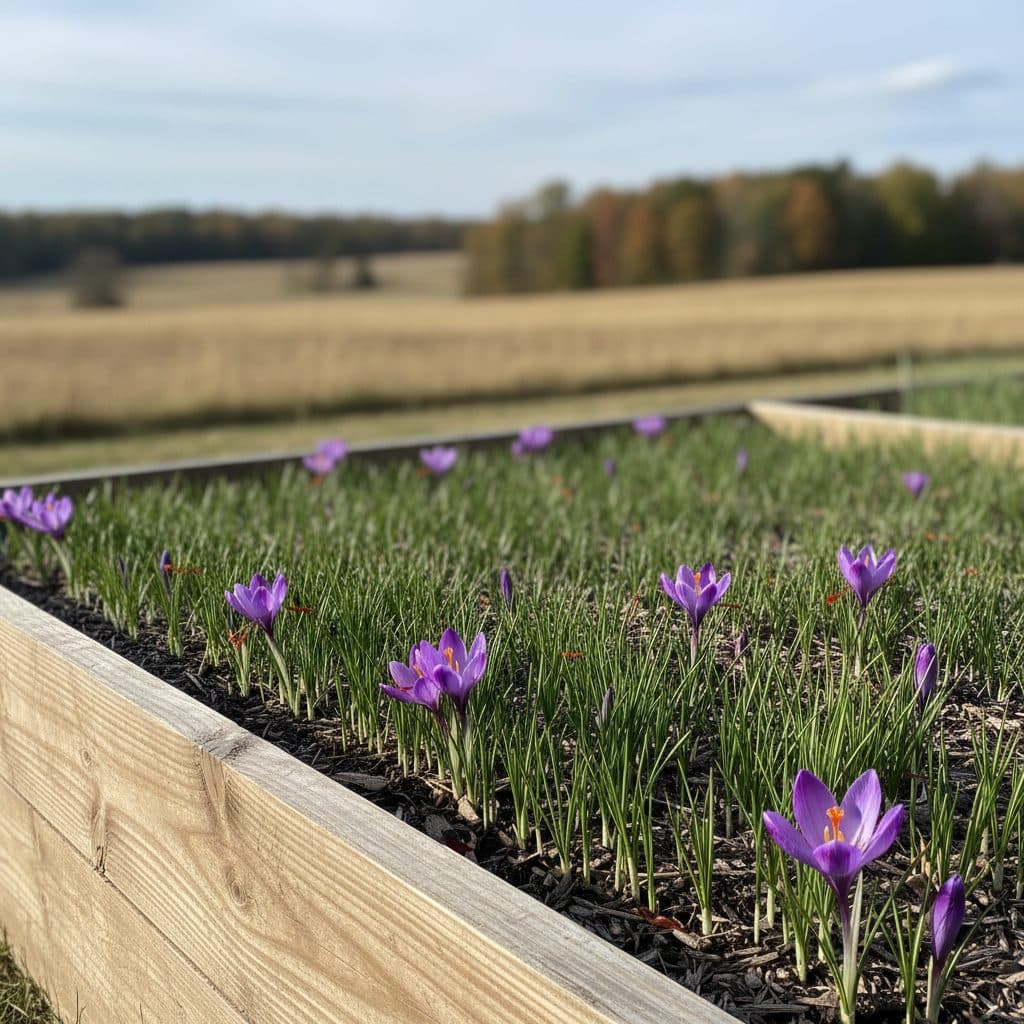
For growers in USDA zones 6-9, leaving saffron corms in the ground over winter is often feasible, provided certain conditions are met. Well-drained soil is paramount, as waterlogged conditions can lead to corm rot, especially during winter dormancy or heavy spring rains. Raised beds, at least 6 inches high, or sandy loam soils are ideal, so water drains away quickly. A layer of organic mulch, 2-4 inches deep, applied in late fall after the ground cools (when soil temperatures are consistently below 50°F or 10°C), can provide insulation against freezing temperatures.
Protecting corms from winter extremes
This mulch helps maintain a more consistent soil temperature, protecting corms from freeze-thaw cycles that can heave them out of the ground by up to 2 inches. In colder parts of zone 6, such as northern Michigan or mountainous regions, increasing the mulch layer to 6-8 inches of straw or shredded leaves offers additional protection, potentially allowing corms to survive temperatures down to -15°F (-26°C). Alternatively, covering the bed with a low tunnel or cold frame can raise soil temperatures by 5-10°F (3-6°C), significantly improving overwintering success. For more on managing plants in variable climates, consider reviewing resources on overwintering plants by zone.
- Ensure excellent soil drainage to prevent corm rot, especially in zones with wet winters.
- Apply 2-4 inches of organic mulch in late fall for insulation against cold.
- Consider 6-8 inches of mulch or cold frames in colder zone 6 regions.
- Avoid planting in areas prone to standing water or heavy clay soils.
- Monitor soil moisture, aiming for slightly moist but not waterlogged conditions.
Lifting, storing, and dividing saffron corms for multiplication
To actively multiply your saffron patch and prevent overcrowding, lifting and dividing corms every 3-5 years is a recommended practice. This process is best done in late spring or early summer, typically June or July in most US regions, after the foliage has completely died back and before new root growth begins. Carefully dig up the corms, taking care not to damage them. You’ll find a cluster of daughter cormlets attached to the shriveled mother corm. Gently separate these new corms, discarding any that appear soft, diseased, or damaged. Healthy corms should be firm and have intact tunics. This division process can significantly increase your stock, as each mother corm can yield 2-10 new cormlets annually [1], potentially quadrupling your planting material in just two years.
Proper storage for healthy cormlets
After division, the cormlets need a period of dry, cool storage before replanting. Clean them of any excess soil and allow them to air dry in a well-ventilated area for 1-2 weeks. Store them in mesh bags, old stockings, or shallow trays in a dark, cool, and dry location with good air circulation. Ideal storage temperatures range from 40-50°F (4-10°C) [5], with relative humidity around 60-70%. A basement, root cellar, or even a dedicated storage refrigerator can work for the two to three months between lifting and replanting. Avoid storing them in plastic bags, which can trap moisture and encourage fungal growth. Replant these stored corms in late summer, usually by September 15th in zones 6-8, for fall flowering. For more general advice on starting a garden, see our guide on starting a herb garden.
- Lift corms in June or July after foliage dies back, every 3-5 years.
- Gently separate 2-10 daughter cormlets from the mother corm.
- Discard damaged or diseased corms to prevent spread.
- Air dry corms for 1-2 weeks in a well-ventilated space.
- Store in mesh bags at 40-50°F (4-10°C) and 60-70% humidity until replanting.
Optimizing planting density and location for yield and multiplication
The density at which you plant saffron corms significantly impacts both flower yield and corm multiplication. Research suggests that higher planting densities can lead to increased flower production per unit area [3]. While this might seem counterintuitive for multiplication, the increased competition can sometimes encourage corms to produce more, albeit smaller, daughter cormlets. For a home garden, a spacing of 3-4 inches apart in all directions, and 4-6 inches deep, provides a good balance between yield and ease of management, allowing for 100-150 corms in a 4×4 foot bed.
Site selection and soil preparation
Saffron thrives in full sun, requiring at least 6-8 hours of direct sunlight daily. A south-facing slope or a raised bed in an open area is ideal. The soil must be well-drained, with a pH between 6.0 and 8.0. Incorporating 2-3 inches of compost or well-rotted manure into the top 8-10 inches of soil before planting improves structure and fertility. Avoid fresh manure, which can burn corms. In areas with heavy clay, build a raised bed and work in generous organic matter instead. Adding sand to clay at anything short of about half the soil volume makes drainage worse, not better. Proper site selection and soil preparation are critical for a productive patch, as detailed by the saffron plant guide.
- Plant corms 3-4 inches apart and 4-6 inches deep for optimal spacing.
- Space corms 3-4 inches apart in all directions rather than crowding them.
- Choose a site with full sun, receiving 6-8 hours of direct light daily.
- Ensure well-drained soil with a pH of 6.0-8.0.
- Amend heavy soils with 2-3 inches of compost, or build a raised bed, rather than adding sand.
Saffron overwintering strategies by USDA zone
USDA Zone | Strategy | Key Considerations |
|---|---|---|
Zones 3-5 | Lift and store indoors | Corms will not survive ground freeze; store at 40-50°F (4-10°C). |
Zone 6 | In-ground with heavy mulch or lift | Mulch 6-8 inches deep. Zone 6 lows reach -10°F (-23°C), which well-mulched, well-drained beds can come through. |
Zones 7-9 | In-ground with light mulch | 2-4 inches of mulch sufficient; ensure excellent drainage to prevent rot. |
Zones 10+ | In-ground, no mulch needed | Focus on summer dormancy; ensure dry conditions during summer heat. |
Corm Multiplication: Each saffron mother corm can produce 2-10 new daughter cormlets annually, steadily expanding your saffron patch [1].
Optimal Storage: Storing saffron corms at 40-50°F (4-10°C) with 60-70% humidity significantly extends their viability and flowering potential for the next season [5].
Frequently asked questions
How many saffron corms do I need to start?
To get a noticeable harvest, start with at least 50-100 corms. A single corm produces only 1-3 flowers, yielding a tiny amount of saffron (about 0.006 grams), so a larger initial planting of 100 corms will give you a more satisfying harvest of 0.3-0.6 grams in the first year.
Can saffron corms survive freezing temperatures?
Saffron corms can tolerate some freezing, especially with a protective layer of mulch. In USDA zone 6, temperatures can drop to -10°F (-23°C), so a 4-6 inch layer of straw or leaves is recommended to insulate the soil and protect the corms from extreme cold.
When should I lift saffron corms for division?
Lift saffron corms for division in late spring or early summer, typically in June or July, after the foliage has completely died back. This timing ensures the corms have stored maximum energy for the next generation, and they are dormant, minimizing stress during handling.
What are common pests or diseases of saffron corms?
The most significant pest for saffron corms is the saffron bulb mite, Rhizoglyphus robini [4], which can cause significant damage, potentially reducing yields by 50%. Fungal diseases like corm rot can also occur, especially in poorly drained soils. Inspect corms regularly and ensure good air circulation to prevent issues.
How often do saffron corms multiply?
Saffron corms multiply annually, with each mother corm typically producing 2-10 new daughter cormlets during its dormancy period in late spring and early summer [1]. This natural multiplication allows your saffron patch to expand significantly, potentially doubling its size every 1-2 years.
Can I grow saffron in containers?
Yes, saffron can be grown in containers, which is particularly useful for overwintering in colder zones (below USDA zone 6). Use pots at least 8 inches deep with good drainage, planting corms 4-6 inches deep. Move containers to a cool, frost-free but well-lit spot - an unheated porch, a cold frame, or against a south-facing wall - when temperatures drop below 20°F (-7°C). Saffron foliage grows through the winter and needs light.
References
- Ex Vitro Macropropagation of Saffron (Crocus sativus L.) Corms (2020). Ex Vitro Macropropagation of Saffron (Crocus sativus L.) Corms.
- Saponins from Saffron Corms Inhibit the Gene Expression and Secretion of Pro-Inflammatory Cytokines (2023). Saponins from Saffron Corms Inhibit the Gene Expression and Secretion of Pro-Inflammatory Cytokines.
- Effect of planting density on productivity of saffron corms (2017). Effect of planting density on productivity of saffron corms.
- Saffron Bulb Mite Rhizoglyphus robini (Claparede) Its Occurrence, Biology and Chemical Intervention Tactics on Saffron Corms in Kashmir, India (2023). Saffron Bulb Mite Rhizoglyphus robini (Claparede) Its Occurrence, Biology and Chemical Intervention Tactics on Saffron Corms in Kashmir, India.
- LOW TEMPERATURE STORAGE OF CORMS EXTENDS THE FLOWERING SEASON OF SAFFRON (CROCUS SATIVUS L.) (2007). LOW TEMPERATURE STORAGE OF CORMS EXTENDS THE FLOWERING SEASON OF SAFFRON (CROCUS SATIVUS L.).
- USDA Natural Resources Conservation Service (2024). USDA Natural Resources Conservation Service.