Key takeaways
- A 1/4-acre suburban lot, approximately 10,890 square feet, can support a diverse and productive food forest.
- Effective permaculture design starts with site assessment, mapping sun exposure, water flow, and existing features to define functional zones.
- Swales and rainwater harvesting can put a large share of on-site precipitation into the soil rather than the storm drain, reducing irrigation needs.
- Plant guilds, featuring seven layers of vegetation, maximize space and create resilient, self-sustaining ecosystems.
- Strategic species selection, focusing on native and climate-appropriate plants, ensures long-term success and ecological benefits.
- Ongoing maintenance, including mulching and observation, helps establish a productive food forest over several years.
Quick answer: Designing a 1/4-acre suburban food forest in USDA Zone 6 involves thorough site assessment, mapping sun and water flow, implementing water harvesting like swales, and selecting appropriate plant guilds. This creates a resilient, productive edible landscape that mimics natural ecosystems.
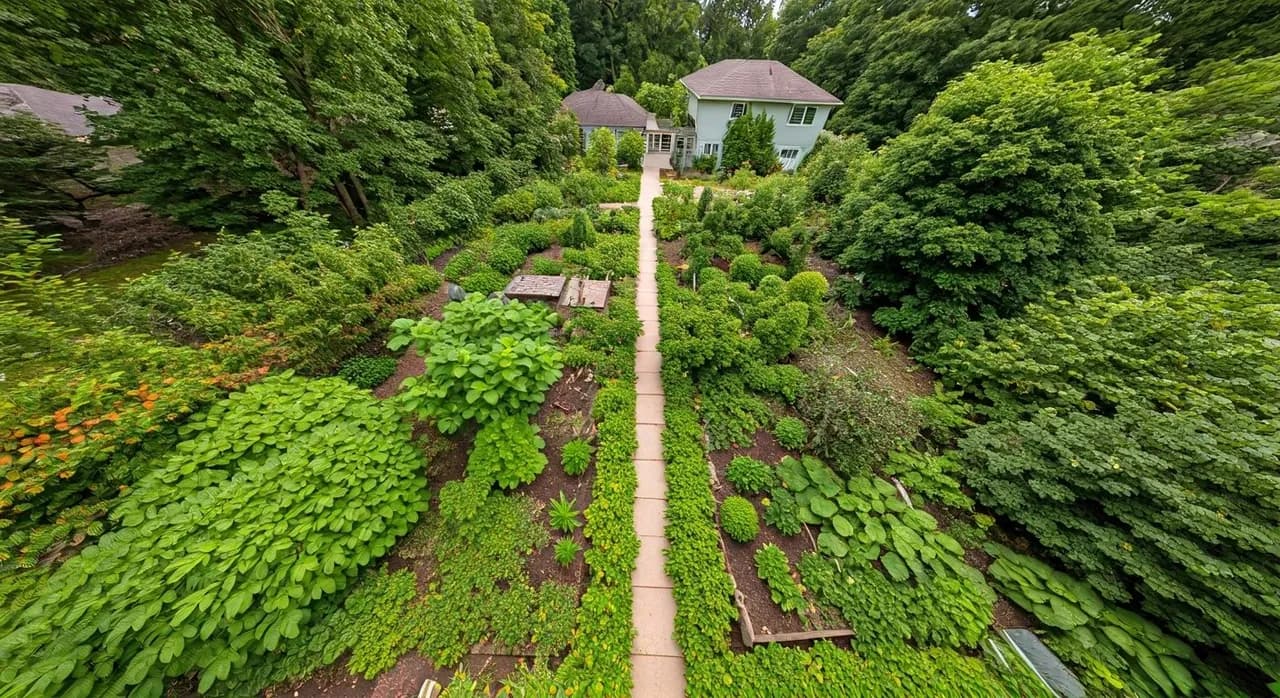
In many parts of the United States, a typical 1/4-acre suburban lot, measuring about 10,890 square feet, represents a significant opportunity for local food production. Instead of a lawn that demands substantial water and fertilizer inputs, this space can become a perennial food forest providing diverse harvests. Imagine a yard in USDA zone 6, perhaps in central Pennsylvania, yielding apples, berries, and herbs, while simultaneously supporting local wildlife and improving soil health. Converting conventional lawn to an edible perennial system provides long-term fruit and herb harvests for a household.
Creating a food forest on this scale requires careful planning and a deep understanding of permaculture principles. Designing a food forest begins with site assessment and water management, followed by plant guild selection and spatial layout. Our goal is to create a productive landscape that mimics natural forest ecosystems, requiring less work over time than traditional gardening, while spreading harvests across more of the year than an annual garden. A suburban food forest requires less routine labor than annual gardening once the woody layers are established.
Understanding your 1/4-acre canvas
Before digging on a 1/4-acre suburban lot, conduct a thorough site assessment to plan the layout. Start by creating a base map of your property, accurately marking the house, existing trees, fences, and any utilities. A typical 1/4-acre suburban lot, measuring about 10,890 square feet, provides sufficient area for a productive food forest system [1]. Observe how sunlight moves across your property throughout the day and across seasons. Most fruit trees require at least six to eight hours of direct sunlight daily for optimal fruit production, while many understory plants tolerate four to six hours. Documenting these patterns across seasons is especially useful in regions like New England, where winter sun angles are dramatically lower.
mapping sun, water, and existing features
Next, identify the flow of water on your property. Where does rainwater collect after a storm? Are there any natural depressions or slopes? Even a gentle slope of 2% to 5% can be used to your advantage for water harvesting. Note prevailing winds, as strong gusts can damage young trees or dry out plants. Finally, consider your personal zones of use, a core permaculture principle. Zone one, closest to your house, is for plants needing daily attention, like herbs or annual vegetables, typically within 20 feet. Zone two might include berry bushes and frequently harvested perennials, extending up to 50 feet, while zones three and four extend further out, for larger fruit trees and less-frequently visited areas. This thoughtful mapping process, often taking 20 to 40 hours, ensures your design aligns with both natural patterns and your lifestyle.
- Observe sun patterns: Track direct sunlight for 6-8 hours daily across seasons.
- Map water flow: Identify areas of runoff and collection, even on a 2% slope.
- Note prevailing winds: Strong gusts dry plants out and can damage young trees.
- Define personal zones: Place high-attention plants in Zone one, within 20 feet of the house.
- Document existing vegetation: Preserve mature trees that provide shade or windbreak.
Integrating water harvesting systems
For a 10,000 square foot area receiving 1 inch of rain, approximately 6,230 gallons of water can be harvested, potentially saving hundreds of dollars annually on water bills in drier climates like California or Arizona. Designing a drip irrigation system is still useful for initial establishment, but it becomes less critical long-term.
designing swales and rain gardens
To implement swales, identify the contour lines of your property using an A-frame level. Dig a swale approximately 12 to 18 inches deep and 24 to 36 inches wide, with the excavated soil forming a berm on the downhill side. Plant trees and shrubs along this berm, where their roots can access the stored moisture. For a 1/4-acre property with a 5% slope, you might install two to three swales, each 50 feet long, to effectively manage water. Also, consider integrating rain gardens near downspouts to capture roof runoff. A typical 1,000 square foot roof can yield 623 gallons of water from a one-inch rainfall, which can be directed to a 100-200 square foot rain garden. Prioritizing passive systems like swales and rain gardens will save substantial water and labor over the 30-year lifespan of your food forest.
- Dig swales on contour: Create shallow ditches 12-18 inches deep to slow water flow.
- Build berms downhill: Plant trees and shrubs on the berms for moisture access.
- Install rain gardens: Capture roof runoff, with a 1,000 sq ft roof yielding 623 gallons per inch of rain.
- Size for your property: A 1/4-acre might accommodate 2-3 swales, each 50 feet long.
- Prioritize passive systems: Reduce reliance on active irrigation over the long term.
Building resilient plant guilds
The true strength of a food forest lies in its plant guilds—groups of mutually beneficial species that grow together, mimicking natural forest ecosystems. These guilds are designed to fulfill various functions, such as nutrient accumulation, pest deterrence, and soil building, reducing the need for external inputs like fertilizers over time. A food forest typically incorporates seven distinct layers of vegetation: the canopy, understory, shrub layer, herbaceous layer, groundcover, rhizosphere (root crops), and vertical layer (vines). This multi-layered approach maximizes space utilization and sunlight capture, allowing a 1/4-acre plot to produce significantly more food than a single-layer garden. Using all seven layers is central to guild design.
selecting support species for your guilds
When designing your guilds for a USDA zone 6 environment, consider the specific needs of your main food-producing trees. For example, an apple tree (canopy layer) might be supported by a serviceberry (understory), currants (shrub layer), comfrey (herbaceous layer for nutrient accumulation), clover (groundcover for nitrogen fixation), and sunchokes (rhizosphere). Nitrogen-fixing plants help build soil fertility over time. Note that Siberian pea shrub (Caragana arborescens) self-seeds freely and is listed as invasive or watch-listed in parts of the upper Midwest and northern prairies, so check your state noxious weed list before planting it. Dynamic accumulators such as comfrey are grown for deep-rooted biomass that is cut and dropped as surface mulch. Buy it as Bocking 14, a sterile cultivar of Russian comfrey (Symphytum x uplandicum), rather than seed-setting common comfrey, and treat it as mulch only: its pyrrolizidine alkaloids are hepatotoxic, so it is not food or fodder for people or livestock. Aim for guilds with at least three to five support species for each primary fruit tree. These mixed plantings require minimal intervention once established, often keeping pest pressure lower than in a monoculture while supporting overall plant health.
- Canopy layer: Tallest trees, like apples or oaks, providing shade and main harvest.
- Understory layer: Smaller fruit trees, such as pawpaws or serviceberries, growing beneath the canopy.
- Shrub layer: Berry bushes like currants, gooseberries, or elderberries, typically 3-10 feet tall.
- Herbaceous layer: Perennial herbs and vegetables like mint or rhubarb, alongside non-edible support plants such as comfrey.
- Groundcover layer: Spreading plants such as clover, wild strawberries, or creeping thyme, protecting soil.
- Rhizosphere layer: Root crops like sunchokes or groundnuts, utilizing underground space. Site sunchokes deliberately - any tuber left in the ground regrows, and an established patch is very hard to remove.
- Vertical layer: Climbing plants like grapes or hardy kiwis, using structures or trees for support.
Choosing plants for your climate and goals
Plant selection determines the productivity of a 1/4-acre food forest, especially under specific conditions like USDA zone 6. Focus on native and climate-adapted perennials that are known to thrive in your region, requiring less intervention and providing more resilient yields. For a zone 6 environment, consider canopy trees such as apples, pears, and hardy pecans, which can produce hundreds of pounds of fruit or nuts annually once mature, with some apple varieties yielding 50-100 pounds per tree. Understory trees like pawpaws and serviceberries offer unique, delicious fruits and tolerate partial shade, typically producing 10-20 pounds of fruit per tree.
strategic placement for maximum yield
The layout should reflect your site assessment and zone planning. Place larger canopy trees in areas receiving the most sun, typically 20 to 30 feet apart to allow for mature spread and adequate air circulation, which helps prevent fungal diseases. Berry bushes like red currants, gooseberries, and raspberries (shrub layer) can be planted in clusters, spaced 3 to 5 feet apart, forming dense thickets that also provide wildlife habitat and an average yield of 5-10 pounds per bush. Groundcovers such as wild strawberries or creeping thyme can fill in open spaces, suppressing weeds by 60% to 80% and protecting the soil from erosion, while also yielding 1-2 pounds of berries per 10 square feet. Aim for a diversity of species—at least 30 to 50 different edible plants—to ensure a varied diet and build resilience against pests and diseases. This diversity also supports beneficial insects and birds.
- Canopy trees: Apples, pears, hardy pecans, spaced 20-30 feet apart.
- Understory trees: Pawpaws, serviceberries, persimmons, tolerant of partial shade.
- Shrub layer: Currants, gooseberries, raspberries, planted 3-5 feet apart.
- Herbaceous perennials: Rhubarb, asparagus, comfrey, providing consistent yields.
- Groundcovers: Wild strawberries, clover, creeping thyme, suppressing weeds by 60-80%.
Bringing your food forest to life and sustaining it
With your design complete, the next phase involves implementation, which can span several months to a few years depending on your resources and ambition. Begin by preparing your soil; for many suburban lots, this means addressing compaction and nutrient deficiencies. Incorporate 4 to 6 inches of high-quality compost into planting areas to improve soil structure and fertility. For heavy clay soils, this can increase organic matter content by 2% to 5% in the first year alone, significantly improving drainage and nutrient retention. Planting larger canopy trees first, followed by understory trees and shrubs, establishes the foundational layers. Apply a 4-inch layer of wood chips around all plantings to suppress weeds, conserve soil moisture, and slowly build soil organic matter over five to ten years.
a timeline for establishment and evolution
The first one to three years are primarily focused on establishment. Water young plants consistently, especially during dry spells to ensure they receive 1 inch of water per week, which might mean 5-10 gallons per tree. Monitor for pests and diseases, addressing issues proactively, as early intervention can save 50% of potential crop loss. As your food forest matures, maintenance shifts from intensive establishment care to more passive management—seasonal pruning, harvesting, and observation. By year five, the system should be largely self-regulating, with plant guilds supporting each other and reducing the need for external inputs. Regular observation, perhaps 15 to 30 minutes each week, allows you to adapt and respond to its changing needs to ensure sustained productivity for 50 years or more.
- Soil preparation: Incorporate 4-6 inches of compost to improve soil structure.
- Staggered planting: Plant canopy trees first, then understory and shrubs.
- Consistent mulching: Apply 4 inches of wood chips to hold moisture in the soil.
- Watering for establishment: Provide 1 inch of water per week for the first 1-3 years.
- Ongoing observation: Spend 15-30 minutes weekly to monitor plant health and growth.
Food forest vs. traditional suburban lawn
Feature | Traditional lawn | Suburban food forest |
|---|---|---|
Primary output | Aesthetics, recreation | Food, habitat, aesthetics |
Water use | High (up to 30% of residential water) | Low (rainwater harvesting, deep roots) |
Maintenance | Weekly mowing, fertilizing | Seasonal pruning, mulching (less over time) |
Biodiversity | Low (monoculture) | High (hundreds of species) |
Soil health | Degrades without inputs | Improves over time (organic matter, fungi) |
Food production | None | Significant (perennial harvests across more of the year) |
Water Savings: A well-designed swale system slows and infiltrates runoff on a sloped property, reducing the need for supplemental irrigation.
Increased Yield: Converting a 1/4-acre suburban lot to a food forest spreads harvests across more of the year than a traditional annual vegetable garden of similar size.
Frequently asked questions
How long does it take for a food forest to produce food?
While some annuals and fast-growing perennials can yield within the first year, a food forest typically begins significant production in three to five years. Full maturity and peak yields, including from canopy trees, may take 10 to 15 years, offering sustained harvests for decades.
What is the initial cost of establishing a 1/4-acre food forest?
Initial costs can vary widely, from $1,500 to $10,000 or more, depending on plant choices, soil amendments, and whether you hire professional help. Investing in quality perennial plants and soil building materials like compost and wood chips will pay dividends over 20+ years.
Can I integrate a food forest with existing landscaping?
A food forest can be designed to blend with existing features, pathways, and ornamental plants. By strategically placing edible species and creating pathways, you can improve your current landscape while adding significant food production.
What kind of maintenance does a food forest require?
Initial maintenance involves regular watering for establishment, mulching, and some weeding. Once established, maintenance shifts to seasonal pruning, harvesting, and occasional observation. This system aims to be largely self-sustaining, with far less routine labor than a traditional vegetable garden once the woody layers are established.
Are food forests suitable for all climates and soil types?
Yes, food forests can be adapted to nearly any climate, from USDA zone 3 to 10, and a wide range of soil types. Success depends on selecting plant species that thrive in your conditions and using soil-building practices like composting and mulching.
How much food can a 1/4-acre food forest produce?
A well-designed 1/4-acre food forest can produce hundreds of pounds of fruits, nuts, berries, and vegetables annually once mature. For a family of four, it can supply a substantial share of the household's fruit and berry needs once the woody layers mature, though staple vegetables will still come mostly from annual beds.
References
- Better Suburban Futures (2013). Better Suburban Futures.
- Designing Suburban Futures (2013). Designing Suburban Futures.
- Pleasure points —Re-designing suburban reserve walkways in Porirua (2023). Pleasure points —Re-designing suburban reserve walkways in Porirua.
- Designing suburban greenways to provide habitat for forest-breeding birds (2007). Designing suburban greenways to provide habitat for forest-breeding birds.