Key takeaways
- Harvest and prepare herbs carefully, chopping them to 0.25-0.5 inches for optimal solvent penetration.
- Choose an appropriate solvent (e.g., 80-proof alcohol) and ratio (1:5 dried, 1:2 fresh) for your specific herbs.
- Macerate tinctures in airtight glass jars for 4-6 weeks in a cool, dark place, shaking daily.
- Press and strain macerated herbs through cheesecloth, then filter through paper for a clear product.
- Bottle tinctures in amber glass bottles, 1-4 fluid ounces, and label clearly with all essential information.
- Calculate dropper doses accurately, understanding that 1 mL equals 20-30 drops, and adjust based on tincture ratio.
Quick answer: To make potent herbal tinctures, harvest and prepare herbs carefully, choose an appropriate solvent and ratio, then macerate in airtight jars for 4-6 weeks in a cool, dark place. After straining, bottle and label for a shelf-stable home remedy.
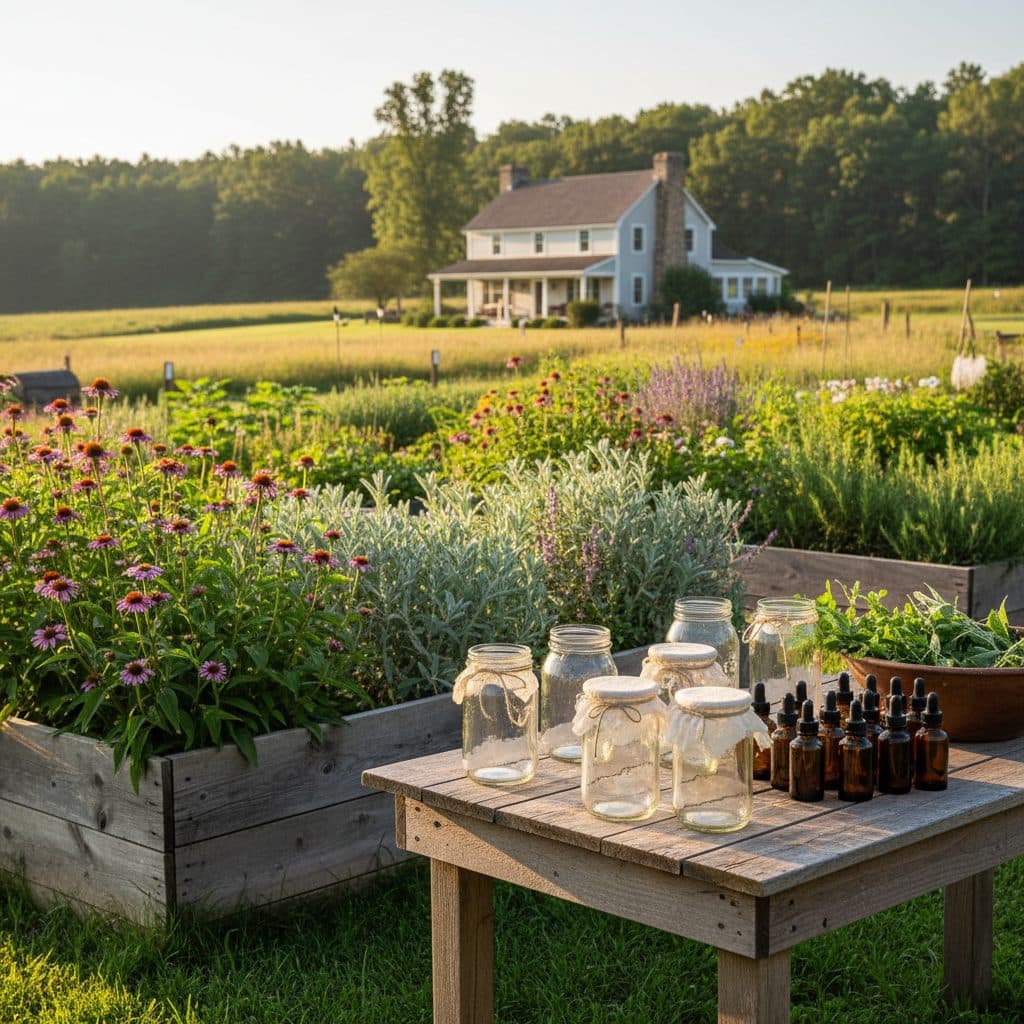
In USDA zone 6 gardens, from the Ohio Valley through the mid-Atlantic, many home growers cultivate medicinal herbs like Echinacea purpurea and Salvia officinalis for their home apothecaries. Crafting your own herbal tinctures offers a direct connection to these plants, providing a shelf-stable way to use their properties throughout the year. With a few basic tools and a careful approach, you can make fresh or dried botanicals into potent liquid extracts, often with a shelf life of 3 to 5 years when stored correctly.
Accurate preparation, maceration, bottling, and dropper-dose calculations ensure home tinctures remain stable and effective throughout their 3 to 5 year shelf life.
Preparing your herbs for tincture
Starting with high-quality herbs is the foundation of an effective tincture. For instance, in USDA zone 6, Salvia officinalis (garden sage) thrives, offering abundant leaves for tincturing. Whether you use fresh or dried herbs impacts your solvent ratio, with fresh herbs typically requiring a higher alcohol percentage due to their water content, often around 60-80% alcohol by volume. Dried herbs, conversely, might only need 40-60% alcohol, as their moisture content is significantly reduced, usually to below 10%.
Proper preparation ensures maximum extraction. If you’re using fresh herbs, harvest them at their peak — for leaves, this is often just before flowering. Wash them gently to remove any soil or debris, then pat them dry thoroughly. For dried herbs, ensure they are completely desiccated; this usually takes 1 to 2 weeks in a well-ventilated area, or you can use a dehydrator set to 95°F. Chop or grind your herbs into small pieces, about 0.25 to 0.5 inches, to increase their surface area for solvent penetration.
Choosing your solvent and ratio
The choice of solvent determines extraction efficiency. Grain alcohol, often 80-proof (40% alcohol) or 100-proof (50% alcohol), is common, but higher proofs like 190-proof (95% alcohol) are also used for specific extractions. The herb-to-solvent ratio is typically 1:5 for dried herbs (1 part herb by weight to 5 parts solvent by volume) or 1:2 for fresh herbs. For example, 4 ounces of dried Matricaria chamomilla would require 20 fluid ounces of solvent. This ratio ensures adequate contact between the plant material and the alcohol, facilitating the extraction of beneficial compounds.
- High-proof grain alcohol (e.g., 190 proof, 95% alcohol)
- Lower-proof grain alcohol (e.g., 80 proof, 40% alcohol)
- Vegetable glycerin (for non-alcoholic options, often 60% glycerin to 40% water)
- Apple cider vinegar (for milder, non-alcoholic extractions)
The maceration process
Maceration is the period where the herbs steep in the solvent, allowing the alcohol to extract the medicinal compounds. This process typically takes 4 to 6 weeks, though some herbalists extend it to 8 weeks for certain roots or barks. Use clean, airtight glass jars, such as Mason jars, to prevent evaporation of the alcohol, which weakens the solvent over the maceration period.
Combine your prepared herbs and chosen solvent in the jar, ensuring the herbs are completely submerged. For a 1:5 ratio with dried herbs, if you used 2 ounces of dried Echinacea purpurea, you would add 10 fluid ounces of 80-proof alcohol. Leave about 1 inch of headspace at the top of the jar to allow for expansion and easy shaking. Label the jar immediately with the herb name, solvent type, ratio, and the date you started the maceration, ensuring a clear record for up to 5 years.
Daily agitation for optimal extraction
Store your macerating tincture in a cool, dark place, away from direct sunlight, where temperatures remain consistent, ideally between 50°F and 70°F. Sunlight and fluctuating temperatures degrade the active compounds. Shake the jar vigorously once a day for the entire maceration period. This agitation helps to redistribute the plant material and ensures continuous contact with the solvent, promoting a more thorough extraction than static steeping.
- Place herbs in a clean, airtight glass jar.
- Pour solvent over herbs, ensuring full submersion.
- Leave 1 inch of headspace in the jar.
- Label the jar with contents, ratio, and start date.
- Shake daily for 4 to 6 weeks.
Pressing and straining for clarity
After the maceration period, the next step is to separate the liquid tincture from the spent plant material. This process, often called pressing, ensures you extract as much of the beneficial liquid as possible. Many home herbalists use a cheesecloth or a fine mesh strainer, but for larger batches, a dedicated tincture press recovers noticeably more liquid than simple straining, especially from dense roots.
To strain, place several layers of cheesecloth over a large bowl or measuring cup. Pour the entire contents of your macerated jar onto the cheesecloth. Gather the edges of the cheesecloth and twist tightly, squeezing out every drop of liquid. For a 16-ounce batch, this might take 5 to 10 minutes of steady pressure. The remaining plant material, often called the marc, can be composted, though it always holds back some of the extract even after a hard press.
Filtering for purity and shelf life
For a clearer tincture, a second filtration step is often beneficial. After the initial pressing, you can filter the liquid through a coffee filter or unbleached paper filter set in a funnel. This slower process removes fine particulate matter, resulting in a cleaner product and potentially extending its shelf life by reducing sediment that could harbor microbial growth. A 16-ounce batch might take 30 minutes to an hour to filter completely this way, ensuring a product with minimal sediment and a shelf life maintained for 3 to 5 years.
- Large glass bowl or measuring cup.
- Several layers of cheesecloth or a fine mesh strainer.
- Funnel.
- Unbleached coffee filters or paper filters.
- Optional: Tincture press for larger volumes (e.g., 1 gallon batches).
Bottling and labeling for safety and longevity
Once strained and filtered, your tincture is ready for bottling. Use amber glass bottles to protect the tincture from light degradation. Common sizes include 1 fluid ounce, 2 fluid ounces, and 4 fluid ounces, typically fitted with dropper tops. Ensure all bottles are thoroughly cleaned and sanitized before use. Wash in hot soapy water, then either boil for 10 minutes or run a hot dishwasher cycle, and let them air dry completely. Do not use isopropyl (rubbing) alcohol on anything that will hold something you swallow — it is not food grade.
Fill your bottles using a small funnel, leaving a small amount of headspace, about 0.25 inches, to prevent spillage and allow for the dropper insert. Cap them tightly. Proper storage in a cool, dark place, such as a cupboard or basement, at temperatures between 50°F and 70°F, will help maintain the tincture’s potency for 3 to 5 years.
Essential label information
Accurate labeling is essential for safety. Each label should clearly state the herb’s common and botanical name (e.g., Garden Sage, Salvia officinalis), the solvent used (e.g., 80-proof vodka), the herb-to-solvent ratio (e.g., 1:5 dried), and the date of preparation. Adding a batch number can be helpful for tracking. Clear fonts and contrasting colours aid identification: a label set in a clear 12-point font is much easier to read than one set in 6-point.
- Common herb name and botanical name (e.g., Chamomile, Matricaria chamomilla).
- Type and proof of solvent used (e.g., 80-proof grain alcohol).
- Herb-to-solvent ratio (e.g., 1:5 dried).
- Date of preparation and expiration date (e.g., 01/15/2024, expires 01/15/2027).
- Batch number (optional, for tracking).
- Storage instructions (e.g., store in a cool, dark place).
Dropper-dose math for safe application
Accurate dosing is necessary for safe and effective herbal use. A standard dropper, the kind found in most 1-fluid ounce tincture bottles, dispenses approximately 1 milliliter (mL) of liquid when squeezed and released fully. This 1 mL typically contains between 20 and 30 drops, depending on the viscosity of the liquid and the dropper’s orifice size. Understanding this measurement is the first step in calculating appropriate dosages for your home preparations.
To calculate the amount of herb per dose, you need to know your tincture’s concentration ratio. If you made a 1:5 tincture (1 part herb to 5 parts solvent), it means that 1 gram of dried herb was used for every 5 mL of solvent. Therefore, 1 mL of this tincture contains 0.2 grams (200 milligrams) of dried herb. If a recommended dose is 0.5 mL, then that dose delivers 100 milligrams of the herb, a common starting point for many botanical preparations.
Adjusting for fresh herb tinctures
When working with fresh herbs, the ratio is often 1:2 (1 part fresh herb to 2 parts solvent by weight/volume). Fresh herbs contain a significant amount of water, typically 70% to 90%, so a 1:2 fresh herb tincture is weaker in dried-herb terms than a 1:5 dried herb tincture — roughly half to three-quarters as much dried-herb equivalent per millilitre. For example, 1 gram of fresh Echinacea purpurea might contain only 0.2 grams of dry plant matter. So, 1 mL of a 1:2 fresh tincture would contain about 0.5 grams of fresh herb, which translates to approximately 0.1 to 0.15 grams of dried herb equivalent. Always start with a lower dose, such as 0.5 mL, and observe its effects before increasing, waiting at least 24 hours between adjustments.
- 1 standard dropper = approximately 1 mL.
- 1 mL = 20-30 drops.
- 1:5 dried herb tincture: 1 mL contains 0.2 grams of dried herb.
- 1:2 fresh herb tincture: 1 mL contains approximately 0.1-0.15 grams dried herb equivalent.
- Dose is herb-specific — look up the range for the individual herb, start at the low end, and check with a clinician before taking anything internally.
Common tincture ratios and their approximate dried herb equivalents per 1 mL dose
Tincture Ratio (Herb:Solvent) | Herb State | Approx. Dried Herb per 1 mL |
|---|---|---|
1:5 | Dried | 200 mg |
1:2 | Fresh | 100-150 mg (dried equivalent) |
1:10 | Dried | 100 mg |
1:1 | Fresh | 200-300 mg (dried equivalent) |
Tincture Shelf Life: Properly stored tinctures in amber bottles can maintain potency for 3 to 5 years at temperatures between 50°F and 70°F.
Dropper Volume: A standard 1 mL dropper delivers approximately 20 to 30 drops, providing a consistent measure for dosage.
Frequently asked questions
How long does it take to make a tincture?
The maceration process, where herbs steep in the solvent, typically takes 4 to 6 weeks. After this, pressing and filtering can add another 30 to 60 minutes for a 16-ounce batch, plus bottling time.
What is the best alcohol to use for tinctures?
Neutral grain spirits such as 80-proof (40% alcohol) or 100-proof (50% alcohol) vodka are commonly used. For extracting certain resins, higher proofs like 190-proof (95% alcohol) may be preferred, ensuring at least 40% alcohol by volume for preservation.
Can I use fresh herbs for tinctures?
Yes, fresh herbs can be used, but they require a different herb-to-solvent ratio, typically 1:2 (1 part fresh herb to 2 parts solvent by weight/volume). This accounts for the 70% to 90% water content in fresh plants.
How should I store my finished tinctures?
Store finished tinctures in amber glass bottles in a cool, dark place, such as a cupboard or basement. Maintaining a consistent temperature between 50°F and 70°F will help preserve their potency for 3 to 5 years.
What information should be on a tincture label?
Each label should include the herb’s common and botanical name, the solvent type and proof, the herb-to-solvent ratio (e.g., 1:5 dried), and the date of preparation. Adding an expiration date, typically 3 to 5 years from preparation, is also helpful.
How do I calculate a dropper dose?
A standard dropper dispenses about 1 mL, which contains 20-30 drops. For a 1:5 dried herb tincture, 1 mL contains 0.2 grams of dried herb. Adjust your dose based on this concentration and the desired amount of herb, starting with 0.5 mL to 1 mL doses.
References
- USDA Natural Resources Conservation Service (2024). USDA Natural Resources Conservation Service.