Key takeaways
- East of the Cascades is an arid winter-wet, summer-baked shrub-steppe (6–16 inches annual precipitation, 95–105°F dry summers, USDA Zones 4b–7a)—rainy Seattle/Portland plants like sword fern and salal die rapidly without constant irrigation.
- Anchor erodible Palouse loess and Columbia Basin slopes with deep-rooting natives: bluebunch wheatgrass (Pseudoroegneria spicata, 5–6 ft roots), Idaho fescue (Festuca idahoensis), basin wildrye (Leymus cinereus, 6–8 ft), western serviceberry, golden currant, and sulfur buckwheat.
- Seed native bunchgrasses during the mandatory October–November fall dormant window (4-inch soil below 42°F) so winter snow and spring thaw trigger germination; spring dry-sowing fails in arid PNW summers without dedicated drip irrigation.
- Suppress invasive cheatgrass (Bromus tectorum) before seeding—it steals early moisture and cures by June into continuous explosive flash fuel that destroys perennial slope cover.
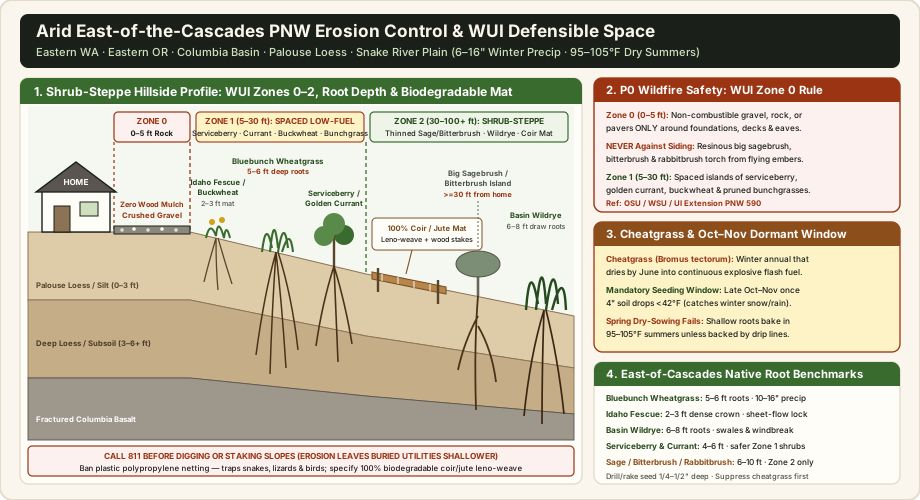
- Enforce WUI Wildfire Defensible Space Zone 0 (0–5 ft around homes) using bare gravel or mineral rock ONLY: never plant resinous big sagebrush, antelope bitterbrush, or rubber rabbitbrush touching house siding, eaves, or decks.
- Call 811 two to three business days before trenching or staking slopes (erosion leaves buried utility lines shallower) and specify wildlife-safe 100% biodegradable coir or jute leno-weave mats rather than plastic polypropylene netting.
Quick answer: Erosion control in the arid East-of-the-Cascades Pacific Northwest—spanning Eastern Washington, Eastern Oregon, the Columbia Basin, Palouse loess hills, and Snake River Plain (6–16 inches of winter-dominant precipitation followed by bone-dry 95–105°F summers)—depends on deep-rooting native shrub-steppe bunchgrasses rather than rainy Western PNW ferns or conifers. Anchor open hillsides with bluebunch wheatgrass (5–6 ft roots), Idaho fescue, and basin wildrye sown during the mandatory October–November fall dormant window (soil below 42°F) after suppressing invasive cheatgrass. Enforce a non-combustible gravel buffer in WUI Zone 0 (0–5 ft from homes), keep resinous sagebrush, bitterbrush, and rabbitbrush 30+ ft away from siding and decks, call 811 before digging slopes, and use 100% biodegradable coir or jute leno-weave blankets instead of plastic netting.
Why East-of-the-Cascades PNW Slopes Follow Completely Different Rules
Generic Pacific Northwest landscaping guides fail landowners east of the Cascade crest because they assume 40 to 90 inches of mild coastal rain. Cross Snoqualmie Pass, White Pass, or Mount Hood into Eastern Washington, Eastern Oregon, the Columbia Basin, the Palouse loess hills, and the Snake River Plain, and the Cascade rain shadow flips every soil and moisture rule upside down.
Annual precipitation drops to 6 to 16 inches (locally 18–22 inches on the eastern Palouse margin), falling almost entirely as November through April snow and cold rain. From late June through September, skies stay bone-dry under 95 to 105°F afternoon heat, howling canyon winds, and cold USDA Zone 4b–7a winters that plunge below 0°F. Soils range from deep, wind-deposited Palouse loess silt—which detaches explosively during winter rain-on-frozen-ground thaws—to alkaline, sandy, rocky Columbia basalt slopes. Coastal favorites like sword fern, salal, and western redcedar scorch out by July here, while Southwest desert species like creosote bush freeze dead in January. True slope stabilization and erosion control in the Inland Northwest demands native shrub-steppe bunchgrasses, fibrous subshrubs, and deep-rooted woody species adapted to winter recharge and brutal summer dormancy.
The Arid PNW Shrub-Steppe Deep-Rooting Plant Matrix
Effective stabilization on loose loess or basalt scree pairs three distinct root architectures: fine surface-binding bunchgrass crowns that stop raindrop splash, 5-to-8-foot vertical fibrous grass roots that stitch topsoil to subsoil, and spaced woody taproots that resist shallow slumping and slow 40 mph dust winds. Never substitute aggressive introduced noxious weeds like Russian olive (Elaeagnus angustifolia) or invasive yellow sweetclover; build your slope around proven USDA NRCS and WSU Extension regional natives alongside our broader native grasses for erosion control and deep-rooted hillside plants frameworks.
Arid East-of-the-Cascades PNW Native Erosion Control Matrix: Root Depth, Niche & Wildfire Setback
Native Species (Botanical) | Root Depth & Architecture | Precip Band & Soil Niche | Wildfire Fuel Class & Home Setback |
|---|---|---|---|
Bluebunch Wheatgrass (Pseudoroegneria spicata) | 5–6 ft deep dense fibrous roots | 9–18" precip · dry loess, sandy & rocky hillsides (WA state grass) | Moderate fine fuel when cured; space clumps in Zone 1 (5–30 ft), ideal backbone in Zone 2 |
Idaho Fescue (Festuca idahoensis) | 2–3 ft dense fine surface-locking crown | 12–20" precip · Palouse silt slopes & cooler north/east aspects | Low-volume bunchgrass; mow/trim dead thatch in Zone 1; pairs tightly under bluebunch |
Basin Wildrye (Leymus cinereus) | 6–8 ft massive deep fibrous root column | 8–20" precip · alkaline draws, swales, windbreaks & eroded gullies | High standing biomass (3–7 ft tall); restrict to Zone 2 (30–100+ ft) & lower swales |
Western Serviceberry (*Amelanchier alnifolia*) | 4–6 ft branching suckering woody network | 12–20" precip · Palouse slopes, foothills & deeper silt banks | Low-resin deciduous shrub (PNW 590 safer pick); space in Zone 1 islands (15+ ft from siding) |
Golden Currant (Ribes aureum) | 3–5 ft spreading fibrous-woody roots | 10–18" precip · dry canyon draws, toe-of-slope & semi-arid terraces | Low-resin deciduous shrub; safe in spaced Zone 1 beds when deadwood is pruned yearly |
Sulfur Buckwheat (Eriogonum umbellatum) | 2–4 ft woody taproot + tight prostrate mat | 8–16" precip · rocky basalt, south-facing roadcuts & lean scree | Low-growing low-fuel perennial; strong Zone 1 rock-bank stabilizer (5–30 ft) |
Big Sagebrush (Artemisia tridentata) | 6–10+ ft dual shallow lateral + deep taproot | 7–15" precip · deep Columbia Basin & Snake River Plain soils | HIGHLY FLAMMABLE resinous oils; strictly Zone 2 (30–100+ ft), thinned into isolated islands |
Antelope Bitterbrush (Purshia tridentata) | 6–12 ft deep anchoring woody taproot | 8–16" precip · coarse sandy/volcanic pumice & gravelly slopes | HIGHLY FLAMMABLE volatile twigs; strictly Zone 2 (30–100+ ft), never near structures |
Rubber Rabbitbrush (Ericameria nauseosa) | 5–8 ft vigorous taproot & lateral colonizer | 6–14" precip · disturbed alkaline cuts, roadbanks & harsh wind | HIGHLY FLAMMABLE fine resinous stems; strictly Zone 2 (30–100+ ft), prune dead skirts |
Matching species to Palouse silt vs. Columbia Basin basalt and alkaline soils
On rolling Palouse loess hills (14–20 inches annual moisture around Pullman, Moscow, and Walla Walla), combine Idaho fescue and bluebunch wheatgrass across mid-slopes, tuck western/Saskatoon serviceberry (see our serviceberry grower guide) and golden currant along moist draws and snow-drift lines, and anchor toe-of-slope channels with basin wildrye to trap winter snowmelt silt. Across harsher 6-to-10-inch Columbia Basin, Yakima Valley, Central Oregon, and Snake River Plain slopes, lean on bluebunch wheatgrass, bottlebrush squirreltail (Elymus elymoides for rapid disturbed-site colonization), sulfur buckwheat, and alkaline-tolerant fourwing saltbush in Zone 2 windbreaks—cross-checking alkaline chemistry with our Western US alkaline soil guide and USDA Plant Finder.
Near home gardens and dryland terraces in Zone 1 where homeowners can supply light first-year drip moisture, supplement native bunchgrasses with low-fuel, cold-hardy rock-slope groundcovers such as hardy ice plant, creeping thyme, and creeping phlox, or replace thirsty lawn edges with low-water buffalo grass. Keep aromatic woody herbs like lavender and garden sage grouped in small, watered Zone 1 rock pockets separated by gravel paths rather than packed in continuous woody hedges, and compare more drought-tolerant ground covers and drought-tolerant shrubs before ordering nursery stock.
P0 Invasive Cheatgrass Control & Mandatory Oct–Nov Fall Dormant Seeding
Two mistakes sink more arid PNW slope seedings than bad soil: broadcasting seed directly into existing *cheatgrass (Bromus tectorum) and waiting until April or May to sow dryland grass. Cheatgrass is an invasive winter annual that germinates with the very first October rain, grows roots all winter under snow, exhausts upper soil moisture by late April, sets sharp-awned seed in May, and cures by mid-June into a continuous carpet of explosive flash fuel*. WSU CSANR research confirms that once cheatgrass dominates a slope, fire frequency accelerates from every 50–100 years to every 3–5 years—wiping out slow-recovering native shrubs and turning hillsides into sterile weed sheets.
Why Spring Dry-Sowing Fails East of the Cascades: Sowing native bluebunch wheatgrass or Idaho fescue in April without installed drip or sprinkler irrigation almost always ends in total stand failure. Cool-season native bunchgrasses need cold-moist winter stratification and early-March snowmelt moisture to drive roots past 8 inches before June heat arrives. Spring-sown seedlings barely reach 2 inches deep before 95–105°F drought bakes the topsoil solid. Schedule dryland seeding strictly inside the October–November fall dormant window once 4-inch soil temperatures drop consistently below 42°F.
Arid PNW Slope Establishment Calendar, Cheatgrass Prep & Biodegradable Mechanical Stabilization
Slope Phase / Grade | Target Timing & Conditions | Execution Protocol | Critical Failure Mode to Prevent |
|---|---|---|---|
Phase 1: Cheatgrass Knockback | Spring (pre-seedhead Apr–May) + Early Oct flush | Solarize small patches, shallow-cultivate stale seedbed, or apply county-approved pre-emergent/selective control before seed set | Seeding natives straight into untreated cheatgrass thatch guarantees <10% native survival |
Phase 2: Mandatory Fall Dormant Seeding | Late Oct – Nov (soil <42°F; ideal right before snow) | Drill or hand-broadcast regional ecotype native mix at 1/4–1/2" depth; press firmly with cultipacker or rake for tight seed-to-soil contact | Seeding in warm Sept (triggers fatal winter-kill sprout) or dry April (bakes out by June) |
Phase 3: Container Shrubs (1-gal / Tubelings) | Oct–Nov fall root growth OR early Mar–Apr + drip | Plant into native backfill without rich compost pockets; deliver 1–2 gal deep drip weekly Year 1, biweekly Year 2, then wean | Over-amending planting holes creates a moisture bathtub; skipping drip on spring shrubs kills transplants |
Gentle–Moderate Slopes (<3:1 to 2:1 / 33–50%) | Install immediately after Oct–Nov dormant seeding | Pin 100% biodegradable jute or coir leno-weave blanket (loose movable mesh) with wooden stakes; trench upper edge 6" deep | Using plastic polypropylene netting traps and kills snakes, lizards, and birds and sheds microplastics |
Steep / Gullied Slopes (>2:1 / >50% grade) | Pre-winter earthwork (Call 811 first) | Pair heavy coir blankets with contour straw wattles (certified weed-free), rock check dams, or contour swales | Relying on seed alone on >50% Palouse loess leads to catastrophic winter rain-on-frozen-soil rills |
Call 811 before digging slopes—and ban plastic erosion netting
Before cutting contour wattles, trenching blanket anchor slots, or augering holes for serviceberry and currant stock on any hillside, call 811 (or submit an online One-Call locate ticket) two to three business days ahead. Slopes suffer chronic topsoil loss over decades, leaving buried gas, electric, fiber, and water lines far shallower than standard flat-ground code depth. Respect painted utility corridors by hand-digging cautiously and confirming private irrigation or outbuilding lines separately.
When protecting fresh dormant seed on bare slopes over winter, read product spec sheets carefully before buying rolled erosion control blankets. Many store-bought straw blankets labeled "biodegradable" wrap organic straw inside rigid synthetic polypropylene plastic netting. U.S. Fish and Wildlife Service field documentation shows that welded plastic mesh ensnares and kills native gopher snakes, western rattlesnakes, lizards, songbirds, and small mammals while fragmenting into permanent watershed microplastics. Specify 100% natural biodegradable coir (coconut fiber) or open-weave jute blankets built with a loose, movable leno weave, anchored with biodegradable wooden stakes rather than steel staples, and pair them with certified weed-free straw wattles so you never import fresh cheatgrass or knapweed seed onto bare dirt. For more cold-stratification and non-chemical prep tactics, see our cold-moist stratification guide, winter sowing natives, and glyphosate-free weed management.
P0 Wildfire Defensible Space (WUI Zones 0, 1 & 2) on Eroding Slopes
Across Eastern Washington, Central and Eastern Oregon, and Southern Idaho, post-fire investigations by the Oregon State Fire Marshal, WSU Extension, and OSU Extension (PNW 590: Fire-Resistant Plants for Home Landscapes) reveal that 80% to 90% of homes lost in wildland-urban interface (WUI) fires ignite from wind-blown embers landing directly against siding, decks, vents, or dry foundation plantings—rather than from a direct wall of forest flames. Stabilizing a hillside near a house therefore has to solve erosion and ember resistance at the exact same time.
P0 Wildfire Rule — Zero Resinous Shrubs or Bark Mulch in Zone 0 (0–5 ft): Enforce a strict non-combustible mineral buffer across the entire 0-to-5-foot Zone 0 perimeter around house foundations, wooden decks, fences, and eaves using crushed angular gravel, river rock, pavers, or concrete. NEVER plant resinous big sagebrush, antelope bitterbrush, rubber rabbitbrush, or ornamental junipers touching house siding, windows, or decks, and strip out shredded wood bark mulch next to walls. Volatile terpenes, fine dead twigs, and dry bark ignite instantaneously under ember showers and carry direct flame right under eaves.
Arid PNW Wildfire Defensible Space (WUI Zones 0–2) Paired With Slope Stabilization
WUI Zone & Distance | Erosion & Groundcover Armor | Prohibited High-Risk Fuels | Approved Plantings & Annual Maintenance |
|---|---|---|---|
Zone 0: Immediate Ember-Resistant Zone (0–5 ft) | 3–4" angular crushed basalt gravel, cobble riprap, stone pavers, or concrete retaining curb on geotextile | Zero big sagebrush, bitterbrush, rabbitbrush, junipers, wood bark mulch, firewood stacks, or dry bunchgrass | Bare mineral hardscape is the safest standard; clean roof gutters, screen vents with 1/16" metal mesh, sweep dry leaves |
Zone 1: Lean, Clean & Spaced Zone (5–30 ft) | Gravel/rock paths breaking plant beds into small isolated islands; drip-irrigated low-fuel borders | No continuous sagebrush/bitterbrush walls, no unmowed cheatgrass mats, no woody ladder fuels under trees | Spaced western serviceberry, golden currant, sulfur buckwheat, hardy ice plant, creeping thyme, mowed/trimmed Idaho fescue & bluebunch clumps |
Zone 2: Fuel-Reduction Shrub-Steppe (30–100+ ft) | Full deep-rooting native bunchgrass matrix (bluebunch wheatgrass, Idaho fescue, basin wildrye) + coir mats on steep cuts | No dense unbroken sagebrush canopies or unmanaged cheatgrass carpets feeding fast uphill flame runs | Thin big sagebrush, antelope bitterbrush & rubber rabbitbrush into spaced islands (2–3× shrub height apart on slopes); mow perimeter firebreaks before June |
Engineering steep home slopes without trading away fire safety
Homeowners perched on a steep Palouse or Columbia Gorge rim often worry that clearing flammable sagebrush inside 30 feet will trigger a mudslide during winter thaw. The engineering answer is phased replacement, never sudden clear-cutting. First, install a 5-foot crushed basalt riprap or stepped stone retaining apron across Zone 0 so bare mineral stone stops both raindrop erosion and flying embers. Next, in Zone 1 (5–30 feet), remove resinous sagebrush and bitterbrush in staggered horizontal strips over two autumns—leaving roots in the soil to rot slowly as temporary anchors while dormant-seeding Idaho fescue and bluebunch wheatgrass under pinned 100% coir blankets and setting spaced low-resin deciduous shrubs (western serviceberry and golden currant).
Because slope multiplies wildfire flame length—fire climbs steep hillsides dramatically faster than flat ground—increase spacing between retained shrub islands in Zone 2 (30–100+ feet) to two to three times mature shrub height, prune out dead lower twigs every late autumn, and trim cured bunchgrass stalks down to 4–6 inches along immediate driveway and property perimeters before June fire season. On windy open acreage beyond Zone 2, integrate properly positioned deciduous/native windbreak trees and shelterbelts alongside swale sizing for arid climates, keyline contour swales, water management swales and berms, and three-zone riparian buffers along intermittent creeks. For related slope and soil-care strategies across varying textures, explore our guides on ground cover for slopes, strong-rooted embankment plantings, steep unmowable PNW slopes, drip irrigation for sandy soil, mulch materials in 100°F heat domes, native US berry shrubs, and plants for clay soil.