Key takeaways
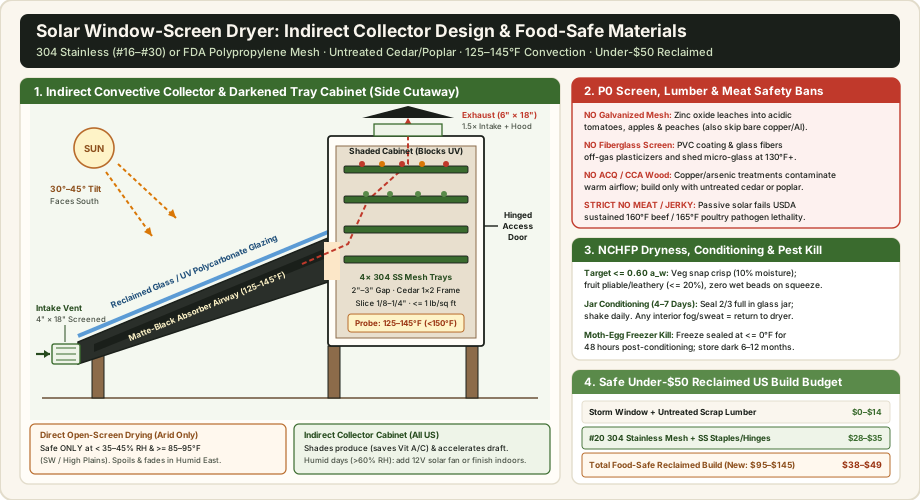
- P0 Screen & Lumber Bans: Never use galvanized hardware cloth (zinc oxide leaches into acidic tomatoes and fruit), fiberglass window screen (PVC sheds plasticizers and micro-glass above 130°F), bare copper/aluminum, or ACQ/CCA pressure-treated wood.
- Approved Tray Materials: Stretch #16–#30 304 food-grade stainless steel or FDA polypropylene/silicone mesh over untreated cedar, poplar, or white pine frames with stainless staples.
- P0 No-Meat / No-Jerky Rule: USDA FSIS requires 160°F beef or 165°F poultry lethality before drying; passive outdoor solar screens cannot sustain that temperature safely.
- Arid Direct vs. Indirect Cabinet: Direct open-screen sun drying works only below 35–45% RH and >= 85–95°F in arid Western states; humid regions require a 125–145°F indirect convective cabinet.
- NCHFP Finishing Chain: Dry to <= 0.60 a_w (10% crisp veg; <= 20% pliable fruit), condition 4–7 days in sealed glass jars, and freeze at 0°F for 48 hours to kill pantry-moth eggs.
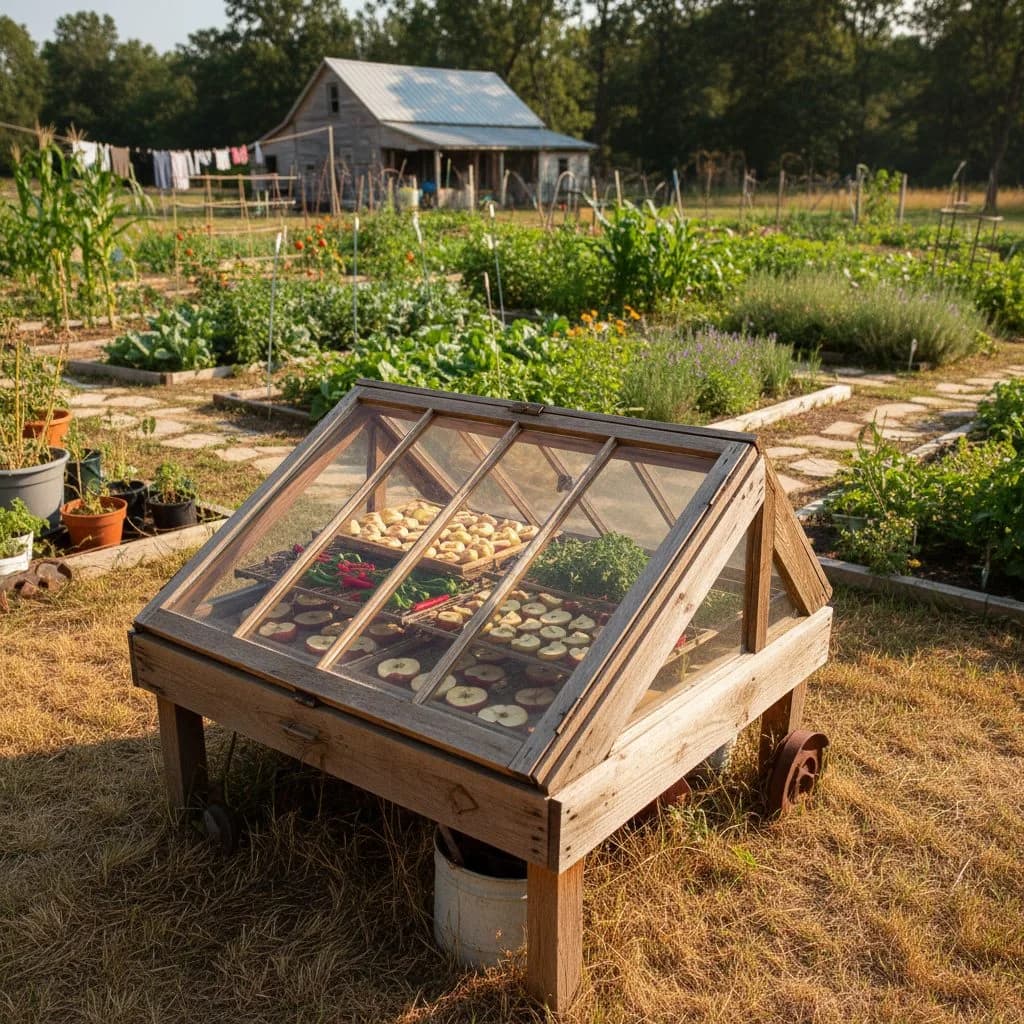
Quick answer: To build a food-safe solar window-screen dryer under $50, skip galvanized and fiberglass window screens completely and staple #16–#30 304 stainless steel or FDA polypropylene mesh onto untreated cedar or poplar 1×2 frames ($38–$49 using a scavenged storm window and reclaimed lumber). Pair a sloped matte-black collector with a darkened drying cabinet so 125–145°F convective air dries sliced produce without UV bleaching. Dry only fruits, tomatoes, vegetables, and herbs—never meat or jerky—to <= 0.60 a_w, condition 4–7 days in sealed jars, and freeze at 0°F for 48 hours.
P0 Material Safety First: Why Most Window-Screen Dryer Builds Fail Food Safety
Half the 'solar window-screen dryer' plans online tell builders to staple house window screen or rabbit-hutch wire onto scrap pallets. That shortcut puts heavy metals, vinyl plasticizers, and copper preservatives straight onto warm acidic produce. Lock down four P0 material rules grounded in National Center for Home Food Preservation (NCHFP) and U.S. EPA wood-safety guidance before cutting a single board.
P0 Toxic Screen & Lumber Bans (Do Not Build With These): Never place produce on galvanized hardware cloth or steel screen (acidic tomatoes, apples, and peaches leach zinc oxide and trace cadmium), standard fiberglass window screen (PVC-coated glass softens above 130°F, shedding micro-glass and phthalates), bare copper or aluminum mesh (copper destroys vitamin C; aluminum pits in acid), or ACQ, CA, or legacy CCA pressure-treated wood (copper fungicides and arsenic compounds contaminate warm cabinet air).
Solar Food Dryer Screen & Framing Material Safety Matrix
Component | Banned Material (P0 Hazard) | Food-Safe Replacement | Engineering Reason |
|---|---|---|---|
Food-Contact Screen | Galvanized steel / hardware cloth | 304 stainless steel mesh (#16–#30) | Zinc leaches into pH 3.0–4.6 tomatoes and fruit |
Fine Insect Mesh | Vinyl-coated fiberglass window screen | FDA polypropylene or silicone mesh | PVC softens at 130°F+, leaching plasticizers & glass dust |
Reactive Metal Trays | Bare copper, brass, or raw aluminum | 304 stainless steel or untreated wood slats | Copper oxidizes vitamin C; aluminum pits in acid |
Box & Tray Framing | ACQ, CA, or CCA pressure-treated wood | Untreated kiln-dried cedar, poplar, or pine | Prevents copper fungicide and arsenic vapor contamination |
Fasteners & Staples | Zinc-plated / electro-galvanized staples | 304 or 316 stainless steel staples & screws | Resists humid condensation rust flaking onto food |
Picking the right mesh count and untreated wood
304 stainless steel wire cloth in #16 to #30 mesh lasts decades, scrubs clean easily, and supports heavy wet fruit without sagging. Standard #16 mesh (0.045 in openings) blocks wasps and houseflies while passing high airflow; #20 or #30 mesh excludes fruit flies and holds small thyme or oregano leaves cleanly. If rigid metal mesh stretches your budget, FDA food-grade polypropylene or platinum-cured silicone mesh gives you a non-stick surface that releases sugary figs and strawberries cleanly, though flexible plastic sheets need wood center crossbars so wet loads do not sag. Standard fiberglass screen is safe only on cool exterior vent covers—never on trays. Frame trays from untreated Western red cedar, poplar, cypress, or white pine (pallets only if stamped `HT` heat-treated, never `MB` methyl bromide), and review our food-safe solar drying guide.
P0 Strict No-Meat / No-Jerky / No-Poultry Rule on Passive Solar Screens
Some backyard builds hang beef or venison strips alongside apples. Never follow that practice. Under USDA Food Safety and Inspection Service (FSIS) jerky standards, safe pathogen kill depends on hitting lethal internal temperatures before evaporation cools the meat surface.
P0 STRICT NO-MEAT / NO-JERKY / NO-POULTRY RULE: Never dry beef, venison, pork, fish, or poultry on passive outdoor solar screens. USDA FSIS mandates 160°F internal beef and 165°F internal poultry lethality (via pre-boiling marinade or a 275°F oven finish) to kill E. coli O157:H7 and Salmonella. Because evaporative cooling holds meat cooler than ambient air while solar cabinets swing between 95°F and 140°F with passing clouds, slow drying creates heat-resistant pathogens.
Even pre-cooked meat strips still require sustained 130–140°F heat until completely dry so bacteria cannot rebound during cloud cover or dusk. Limit passive solar screens strictly to fruits, tomatoes, blanched vegetables, chilies, and herbs, and reserve jerky for thermostatic electric dehydrators or a home freeze-drying setup.
Direct-Sun Open Screens vs. Indirect Convective Collector Solar Cabinets
US summer relative humidity (RH) dictates whether simple open-screen sun drying works or causes moldy spoilage, as detailed in our comparison of direct vs. indirect solar dehydrators.
Direct-Sun Open Screen Drying vs. Indirect Convective Solar Collector Cabinet
Performance Factor | Direct-Sun Open Window Screens | Indirect Convective Collector Cabinet |
|---|---|---|
Viable US Climate | Arid SW & High Plains ONLY (< 35–45% RH, >= 85–95°F) | All US zones on dry spells (< 60–65% RH; add 12V solar fan in East) |
Drying Temperature | Ambient 85–105°F with direct UV glare | 125–145°F warm convective draft inside shaded cabinet |
Vitamin & Color Retention | Low: direct UV destroys vitamins A & C and fades herbs | High: darkened chamber preserves nutrients and bright pigment |
Pest & Rain Exclusion | Weak: vulnerable to windblown dust, flies, and rain | Strong: #20 screened intake/exhaust vents + overhanging rain hood |
1/4" Apple Dry Time | 3–5 arid days (bring trays inside nightly) | 1.5–3 clear days via continuous thermosyphon chimney draw |
In the arid Southwest and High Plains (< 35–45% RH, >= 85–95°F), two raised 304 stainless screens set on cinder blocks or sawhorses in steady wind dry figs, apricots, and halved tomatoes fast—see our arid Southwest solar drying guide. In the Humid East, Southeast, or Midwest (55–85% RH), open screens stall moisture evaporation, sour fruit, bleach herbs, and attract insects. An indirect convective collector separates heat absorption from produce: air warms inside a glazed black channel, rises through shaded trays, and vents out the top chimney. Rotating the bottom tray to the top position midday equalizes drying speed across all four shelves.
Real Under-$50 Reclaimed Bill of Materials vs. New Retail Lumber
Buying new kiln-dried cedar, polycarbonate glazing, and 304 stainless mesh retail runs $120 to $170 today. Reaching a food-safe build under $50 ($38–$49) means spending your cash on food-contact 304 stainless mesh and fasteners while scavenging the glazing and framing shell, matching our scrap-wood solar dehydrator plans.
Honest US Cost Breakdown: Under-$50 Reclaimed Safe Build vs. All-New Retail
Part & Spec | Reclaimed Under-$50 Path | All-New US Retail Path | Safety Rule |
|---|---|---|---|
Collector Glazing (24" × 48") | $0 (salvaged storm window or patio glass) | $28–$42 (UV twin-wall polycarbonate) | Avoid yellowing PVC; glass/polycarbonate stays stable at 150°F |
Cabinet Shell & Legs | $0–$12 (HT pallets, clean 1/2" ply, scrap 2×2) | $38–$55 (new 1/2" CDX ply + 2×2s) | Reject green/brown ACQ lumber and MB chemical pallets |
4 Tray Frames (18" × 22") | $6–$10 (untreated pine/poplar 1×2s) | $14–$20 (kiln-dried 1×2 cedar/poplar) | Leave interior food wood raw (no stain or varnish) |
304 Stainless Mesh (#20) | $20–$26 (24" × 10 ft 304 SS mesh roll) | $22–$28 (304 SS or FDA polypropylene) | Never substitute PVC-fiberglass or galvanized cloth |
Absorber & SS Hardware | $12–$15 (high-temp BBQ paint + SS staples/hinges) | $18–$26 (28-ga flashing + SS hardware) | Bake collector paint 48 hrs in sun before loading food |
Total Completed Build | $38–$49 (food-safe under $50 met) | $120–$171 (heirloom build) | Eliminates zinc, PVC phthalate, and copper contamination |
Step-by-Step Build Geometry: Vent Ratios, Collector Tilt, and Airflow
Pair a 24 in × 48 in sloped solar collector (sized to a salvaged storm window) with a 24 in wide × 20 in deep × 28 in tall darkened cabinet holding four slide-out trays (~11 sq ft total capacity, or 10–12 lbs sliced produce).
- Frame the collector at 30°–45° tilt: Screw untreated 2×2 or 2×4 side rails (48 in × 5.5 in deep) onto a 1/2 in plywood floor, line the airway with matte-black painted flashing or stacked black absorber screen, and cure flat-black high-temp stove/BBQ paint empty in full sun for 48 hours. Set tilt to 30°–35° in Southern states or 40°–45° in Northern zones.
- Attach the darkened cabinet: Join the collector's upper lip into the bottom front of the 24 in × 20 in × 28 in plywood box. Screw 1×1 untreated cedar or poplar cleats spaced 3 in vertically inside the side walls for four trays, and hinge a weatherstripped rear door.
- Cut 1.5× exhaust-to-intake vents: Cut a 4 in × 18 in (72 sq in) screened intake across the collector mouth and a 6 in × 18 in (108 sq in) exhaust slot across the cabinet crown so humid air clears freely under a 4 in overhanging rain hood.
- Staple taut 304 stainless trays: Build four 18 in × 22 in untreated 1×2 frames (leaving a 1/2 in front/rear airflow gap), stretch #20 304 stainless mesh drum-tight with T50 304 stainless staples every 2 in, and cap edges with 1/4 in wood strips.
- Seal glazing and boost humid-zone airflow: Bed the storm glass onto neutral-cure silicone under screwed wood battens. In humid summers (55–65% RH), add a 12V PC exhaust fan wired to a 10W solar panel at the chimney—see our humid Southeast solar dehydrator guide and DIY solar dehydrator build walkthrough.
Controlling heat at 125–145°F to avoid case-hardening
Hang a probe thermometer on the middle tray: target 125–145°F for fruit and vegetables (95–115°F for sweet basil and peppermint to retain essential oils). If readings exceed 150°F, crack the rear door 1/2 in; excess heat causes case-hardening, sealing exteriors dry while wet centers mold later.
Produce Prep, Blanching, Dryness Endpoints (<= 0.60 a_w) & Post-Dry Pest Kill
Slice produce evenly to 1/8–1/4 in and spread single-layer at <= 1 lb per sq ft, checking crop prep rules in our dehydrating garden harvest guide and food drying methods guide.
NCHFP Prep, Blanching, Target Temperature & Crisp/Pliable Endpoints by Crop
Crop Group | Slice & Pre-Treatment | Target Temp | NCHFP Dryness Test (<= 0.60 a_w) |
|---|---|---|---|
1/4" slices; 10 min dip in ascorbic acid (3,000 mg/gal) or 1:1 lemon-water | 130–140°F | Pliable/leathery (<= 20% moisture); zero moisture beads when halved and squeezed | |
Halved cored paste tomatoes (skin down) or 1/4" rings; split thin chilies | 130–140°F | Dry leathery for storage or crisp-brittle for grinding spice powder | |
Green Beans, Carrots, Squash | 1/8–1/4" coins; steam/water blanch 2–4 min & ice-cool per NCHFP | 125–135°F | Crisp/brittle (<= 10% moisture); snaps cleanly without bending |
Wash, salad-spin dry, strip coarse stems; load in lower shaded trays | 95–115°F | Leaves crumble cleanly into flakes; thin stems snap crisp |
Mandatory NCHFP conditioning & 0°F moth-egg freezer kill
Sealing trays straight into pantry jars invites condensation mold and pantry moths. Complete three finishing steps after every batch:
- Hit <= 0.60 a_w and cool to room temp: Mold and yeast growth halts below 0.60 water activity (10% moisture crisp veg; <= 20% pliable fruit). Cool trays indoors 30–60 minutes before jarring; verify crop cues in our tomato dehydration guide and apple and pear preservation guide.
- Condition in sealed glass jars for 4–7 days: Fill clean quart Mason jars 2/3 full, seal airtight, and shake daily for 4 to 7 days (7–10 days for thick fruit halves) so drier pieces equalize stray moisture. Any condensation fog on jar walls means returning the batch to the dryer immediately.
- Freeze at 0°F for 48 hours: Seal conditioned jars or heavy pouches and freeze at 0°F (-18°C) or colder for 48 hours per NCHFP insect-pasteurization rules to kill hitchhiking pantry-moth eggs. Thaw sealed before opening, then store dark 6–12 months alongside water-bath canning and pantry spice storage.
Never leave half-dried trays outdoors in > 70% night dew—bring trays indoors onto a 140°F oven rack or over an indoor fan, and plan overflow harvests with herb drying and summer squash preservation.